
JEE/NEET Physics · Electrostatics series · Part 2 of 8 · All parts →
- The field is the push a +1 C test charge would feel at a point — it exists even in empty space
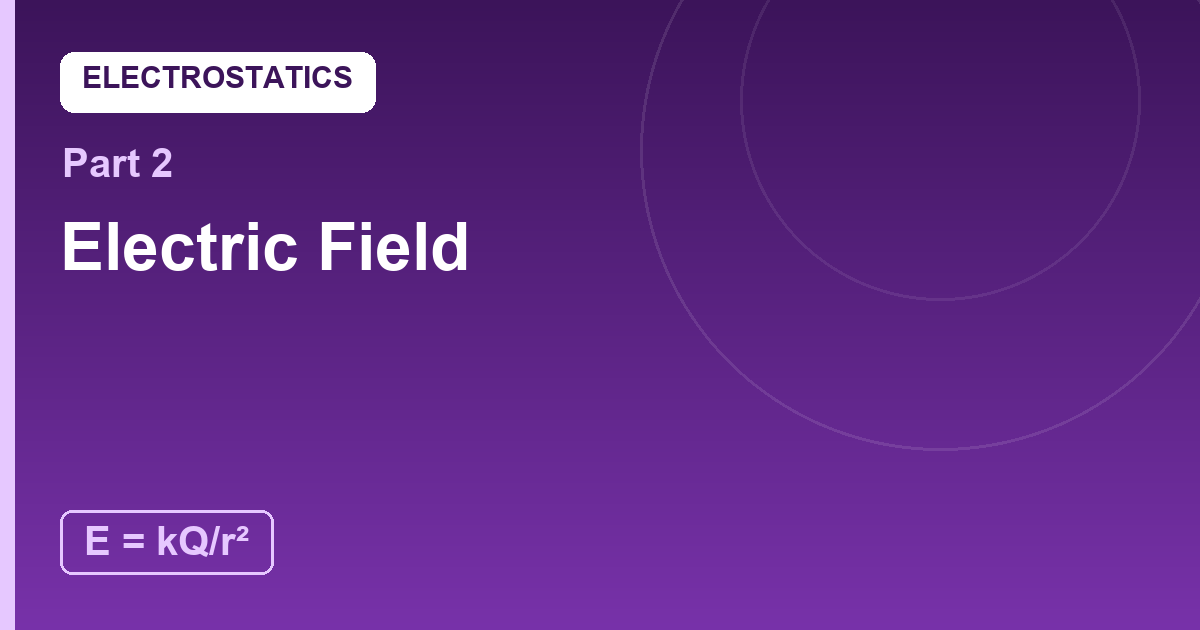
- E = F/q (definition) · E = kQ/r² (point charge)
- Field lines: out of +, into −; never cross; denser = stronger
- Multiple charges: fields add as vectors (superposition)
- Uniform field: parallel equally-spaced lines (between plates)
A charge changes the space around it. Bring another charge near — even without touching — and it’s pushed or pulled. The ‘changed space’ is the electric field: invisible, everywhere around every charge, and the single most useful idea in Class 12 physics. Part 2 of the Electrostatics series.
- What a field really is
- What each letter means
- Field lines: drawing the invisible
- Superposition: fields add as arrows
- Uniform fields
- Solved examples
- Common mistakes
- This physics in your daily life
- Practice set
- Recap
What a Field Really Is
Don’t ask ‘how hard does charge A push charge B’ — ask ‘what push would a test charge feel at this point?‘ That push-per-coulomb, at every point in space, is the field:
| Letter | What it means (plain words) | Value / unit |
|---|---|---|
| E | electric field — push per unit positive charge at a point | N/C (same as V/m) |
| F | force a test charge q feels there | N |
| Q | the source charge creating the field | C |
| r | distance from the source’s CENTRE | m |
Same move as gravity’s g (Gravitation Part 9): g is ‘pull per kg’, E is ‘push per coulomb’. The field picture’s power: it lets space itself carry the physics — a charge doesn’t reach out; it changes its neighbourhood.
Field Lines: Drawing the Invisible
Field lines make fields visible. The rules: lines leave + charges and enter − charges; they never cross; where lines are dense the field is strong. The line’s direction at any point is the push a positive test charge would get. A single positive charge radiates outward like a spiky sun; a dipole’s lines arc from + to − like iron filings on paper.
Superposition: Fields Add as Arrows
Two or more sources? Each point feels every field at once — add them as vectors (arrows head-to-tail, then combine). Two equal positive charges side by side: at the midpoint their fields point oppositely and CANCEL (E = 0 at the centre). A + and − pair (dipole): midpoint fields point the same way and DOUBLE. Always draw the two arrows before adding.
Uniform Fields
Between two parallel charged plates, the field lines are parallel, evenly spaced, straight — the uniform field: same strength and direction everywhere inside. E = V/d links it to the voltage across the plates (Part 3). Every oscilloscope and old TV steered electrons with exactly this field.
Solved Examples
Direct: E = kQ/r² = 9×10⁹ × 3×10⁻⁶ / 0.09 = 3×10⁵ N/C, pointing away (source is +).
Feel it: a 1 C test charge there would be shoved with 300,000 N. ✔
Answer: E = 3×10⁵ N/C, radially outward
Think: near the small charge, its field can match the big one’s. Let the point be x from the 4 μC:
k(4)/x² = k(1)/(0.3−x)² → 2/x = 1/(0.3−x) → x = 0.2 m.
20 cm from the 4 μC charge (10 cm from the 1 μC). The equal-and-opposite point is always nearer the SMALLER charge. ✔
Answer: 20 cm from the 4 μC charge
Both fields point from + toward −: E₊ = kq/(d/2)² away from +; E₋ = kq/(d/2)² toward − — SAME direction.
E = 2 × 4kq/d² = 8kq/d², pointing from + to −.
Contrast: two equal LIKE charges → midpoint E = 0. The dipole doubles; the pair cancels. Draw arrows; never guess. ✔
Answer: E = 8kq/d² along the dipole axis
- Treating E as a force. E (N/C) belongs to the point in space; F = qE belongs to a specific charge placed there.
- Adding field magnitudes like numbers. Fields add as VECTORS — two equal opposite fields at a point give zero, not double.
- Field lines crossing or starting mid-air. Lines start on +, end on −, never cross (a crossing would mean two pushes at once).
- Using E = kQ/r² for plates or sheets. That’s the point-charge formula only — plates give the uniform V/d field; big flat sheets give σ/2ε₀.
This Physics in Your Daily Life
- Lightning rods work by field shape: the sharp tip concentrates field lines so strongly that air breaks down there first — the strike takes the offered path to ground.
- Photocopier drums and electrostatic precipitators (factory smoke cleaners) steer particles with shaped fields — clean air is applied field lines.
- Old CRT televisions and oscilloscopes steered electron beams with uniform plate fields — the picture you watched was E = V/d in action at 25,000 volts.
- Microwave and radio reception begins with passing radio waves’ fields pushing electrons in your antenna — every bar of signal starts as a field.
- Shielding (Part 5 preview): your phone loses signal in a lift because the metal cage’s fields rearrange — fields, blocked by conductors, in daily life.
Practice set (answers hidden — try first)
(NEET-level) E at 20 cm from a 2 μC charge:
(NEET-level) A 4 μC charge feels 0.8 N in a field. E:
(Concept) Two equal positive charges, midpoint field:
(JEE Main-level) A dipole’s midpoint field direction:
(JEE Main-level) E = 0 between +4q and +q, 1 m apart, is at:
- E = F/q · E = kQ/r²
- lines: + → −, dense = strong
- 🔣 E = F/q (definition); E = kQ/r² (point charge)
- 🔣 field lines: out of +, into −, never cross, dense = strong
- 🔣 superposition: add fields as vectors; opposite equal fields cancel
- 🔣 midpoint: like pair → zero; dipole → doubled along axis
- 🔣 uniform field between plates: E = V/d
- 🔁 E = F/q; point charge E = kQ/r²
- 🔁 field lines: never cross; density = strength
- 🔁 fields superpose as vectors
- 🧠 Chant: ‘lines out of plus, into minus, never crossing’.
- 🧠 Zero-point rule: ‘the neutral spot hides nearer the smaller charge’.
- 🏠 Daily: lightning rods, photocopiers, CRT screens — field-shape engineering.
- 🏠 Daily: phone dead in a lift = fields and conductors, Part 5 preview.
Quick revision
- The field is the push a +1 C test charge would feel at a point — it exists even in empty space
- E = F/q (definition) · E = kQ/r² (point charge)
- Field lines: out of +, into −; never cross; denser = stronger
- Multiple charges: fields add as vectors (superposition)
- Uniform field: parallel equally-spaced lines (between plates)
- Field lines: drawing the invisible
Have a doubt on this topic?