Vitamins and Deficiency Diseases: Complete Revision Table for NEET
Vitamins and deficiency diseases is the single most repeated biology topic in SSC, Railways, NEET and UPSC exams — examiners recycle the same twenty facts every year. This page fixes the entire topic permanently: one master table, fat-soluble and water-soluble breakdowns, chemical names, mnemonics, food sources and 12 solved PYQs. Read the master table first, then the mnemonics, then attempt the drill.
- Quick Answer: Vitamins and Deficiency Diseases at a Glance
- Fat-Soluble Vitamins (A, D, E, K): Complete Table
- Water-Soluble Vitamins (B-Complex and C): Complete Table
- Vitamin Deficiency Diseases Mnemonics for Rapid Recall
- Chemical Names of Vitamins (Commonly Asked in SSC & Railways)
- Rich Food Sources of Each Vitamin
- Key Functions of Vitamins in the Human Body
- Fat-Soluble vs Water-Soluble Vitamins: Key Differences
- Previous Year Questions (PYQs) on Vitamins and Deficiency Diseases
- Vitamins and Deficiency Diseases PDF Revision Notes
- Frequently Asked Questions (FAQs)
- Q: Which vitamin deficiency causes scurvy?
- Q: What are the four fat-soluble vitamins?
- Q: Which vitamin is synthesised in the skin by sunlight?
- Q: Which vitamin deficiency causes night blindness?
- Q: What is a good mnemonic to remember vitamin deficiency diseases?
- Related Biology Topics for Government Exams
- Related reading
Quick Answer: Vitamins and Deficiency Diseases at a Glance
Start here. This master table answers 80% of all questions ever asked on this topic. Read it once tonight and once before your exam.
| Vitamin | Chemical Name | Type | Deficiency Disease | Key Source |
|---|---|---|---|---|
| A | Retinol | Fat-soluble | Night blindness, xerophthalmia | Carrot, liver, milk |
| B1 | Thiamine | Water-soluble | Beriberi | Whole grains, yeast |
| B2 | Riboflavin | Water-soluble | Cheilosis, angular stomatitis | Milk, eggs |
| B3 | Niacin | Water-soluble | Pellagra (4 Ds) | Groundnut, liver |
| B5 | Pantothenic acid | Water-soluble | Burning foot syndrome | Eggs, legumes |
| B6 | Pyridoxine | Water-soluble | Convulsions, anaemia | Cereals, fish |
| B7 | Biotin | Water-soluble | Hair loss, dermatitis | Egg yolk, soybean |
| B9 | Folic acid | Water-soluble | Megaloblastic anaemia | Green leafy vegetables |
| B12 | Cyanocobalamin | Water-soluble | Pernicious anaemia | Meat, dairy (only animal foods) |
| C | Ascorbic acid | Water-soluble | Scurvy | Citrus fruits, amla |
| D | Calciferol | Fat-soluble | Rickets (children), osteomalacia (adults) | Sunlight, fish liver oil |
| E | Tocopherol | Fat-soluble | Reproductive disorders, anaemia | Wheat germ, vegetable oils |
| K | Phylloquinone | Fat-soluble | Delayed blood clotting, haemorrhage | Green leafy vegetables |
Fat-Soluble Vitamins (A, D, E, K): Complete Table
Fat-soluble vitamins are stored in the liver and adipose tissue — remember the mnemonic “KEDA” or “ADEK”. Because they accumulate, excess intake causes hypervitaminosis, a genuine NEET-level point.
| Vitamin | Function | Deficiency | Excess (Toxicity) |
|---|---|---|---|
| A (Retinol) | Vision (rhodopsin), epithelial maintenance | Night blindness, xerophthalmia, keratinisation | Hypervitaminosis A — headache, liver damage |
| D (Calciferol) | Calcium and phosphorus absorption | Rickets, osteomalacia | Hypercalcaemia, kidney stones |
| E (Tocopherol) | Antioxidant, membrane protection | Rare — muscle weakness, sterility (in animals) | Generally low toxicity |
| K (Phylloquinone) | Blood clotting (synthesis of clotting factors) | Delayed clotting, bleeding disorders | Jaundice in high synthetic doses |
Water-Soluble Vitamins (B-Complex and C): Complete Table
Water-soluble vitamins cannot be stored (except B12 in the liver) and are excreted in urine — so daily intake is essential. This is the most examined pair distinction in exam biology.
- B1 (Thiamine) — carbohydrate metabolism; deficiency causes beriberi (dry and wet) and Wernicke’s encephalopathy in alcoholics.
- B2 (Riboflavin) — FAD coenzyme; deficiency causes cheilosis (cracked lips) and angular stomatitis.
- B3 (Niacin) — NAD/NADP coenzyme; deficiency causes pellagra — the famous 4 Ds: dermatitis, diarrhoea, dementia, death.
- B5 (Pantothenic acid) — part of coenzyme A; deficiency causes burning foot syndrome.
- B6 (Pyridoxine) — amino acid metabolism; deficiency causes convulsions and peripheral neuritis.
- B7 (Biotin) — fat and protein metabolism; deficiency causes hair fall and dermatitis (raw egg white excess blocks biotin).
- B9 (Folic acid) — DNA synthesis, RBC formation; deficiency causes megaloblastic anaemia; critical in pregnancy (neural tube defects).
- B12 (Cyanocobalamin) — RBC maturation; deficiency causes pernicious anaemia; found only in animal foods.
- C (Ascorbic acid) — collagen synthesis, iron absorption, antioxidant; deficiency causes scurvy — bleeding gums, delayed wound healing.
Vitamin Deficiency Diseases Mnemonics for Rapid Recall
Memorise these five keyword chains tonight; they cover 90% of MCQ traps:
- “A for Eye, D for Bones, K for Clotting, C for Gums, B1 for Nerves” — the master chain.
- Pellagra 4 Ds: Dermatitis, Diarrhoea, Dementia, Death.
- “ADEK are fat” — A, D, E, K are fat-soluble; everything else dissolves in water.
- “B12 needs an intrinsic factor from the stomach” — absence causes pernicious anaemia (a repeated NEET trap).
- “Sunshine vitamin = D” — the only vitamin synthesised in the skin.
Chemical Names of Vitamins (Commonly Asked in SSC & Railways)
SSC and Railways ask chemical names almost every cycle. Drill this table until recall is instant:
| Vitamin | Chemical Name |
|---|---|
| A | Retinol |
| B1 | Thiamine |
| B2 | Riboflavin |
| B3 | Niacin / Nicotinamide |
| B5 | Pantothenic acid |
| B6 | Pyridoxine |
| B7 | Biotin |
| B9 | Folic acid (Folacin) |
| B12 | Cyanocobalamin |
| C | Ascorbic acid |
| D | Calciferol |
| E | Tocopherol |
| K | Phylloquinone / Menaquinone |
Rich Food Sources of Each Vitamin
One-liner MCQs love source-matching. Learn these:
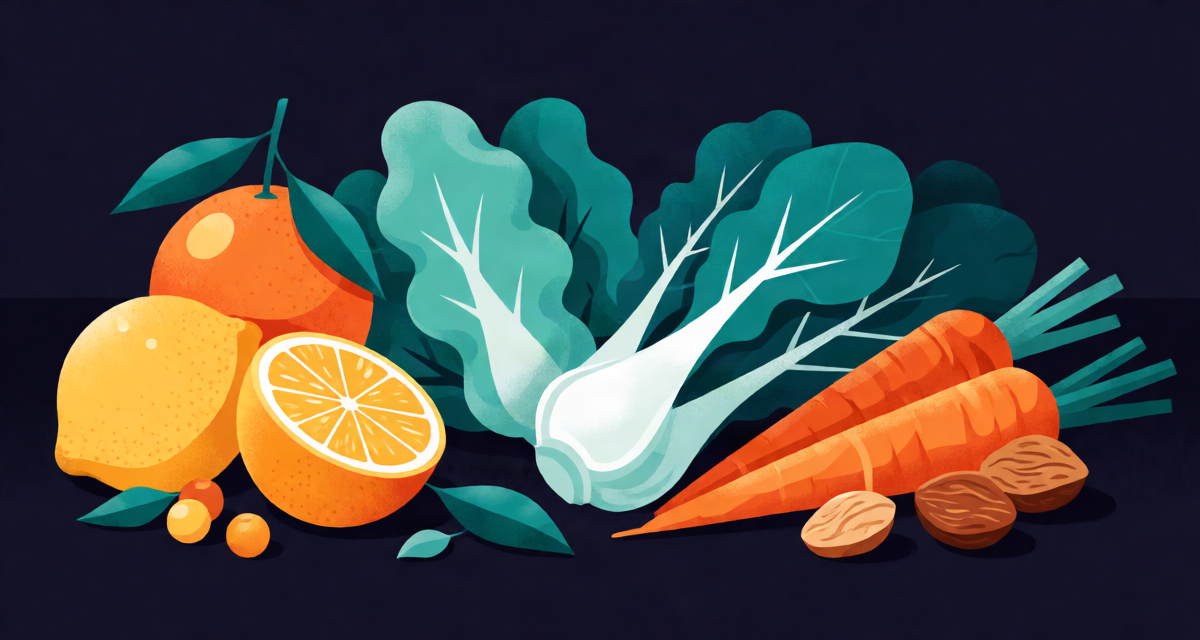
- Vitamin A: carrot, papaya, green leafy vegetables, liver, fish liver oil, milk. (Precursor: beta-carotene.)
- Vitamin D: sunlight (UV-B on skin), fatty fish, egg yolk, fortified milk.
- Vitamin E: wheat germ oil, sunflower oil, nuts, whole grains.
- Vitamin K: green leafy vegetables (spinach, cabbage), also synthesised by gut bacteria.
- Vitamin C: amla (richest source), citrus fruits, guava, tomatoes.
- B vitamins: whole grains, yeast, eggs, meat, legumes, milk.
- B12 only from animal sources: meat, fish, eggs, dairy — strict vegetarians are at risk.
Key Functions of Vitamins in the Human Body
One line each — exactly how examiners frame “match the function” questions:
- A — forms rhodopsin (visual purple) for low-light vision.
- D — promotes calcium and phosphorus absorption from the intestine.
- E — antioxidant; protects cell membranes from free radicals.
- K — essential for synthesis of prothrombin and clotting factors.
- B-complex — act as coenzymes in energy metabolism.
- C — collagen synthesis, wound healing, iron absorption, immunity.
Fat-Soluble vs Water-Soluble Vitamins: Key Differences
| Feature | Fat-Soluble (A, D, E, K) | Water-Soluble (B, C) |
|---|---|---|
| Storage | Stored in liver and fat tissue | Not stored (except B12); excreted in urine |
| Toxicity risk | High — hypervitaminosis possible | Low — excess is excreted |
| Daily requirement | Not needed every day | Needed daily in diet |
| Absorption | Requires bile and dietary fat | Absorbed directly with water |
Previous Year Questions (PYQs) on Vitamins and Deficiency Diseases
Attempt these twelve without looking up. All follow actual SSC, Railways, NEET and UPSC patterns.
- Deficiency of vitamin C causes — (a) Rickets (b) Scurvy (c) Beriberi (d) Pellagra. Ans: (b) Scurvy.
- Which vitamin is synthesised in the skin by sunlight? (a) A (b) C (c) D (d) K. Ans: (c) Vitamin D.
- Chemical name of vitamin B12 — Ans: Cyanocobalamin.
- Night blindness is caused by deficiency of — Ans: Vitamin A.
- Beriberi is caused by deficiency of — (a) B1 (b) B3 (c) B6 (d) B12. Ans: (a) Thiamine (B1).
- The 4 Ds — dermatitis, diarrhoea, dementia and death — describe — Ans: Pellagra (Niacin/B3 deficiency).
- Pernicious anaemia is due to deficiency of — Ans: Vitamin B12.
- Which vitamin helps in blood clotting? Ans: Vitamin K (phylloquinone).
- Richest source of vitamin C among fruits — Ans: Amla (Indian gooseberry).
- Rickets is a disease of — (a) adults (b) children (c) both equally (d) elderly. Ans: (b) Children (osteomalacia is the adult form).
- Which vitamin deficiency causes delayed wound healing and bleeding gums? Ans: Vitamin C.
- Vitamin E is chemically known as — Ans: Tocopherol.
Vitamins and Deficiency Diseases PDF Revision Notes
Want the master table as a single printable page for the exam-eve corridor? Hmmnm.in’s one-page vitamins revision PDF compresses everything above — master table, chemical names, mnemonics and the fat-soluble vs water-soluble comparison — into one downloadable sheet. Print it, fold it, read it twice the night before your shift.
Frequently Asked Questions (FAQs)
Q: Which vitamin deficiency causes scurvy?
Vitamin C (ascorbic acid) deficiency causes scurvy; symptoms include bleeding gums and delayed wound healing.
Q: What are the four fat-soluble vitamins?
Vitamins A, D, E and K are fat-soluble; they are stored in the liver and fatty tissues.
Q: Which vitamin is synthesised in the skin by sunlight?
Vitamin D is synthesised when the skin is exposed to sunlight (UV rays); deficiency causes rickets in children.
Q: Which vitamin deficiency causes night blindness?
Vitamin A (retinol) deficiency causes night blindness and, if severe, xerophthalmia.
Q: What is a good mnemonic to remember vitamin deficiency diseases?
“A for Eye, D for Bones, K for Clotting, C for Gums, B1 for Nerves” — simple keyword linking for fast recall in exams.
Related Biology Topics for Government Exams
Pair this page with your broader biology revision chain: human physiology and digestion, nutrition and balanced diet, human diseases and their pathogens, and the circulatory and excretory systems. Cover those next — vitamins questions frequently appear bundled with nutrition and disease MCQs in the same shift. Revise the master table once more before you close this page.
Related reading
- Semiconductors and the India Semiconductor Mission: Fab Incentives, How Chips Are Made, and ISM Facts for UPSC GS3
- Socio-Religious Reform Movements of 19th Century India: Leaders, Organisations and Years Mapped for Exams
Quick revision
- B1 (Thiamine): — carbohydrate metabolism; deficiency causes beriberi (dry and wet) and Wernicke’s encephalopathy in alcoholics.
- B2 (Riboflavin): — FAD coenzyme; deficiency causes cheilosis (cracked lips) and angular stomatitis.
- B3 (Niacin): — NAD/NADP coenzyme; deficiency causes pellagra — the famous 4 Ds: dermatitis, diarrhoea, dementia, death.
- B5 (Pantothenic acid): — part of coenzyme A; deficiency causes burning foot syndrome.
- B6 (Pyridoxine): — amino acid metabolism; deficiency causes convulsions and peripheral neuritis.
- B7 (Biotin): — fat and protein metabolism; deficiency causes hair fall and dermatitis (raw egg white excess blocks biotin).
Have a doubt on this topic?