SSC CGL Tier-1 Morning Rapid Revision: 25 High-Yield Facts
The SSC CGL Tier-1 exam is today, and the last hours before the bell are not for learning anything new. However, a calm 25-fact sweep can warm up your recall, steady your nerves, and prime the high-yield zones that the paper loves. Therefore, read this capsule once with your tea, once outside the centre, and trust your preparation.
- High-Yield Current Affairs from This Fortnight
- The Summit Season
- Awards, Sports and Days
- Polity and Constitution Rapid Fire
- Economy in One Screen
- Science and Static GK Sweep
- Five-Question Warm-Up Drill
- Exam-Day Pointers
- FAQ
- Can I revise from notes at the centre?
- What accuracy should I target?
- History and Geography Sweep
- Static GK: Firsts and Superlatives
- The Last 30 Minutes at the Centre
- If a Question Looks New
- Science Formula Flash Cards
- Computer and Abbreviation Bank
- Reasoning Speed Presets
- One More FAQ Before You Leave
- What if the biometric queue is long?
- Quick Number Check Before the Gate
- A Calm Mind Scores Marks
- In Short: The Plain-English Summary
- Glossary in Five Lines
- The Thirty-Second Recap
- Key Takeaways
SSC CGL Tier-1 Tomorrow (September 15): The Last-24-Hours Plan, Checklist and Section Strategy
Contents: this guide gives you 25 rapid-revision facts across current affairs, polity, economy and science, followed by a five-question warm-up drill, exam-day pointers, and a final checklist before you leave home.
High-Yield Current Affairs from This Fortnight
The Summit Season
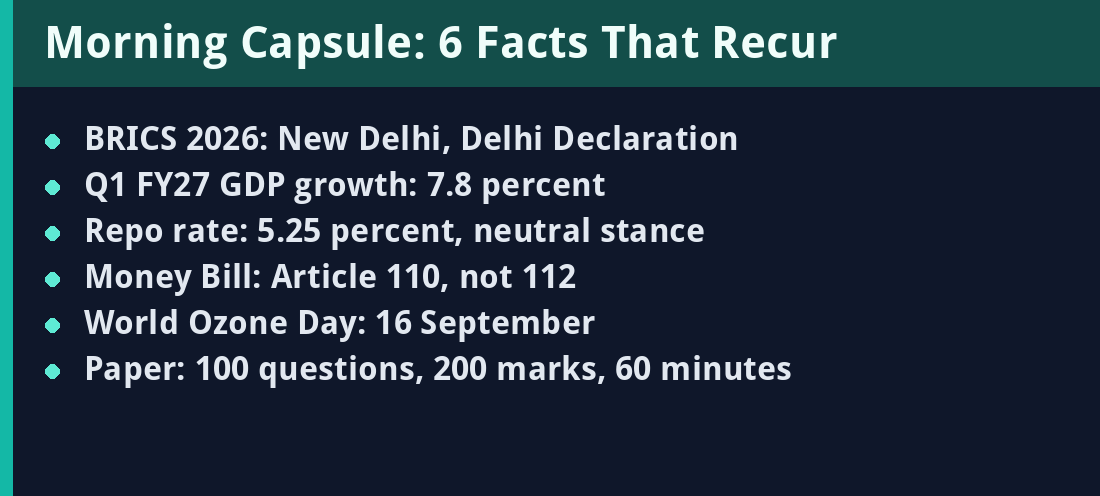
- India hosted the 18th BRICS Summit in New Delhi on 12-13 September 2026, and the leaders adopted the Delhi Declaration.
- The summit expanded the grouping’s agenda on trade in national currencies, counter-terror cooperation and climate finance.
- India’s Q1 FY27 GDP growth printed at 7.8 percent, the strongest first quarter in five years.
- The RBI Monetary Policy Committee held the repo rate at 5.25 percent, keeping the stance neutral.
- GST 2.0 completed one year with its rationalised four-slab structure and record monthly collections.
Awards, Sports and Days
- World Ozone Day falls on 16 September, marking the 1987 signing of the Montreal Protocol.
- International Day of Democracy is observed on 15 September.
- Engineer’s Day in India honours Sir M. Visvesvaraya on 15 September.
- The Asian Games cycle moves to Aichi-Nagoya, Japan, in 2026.
- The Monaco Formula One circuit remains the shortest lap on the 2026 calendar – a classic distractor option.
Polity and Constitution Rapid Fire
| Item | Fact |
|---|---|
| Money Bill | Article 110; only Lok Sabha decides |
| Annual Financial Statement | Article 112 |
| Fundamental Duties | Article 51A, 11 duties |
| Quorum in Lok Sabha | One-tenth of members |
| Estimates Committee | 30 members, all from Lok Sabha |
Moreover, remember the paired articles examiners swap: Article 72 is the President’s pardon, while Article 161 is the Governor’s. Similarly, Article 32 is the right to constitutional remedies, whereas Article 226 is the wider High Court writ jurisdiction.
Economy in One Screen
- MPC has six members, chaired by the RBI Governor, under Section 45ZA of the RBI Act.
- Inflation targeting is 4 percent with a 2-6 percent band.
- M1 equals currency with the public plus demand deposits plus other deposits with the RBI.
- WPI is published by the Office of the Economic Adviser; CPI is published by the NSO.
- Fiscal deficit for FY26 aimed below 4.5 percent of GDP on the consolidation path.
Science and Static GK Sweep
- Vitamin C is ascorbic acid; its deficiency causes scurvy.
- The SI unit of pressure is the pascal, and one bar equals 100,000 pascals.
- Chlorophyll absorbs mainly red and blue light, reflecting green.
- The longest coastline among Indian states belongs to Gujarat.
- The Sundarbans is the largest delta in the world, formed by the Ganga-Brahmaputra system.
Five-Question Warm-Up Drill
- The Delhi Declaration 2026 is linked to which grouping? Answer: BRICS. The 18th summit met in New Delhi.
- Which article defines a Money Bill? Answer: Article 110. Article 112 is the budget, a favourite swap.
- World Ozone Day is observed on: Answer: 16 September. It marks the 1987 Montreal Protocol signing.
- The repo rate held by the MPC in September 2026 is: Answer: 5.25 percent. The stance stayed neutral.
- Engineer’s Day commemorates: Answer: Sir M. Visvesvaraya. His birth anniversary is 15 September.
One calm sweep of high-yield facts beats one panicked chapter at the centre gate.
Exam-Day Pointers
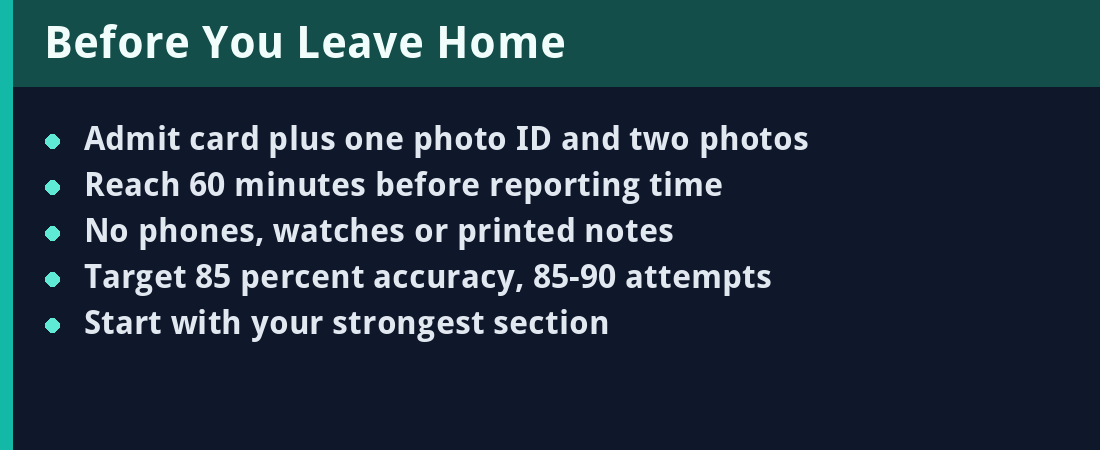
Reach the centre at least 60 minutes before your shift. For example, if reporting is at 8:00 am, plan to arrive by 7:00 am. Consequently, carry only the admit card, one photo ID, two passport photos, and a transparent water bottle. Meanwhile, leave phones, smart watches and study material at home or with your escort, because biometric frisking is strict.
| Shift | Reporting | Exam Window |
|---|---|---|
| Morning | 8:00 am | 9:00-10:00 am |
| Afternoon | 1:00 pm | 2:00-3:00 pm |
| Evening | 4:30 pm | 5:00-6:00 pm |
Therefore, in the hall, attempt General Intelligence first if you are quick, otherwise start with your strongest section. In addition, remember the paper has 100 questions for 200 marks in 60 minutes with 0.50 negative marking.
FAQ
Can I revise from notes at the centre?
No. Most centres ban printed material inside the gate. However, this single-page capsule in your head is enough.
What accuracy should I target?
Aim for 85 percent accuracy with about 85-90 attempts. Consequently, a 150-plus score stays within reach across shifts.
History and Geography Sweep
- The Revolt of 1857 began at Meerut on 10 May, and Mangal Pandey’s Barrackpore incident preceded it in March.
- The Indian National Congress was founded in 1885 by A. O. Hume, with W. C. Bonnerjee as the first president.
- The Gandhian phase opened with the Champaran Satyagraha of 1917 against indigo planters.
- The Non-Cooperation Movement was withdrawn in 1922 after the Chauri Chaura incident.
- The Salt March of 1930 covered 385 kilometres from Sabarmati to Dandi over 24 days.
- The Quit India Resolution was passed in Bombay on 8 August 1942.
- The Tropic of Cancer passes through eight Indian states, from Gujarat to Mizoram.
- The Nilgiri Biosphere Reserve links the Western Ghats’ richest biodiversity corridors across three states.
- Kanchenjunga, at 8,586 metres, is India’s highest peak located fully within Sikkim.
- The Godavari is the longest peninsular river, earning the name Dakshina Ganga.
Static GK: Firsts and Superlatives
| Category | Answer |
|---|---|
| First Governor-General of free India | Lord Mountbatten |
| First Indian Governor-General | C. Rajagopalachari |
| First Chief Election Commissioner | Sukumar Sen |
| First Indian in space | Rakesh Sharma, 1984 |
| Longest national highway | NH-44, Srinagar to Kanyakumari |
However, examiners rarely ask these directly. Instead, they swap pairs – for example, Mountbatten against C. Rajagopalachari, or NH-44 against NH-27. Therefore, always revise firsts in conflicting pairs rather than isolated facts. Moreover, the same trick applies to dams and rivers: Bhakra on the Sutlej, Hirakud on the Mahanadi, and Sardar Sarovar on the Narmada.
The Last 30 Minutes at the Centre
Use the final half hour for two passes only. Firstly, scan this capsule’s tables once, because tabular facts stick fastest under mild adrenaline. Secondly, breathe slowly for three minutes, since a lower heart rate measurably improves first-attempt accuracy. Meanwhile, avoid group discussions about guessed cutoffs, because speculation leaks confidence faster than it builds insight. Consequently, candidates who stay quiet and warm generally outperform louder revisers in the first section itself.
If a Question Looks New
Some questions will look unfamiliar, and that is by design. Therefore, apply the elimination protocol: strike one clearly wrong option, strike one extreme option, and choose between the rest within 40 seconds. However, if two options survive after elimination, skip and return. In addition, remember that unattempted questions cost nothing, while wrong answers cost 0.50 marks each.
Science Formula Flash Cards
- Speed equals distance over time; therefore, a 600-metre lap in 75 seconds means 8 metres per second.
- Profit percentage is profit over cost times 100, so a 120-rupee gain on 480 rupees cost is 25 percent.
- Simple interest equals principal times rate times time over 100; consequently, 8,000 rupees at 6 percent for 3 years yields 1,440 rupees.
- Compound interest on 10,000 rupees at 10 percent for 2 years is 2,100 rupees, not 2,000.
- The average of first n natural numbers is (n+1)/2, therefore the average of 1 to 50 is 25.5.
- In a 60-minute paper, budget 36 seconds per question to attempt all hundred with a review buffer.
Computer and Abbreviation Bank
- URL stands for Uniform Resource Locator, and HTTP is the HyperText Transfer Protocol.
- RAM is volatile, whereas ROM retains firmware – a repeat pair in every cycle.
- Ctrl plus S saves, Ctrl plus Z undoes, and Alt plus Tab switches windows.
- NPCI operates UPI, and a UPI PIN authorises transactions, not a login password.
- Aadhaar e-KYC uses biometric or OTP validation for paperless onboarding.
- CPU, GPU and TPM acronyms appear in banking computer-awareness sections.
Reasoning Speed Presets
Reasoning rewards pattern presets rather than fresh thinking under pressure. For example, in coding-decoding, write the alphabet positions once and manipulate numbers, not letters. Similarly, in syllogisms, draw the minimal diagram first and test each conclusion against it. Moreover, series questions usually hide a single operation – square, prime gap, or alternate arithmetic. Consequently, 20 seconds of pattern naming saves a full minute of blind calculation.
One More FAQ Before You Leave
What if the biometric queue is long?
Stay in queue calmly; the invigilation protocol accounts for registration delays. However, once seated, the clock is common to the hall, not to your entry time.
Quick Number Check Before the Gate
Recite these six numbers once more, because digits anchor memory better than sentences. Firstly, 100 questions, 200 marks, 60 minutes, 0.50 negative. Secondly, 4 sections of 25 questions each. Thirdly, 7.8 percent GDP growth in Q1 FY27. Fourthly, 5.25 percent repo under a neutral stance. Fifthly, 16 September for World Ozone Day. Finally, 18th for the BRICS summit edition hosted in New Delhi. Consequently, even a nervous mind retrieves these anchors first, and confidence follows retrieval.
A Calm Mind Scores Marks
Preparation gets you to the centre; temperament gets you through the paper. Therefore, treat the first five minutes as an investment round rather than a scoring round. Read the interface carefully, confirm the section order, and note the clock position before question one. Moreover, candidates who blink, stretch and exhale between sections report fewer silly errors in the second half of the paper. Meanwhile, remember that a normal paper feels slightly hard, because normal papers carry 15 tricky questions by design. Consequently, do not read difficulty as disaster; read it as distribution.
Furthermore, trust the arithmetic of your plan. If your mock average is 150 plus, then your preparation supports a 150-plus outcome regardless of today’s mood. However, if the paper surprises everyone, the cutoff falls with it, and calm candidates harvest the gap. In other words, relative performance rewards stability, and stability is a choice available every single minute of the exam.
In Short: The Plain-English Summary
In short, here is the whole page in plain words. You read 25 facts today. Therefore, read them again tonight. The facts cover the summit, the rates, the articles and the dates. However, the paper rewards calm, not speed. So trust your work. Moreover, keep the checklist simple: card, photo, water bottle. The verification protocol at the gate takes minutes. Finally, sleep well.
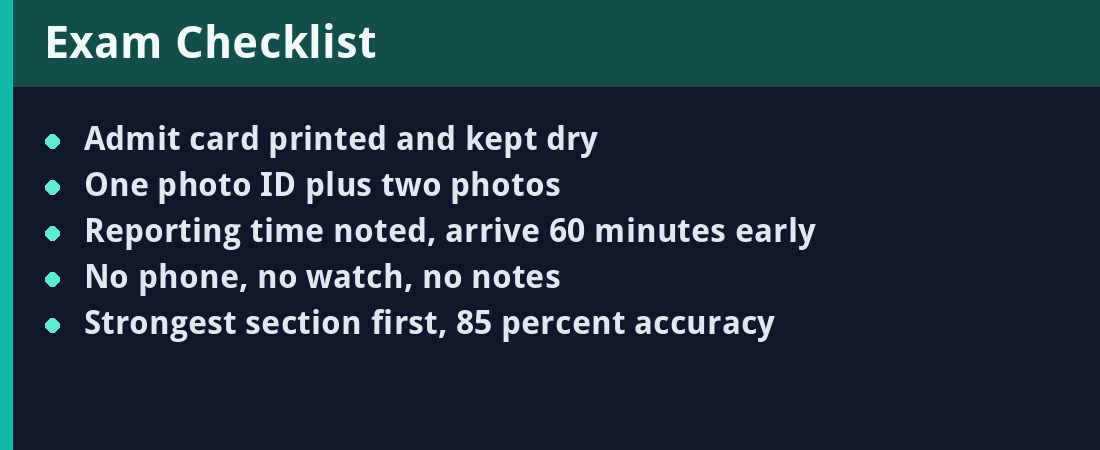
- Admit card printed and kept dry
- One photo ID plus two photos
- Reporting time noted, arrive 60 minutes early
- No phone, no watch, no notes
- Strongest section first, 85 percent accuracy
Glossary in Five Lines
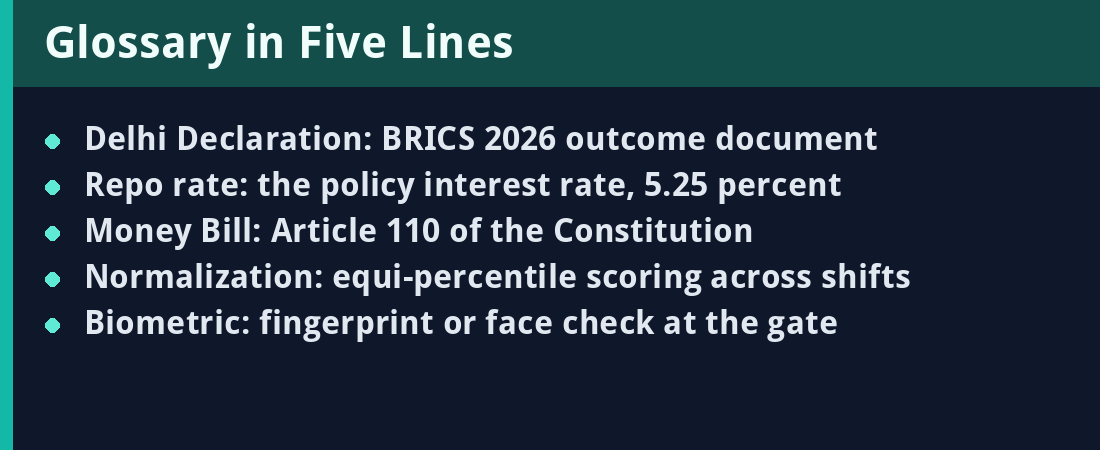
- Delhi Declaration: BRICS 2026 outcome document
- Repo rate: the policy interest rate, 5.25 percent
- Money Bill: Article 110 of the Constitution
- Normalization: equi-percentile scoring across shifts
- Biometric: fingerprint or face check at the gate
The Thirty-Second Recap
Twenty-five facts. One summit. One rate. One protocol. Read the table twice. However, do not add topics now. Trust the work. Moreover, pair each article with its number. Sleep on time. Eat light. Reach early. Carry the card. Show the ID. Smile at the gate. Breathe slow. Start with strength. Watch the clock. Skip the stubborn ones. Mark and move. Therefore, verify the marked ones last. Finish calm. Then rest. Finally, the bell is just a quiz you already prepared for.
Key Takeaways
In conclusion, your job today is recall, not learning. The 25 facts above cover the fortnight’s headlines, the paired articles, the economy basics and the science staples that recur every cycle. To summarize: sleep early, reach early, attempt your strongest section first, and let the preparation speak. Best of luck for Tier-1.
References for deeper reading: ssc.gov.in (official notices), pib.gov.in (summit and GDP releases), rbi.org.in (policy statement), mospi.gov.in (NSO data).
Quick revision
- India hosted the 18th BRICS Summit in New Delhi on 12-13 September 2026, and the leaders adopted the Delhi Declaration.
- The summit expanded the grouping’s agenda on trade in national currencies, counter-terror cooperation and climate finance.
- India’s Q1 FY27 GDP growth printed at 7.8 percent, the strongest first quarter in five years.
- The RBI Monetary Policy Committee held the repo rate at 5.25 percent, keeping the stance neutral.
- GST 2.0 completed one year with its rationalised four-slab structure and record monthly collections.
- World Ozone Day falls on 16 September, marking the 1987 signing of the Montreal Protocol.
Have a doubt on this topic?