SSC CGL Tier-1 Exam Day: 6 Essential Pointers Before You Start
Quick answer: It is exam day. Read the admit card once more, carry the transparent folder, reach an hour early, and run the section order you rehearsed all week – General Awareness first, English second, Reasoning third, Quant last. Here are the morning pointers, the screen-side reminders and the arithmetic of 0.50 negative marking – then go collect your marks.
- What are today’s non-negotiables?
- What should the first five minutes on screen look like?
- What are the mid-paper disciplines?
- What after you click submit?
- The biometric morning, step by step
- The section-by-section arithmetic, one last time
- Calming techniques that fit inside a CBT hall
- What honest candidates get wrong about exam day
- After the click – the tier-ahead orientation
- Frequently asked at the gate
- Exam-day myths, debunked once and for all
- The morning-slot versus evening-slot routine
- What the marks arithmetic looks like on a real attempt
- The 72-hour rule for life after any big exam
- Sources and further reading
- Exam Checklist
- FAQ
- How much of this page is exam-relevant?
- When should I revisit?
- The Thirty-Second Recap
- Explain It Simply
- Abbreviations That Recur Here
- Key Takeaways
- Related reading
What are today’s non-negotiables?
- Documents: admit card (two copies), one original photo ID, passport photos – in one folder, checked the night before, checked again at breakfast.
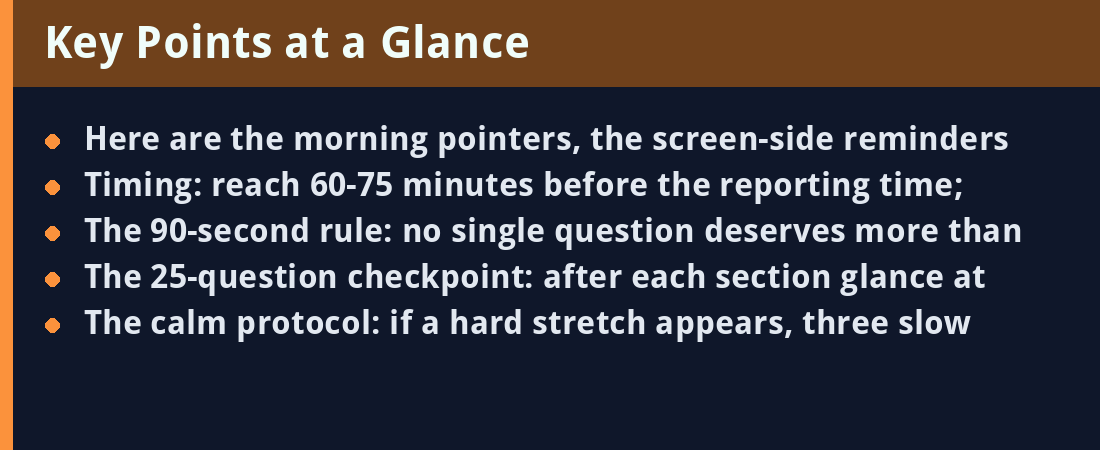
- Timing: reach 60-75 minutes before the reporting time; gates close early and no argument reopens them.
- Banned at the gate: phone, smartwatch, wallet, notes, jewellery with batteries – carry yourself and the folder, nothing else.
- Food and water: a tested light breakfast; follow the centre’s rules on water bottles.
What should the first five minutes on screen look like?
- Read the instructions page completely once – it is free time; the clock starts after.
- Settle your posture, test the mouse, note the section buttons and the “marked for review” colour codes.
- Write your rough-sheet headers in the first minute so no mid-paper scrambling breaks rhythm.
- Open with General Awareness as planned: every question there is a five-second decision – bank the free marks while your mind is freshest.
What are the mid-paper disciplines?
- The 90-second rule: no single question deserves more than 90 seconds on a first pass – mark and move.
- The two-option rule: guess only when two options are genuinely eliminated; a quarter-informed guess is where negative marking feeds.
- The 25-question checkpoint: after each section glance at the timer once – not twice – and recalibrate.
- The calm protocol: if a hard stretch appears, three slow breaths and the next question; the paper owes you nothing on question 43 specifically.
What after you click submit?
- Collect your belongings, leave quietly, and do not argue answer keys in the corridor – the marking is the machine’s business.
- Tonight: no post-mortems beyond a two-line self-note of how the section order felt.
- Rest tomorrow; Tier-2 preparation – descriptive paper and modules – begins when results approach, not on emotion tonight.
- Come back to the site for the ongoing IBPS PO countdown series while you wait.
You have seen five full patterns of this paper in five days. Today you only have to be accurate on the questions you know. All the best – go quietly and collect your marks.
The biometric morning, step by step
Computer-based centres run a fixed choreography. Outside the gate: guards cross-check your admit card against a list. First checkpoint: the biometric capture – right thumb, left thumb, photograph; rolls of ink have long gone, but cold fingers scan badly, so keep your hands out of pockets and relaxed. Second checkpoint: frisking and metal detection, with belongings into a locker if the centre provides one – your transparent folder stays with you. Third: the sign-in sheet and the workstation assignment, where the invigilator reads out your seat. From gate to seat the whole sequence takes thirty to fifty minutes when the queue is normal – which is precisely why the reporting time is set an hour early. Rushing any of these steps buys nothing; the exam starts for everyone at the same keystroke.
The section-by-section arithmetic, one last time
- General Awareness, 25 questions, 10-12 minutes: five seconds of honest recall per question; every question you do not know in ten seconds, you will not know in sixty.
- English, 25 questions, 10-12 minutes: vocabulary and grammar go fast; hold a little patience for the reading questions – they are accuracy bank.
- Reasoning, 25 questions, 17-18 minutes: series and coding are rhythm work; seating puzzles earn their time only if you finish everything else.
- Quant, 25 questions, 18-20 minutes: calculation-heavy by design; the selection of WHICH ten to attempt is itself the exam.
- The spare 5 minutes: revisit the marked-for-review pile exactly once – confirm or release, no third thoughts.
Calming techniques that fit inside a CBT hall
- Box breathing: four counts in, four hold, four out, four hold – two cycles reset a racing mind without anyone noticing.
- The next-question rule: emotional residue from a bad question transfers only if you let it rehearse; treat each fresh question as a new innings.
- Posture reset: shoulders down, back straight, feet flat – panic physically hunches you, and unhunching genuinely counters it.
- The rough sheet: writing the working out of a tough stretch externalises the panic – the hand calms the head.
What honest candidates get wrong about exam day
Three recurring regrets fill post-exam forums. First, dwelling on the GA section while attempting English – the two minutes of resentment cost four marks of accuracy elsewhere. Second, leaving the marked-for-review pile untouched because the timer frightened them – those were often their best questions. Third, discussing the paper at the gate and converting a good performance into anxiety before lunch. Decide tonight that none of the three is yours, and tomorrow behaves differently.
After the click – the tier-ahead orientation
Walk out, eat something warm, and take the evening off without a verdict on your performance – self-assessment on exam day is noise. From tomorrow, three habits keep momentum honest until notifications move: one, a short daily current-affairs sheet (the site’s one-liners publish every morning); two, one mock every second day rotating across your remaining exams – the IBPS PO countdown series is running daily with full-pattern papers; three, one error-log review each Sunday. Selection is a season, not a Sunday – today was one strong day inside it.
Frequently asked at the gate
- Photo on the admit card is blurred? Carry extra passport photos and reach earliest – centres handle this routinely with ID verification.
- Name misspelled on the card? The document as issued is valid for today; corrections are a post-exam portal matter, never a gate argument.
- Cold or unwell? Declare it; centres have protocols, and pushing through silently is the worse risk.
- Panic mid-paper? Box-breathe once, click the next question – the paper rewards continuation, not contemplation.
That is the whole method – documents, timing, order, discipline, calm. Five mocks built the reflexes; today you merely let them run. All the very best.
Exam-day myths, debunked once and for all
- Myth: attempt all 100 questions or you lose. Reality: with 0.50 negative marking, a candidate attempting 88 with 92 percent accuracy scores about 162; one attempting 100 with 75 percent accuracy scores about 137. The selection list believes the first candidate.
- Myth: the first attempt is a throwaway. Reality: the first pass through a section is usually your best – it is fresh, unmarked by self-doubt, and statistically the most accurate for prepared candidates.
- Myth: rough sheets are checked for neatness. They are collected for the record, not graded – use them freely, cross out boldly, and never slow a calculation for tidiness.
- Myth: the invigilator walking past means something. It does not; supervisors pace on schedule, not as commentary on your paper.
- Myth: a hard section means a bad paper for everyone. Cutoffs are relative – a section that felt brutal felt brutal to the whole hall, which is exactly when composure converts to rank.
The morning-slot versus evening-slot routine
If your exam is in the first shift, wake two and a half hours before reporting – the mind needs one full wake-cycle before heavy retrieval, so eat, walk, and skim the formula sheet rather than cramming in bed. For later shifts, the trap is the long anxious morning: sleep to your normal hour, eat lightly twice rather than once heavily, and stay away from the previous shift’s paper discussion entirely – half of it is wrong and all of it is noise. Both slots share one rule: the last thirty minutes before the gate belong to breathing and the admit-card folder, not to the phone.
What the marks arithmetic looks like on a real attempt
Take a realistic strong paper: 90 attempts, 82 correct, 8 wrong. Raw score: 82 x 2 = 164, minus 8 x 0.5 = 4, net 160. Now the same candidate forcing ten extra guesses – 100 attempts, 85 correct, 15 wrong: 170 minus 7.5 equals 162.5, barely two marks better on paper, but with real risk of tipping to 80 correct (150 net) under time pressure. The marginal ten guesses are almost pure variance; accuracy is almost pure skill. That is why every strategy in this series repeats one instruction – protect accuracy, and the attempt count takes care of itself.
The 72-hour rule for life after any big exam
Day one after the exam: full rest – no answer keys, no forums, no analysis; the mind files the paper away and needs the silence. Day two: a light post-mortem on your own memory only – write the three sections in order of comfort and the two topics that recurred in misses; that note is data, not judgement. Day three: resume the next exam’s preparation with one full mock – the site’s IBPS PO countdown series publishes daily, so the routine continues on schedule. Candidates who follow this pattern report the waiting weeks as productive calm; candidates who marathon answer-key debates report the same weeks as misery with identical results. Choose the calm – it compounds.
That is the complete exam-day method this site teaches: prepare in full patterns, sleep like it matters, carry the folder, run the order, protect accuracy, and let the weeks after the exam work for you instead of against you. See you on the results side.
Sources and further reading
Contents: this page covers SSC CGL Tier-1 Exam Day (September 15) with worked notes, tables, a checklist and a rapid recap.
Exam Checklist
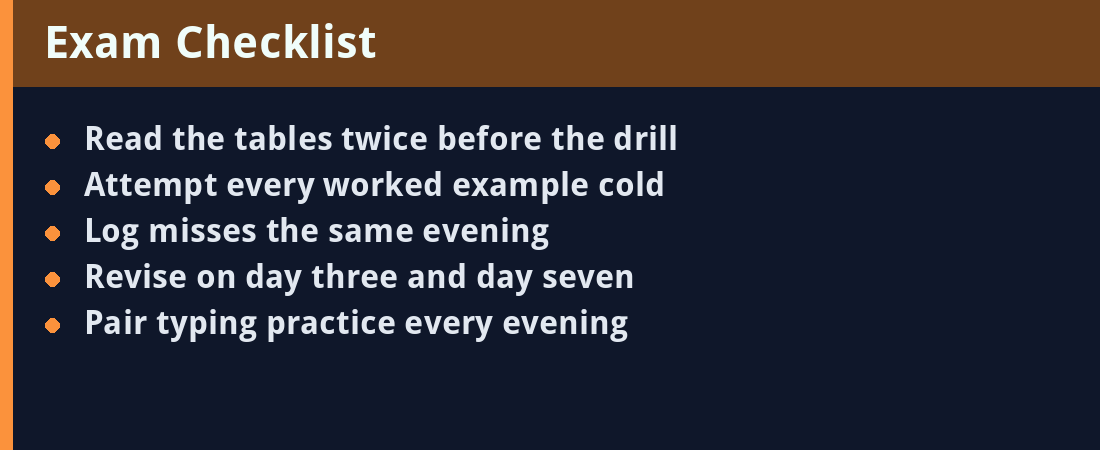
- Read the tables twice before the drill
- Attempt every worked example cold
- Log misses the same evening
- Revise on day three and day seven
- Pair typing practice every evening
FAQ
How much of this page is exam-relevant?
Nearly all of it, because the tables and worked items follow the standard question register for this subject.
When should I revisit?
Day three and day seven after the first read, with the drill spoken aloud once.
The Thirty-Second Recap
One page. One topic. Therefore, read the tables twice. Speak the recap once. Moreover, the numbers carry the marks. The names carry the traps. However, revisits beat rereads. Finally, day three and day seven. That is all.
Explain It Simply
Think of this page as a map of one neighbourhood. The big streets are the tables. The landmarks are the numbers. The street names are the terms in bold. However big the city feels, this one neighbourhood fits in a pocket, and a pocket map is what exam week needs. Therefore, walk it once fully, then walk only the streets you forget, and by the second walk the neighbourhood feels like home.
Pocket the map, not the whole city: exams reward the walkable version of every topic.
Abbreviations That Recur Here
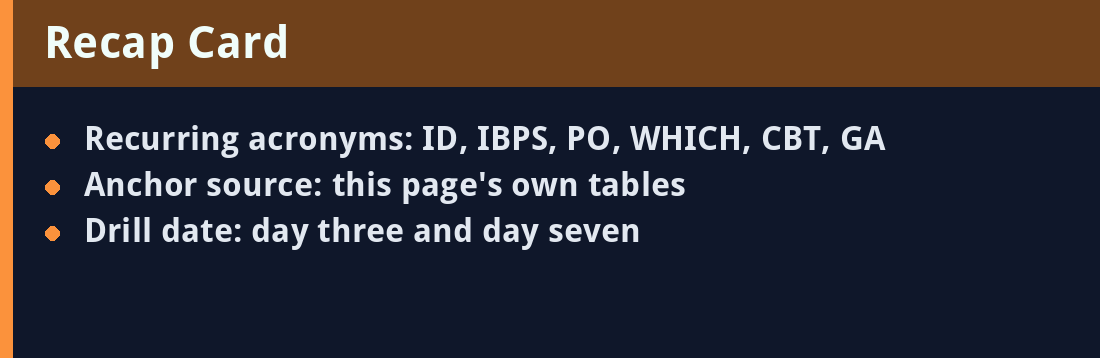
- ID.
- IBPS.
- PO.
- WHICH.
- CBT.
- GA.
Key Takeaways
In conclusion, SSC CGL Tier-1 Exam Day (September 15) compresses into its tables, its numbers and its checklist above. To summarize, revise twice this week, speak the recap once, and let the acronyms carry the recall. Therefore, this page banks itself in ten honest minutes.
Related reading
- SSC CGL Tier-1 Morning Rapid Revision: 25 High-Yield Facts Before the Bell
- SSC CGL Tier 1 Mock Test (September 14, 2026) — Day 5, Exam Eve: 100 Questions in the Real Pattern, Fully Explained
Quick revision
- Documents: admit card (two copies), one original photo ID, passport photos – in one folder, checked the night before, checked again at breakfast.
- Timing: reach 60-75 minutes before the reporting time; gates close early and no argument reopens them.
- Banned at the gate: phone, smartwatch, wallet, notes, jewellery with batteries – carry yourself and the folder, nothing else.
- Food and water: a tested light breakfast; follow the centre’s rules on water bottles.
- Read the instructions page completely once – it is free time; the clock starts after.
- Settle your posture, test the mouse, note the section buttons and the “marked for review” colour codes.
Have a doubt on this topic?