JEE/NEET Physics · Moving Charges & Magnetism series · Part 1 of 8 · All parts →
- A magnetic field B pushes only MOVING charges — a stationary charge feels nothing
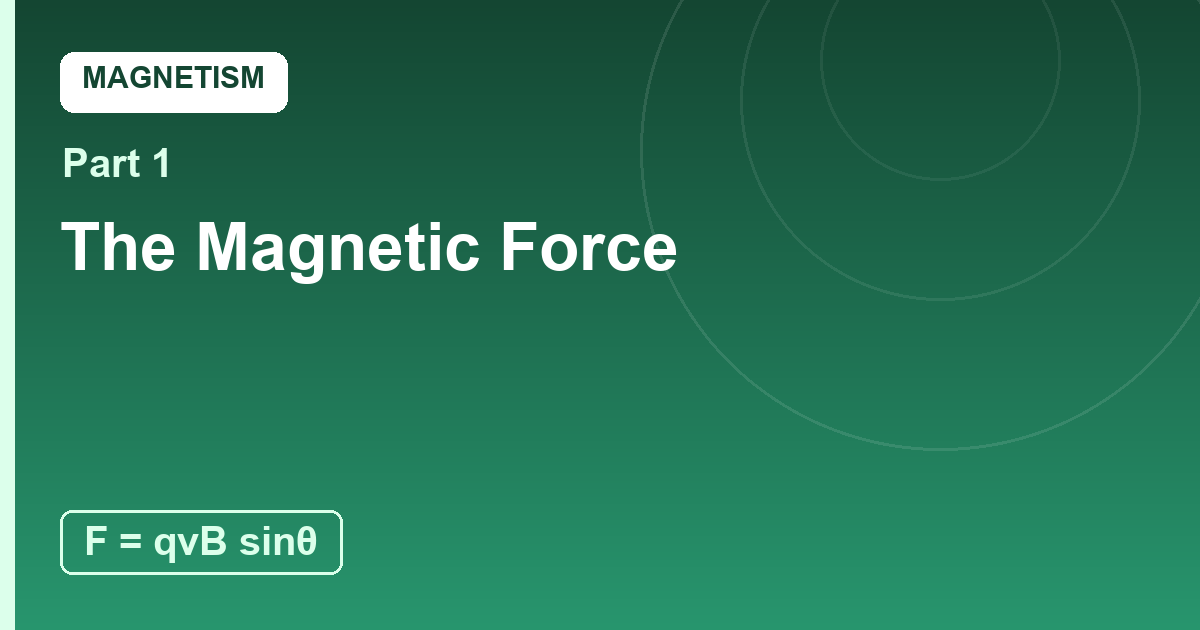
- F = qvB sinθ, direction ALWAYS perpendicular to velocity (right-hand rule)
- Maximum force at 90° to B; ZERO force when moving parallel to B
- The force does no work — it can turn, never speed up or slow down
- Lorentz force: F = q(E + v×B) — electric and magnetic together
Electric fields push any charge, moving or not. Magnetic fields are pickier: they only care about charges that are ALREADY moving — and then they push sideways, never along the motion. That sideways quirk builds every motor ever made. Part 1 of the Moving Charges & Magnetism series.
- The picky field
- The right-hand rule
- Why magnetic force never works
- The Lorentz combo
- Solved examples
- Common mistakes
- This physics in your daily life
- Practice set
- Recap
The Picky Field
Hang a charge at rest in a magnetic field: nothing. Send it past: a force appears — F = qvB sinθ, biggest when motion cuts straight across the field, zero when sliding along it. Magnetism is fundamentally a force about motion.
The Right-Hand Rule
| Letter | What it means (plain words) | Value / unit |
|---|---|---|
| F | magnetic force | N, ⊥ to both v and B |
| q | the charge | C; sign flips the direction |
| v | charge’s velocity | m/s — must be nonzero |
| B | magnetic field strength | tesla (T) |
Why Magnetic Force Never Works
Work = force × displacement in the force’s direction. Since F is always perpendicular to v, the displacement along F is zero: magnetic forces change direction, never speed or energy. They are pure steering.
The Lorentz Combo
Total electromagnetic force: F = qE + qv×B. Electric part accelerates, magnetic part curves — together they describe everything from TV tubes to particle smashers.
Solved Examples
F = qvB = 2×10⁻⁶ × 3×10⁶ × 0.5 = 3 N.
✔
Answer: 3 N
F = 3 × sin30° = 1.5 N — only the cross-field component of motion counts.
✔
Answer: 1.5 N
Electric: qE along +x. Magnetic: v×B = (+y)×(+x) = −z direction, magnitude qvB.
F_x = 1.6×10⁻¹⁴ N, F_z = −1.6×10⁻¹⁴ N: perpendicular pair, magnitude 2.3×10⁻¹⁴ N diagonal.
✔
Answer: ≈2.3×10⁻¹⁴ N, x-z diagonal
- Force on a stationary charge. Magnetic force needs v ≠ 0: at rest, only electric fields act.
- Using left hand for positive charges (unless you deliberately use the electron convention consistently): pick one rule, tattoo it mentally.
- Saying magnetism does work. It NEVER does — no motor’s energy comes from the magnetic field directly (the power comes from the current source; magnetism merely redirects it).
- Dropping the sign of q. Electrons flip the right-hand answer: an exam favourite hidden in one minus.
This Physics in Your Daily Life
- Old TV picture tubes — magnetic coils steered the electron beam across the screen: every show was a right-hand-rule animation at 25 frames/second.
- MRI machines — powerful magnetic fields steer nuclear spins: medicine’s sharpest imaging rides on this card.
- Auroras (northern lights) — solar particles steered along Earth’s field lines into the poles: the sky’s own magnetic force display.
- Motors and loudspeakers — sideways pushes on moving charges in wires become rotation and sound: the entire audio-visual world built on ⊥ forces.
- Particle accelerators like the LHC — superconducting magnets curving 99.9999991%-light-speed protons in a 27 km ring: steering at the edge of physics.
Electricity and magnetism are one force seen from two angles: a moving charge carries its field with it, and another moving charge sees that reshaped field as partly ‘magnetic’. Magnetism is what electricity looks like when everyone is moving — a purely relative effect (Einstein’s first clue on the road to relativity!).
A 1 C charge at 1 m/s across a 1 T field feels 1 N; at rest, zero. Same charge, same field — only the motion changed. And the electric force on that charge in even a mild 10⁵ N/C field is 10⁵ N: magnetism is a gentle correction, huge only when speeds are enormous (as in wires’ electron drifts adding up).
Point fingers along v, curl into B: the thumb’s push is your force. Rotate the hand: force rotates too, ALWAYS sticking perpendicular to the palm’s plane of motion. The rule’s geometry — three mutually perpendicular axes — is the whole law.
Practice set (answers hidden — try first)
(NEET-level) Charge at rest in B: force =
(JEE Main-level) v parallel to B: F =
(NEET-level) 1 μC at 10⁶ m/s ⊥ to 2 T: F =
(Concept) Magnetic force can change a charge’s
(JEE Main-level) Kinetic energy of a charge in B alone:
- F = qvB sinθ; needs motion
- direction by right-hand rule (× product)
- force ⊥ v always → zero work
- F = 0 along B, max across it
- Lorentz: q(E + v×B)
- 🔁 force law with angle
- 🔁 right-hand mechanics
- 🔁 work-free steering
- 🧠 Chant: ‘no motion, no magnetism; always sideways’.
- 🧠 Zero-work rule: ‘magnets steer, engines pay’.
- 🏠 Daily: TV tubes steered beams by this card.
- 🏠 Daily: auroras = solar charges steered to the poles.
Quick revision
- A magnetic field B pushes only MOVING charges — a stationary charge feels nothing
- F = qvB sinθ, direction ALWAYS perpendicular to velocity (right-hand rule)
- Maximum force at 90° to B; ZERO force when moving parallel to B
- The force does no work — it can turn, never speed up or slow down
- Lorentz force: F = q(E + v×B) — electric and magnetic together
- Why magnetic force never works
Have a doubt on this topic?