

IBPS PO Prelims Reasoning: Score 20+ with This 35-Marks Strategy
Reasoning is the scoring engine of the IBPS PO Prelims: 35 questions, 35 marks, one 20-minute window. Unlike quant, it rewards method over memory, and unlike English, it rewards drilling over reading. Therefore, this plan fixes the topic order, the drill schedule and the attempt arithmetic that converts practice into a 20-plus score.
- Section Arithmetic First
- The Four Core Families
- Syllogism and Inequality
- Puzzles and Seating
- Coding-Decoding and Series
- The Twelve-Day Drill Calendar
- Attempt Strategy on the Day
- Solved Mini-Set
- FAQ
- How many puzzles should I attempt?
- Are new pattern questions dangerous?
- The Thirty-Second Recap
- Explain It Simply: Reasoning for a Twelve-Year-Old
- Rapid-Fire: Ten Anchors in Ten Lines
- Abbreviations That Recur
- The Puzzle Taxonomy
- Floor and Schedule Frames
- Circular and Square Seating
- Input-Output and New Patterns
- The Error-Log Taxonomy for Reasoning
- What Toppers Do Differently in Reasoning
- A Week of Reasoning on One Page
- One Last Word on Caps
- Key Takeaways
- Related reading
Contents: section arithmetic, topic weightage table, the four core families, a twelve-day drill calendar, attempt strategy, solved mini-set and FAQ.
Section Arithmetic First
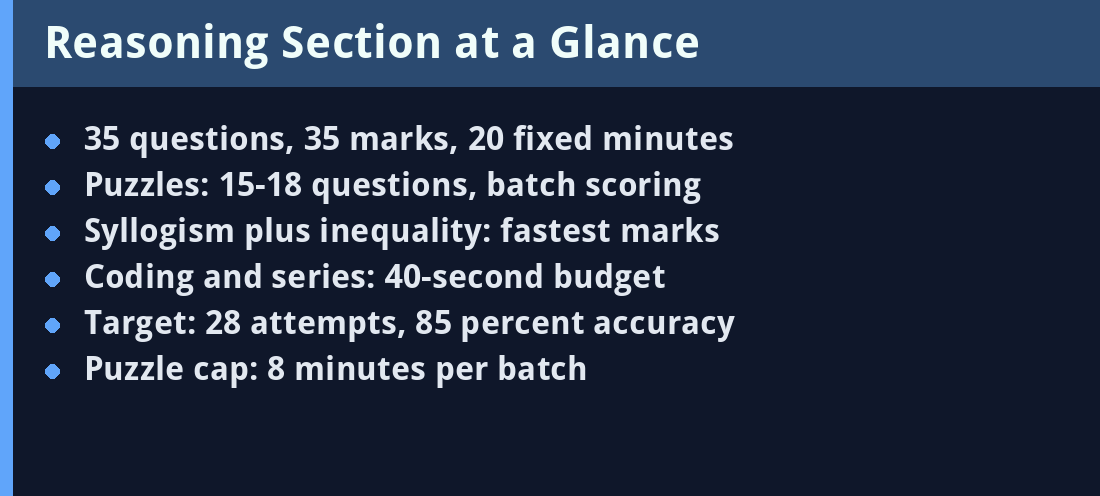
The window is fixed at 20 minutes with 0.25 negative marking, therefore selection decides outcomes again. Meanwhile, reasoning cutoffs historically sit near 8-11 marks while serious candidates target 22 or more. Consequently, about 28 attempts at 85 percent accuracy yield roughly 23 marks after penalty, which is the bank this plan builds.
| Family | Expected Share | Marks per Minute |
|---|---|---|
| Puzzles and seating | 15-18 questions | Medium, batch scoring |
| Syllogism and inequality | 7-9 questions | Highest |
| Coding and series | 5-6 questions | High |
| Miscellaneous logic | 4-5 questions | Variable |
The Four Core Families
Syllogism and Inequality
- Syllogisms: draw minimal diagrams, test each conclusion, never assume distribution.
- Coded inequality: convert symbols first, then chain once, avoiding re-derivation.
- Both families reward a fixed notation, therefore invent yours and keep it.
Puzzles and Seating
- Start with the clue that fixes a person absolutely, not the relative clue.
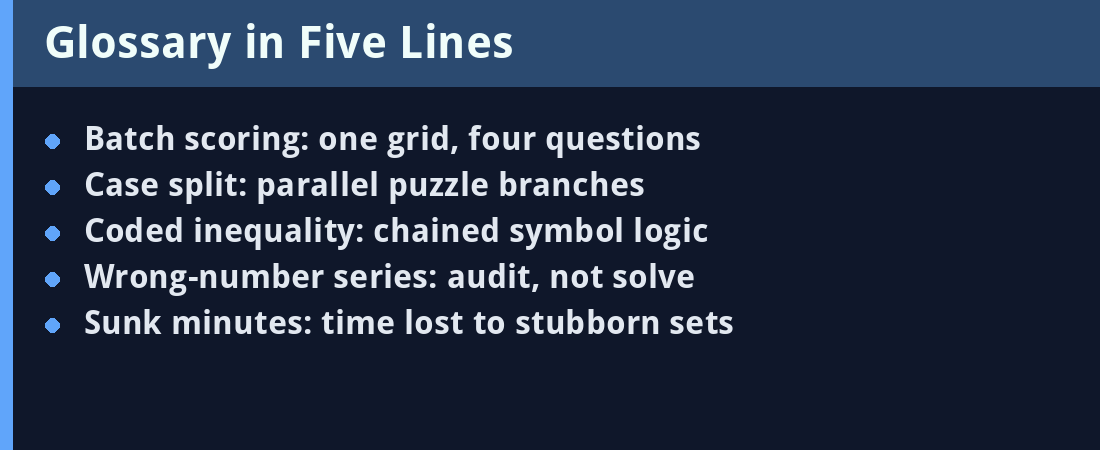
- Write case splits early, and abandon a case the moment it contradicts.
- Linear arrangements hide in floor, schedule and day wrappers, therefore read the frame.
- Batch scoring means four attached questions reward one solved grid.
Coding-Decoding and Series
Coding rewards alphabet-position fluency, therefore memorise positions once and manipulate numbers thereafter. Moreover, series questions usually hide a single operation, and wrong-number variants test the same patterns with an audit. Consequently, ten minutes of daily drilling keeps both families within a 40-second per-question budget.
The Twelve-Day Drill Calendar
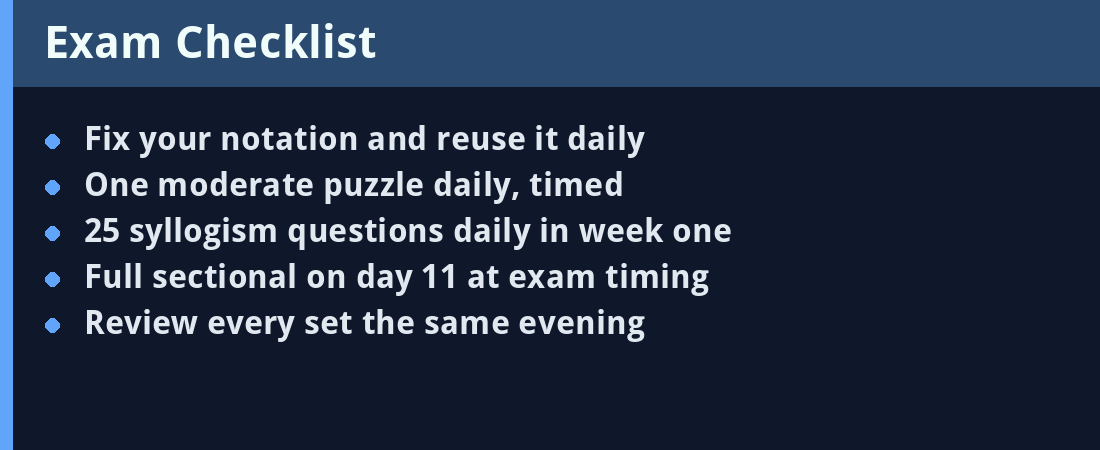
- Days 1-3: syllogism and inequality sets daily, 25 questions, with notation drills.
- Days 4-7: one moderate puzzle and one seating grid daily, timed at 8 minutes each.
- Days 8-10: coding and series sprints, mixed with 10 sprint questions from earlier families.
- Day 11: one full 20-minute sectional at exam timing, reviewed the same evening.
- Day 12: error-log reading plus a light sectional, no fresh topics.
Attempt Strategy on the Day
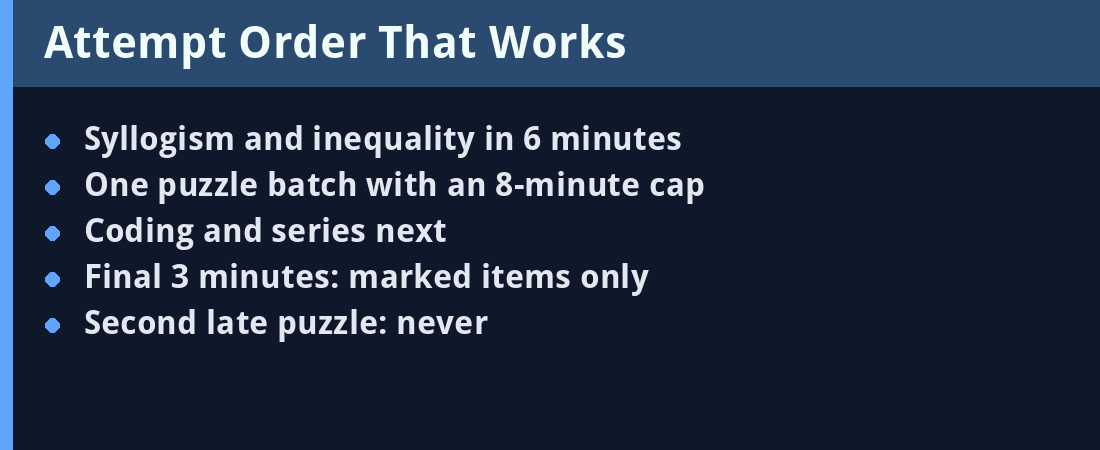
Firstly, clear the sprint families in six minutes. Secondly, take one puzzle with a hard eight-minute cap, choosing the batch with the most attached questions. Thirdly, sweep coding and series next. Finally, spend the last three minutes on marked-for-review items only. However, never open a second puzzle after minute fifteen, because sunk minutes sink sections.
Reasoning is chess with a clock: the opening is memorised, the middle game is method, and clock discipline decides the endgame.
Solved Mini-Set
- In a row of forty, A is thirteenth from the left; A’s position from the right is: Answer: twenty-eighth, from forty minus thirteen plus one.
- If PAPER is coded as QBQFS, the code for STAMP is: Answer: TUBNQ, each letter shifted one forward.
- Series 3, 7, 15, 31, ? continues with: Answer: 63, doubling and adding one.
- All pens are books; some books are long; therefore: Answer: no definite conclusion follows about pens being long.
- Pointing to a photo, he says she is my father’s only daughter’s daughter: Answer: his daughter, since the speaker is male.
FAQ
How many puzzles should I attempt?
Two well-chosen batches, never three, because the third puzzle trades sprint marks for risk.
Are new pattern questions dangerous?
The Thirty-Second Recap
Thirty-five marks. Twenty minutes. Therefore, sprint first. Syllogism. Inequality. Then one puzzle. Hard cap of eight. Moreover, coding pays fast. Series pays fast. Save three minutes for review. However, never open a second puzzle late. Finally, notation is your armour. Drills are your engine. The clock is the referee.
Explain It Simply: Reasoning for a Twelve-Year-Old
Think of this section as a games arcade. Some games are quick taps: spot the pattern, name the code. Some games are jigsaws: seat eight people around a table using clues. The quick games pay small tickets fast. The jigsaws pay four tickets at once, but they eat minutes. Therefore, you play the quick games first. Then you pick one jigsaw, not three. Moreover, you keep a fixed way of writing clues, like keeping puzzle pieces sorted by colour. In addition, wrong answers take a quarter ticket, so wild taps lose money. Finally, the arcade closes in twenty minutes sharp, and the calm player leaves with the most tickets.
Rapid-Fire: Ten Anchors in Ten Lines
- Section: 35 questions, 35 marks, 20 minutes.
- Negative marking: 0.25 per error.
- Sprint families first: about 6 minutes.
- Puzzle cap: 8 minutes per batch.
- Target attempts: 28 at 85 percent accuracy.
- Cutoff zone: 8-11 marks historically.
- Alphabet positions: memorise once, reuse forever.
- Case splits: write early, abandon early.
- Review window: final 3 minutes, marked items only.
- Second puzzle after minute 15: never.
Abbreviations That Recur
- IBPS: the Institute of Banking Personnel Selection.
- PO: probationary officer, the target post.
- LR: logical reasoning, the section’s formal name.
- DI: data interpretation, its quant-side cousin.
- PYQ: previous year questions, the drill gold standard.
- UI: the exam interface, where flags and clocks live.
The Puzzle Taxonomy
Floor and Schedule Frames
- Floor puzzles: fix the highest and lowest anchors first, then split cases.
- Schedule frames: assign the day or slot with the most constraints before others.
- Both reward a grid template, therefore draw the same grid every time.
Circular and Square Seating
- Circular: count facing direction immediately, inward or outward.
- Square: eight-person frames pair corner and edge constraints.
- Linear: note whether all face one way or alternate facing.
- Write people above or below the line to encode direction visually.
Input-Output and New Patterns
Input-output questions carry a fixed machine logic, therefore trace two full transformations before answering anything. Moreover, new-pattern wrappers usually reduce to old families once the frame is named. Consequently, thirty seconds of frame-naming saves three minutes of blind case-solving, which is the entire economics of this section.
The Error-Log Taxonomy for Reasoning
- Misread clue: the grid was right, the reading was wrong.
- Case abandonment delay: you stayed with a dead case too long.
- Notation slip: symbols meant two things in one grid.
- Frame mislabel: a floor puzzle treated as a schedule.
- Clock surrender: no cap was set before starting.
Notably, categories three to five are habits, not knowledge gaps, therefore they respond to process fixes rather than more practice volume. As a result, reviewing the log weekly converts reasoning from a talent test into a procedure test.
What Toppers Do Differently in Reasoning
Across topper transcripts, three habits recur in this section. Firstly, they name the puzzle family before touching the clues, which saves the frame-mislabel error entirely. Secondly, they keep one notation system across months, so their grids read like shorthand rather than experiments. Thirdly, they set the cap before starting, and the clock, not mood, ends a set. Moreover, they review misses the same evening, when the wrong case split is still memorable. Consequently, their practice compounds while volume-only practice merely repeats.
Furthermore, toppers treat the interface as an instrument: flags for review, section clock glances at fixed intervals, and no question-level panic. As a result, their accuracy stays banked while others leak marks in the final five minutes.
A Week of Reasoning on One Page
Picture the drill week as a circuit. Monday opens with twenty-five syllogism questions and five inequality sets, each solved with the fixed notation and timed as a batch. Tuesday takes one moderate floor puzzle and one linear seating grid, both under eight-minute caps, with the grid template drawn before reading any clue. Wednesday shifts to coding-decoding and number series sprints, twenty questions in two ten-minute halves. Thursday mixes families deliberately: five syllogisms, one puzzle, ten series questions, mimicking the exam’s shuffled order. Friday holds the second puzzle of the week, one floor frame and one schedule frame, with case splits written and abandoned honestly. Saturday carries the full twenty-minute sectional at exam timing, and the evening review classifies every miss into the five-category error taxonomy. Sunday rests the section entirely, letting the patterns settle, with only the error log reread once.
Notice the circuit’s arithmetic: roughly one hundred and forty questions across the week, every one reviewed. Therefore, volume stays moderate while learning stays high, which is the ratio toppers report. Moreover, because every session has a cap and a template, the week scales down gracefully during busy college days without losing its shape.
One Last Word on Caps
Finally, write your three caps on paper and read them before every sectional: six minutes for sprints, eight for the chosen puzzle, three for review. Therefore, the caps survive exam-day nerves, because paper outruns memory under pressure, and the section stays a procedure rather than a gamble on the day that actually counts.
Key Takeaways
In conclusion, reasoning rewards a fixed method: sprint families first, one capped puzzle, notation discipline and a protected review window. To summarize, twelve drilling days move an average score into the twenties, provided reviews accompany every set. Therefore, run the calendar exactly, log every miss, and let the section bank the marks your quant and English build upon.
References: ibps.in for the official pattern and previous-year papers for drill material.
Related reading
- IBPS PO Prelims Mock Test (September 16, 2026): 100 Questions in the Real Exam Pattern, Fully Explained — Day 7, 19 Days to Exam
- RBI's Monetary Policy Toolkit: Repo, SDF, MSF, OMO and the CRR-SLR Pair Explained
Quick revision
- Syllogisms: draw minimal diagrams, test each conclusion, never assume distribution.
- Coded inequality: convert symbols first, then chain once, avoiding re-derivation.
- Both families reward a fixed notation, therefore invent yours and keep it.
- Start with the clue that fixes a person absolutely, not the relative clue.
- Write case splits early, and abandon a case the moment it contradicts.
- Linear arrangements hide in floor, schedule and day wrappers, therefore read the frame.
Have a doubt on this topic?