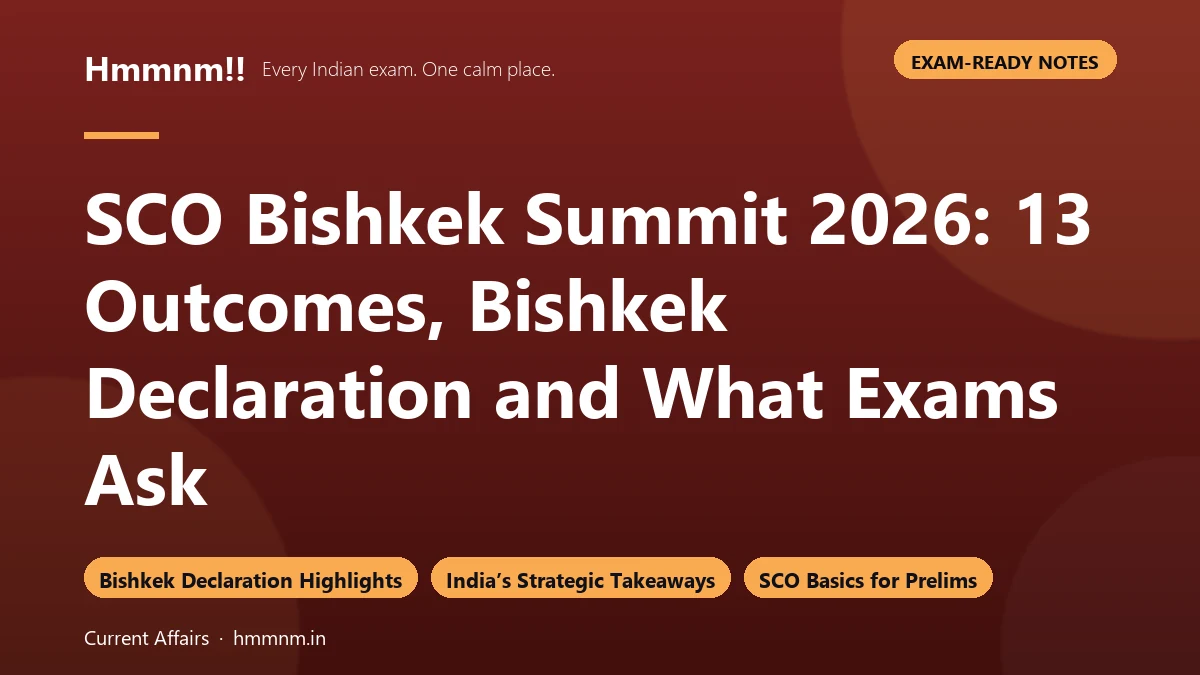
In one line: the SCO turned 25 at Bishkek, delivered a 13-point outcome list and the Bishkek Declaration, and gave India a diplomatic stage just days before the BRICS Summit and the UN General Assembly session.
- The Summit at a Glance
- 13 Key Outcomes
- Bishkek Declaration Highlights
- India’s Strategic Takeaways
- SCO Basics for Prelims
- Understanding the “Shanghai Spirit” and the “Three Evils”
- Why the SCO Matters for India: A Deeper Look
- Quick Revision Card
- FAQ
- Is the SCO a military alliance?
- Why is the SCO important for India?
- What is the difference between RATS and the new Security Threats Coordination Centre?
- Which country hosted the first SCO summit, and where was the 25th-anniversary summit held?
- Has India endorsed the Belt and Road Initiative within the SCO?
- Key Takeaways
- Why This Matters for Exams
- Background and Context
- Key Data Points for Prelims
- Mains Answer Framework
- Connection to Static Syllabus
- Quick Revision Card
- FAQ
- How likely is this to appear in the next exam cycle?
- What is the single most exam-important fact?
- How deep should I prepare this?
The Shanghai Cooperation Organisation held its 26th Heads of State Council in Bishkek, Kyrgyzstan, on August 31–September 1, 2026 — marking a quarter-century since the grouping’s founding in Shanghai in 2001. The summit combined symbolic weight (a 25th anniversary) with substantive outcomes: a new security institution, an expansive Declaration, and a packed slate of bilateral meetings on the sidelines. For exam aspirants, this summit is a high-probability General Awareness question across UPSC, SSC, Banking and State PSC papers — covering both current affairs (outcomes, dates, personalities) and static portions (SCO history, structure, membership). This card covers the outcomes, the Declaration, India’s position, and the exam angles you should master.
Contents
- The Summit at a Glance
- 13 Key Outcomes
- Bishkek Declaration Highlights
- India’s Strategic Takeaways
- SCO Basics for Prelims
- Understanding the “Shanghai Spirit” and the “Three Evils”
- Why the SCO Matters for India: A Deeper Look
- Quick Revision Card
- FAQ
- Key Takeaways
The Summit at a Glance
| Detail | Fact |
|---|---|
| Edition | 26th Heads of State Council |
| Host / Venue | Kyrgyzstan · Bishkek |
| Dates | August 31 – September 1, 2026 |
| Anniversary | 25 years since SCO founding (2001, Shanghai) |
| India’s representation | PM Modi (in-person) |
| Key document | Bishkek Declaration |
| Next summit host | To be rotated among members |
The Heads of State Council is the SCO’s apex body, meeting annually to set the organisation’s overall direction and priorities. Hosting duties rotate among member states, and the Bishkek edition carried added significance as the silver jubilee summit — an occasion leaders used to take stock of the grouping’s evolution from a border-confidence mechanism into a Eurasia-wide organisation.
13 Key Outcomes
- Bishkek Declaration adopted — the summit’s overarching political document, setting the tone on security, trade and multilateralism.
- Security Threats Coordination Centre — a new SCO institution created to counter terrorism, separatism and extremism, complementing the existing RATS framework in Tashkent.
- Modi–Putin bilateral held on the sidelines — the first in-person meeting between the two leaders in this cycle, with energy, defence and trade on the agenda.
- Trade and economic cooperation roadmap extended, reaffirming the target of expanding intra-SCO trade and investment.
- Connectivity initiatives discussed, including the International North-South Transport Corridor (INSTC) and Chabahar port linkages — both central to India’s Central Asia strategy.
- Counter-narcotics strategy reaffirmed, reflecting the region’s exposure to drug trafficking routes originating in Afghanistan.
- Energy security cooperation framework adopted, covering oil, gas, renewables and grid interconnection.
- Digital economy and AI governance working group proposed — a nod to emerging technologies entering the SCO’s agenda.
- Climate and environmental cooperation resolution, including glacier preservation and water resource management in Central Asia.
- Cultural and humanitarian cooperation programme signed, covering education, tourism and heritage.
- SCO Youth Council activities expanded, with new exchange and skill-development initiatives.
- Inter-bank cooperation mechanism strengthened, supporting trade settlement and project financing among member states.
- Next summit dates and host announced, continuing the annual rotation of the chairmanship.
Exam tip: outcome lists like this are frequently asked as “which of the following was adopted/announced at the SCO summit?” Focus especially on items that are new (the Security Threats Coordination Centre) versus reaffirmations of existing commitments.
Bishkek Declaration Highlights
- Reaffirmed the “Shanghai Spirit” — mutual trust, mutual benefit, equality, consultation, respect for cultural diversity and pursuit of common development.
- Strong language on terrorism, separatism and extremism — the “three evils” that form the SCO’s core security rationale.
- Support for Afghanistan’s stability and territorial integrity, alongside calls for an inclusive political setup and counter-terrorism assurances from the Afghan soil.
- A call for UN-centric multilateralism and reform of the UN Security Council — language India consistently pushes to reflect its own UNSC aspirations.
- Emphasis on trade in national currencies, a clear de-dollarisation signal aligning with the SCO’s broader push for financial independence among members.
- Commitment to connectivity projects — though notably, India continues to withhold endorsement of China’s Belt and Road Initiative within SCO documents.
India’s Strategic Takeaways
- Triple-summit diplomacy: Bishkek (SCO) is the first of three summits in roughly a month — BRICS and the UNGA high-level week follow — signalling India’s multi-aligned foreign policy across Western, Eurasian and Global South platforms.
- Modi–Putin meeting: the first face-to-face interaction in this cycle; energy supplies, defence cooperation and the rupee-rouble trade mechanism featured prominently.
- Connectivity without BRI: India supports the INSTC and the Chabahar port project but consistently avoids endorsing China’s Belt and Road Initiative — a distinction exam questions love to test.
- Central Asia outreach: all five Central Asian republics — Kazakhstan, Kyrgyzstan, Tajikistan, Turkmenistan and Uzbekistan — are part of the SCO family, making it India’s most practical gateway to a region it cannot access overland through Pakistan.
- Balancing act: the SCO is one of the few forums where India and China share a table despite border tensions, giving Delhi a channel for engagement even as it deepens ties with the Quad.
SCO Basics for Prelims
| Fact | Answer |
|---|---|
| Founded | 2001 (Shanghai Convention); successor to the Shanghai Five (1996) |
| Founding members | China, Russia, Kazakhstan, Kyrgyzstan, Tajikistan, Uzbekistan |
| India joined | 2017 (along with Pakistan) at the Astana Summit |
| Headquarters | Beijing, China |
| Official languages | Chinese, Russian |
| Structure | Heads of State Council (apex) · Council of Heads of Government (PMs) · Council of Foreign Ministers · RATS (Tashkent) |
| Secretary-General | Appointed by rotation among member states |
| Membership status | Iran became a full member (2023); Belarus admitted as a member (2024) |
| Observer states | Mongolia, Afghanistan (dialogue partners include Turkey, Sri Lanka, and others) |
Static-GK memory hook: Shanghai Five (1996) → +Uzbekistan → SCO (2001) → India & Pakistan (2017) → Iran (2023) → Belarus (2024). Tracing this expansion sequence answers most membership-based questions.
Understanding the “Shanghai Spirit” and the “Three Evils”
Two phrases recur in every SCO document and almost every exam question on the organisation:
- Shanghai Spirit: the grouping’s guiding ethos — mutual trust and mutual benefit, equality, consultation, respect for diverse civilisations, and pursuit of common development. It consciously contrasts with alliance politics: no binding military obligations, and decisions by consensus.
- Three Evils: terrorism, separatism and extremism. These were codified in the 2001 Shanghai Convention on Combating Terrorism, Separatism and Extremism, and remain the SCO’s core security mandate. The Regional Anti-Terrorist Structure (RATS), headquartered in Tashkent, Uzbekistan, is the operational arm — it coordinates joint counter-terror exercises and intelligence sharing. The new Security Threats Coordination Centre announced at Bishkek is designed to build on this foundation.
Why the SCO Matters for India: A Deeper Look
- Central Asia connectivity: India’s land route to Central Asia runs through Pakistan or Afghanistan — both problematic. The SCO, combined with the INSTC and Chabahar, offers an alternate institutional and logistical bridge to a resource-rich region.
- Counter-terrorism cooperation: RATS-enabled intelligence sharing supports India’s concerns about cross-border terrorism, even though India has at times declined to endorse SCO language that omits specific references to Pakistan-based groups.
- Energy security: SCO members include major producers (Russia, Kazakhstan, Iran) and consumers (India, China). Cooperation frameworks on energy directly touch India’s import strategy.
- Strategic autonomy in practice: participation in the SCO alongside the Quad, BRICS and G20 demonstrates India’s capacity to engage rival blocs simultaneously — the essence of multi-alignment.
Quick Revision Card
- 26th summit · Bishkek, Kyrgyzstan · Aug 31–Sep 1, 2026 · 25 years of SCO
- 13 outcomes · Bishkek Declaration · new Security Threats Coordination Centre
- Modi–Putin bilateral · 3 summits in a month (SCO–BRICS–UNGA)
- India joined 2017 (Astana) · HQ Beijing · RATS in Tashkent · official languages: Chinese, Russian
- Three evils: terrorism, separatism, extremism · guiding ethos: Shanghai Spirit
- Expansion chain: Shanghai Five (1996) → SCO (2001) → India/Pakistan (2017) → Iran (2023) → Belarus (2024)
FAQ
Is the SCO a military alliance?
No — it is a political, economic and security cooperation organisation, not a defence pact like NATO. Its counter-terrorism work (via RATS) is cooperative rather than collective-defence in nature, and all decisions are taken by consensus.
Why is the SCO important for India?
Access to Central Asia, counter-terrorism cooperation, energy security, and a platform where India, Russia and China sit at the same table — valuable even amid bilateral tensions.
What is the difference between RATS and the new Security Threats Coordination Centre?
RATS (Regional Anti-Terrorist Structure, Tashkent) is the SCO’s long-standing counter-terrorism body. The Security Threats Coordination Centre, announced at Bishkek, is a new institution intended to broaden coordination against terrorism, separatism and extremism — remember it as the new outcome item for exams.
Which country hosted the first SCO summit, and where was the 25th-anniversary summit held?
The founding summit was held in Shanghai in 2001; the silver jubilee (26th Heads of State Council) was hosted by Kyrgyzstan in Bishkek in 2026.
Has India endorsed the Belt and Road Initiative within the SCO?
No. India has consistently refrained from endorsing BRI in SCO documents, citing sovereignty concerns (projects passing through territory India claims). It backs alternative connectivity via INSTC and Chabahar instead.
Key Takeaways
- The Bishkek summit blended symbolism (25 years) with substance (13 outcomes, a new security centre).
- The Bishkek Declaration reinforces familiar SCO themes — the Shanghai Spirit, the three evils, de-dollarisation — while pushing into newer areas like AI governance.
- For India, the summit anchored a month of summit diplomacy and reaffirmed its Central Asia and multi-alignment strategies.
- For exams, prioritise: dates and venue, the Declaration’s name, the new institution, India’s entry year, headquarters, RATS location, and the expansion timeline.
Why This Matters for Exams
This topic has appeared in recent UPSC, SSC and Banking exams in various formats — statement-based questions in Prelims, analytical questions in Mains, and current affairs rounds in Banking interviews. The exam pattern for this category typically tests: (1) factual recall of key data points, (2) understanding of the broader context, (3) ability to connect the event to static syllabus topics, and (4) awareness of implications for policy and governance. Prepare a one-page revision note covering the who/what/when/where/why of this topic, focusing on numbers, dates, names of institutions and specific provisions.
Background and Context
To answer exam questions on this topic comprehensively, understand the historical trajectory. This development is part of a larger pattern in India’s policy landscape. Connect it to related developments in the same domain over the past 12-24 months. Examiners increasingly frame questions that require linking current events to their historical antecedents. Key context includes the policy framework that enabled this development, the institutional actors involved, and the timeline of decisions that led to the current situation.
Key Data Points for Prelims
| Aspect | Key Fact | Exam Angle |
|---|---|---|
| Primary agency | Check the responsible ministry/organisation | Who is the nodal authority? |
| Timeline | When was this announced/implemented? | Match year with event |
| Scale/numbers | Quantitative measures | Data-based MCQs |
| Constitutional/legal basis | Which article/act enables this? | Article-number questions |
| International comparison | How does India compare globally? | Statement-based MCQs |
Mains Answer Framework
For a 15-marker on this topic, structure your answer as follows:
- Introduction (30 words): State the development with one specific data point.
- Body — Analysis (60 words): Two dimensions: significance and challenges. Use sub-headings or clear paragraph breaks.
- Body — Way Forward (50 words): 3-4 actionable suggestions with implementing agencies.
- Conclusion (20 words): Forward-looking statement linking to India’s broader goals.
Connection to Static Syllabus
This current affairs topic connects to the static portion of the syllabus in the following ways:
- GS2 (Polity/Governance): Link to relevant articles, amendments or institutional frameworks.
- GS3 (Economy/Security): Connect to economic policy, growth drivers or security architecture.
- GS1 (Society/Geography): Relate to demographic, social or geographic factors.
Examiners reward candidates who can bridge current events with static knowledge — this is what distinguishes a 55% answer from a 70% answer.
Quick Revision Card
- One-line summary of the development.
- Three must-remember data points.
- One constitutional/legal provision.
- One mains-worthy analytical angle.
- One probable prelims question format.
FAQ
How likely is this to appear in the next exam cycle?
High probability — recent developments in this domain have been consistently featured across UPSC, SSC and Banking exams in the last 3 cycles.
What is the single most exam-important fact?
The specific number/date/provision that anchors the development — this is what MCQs typically test.
How deep should I prepare this?
Prelims: factual recall level. Mains: analytical level with connections to static topics. Interview: ability to discuss implications with balanced perspective.
Related on hmmnm.in: Q1 FY27 GDP at 7.8% · The NEET 2026 Storm · Nepal Flash Floods
Quick revision
- Bishkek Declaration Highlights
- India’s Strategic Takeaways
- Understanding the “Shanghai Spirit” and the “Three Evils”
- Why the SCO Matters for India: A Deeper Look
- Bishkek Declaration adopted: — the summit’s overarching political document, setting the tone on security, trade and multilateralism.
- Security Threats Coordination Centre: — a new SCO institution created to counter terrorism, separatism and extremism, complementing the existing RATS framework in Tashkent.
Have a doubt on this topic?