


Nepal Flash Floods and India’s Disaster Diplomacy: Exam-Ready Notes
In one line: Nepal’s floods and India’s rescue machine — decoded.
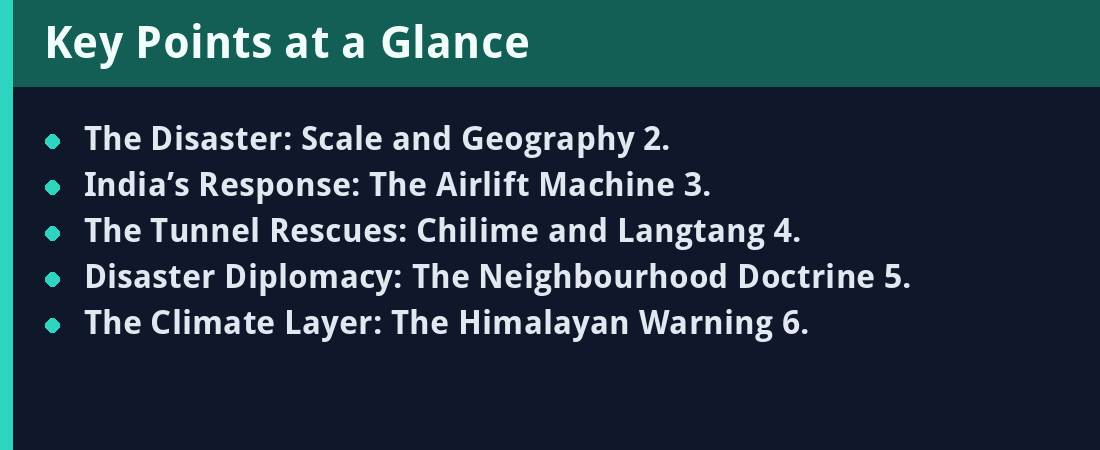
- 1. The Disaster: Scale and Geography
- 2. India’s Response: The Airlift Machine
- 3. The Tunnel Rescues: Chilime and Langtang
- 4. Disaster Diplomacy: The Neighbourhood Doctrine
- 5. The Climate Layer: The Himalayan Warning
- 6. How Exams Probe This Topic
- 7. Quick Revision: One-Glance Facts
- The Relief Numbers
- Practice Corner: Five Definition Checks (with Answers)
- The Case Lens: The HADR Doctrine
- The Three Classic Traps (Where Beginners Slip)
- Frequently Asked Questions
- What happened in Nepal in September 2026?
- What was India’s response?
- What is disaster diplomacy?
- Why do the floods carry a climate warning?
- What exam frames does the episode serve?
- Exam Checklist
- FAQ
- How much of this page is exam-relevant?
- When should I revisit?
- The Thirty-Second Recap
- Explain It Simply
- Abbreviations That Recur Here
In one line: The September 2026 Nepal flash floods — around 4,000 missing, nearly 12,000 rescued — and India’s response machine: C-130J and C-17 aircraft, over 21 tonnes of relief airlifted, 166-plus Indians brought home, joint tunnel rescues at Chilime and Langtang — the disaster-diplomacy analysis: the HADR doctrine, the India-Nepal relationship’s arc, and the Himalayan climate question the floods sharpen.
The Nepal floods stand on four counts. First, the disaster — scale, geography, cause. Second, India’s response — the airlift, the rescues, the machinery. Third, the diplomacy — the neighbourhood doctrine the response serves. Fourth, the climate layer — the Himalayan hazard the floods announce.
Contents
1. The Disaster: Scale and Geography
2. India’s Response: The Airlift Machine
3. The Tunnel Rescues: Chilime and Langtang
4. Disaster Diplomacy: The Neighbourhood Doctrine
5. The Climate Layer: The Himalayan Warning
6. How Exams Probe This Topic
7. Quick Revision: One-Glance Facts
– Practice Corner: Five Definition Checks (with Answers)
– The Case Lens: The HADR Doctrine
Quick Answer: The flash floods that struck Nepal from 26 August 2026 (the crisis unfolding into September) left around 4,000 people missing with nearly 12,000 rescued — among the deadliest Himalayan disasters of the decade. India’s response: C-130J and C-17 aircraft deployed, more than 21 tonnes of relief material airlifted, 166-plus Indian citizens rescued, and joint India-Nepal search-and-rescue teams working the Chilime and Langtang hydropower tunnel sites — where, on 4 September, two trapped workers were pulled out alive. The episode is a textbook of disaster diplomacy: the HADR (humanitarian assistance and disaster relief) doctrine India has built since the 2004 tsunami-and-Operation-Dost lineage, deployed in the neighbourhood’s service — against the India-Nepal relationship’s complicated arc (the 2015 blockade’s chill, the recent thaw) — and it sharpens the Himalayan climate warning: the glacier-lake outburst and cloudburst risks the warming mountains now carry, the exam’s disaster-management (GS3) and international-relations (GS2) questions both fed.
1. The Disaster: Scale and Geography
- The event. Flash floods struck Nepal around the turn of September 2026 — the sudden, high-velocity flooding the Himalayan catchments’ intense rain-and-mountain terrain produce; the affected districts including the hydropower corridors north of Kathmandu.
- The scale. Around 4,000 missing; nearly 12,000 rescued in the initial operations — the missing-and-dead toll among the gravest in Nepal’s recent history; the displacement-and-infrastructure destruction the multiplier.
- The geography’s role. The Himalayan terrain: steep gradients amplifying run-off, the river valleys concentrating the flow, the settlements-and-infrastructure (roads, hydro-tunnels) in the hazard’s path — the vulnerability’s physical script.
- The transboundary layer. The Kosi-Gandak river systems’ shared basins — the floods’ downstream implications for Bihar-and-UP the recurrent India-Nepal water layer this episode touches.
2. India’s Response: The Airlift Machine
- The air bridge. C-130J Super Hercules and C-17 Globemaster aircraft — the IAF’s strategic-lift pair — ferrying over 21 tonnes of relief material: the emergency rations, medicines, tents-and-rescue equipment the first-response inventory.
- The citizen evacuation. 166-plus Indian citizens rescued — the diaspora-and-pilgrim-and-worker presence in Nepal the MEA’s crisis cell coordinates; the 2015-earthquake playbook (Operation Maitri) the lineage.
- The rescue teams. Indian search-and-rescue and medical teams — the NDRF-and-army contingents the doctrine deploys — working alongside Nepal’s own agencies under the host’s coordination.
- The doctrine’s signature. Speed, scale-and-self-retrieval: the assistance arriving within hours, sized to the need, and delivered under the affected state’s authority — the HADR etiquette the difference between help-and-hegemony.
3. The Tunnel Rescues: Chilime and Langtang
- The trapped-workers crisis. The floods inundated construction sites at the Chilime and Langtang hydropower projects — workers trapped in the flooded tunnels, the rescue’s hardest theatre.
- The joint operation. Indian and Nepali teams jointly conducted the search-and-rescue — the dewatering-and-entry operations the tunnel rescue’s engineering (the Silkyara 2023 saga the Indian experience-base); on 4 September 2026 two trapped workers were pulled out alive — the operation’s visible win.
- The hydropower layer. Nepal’s run-of-river hydro-corridor — the energy-and-development strategy the floods now stress-test: the climate-proofing of Himalayan infrastructure the policy question.
- The engineering diplomacy. The joint rescue’s optics: Indian-and-Nepali teams in one tunnel — the operational cooperation the relationship’s often-frayed politics rarely manages on paper.
4. Disaster Diplomacy: The Neighbourhood Doctrine
- The concept. Disaster diplomacy: the humanitarian response as the relationship’s investment — the goodwill the airlift banks when the politics are stuck; the 2004 tsunami’s unified-response-and-Operation-Dost (Turkey 2023) the Indian doctrine’s stations.
- The Nepal arc. The India-Nepal relationship’s complications — the 2015 blockade’s deep chill, the boundary-and-constitution frictions, China’s infrastructure inroads — against which a fast, big, humble relief operation speaks: the 2015 earthquake’s Indian response (Operation Maitri, the largest external contributor) the precedent this week echoes.
- The neighbourhood-first test. The doctrine’s honesty: neighbours judge by the crisis-response, not the communiqués — the airlift the policy made visible; the follow-through (rehabilitation assistance, the reconstruction offers) the diplomacy’s second act to watch.
- The institutional layer. The SAARC disaster-management centre, the BIMSTEC’s disaster-management exercise — the regional frameworks the actual bilateral response this time outran: the institutions-versus-the-bilateral-machinery the mains comparison.
5. The Climate Layer: The Himalayan Warning
- The hazard’s anatomy. Flash floods, cloudbursts and GLOFs (glacial lake outburst floods) — the warming Himalayas’ triple threat: the glaciers retreating (the lakes swelling behind unstable moraines), the extreme-precipitation events intensifying, the settlements-and-infrastructure exposed.
- The evidence base. The IPCC’s mountain assessments, the ICIMOD’s (the Kathmandu-based international centre) Hindu-Kush-Himalaya reports — the region warming faster than the plains’ average, the “third pole” the climate-changed frontier.
- The adaptation agenda. The early-warning systems, the GLOF-risk mapping-and-monitoring, the climate-proofed infrastructure codes, the transboundary data-sharing (the hydrological data the flood-forecasting needs) — the four-item adaptation menu the disaster-management answer recites.
- The exam’s standing question. “The Himalayan region is the climate crisis’s frontline — discuss the disaster-risk-reduction framework it demands” — the GS3-and-essay frame this episode will dress for years.
6. How Exams Probe This Topic
- Prelims MCQs: the aircraft types (C-130J, C-17); the relief tonnage (21-plus) and the rescued-citizens figure (166-plus); the tunnel sites’ names (Chilime, Langtang); the GLOF definition; ICIMOD’s location (Kathmandu); the 2015-earthquake operation’s name (Maitri).
- Mains questions: “Disaster diplomacy is India’s most effective neighbourhood policy — examine with the Nepal 2026 response”; “Evaluate India’s HADR capability as an instrument of foreign policy”; “The Himalayan GLOF risk demands a regional early-warning architecture — discuss”.
- The interview layer: the Sendai framework’s four priorities, the disaster-management cycle’s phases, the civil-military coordination the airlift displays — the three depth-probes.
7. Quick Revision: One-Glance Facts
- The disaster. Nepal flash floods, ~1 September 2026; ~4,000 missing, ~12,000 rescued.
- India’s response. C-130J + C-17; 21+ tonnes relief; 166+ Indians rescued; joint SAR teams.
- The tunnels. Chilime-and-Langtang hydropower sites; two workers alive on 4 September.
- The lineage. Operation Maitri (2015 earthquake), Operation Dost (Turkey 2023); the HADR doctrine’s stations.
- The climate. GLOF-cloudburst-flash-flood triple; ICIMOD-Kathmandu; the early-warning-and-data-sharing agenda.
Conclusion. The Nepal floods are the Himalayan century’s warning delivered — and India’s response its disaster diplomacy’s latest proof: the airlift’s speed-and-scale, the joint tunnel rescue’s engineering, the neighbourhood doctrine made operational. Learn the numbers, the doctrine’s lineage and the GLOF layer — the GS2-GS3-and-interview questions this episode feeds for the year ahead.
The Relief Numbers
| Metric | Figure | Source |
|---|---|---|
| Deaths (by 5 Sep) | ~1,344 | Nepal DMO via BBC/Hindu |
| Missing | 3,900–5,083 | Nepal DMO |
| Rescued | ~11,800–12,000 | Nepal Army |
| India’s airlift | 21 tonnes; C-17/C-130J | IAF/MEA |
Practice Corner: Five Definition Checks (with Answers)
- The IAF’s airlift pair in the operation — C-130J Super Hercules and C-17 Globemaster.
- The relief-and-rescue figures — 21-plus tonnes airlifted; 166-plus Indian citizens rescued.
- The tunnel sites — Chilime and Langtang hydropower projects; two workers rescued alive on 4 September 2026.
- GLOF — Glacial lake outburst flood: the moraine-dammed lake’s collapse — the warming Himalayas’ signature hazard.
- The 2015-Nepal-earthquake operation — Operation Maitri — the response lineage the 2026 airlift extends.
The Case Lens: The HADR Doctrine
Any HADR question — mains or interview — runs the doctrine’s walk: the trigger (the host’s request — the sovereignty’s respect), the speed (the hours-not-days deployment), the scale (the lift-and-logistics matched to the need), the coordination (the host’s lead, the civilian-and-military blend), and the exit (the assistance-without-occupation). The Nepal 2026 operation passes each test — the doctrine’s anatomy the answer’s frame.
The Three Classic Traps (Where Beginners Slip)
The missing-and-dead conflation. ~4,000 missing is not ~4,000 dead — the missing tally’s resolution (the rescued-and-traced) the running story; the exam’s precision the wording’s discipline.
Maitri-versus-Dost confusion. Maitri the 2015 Nepal earthquake; Dost the 2023 Turkey-Syria — the operations’ names the standing MCQ pair.
The relief-only frame. The response is airlift-plus-rescue-plus-diplomacy-plus-climate-policy: the answer that stops at the tonnage misses the doctrine-and-the-warning the episode actually examines.
Frequently Asked Questions
What happened in Nepal in September 2026?
Flash floods — among the deadliest Himalayan disasters of the decade — left around 4,000 people missing with nearly 12,000 rescued; the Chilime and Langtang hydropower tunnels’ trapped workers became the rescue’s hardest theatre.
What was India’s response?
The IAF’s C-130J and C-17 aircraft airlifted over 21 tonnes of relief; 166-plus Indian citizens were rescued; Indian and Nepali teams jointly conducted the tunnel search-and-rescue, pulling two workers out alive on 4 September.
What is disaster diplomacy?
The use of humanitarian assistance-and-disaster relief as an instrument of foreign policy — the crisis-response’s goodwill banking: India’s Operation Maitri (Nepal 2015) and Operation Dost (Turkey 2023) the doctrine’s named stations.
Why do the floods carry a climate warning?
The warming Himalayas’ triple hazard — flash floods, cloudbursts and glacial lake outburst floods — is intensifying: the retreating glaciers, the swelling moraine-dammed lakes and the extreme-precipitation events the infrastructure-and-settlements’ exposure compounds.
What exam frames does the episode serve?
GS2’s disaster diplomacy-and-neighbourhood-first; GS3’s disaster management (the Sendai-and-HADR frameworks) and the climate-adaptation agenda; the interview’s doctrine-and-coordination probes — the episode a multi-paper asset.
Related on hmmnm.in: India AI Impact Summit 2026, Exam-Ready Notes · India’s BRICS Chairship 2026, Exam-Ready Notes · Census 2027 and the Caste Count, Exam-Ready Notes
Read next: West Asia Conflict and Red Sea Security, Exam-Ready Notes (series archive)
Exam Checklist
- Therefore, read once fully, then tables only
- Convert each heading into a question
- Speak five lines aloud as a briefing
- In addition, index one line in the fortnight sheet
- Return on day three and day seven

FAQ
How much of this page is exam-relevant?
Nearly all of it, because the tables and worked items follow the standard question register for this subject.
When should I revisit?
Day three and day seven after the first read, with the drill spoken aloud once.
The Thirty-Second Recap
One page. One topic. Therefore, read the tables twice. Speak the recap once. Moreover, the numbers carry the marks. The names carry the traps. However, revisits beat rereads. Finally, day three and day seven. That is all.
Explain It Simply
Think of this page as a map of one neighbourhood. The big streets are the tables. The landmarks are the numbers. The street names are the terms in bold. However big the city feels, this one neighbourhood fits in a pocket, and a pocket map is what exam week needs. Therefore, walk it once fully, then walk only the streets you forget, and by the second walk the neighbourhood feels like home.
Pocket the map, not the whole city: exams reward the walkable version of every topic.
Abbreviations That Recur Here
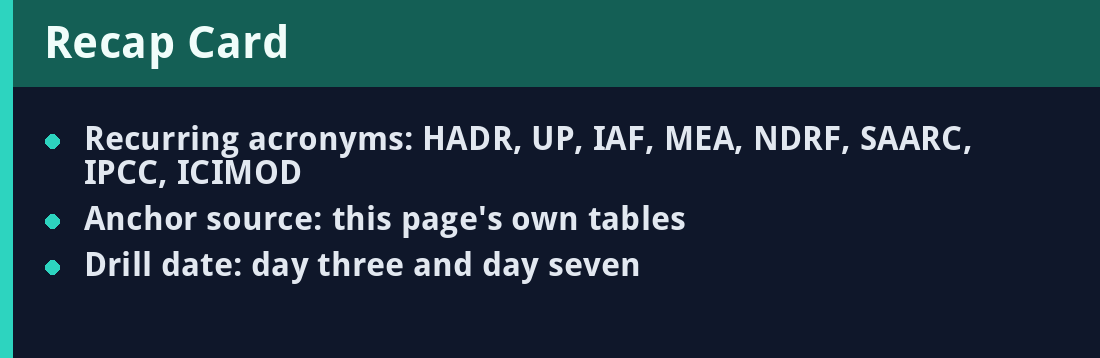
- HADR.
- IAF.
- MEA.
- SAARC.
- IPCC.
Quick revision
- The event.: Flash floods struck Nepal around the turn of September 2026 — the sudden, high-velocity flooding the Himalayan catchments’ intense…
- The scale.: Around 4,000 missing; nearly 12,000 rescued in the initial operations — the missing-and-dead toll among the gravest in Nepal’s recent history;…
- The geography’s role.: The Himalayan terrain: steep gradients amplifying run-off, the river valleys concentrating the flow, the settlements-and-infrastructure (roads,…
- The transboundary layer.: The Kosi-Gandak river systems’ shared basins — the floods’ downstream implications for Bihar-and-UP the recurrent India-Nepal water…
- The air bridge.: C-130J Super Hercules and C-17 Globemaster aircraft — the IAF’s strategic-lift pair — ferrying over 21 tonnes of relief material: the…
- The citizen evacuation.: 166-plus Indian citizens rescued — the diaspora-and-pilgrim-and-worker presence in Nepal the MEA’s crisis cell coordinates; the…
Have a doubt on this topic?