JEE/NEET Physics · Electromagnetic Induction series · Part 1 of 6 · All parts →
- Magnetic flux Φ = BA cosθ — how much field passes through a loop (weber)
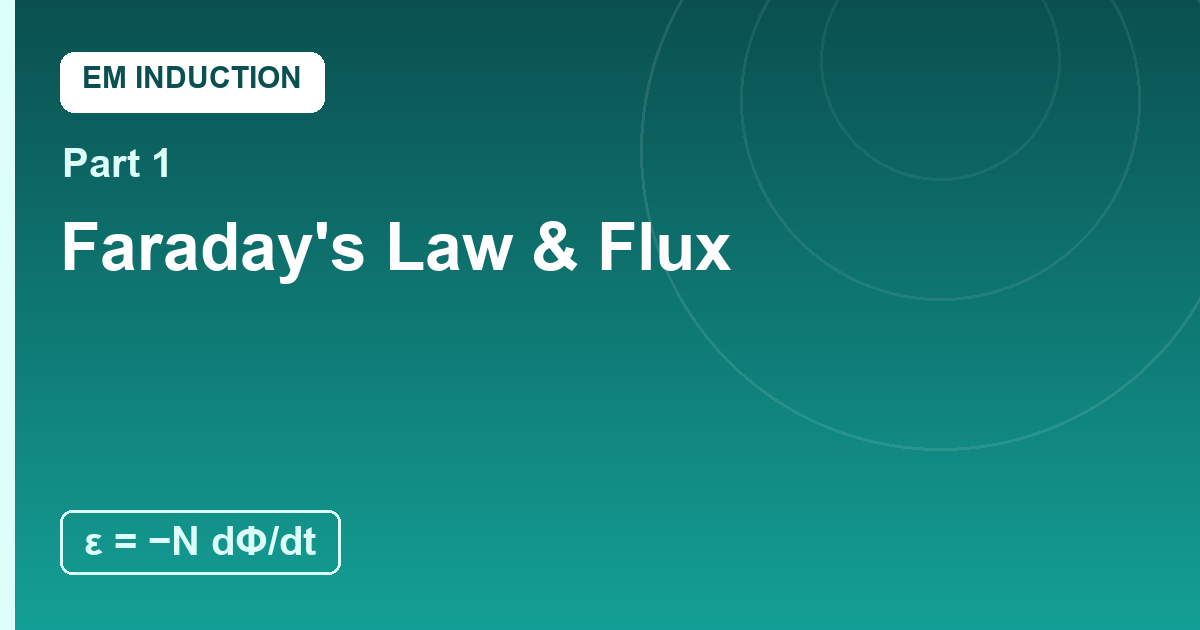
- Faraday: induced EMF = rate of CHANGE of flux: ε = −N dΦ/dt
- No change, no EMF — a huge steady field induces nothing
- Flux can change by changing B, A, or the angle θ — all three work
- One weber = one volt-second: the unit tells the whole story
Move a magnet toward a coil and a voltage appears across it — no battery, no contact, just motion. Faraday’s 1831 discovery: only CHANGE induces electricity. The entire power industry stands on that one word. Part 1 of the Electromagnetic Induction series.
- Flux: field through a loop
- Faraday’s law
- Three ways to change flux
- Flux linkage and N turns
- Solved examples
- Common mistakes
- This physics in your daily life
- Practice set
- Recap
Flux: Field Through a Loop
Magnetic flux counts how much field passes through a loop’s opening — like rain through a bucket’s mouth: tilt it, shrink it, or weaken the rain, less gets in.
| Letter | What it means (plain words) | Value / unit |
|---|---|---|
| Φ | magnetic flux through the loop | weber (Wb) |
| B | magnetic field | tesla |
| A | loop area | m² |
| θ | tilt between field and loop’s normal | degrees |
Faraday’s Law
The EMF depends on how FAST flux changes — a gentle shift over an hour induces nothing; the same shift in a millisecond induces a spark. Change is the currency.
Three Ways to Change Flux
| Change | Example |
|---|---|
| B changes | magnet moving toward coil; electromagnet switched on |
| A changes | loop expanding/contracting; sliding rod circuit |
| θ changes | loop rotating — every generator ever |
Flux Linkage and N Turns
A coil of N loops catches the flux N times: ε = N dΦ/dt. More turns, more voltage — the cheapest amplifier in electrical engineering.
Solved Examples
θ = 0 (to normal): Φ = 0.5 × 0.02 = 0.01 Wb.
✔
Answer: 0.01 Wb
ε = NΔΦ/Δt = 50 × 0.02/0.1 = 10 V.
✔
Answer: 10 V
ε = N A dB/dt = 100 × 0.005 × (1/2) = 0.25 V, constant during the ramp.
Steady change = steady EMF: the AC generator’s half-story.
✔
Answer: 0.25 V (constant)
- Big field = big EMF. Only big CHANGE makes EMF: the world’s steadiest 10 T field induces zero in a resting coil.
- θ measured from the plane. cosθ uses the NORMAL, not the plane — flat-on to the field means θ = 0, flux maximum.
- Forgetting N. Each turn contributes; coils multiply voltage by turns.
- Average vs instantaneous. Faraday gives the instantaneous rate; exam averages need ΔΦ/Δt with the interval stated.
This Physics in Your Daily Life
- Every power plant on Earth — turbines spin coils in magnets (or vice versa): flux changing 50 times a second feeds the grid: civilization runs on dΦ/dt.
- Induction cooktops — changing fields induce currents directly in the pan: the stove stays cool, the food cooks: Faraday in the kitchen.
- Wireless phone charging — flux from a transmitter coil induces EMF in the receiver: cutting the last cable.
- Induction loop hearing systems in theatres — flux changes carried sound directly to hearing aids: accessibility by induction.
- Shop anti-theft gates — tags disturb oscillating flux, gates alarm: retail security riding Faraday.
A static field through a loop is a photograph — nothing happens. Induction is the universe reacting to a NEWS REEL: only when the field through the loop changes does the loop’s charge population feel a new push. Stillness is silence; motion speaks volts.
Flux 0.02 Wb fading in 0.1 s through 50 turns: 10 V. The same 0.02 Wb fading over a day: 0.01 V — invisible. Same total change, wildly different rate: EMF rides the derivative, not the difference.
Draw field lines threading the loop like arrows through a ring. Animate: arrows thickening (B grows), the ring expanding (A grows), or the ring tilting (θ grows) — each animation is an induced EMF; a frozen frame is none.
Practice set (answers hidden — try first)
(NEET-level) B=0.2 T, A=100 cm², ⊥: Φ =
(JEE Main-level) ΔΦ = 0.01 Wb in 0.05 s, N=100: ε =
(NEET-level) Constant flux through a coil: EMF =
(Concept) Three ways to change flux:
(JEE Main-level) Halving the time of a fixed flux change: ε
- Φ = BA cosθ (weber)
- ε = −N dΦ/dt: rate of change is everything
- change B, A, or θ — all induce
- N turns multiply the EMF
- steady flux → zero EMF
- 🔁 flux definition
- 🔁 Faraday’s law structure
- 🔁 three induction routes
- 🧠 Chant: ‘no change, no voltage’.
- 🧠 Bucket image: ‘flux = rain through the bucket mouth’.
- 🏠 Daily: the grid is dΦ/dt at national scale.
- 🏠 Daily: induction cooktops heat pans, not stoves.
Quick revision
- Magnetic flux Φ = BA cosθ — how much field passes through a loop (weber)
- Faraday: induced EMF = rate of CHANGE of flux: ε = −N dΦ/dt
- No change, no EMF — a huge steady field induces nothing
- Flux can change by changing B, A, or the angle θ — all three work
- One weber = one volt-second: the unit tells the whole story
- Flux: field through a loop
Have a doubt on this topic?