JEE/NEET Physics · Moving Charges & Magnetism series · Part 6 of 8 · All parts →
- A current-carrying wire feels force in ANOTHER current’s field: F = BIl sinθ
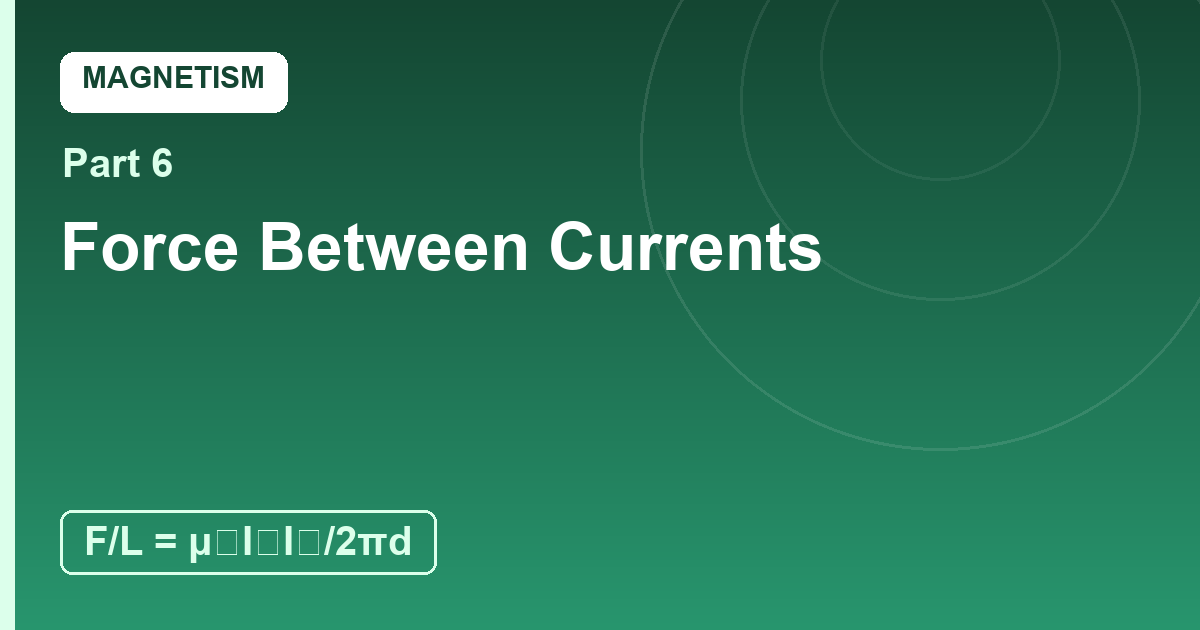
- Two parallel wires: same direction attract, opposite repel — inverse: F/L = μ₀I₁I₂/(2πd)
- The ampere is DEFINED via this force between wires
- Current loops in external fields feel torque (next part’s motor)
- Railguns and loudspeakers: F = BIl doing visible work
Run two wires side by side and they quietly attract or repel — each sits in the field the other weaves. This gentle force defined the ampere for a century, and its violent cousin launches railgun projectiles. Part 6 of the Moving Charges & Magnetism series.
- A wire in someone else’s field
- Parallel wires: the rule of signs
- The ampere’s old definition
- Railguns and speakers
- Solved examples
- Common mistakes
- This physics in your daily life
- Practice set
- Recap
A Wire in Someone Else’s Field
Each drifting electron in wire 2 moves through the field wire 1 weaves (Part 4): force qv×B per electron, summing to F = BIl sinθ on the wire — direction by the same right-hand rule. A wire is just a parade of charges, and the field pushes the parade sideways.
Parallel Wires: The Rule of Signs
One tesla of field from wire 1 acting on wire 2’s current: the direction follows the cross-product and lands as attraction for matching directions. Note: unlike charges (opposites attract), currents do the REVERSE — same attracts.
The Ampere’s Old Definition
Until 2019, one ampere WAS the current that makes two parallel 1-m wires at 1 m distance attract with exactly 2×10⁻⁷ N per metre — force as the definition of unit current: this card written into metrology.
Railguns and Speakers
F = BIl with big B, big I, big l: military railguns (mega-amps, hypersonic projectiles). In your loudspeaker, signal current in a permanent field moves a coil → cone → sound: the same force playing music.
Solved Examples
F = BIl = 0.2 × 4 × 0.5 = 0.4 N.
✔
Answer: 0.4 N
F/L = (4π×10⁻⁷ × 10 × 5)/(2π × 0.02) = 5×10⁻⁴ N/m, attractive.
✔
Answer: 0.5 mN/m attract
F/L = μ₀/2π = 2×10⁻⁷ N/m — the exact number the old ampere definition enshrined.
✔
Answer: 2×10⁻⁷ N/m
- ‘Same currents repel’ (charge intuition). Currents mirror charge rules: SAME direction attracts, opposite repels.
- sinθ dropped for angled wires/fields. F = BIl sinθ — parallel-to-B wire segments feel nothing.
- Confusing field source with feeler. Wire 1’s field acts on wire 2’s current (and vice versa): symmetric, equal, opposite — a Newton’s-third-law pair.
- Force direction misjudged between wires. Use the grip rule for the field at the OTHER wire’s location, then the right-hand force rule — two steps, no guessing.
This Physics in Your Daily Life
- Loudspeaker cones — F = BIl converting signal current to sound: most music you’ve ever heard was pushed by this card.
- Electric motors — coil sides feel BIl forces in a stator field: rotation from sideways pushes: industry’s workhorse.
- Power line bundling — parallel conductors attract strongly during fault surges: line designers space bundles against magnetic cuddling.
- Electric trains’ linear motors — unrolled ‘motor’ geometry pushing trains: F = BIl laid out flat along the track.
- Railgun research and metal forming — extreme pulse currents doing electromagnetic forging: the same gentle force, cranked to mega-amps.
Two rivers flowing the same direction, side by side: each drifts toward the other’s wake. Electron rivers do the same — each wire’s current sits in the other’s circling field, and the cross-product hands every electron a sideways nudge toward the neighbour. Alignment means attraction, upstream-vs-downstream means pushing apart.
Two 10 A wires at 1 cm: 2×10⁻³ N/m — a gram-force per metre: subtle. Crank to 10,000 A pulses (railguns): 2 N/m per… with strong augmented fields, forces reach tonnes: the same formula, from whisper to artillery.
Draw wire 1 with its field circles; at wire 2’s position, the circle-arrow points (say) into the page above and out below — the local field at wire 2 is perpendicular to both the wire and the line between them. Apply v×B to wire 2’s current: the force arrow points straight at wire 1. Flip wire 2’s current: force flips away.
Practice set (answers hidden — try first)
(NEET-level) 2 m wire, 5 A, ⊥ B = 0.3 T: F =
(JEE Main-level) Two 20 A wires at 4 cm: F/L =
(NEET-level) Antiparallel currents:
(Concept) A wire parallel to B feels
(JEE Main-level) 1 A wires at 1 m: F/L =
- F = BIl sinθ on a current-carrying wire
- parallel wires: F/L = μ₀I₁I₂/2πd
- same direction attracts, opposite repels
- old ampere definition = 2×10⁻⁷ N/m
- motors, speakers, railguns
- 🔁 force law for wires
- 🔁 parallel-wire formula and sign rule
- 🔁 ampere definition history
- 🧠 Chant: ‘same flows attract’.
- 🧠 Chain: ‘one weaves, the other feels’.
- 🏠 Daily: speakers play music through BIl pushes.
- 🏠 Daily: fault currents make lines hug — designers space them.
Quick revision
- A current-carrying wire feels force in ANOTHER current’s field: F = BIl sinθ
- Two parallel wires: same direction attract, opposite repel — inverse: F/L = μ₀I₁I₂/(2πd)
- The ampere is DEFINED via this force between wires
- Current loops in external fields feel torque (next part’s motor)
- Railguns and loudspeakers: F = BIl doing visible work
- A wire in someone else’s field
Have a doubt on this topic?