JEE/NEET Physics · Laws of Motion series · Part 7 of 8 · All parts →
- Momentum p = mv — ‘quantity of motion’, a vector (kg·m/s)
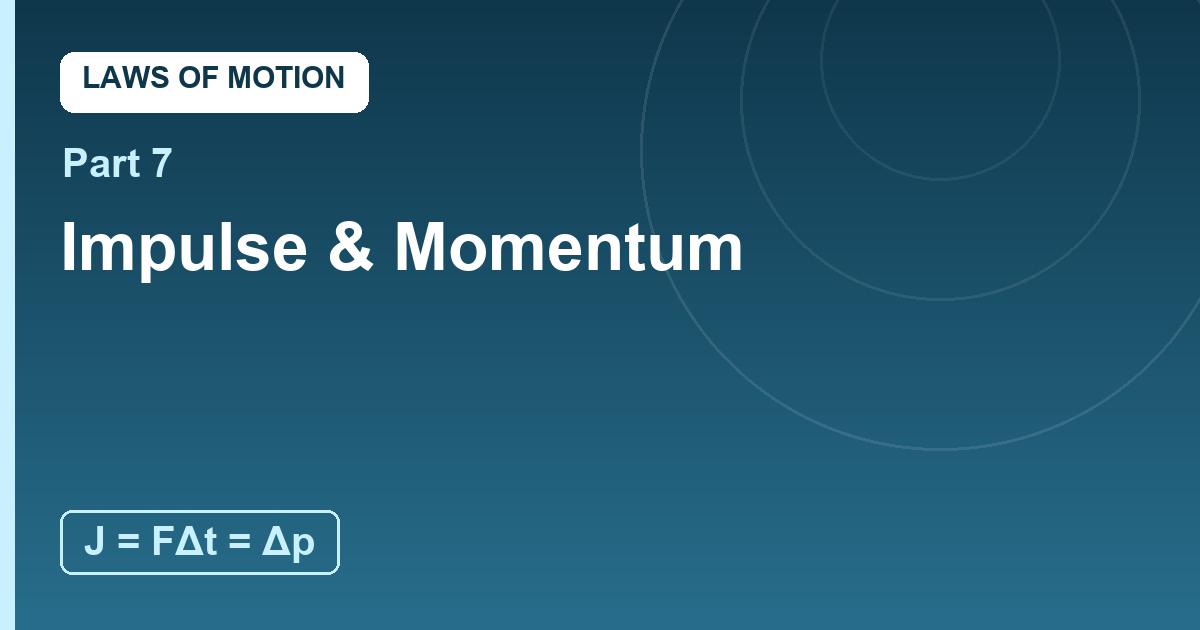
- Impulse J = F × t = Δp — a force acting for a time changes momentum
- Same momentum change: longer time → smaller force (the cushion principle)
- Conservation: with no external force, total momentum of a system never changes
- Newton’s second law’s original form: F = dp/dt
Why do cricketers draw their hands back while catching? Why do airbags save lives? Why do you bend your knees landing a jump? All the same trick: stretch the time, shrink the force. Part 7 of the Laws of Motion series.
- Momentum: motion’s currency
- Impulse: the deposit
- The cushion principle
- Conservation: the unbreakable rule
- Solved examples
- Common mistakes
- This physics in your daily life
- Practice set
- Recap
Momentum: Motion’s Currency
p = mv — mass times velocity, a vector. A 60 kg runner at 8 m/s carries 480 kg·m/s; a 6000 kg truck crawling at 0.08 m/s carries the same amount. Momentum measures ‘how hard it is to stop this’, combining stubbornness (m) with motion (v).
Impulse: The Deposit
| Letter | What it means (plain words) | Value / unit |
|---|---|---|
| p | momentum — the motion currency | kg·m/s, vector |
| J | impulse — momentum delivered | N·s (= kg·m/s) |
| F, Δt | the force and how long it acts | N, s |
The Cushion Principle
The same Δp can be delivered by a big force for a short time (wall) or a small force for a long time (cushion) — J is the product. Cricketers’ backswing, airbags, gym mats, phone cases, egg-drop packaging: all engineer Δt upward to bring F down to survivable size.
Conservation: The Unbreakable Rule
With zero external force, the total momentum of a system never changes — colliding billiard balls, exploding firecrackers, recoiling guns trade it among themselves but the sum stays fixed. This is the mightiest bookkeeping rule in mechanics (and it will return in the Work-Energy series’ collision chapter).
Solved Examples
Δp = 0 − 3 = −3 kg·m/s; F = 3/0.1 = 30 N.
Catch it softly over 0.5 s instead: 6 N — fivefold gentler. ✔
Answer: 30 N (or 6 N with soft hands)
0 = 2v + 0.02(400) → v = −4 m/s backward.
Momentum conservation: before = zero, after must be zero. ✔
Answer: 4 m/s backward
Δp = m(v − u) = 0.5(6 − (−10)) = 8 kg·m/s.
Reversal counts BOTH ways — the sign flip doubles the bookkeeping. ✔
Answer: 8 kg·m/s
- Impulse uses change in momentum, not momentum. J = Δp: a fast ball stopped dead gives more impulse than one deflected slightly.
- Sign errors on rebounds. Reversing velocity flips its sign: Δp spans from −u to +v, the sum of both magnitudes.
- Applying conservation with external forces around. Friction-laden surfaces invalidate it during the crash; gravity perpendicular to motion is usually fine.
- Momentum ≠ kinetic energy. Momentum is conserved in ALL collisions; KE only in elastic ones — different currencies, different rules (Work-Energy series, Part 6).
This Physics in Your Daily Life
- Cricketers’ soft hands — ‘giving’ with the catch doubles or triples the stopping time: the difference between a clean catch and bruised palms.
- Airbags and seatbelt pretensioners — both stretch Δt from milliseconds to tens of milliseconds, dropping peak force below injury thresholds: cushion principle, court-mandated.
- Bending your knees on a jump landing — your leg muscles are the airbag: rigid legs deliver the same Δp in a tenth of the time.
- Egg-drop challenges and packaging foam — engineering Δt is the entire science of shipping fragile goods.
- Rocket propulsion — momentum conservation continuously: throw gas backwards fast, move forwards — the recoil example, running on fuel.
A fixed amount of motion must be removed — that bill (Δp) doesn’t negotiate. But the force is only the RATE of payment: pay over a long time and the rate is gentle; pay instantly and the rate is brutal. Impulse is the bill; force is the EMI. You choose the tenure.
Stop 3 kg·m/s: over 0.01 s → 300 N (hurt); over 0.1 s → 30 N (fine); over 1 s → 3 N (barely felt). The momentum delivered never changed — only the schedule. Every cushioning invention is a point on this curve.
Draw force against time for two catches: a tall thin spike (hard hands) and a short fat hill (soft hands) — the AREAS are identical (same impulse), the peaks wildly different. Safety engineering is the art of reshaping the spike into the hill without losing area.
Practice set (answers hidden — try first)
(NEET-level) 0.1 kg at 30 m/s stopped in 0.2 s: F =
(JEE Main-level) 1 kg at 5 m/s rebounds at 3 m/s: |J| =
(NEET-level) Gun 4 kg fires 40 g at 300 m/s: recoil =
(Concept) Doubling stopping time does what to the force?
(JEE Main-level) Unit of impulse:
- p = mv, the vector currency of motion
- J = FΔt = Δp = area under F-t graph
- cushion principle: longer Δt → smaller F
- no external force → Σp constant
- rebounds: Δp = m(v + u) — both legs count
- 🔁 momentum p = mv (vector)
- 🔁 impulse = Δp = FΔt
- 🔁 cushion principle in daily life
- 🧠 Chant: ‘stretch the time, shrink the force’.
- 🧠 Recoil: ‘gun and bullet split the zero’.
- 🏠 Daily: soft hands, airbags, bent knees — all Δt engineering.
- 🏠 Daily: rockets run on recoil continuously.
Quick revision
- Momentum p = mv — ‘quantity of motion’, a vector (kg·m/s)
- Impulse J = F × t = Δp — a force acting for a time changes momentum
- Same momentum change: longer time → smaller force (the cushion principle)
- Conservation: with no external force, total momentum of a system never changes
- Newton’s second law’s original form: F = dp/dt
- Momentum: motion’s currency
Have a doubt on this topic?