JEE/NEET Physics · Laws of Motion series · Part 2 of 8 · All parts →
- Tension: a rope pulls along its length, same strength at both ends (ideal rope, massless)
- Normal force: a surface pushes perpendicular to itself — its SIZE adjusts as needed
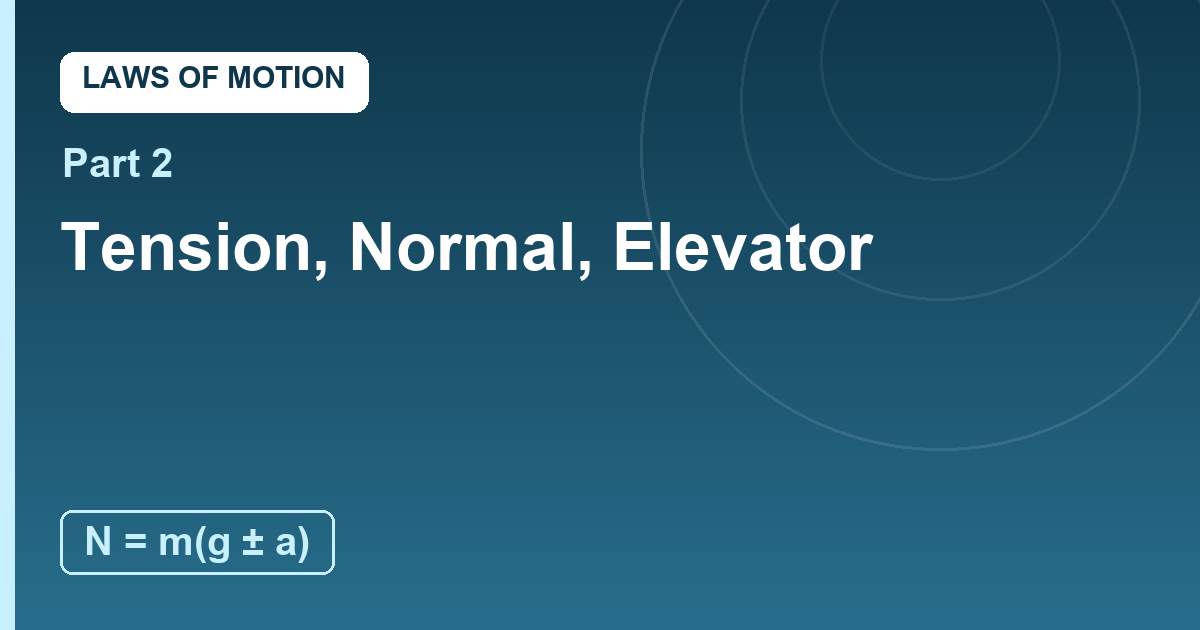
- Elevator going up: N = m(g + a) — you feel heavier; coming down: N = m(g − a)
- Free fall (a = g): N = 0 — weightlessness is just no floor-push
- Apparent weight = the normal force — what the weighing scale actually reads
Stand on a scale in a lift going up and you gain weight; going down you lose it; if the cable snaps the scale reads zero. Your mass never changed — the forces did. Part 2 of the Laws of Motion series.
- Tension: the rope’s message
- Normal force: the floor’s argument
- The elevator problem
- Apparent weight and weightlessness
- Solved examples
- Common mistakes
- This physics in your daily life
- Practice set
- Recap
Tension: The Rope’s Message
A rope can pull, never push (try pushing a dog with a leash). In an ideal (massless) rope the tension is the same at every point and both ends — the rope faithfully transmits a force around corners via pulleys. Its size is whatever the situation demands; you solve for it.
Normal Force: The Floor’s Argument
Press on a table; it pushes back perpendicular (‘normal’) to its surface. Press harder, it pushes harder — a self-adjusting force that grows exactly as needed to prevent you passing through, and no more. On a horizontal surface with no vertical acceleration: N = mg. Tilt the surface and only the component mg cos θ presses in.
The Elevator Problem
| Letter | What it means (plain words) | Value / unit |
|---|---|---|
| N | normal force — the scale’s reading, the ‘apparent weight’ | N |
| a | the lift’s acceleration (signed) | m/s² |
| g | gravity’s pull per kg | 9.8 m/s² down |
Apparent Weight and Weightlessness
The scale never measures mg — it measures the force it must supply: N. Accelerating up, it must supply extra (heavier); accelerating down, it may supply less (lighter); falling with you at g, it supplies nothing at all. Astronauts’ ‘zero gravity’ is really ‘zero normal force’ — perpetual free fall, as the Gravitation series told.
Solved Examples
N = m(g + a) = 50 × 12 = 600 N (vs 500 N at rest).
✔
Answer: 600 N
N = 50 × (10 − 3) = 350 N.
At a = g it would read zero — the cable-cut case. ✔
Answer: 350 N
T − mg = ma → T = 2(10 + 5) = 30 N.
Same elevator logic, tension playing the normal’s role. ✔
Answer: 30 N
- The scale reads mg always. It reads N — only equal to mg when a = 0.
- Constant upward VELOCITY. Cruise speed changes nothing: a = 0 → N = mg. Only acceleration shifts weight.
- Weightlessness = no gravity. Astronauts have ~90% of surface gravity — they feel nothing because nothing pushes them (N = 0 in free fall).
- Tension pointing wrong. Ropes pull ALONG themselves; on an FBD the arrow is away from the body, along the rope.
This Physics in Your Daily Life
- Theme-park drop towers — the stomach-lift is N shrinking toward zero: your organs, like the scale, only feel pushes.
- Aircraft takeoff pushes you into the seat — the seat’s normal force exceeds mg by exactly ma: you weigh more while climbing.
- Flat-bottomed weighing scales lie politely — stand on one in any accelerating lift and you’ll change weight by kilograms without gaining a gram.
- Laundry lines and crane cables — tension is the invisible hand throughout; engineers size every cable by T = m(g+a) with the worst-case jerk.
- Doctors’ hospital bed-lifts are chosen for gentle accelerations: patients feel the g+a and g−a swings that healthy knees ignore.
You don’t feel gravity — you feel the floor stopping you from falling. In free fall there is no floor-push and no feeling at all (astronauts float not because gravity vanished but because nothing resists it). Weight, as felt, is a contact force: the push of whatever holds you up.
Lift up at 2 m/s²: floor must supply mg + ma = 500 + 100 = 600 N — a 20% weight gain you’d swear was real. Down at 5: 250 N — half weight. Cut the cable: 0 N, full weightlessness with gravity still at 100%. Three numbers, one formula, every ride.
Draw the FBD of the lift-rider: weight arrow (mg) down, normal arrow (N) up. Accelerating up → N must out-tug mg: draw N longer. Accelerating down → N shorter. Free fall → N vanishes. The relative lengths of two arrows ARE the felt experience.
Practice set (answers hidden — try first)
(NEET-level) 60 kg, lift up at 1.5 m/s² (g=10): N =
(JEE Main-level) Lift down at g/2: scale reads what fraction of mg?
(NEET-level) Astronauts in the ISS feel weightless because:
(Concept) Lift moving UP at constant 5 m/s: reading =
(JEE Main-level) 5 kg on a rope in lift up at 4 (g=10): T =
- tension pulls along the rope, equal at both ends
- normal ⊥ surface, self-adjusting
- lift up: N = m(g+a); down: m(g−a)
- a = g → N = 0 → weightlessness
- scale reads N, not mg
- 🔁 tension along rope, normal ⊥ surface
- 🔁 N = m(g ± a)
- 🔁 apparent weight = N
- 🧠 Chant: ‘heavier up, lighter down, nothing falling’.
- 🧠 Cruise doesn’t count: constant velocity = normal weight.
- 🏠 Daily: drop-tower stomach lift = N shrinking.
- 🏠 Daily: takeoff pushback into seat = m(g+a).
Quick revision
- Tension: a rope pulls along its length, same strength at both ends (ideal rope, massless)
- Normal force: a surface pushes perpendicular to itself — its SIZE adjusts as needed
- Elevator going up: N = m(g + a) — you feel heavier; coming down: N = m(g − a)
- Free fall (a = g): N = 0 — weightlessness is just no floor-push
- Apparent weight = the normal force — what the weighing scale actually reads
- Tension: the rope’s message
Have a doubt on this topic?