JEE/NEET Physics · Motion in a Plane series · Part 3 of 6 · All parts →
- Launch at angle θ: uₓ = u cos θ (constant), u_y = u sin θ (fights gravity)
- Time of flight T = 2u sin θ / g · Max height H = u² sin²θ / 2g
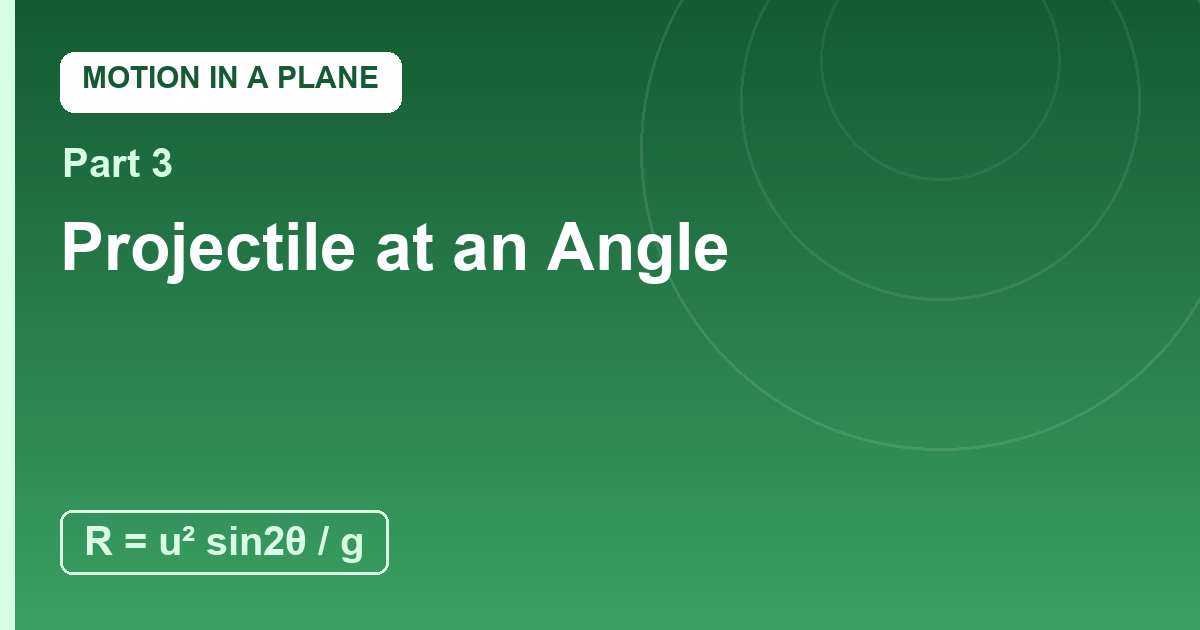
- Range R = u² sin 2θ / g — maximum at θ = 45°
- Complementary angles (30° and 60°) give the SAME range
- At the top: v = u cos θ (horizontal only), a = g downward
A football punt, a cricket lofted drive, a javelin throw, water from a fountain — all the same curve, all run on the same handful of formulas. Launch at an angle is projectile physics in its full glory. Part 3 of the Motion in a Plane series.
- Splitting the launch
- The full toolkit: T, H, R
- The 45° secret and the twin angles
- What happens at the top
- Solved examples
- Common mistakes
- This physics in your daily life
- Practice set
- Recap
Splitting the Launch
Resolve the launch velocity u at angle θ: uₓ = u cos θ rides flat forever; u sin θ climbs, fights gravity, loses, pauses at the top, falls back. Same two-movie trick as Part 2 — only now the vertical movie starts with an upward velocity.
The Full Toolkit
| Letter | What it means (plain words) | Value / unit |
|---|---|---|
| u | launch speed | m/s |
| θ | launch angle above horizontal | degrees |
| T | total time of flight (back to launch level) | s |
| H | maximum height | m |
| R | horizontal range (back to level ground) | m |
The 45° Secret and the Twin Angles
Range R = u² sin2θ/g is biggest when sin2θ = 1, i.e. θ = 45°. And because sin2θ repeats symmetrically, 30° and 60° give identical ranges — one flies low and far, the other high and equally far. Footballers and javelin throwers live between these anchors.
What Happens at the Top
At maximum height the vertical movie pauses (v_y = 0) but the horizontal cruise never stopped: velocity at the top = u cos θ, horizontal, and acceleration is still a full g downward. The peak is a flat instant, not a stop.
Solved Examples
R = u² sin2θ/g = 400 × sin60° / 10 = 400 × 0.866 / 10.
≈ 34.6 m.
✔
Answer: ≈ 34.6 m
T = 2 × 10 × sin45° / 10 = √2 ≈ 1.41 s.
H = 100 × (0.707)² / 20 = 2.5 m.
T ≈ 1.41 s; H = 2.5 m. ✔
Answer: T ≈ 1.41 s; H = 2.5 m
Complementary: 90° − 60° = 30°.
sin120° = sin60° — the sine’s symmetry guarantees it. The 60° shot flies higher, hangs longer, lands identically.
✔
Answer: 30°
- Using sin θ in the range formula. Range carries sin 2θ (double angle!) — sinθ belongs to T and H.
- Height formula vs range formula mix-up. H has sin²θ and 2g; R has sin2θ and g — the exponents and angles differ.
- ‘Velocity is zero at the top.’ Only the vertical part dies; the horizontal u cos θ sails through the peak.
- Forgetting these formulas assume landing at launch height. Cliff-edge landings need the Part 2 method, not the level-ground toolkit.
This Physics in Your Daily Life
- Cricket lofted shots vs drives — a lofted drive launches near 30–40° for distance; the fielder’s throw comes in flatter: same equations, different θ.
- Basketball shooting arcs — a 45–55° launch gives the biggest target margin: the ball drops more vertically onto the rim, geometry forgiving small errors.
- Fountain design — jet speed and angle are chosen so R = u² sin2θ/g lands the water exactly in the basin: municipal decoration as applied ballistics.
- Firefighting nozzles and irrigation sprinklers — range vs height trade-offs tuned by nozzle angle, straight from this card.
- Long jump vs high jump — long jumpers launch ~20° (speed-dominant), high jumpers ~50–60° (height-dominant): the two halves of the sin2θ curve as two Olympic events.
A javelin thrown straight up goes nowhere; thrown flat, it dies at its feet. Somewhere between lies the perfect compromise — enough climb to stay airborne, enough flat push to travel. The geometry of the trade-off peaks exactly at 45°, where climb and push contribute equally.
u = 20 m/s: at 30°, R = 400×sin60°/10 = 34.6 m; at 45°, R = 40 m (the max); at 60°, R = 34.6 m again. And heights: 5 m, 10 m, 15 m — the twins fly to different skies but land on the same mark.
Draw R against θ from 0° to 90°: a symmetric hill peaking at 45°. Every angle on the left has a mirror twin on the right with identical range. The hill’s equation is sin2θ folded over — symmetry made visible.
Practice set (answers hidden — try first)
(NEET-level) u = 10, θ = 45°, g = 10: range =
(JEE Main-level) Same range as a 20° launch: also launch at
(NEET-level) At the highest point, the velocity is:
(JEE Main-level) Doubling u multiplies range by:
(NEET-level) H = u²sin²θ/2g with u = 20, θ = 30°: H =
- uₓ = u cosθ constant; u_y = u sinθ fights g
- T = 2u sinθ/g · H = u² sin²θ/2g
- R = u² sin2θ/g · max at 45°
- complementary angles, same range
- top: v = u cosθ horizontal, a = g down
- 🔁 resolve launch into cruise + climb
- 🔁 three formulas: T, H, R
- 🔁 45° maximum range
- 🧠 Chant: ‘T-one-sine, H-sine-squared, R-double-sine’.
- 🧠 Twin rule: ’30–60 land together; 45 flies farthest’.
- 🏠 Daily: basketball arcs ≈ 50° for a fatter target.
- 🏠 Daily: fountains and sprinklers tune R = u²sin2θ/g.
Quick revision
- Launch at angle θ: uₓ = u cos θ (constant), u_y = u sin θ (fights gravity)
- Time of flight T = 2u sin θ / g · Max height H = u² sin²θ / 2g
- Range R = u² sin 2θ / g — maximum at θ = 45°
- Complementary angles (30° and 60°) give the SAME range
- At the top: v = u cos θ (horizontal only), a = g downward
- The full toolkit: T, H, R
Have a doubt on this topic?