

World Bamboo Day 2026: Key Current Affairs One-Liners for September 18
Good morning, and welcome to the 18 September capsule. Today’s lead observance is World Bamboo Day, and the week’s spine – the Delhi Declaration, the growth print, the ozone anniversary, patient safety – remains one revision away. Twenty-five lines follow, institution-tagged as always. Therefore, read twice, drill once, and close the loop on day three and day seven.
- Today on the Calendar: 18 September
- National Headlines
- International Desk
- Economy Table
- Science and Environment Lines
- Five-Question Drill
- FAQ
- Is bamboo a tree or a grass?
- Does the mission matter for mains?
- The Thirty-Second Recap
- Explain It Simply
- Rapid-Fire
- Abbreviations
- States and Schemes in the Week’s Tail
- Sports and Miscellaneous
- The Editorial Walk
- Closing the Week Like an Editor
- Next Week’s Calendar, Pre-Read
- One Reader’s Habit That Compounds
- The Capsule’s Economics, Briefly
- The Ten-Line Thursday Addendum
- The Final Habit Note
- One Line Forward
- The Bedtime Version
- The Street of Five Doors, Again
- The Walk, Once More with Connectors
- The Abbreviation Echo
- The Capsule in Ten More Numbers
- Key Takeaways
- Related reading
Contents: the bamboo lead, national and international desks, the economy table, science lines, a drill and the closing habit.

Today on the Calendar: 18 September
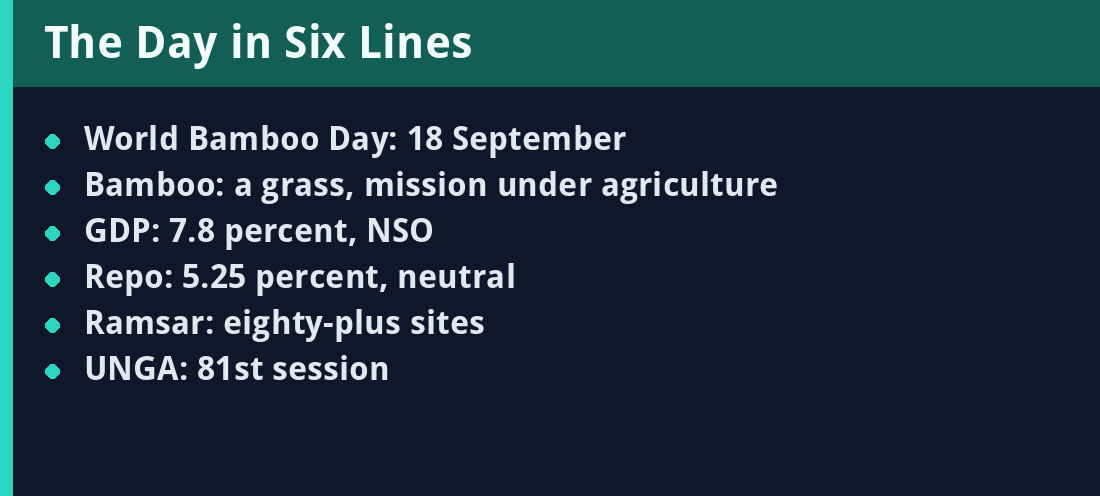
- World Bamboo Day promotes the grass that builds, feeds and binds soil across economies.
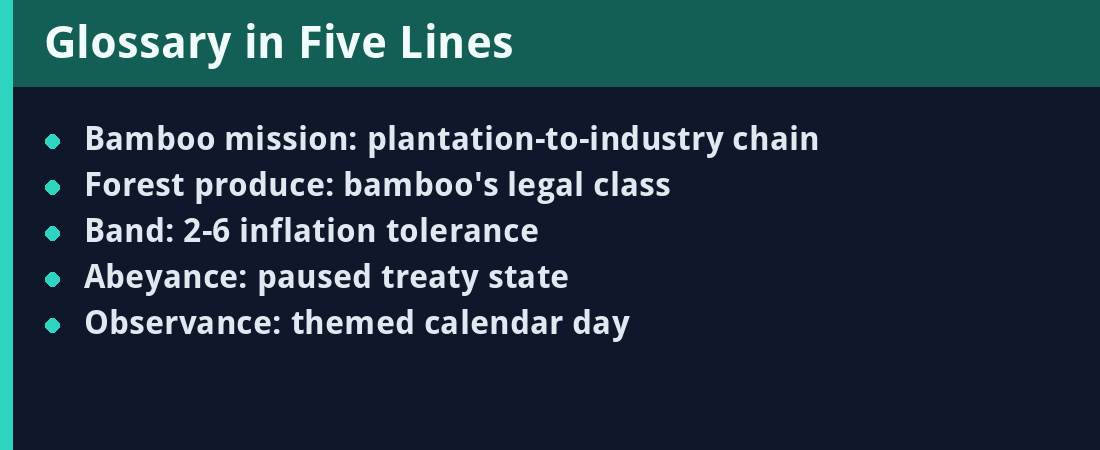
- India’s bamboo mission framework links plantation, industry and income under one umbrella.
- The National Bamboo Mission operates under the agriculture ministry’s structure.
- Bamboo counts as a forest produce for regulation, with state-level harvest rules.
- The day anchors environment-economy crossover questions that prelims loves.
National Headlines
- The Delhi Declaration’s ministerial follow-ups continued through the week.
- Q1 FY27 GDP growth stood at 7.8 percent, the NSO’s strongest first quarter in five years.
- The repo rate held at 5.25 percent with a neutral stance.
- GST 2.0’s first-year analysis kept collections in the headlines.
- The monsoon withdrawal line advanced on IMD schedule.
International Desk
- UNGA’s 81st session carried India’s reform pitch for the Security Council.
- The Indus arbitration track stayed in abeyance through the week.
- Nepal’s flood relief moved India’s disaster-diplomacy pipeline.
- The India-China reset advanced on border-management lines.
- WMO-UNEP assessments kept the mid-century ozone recovery on record.
Economy Table
| Indicator | Reading | Institution |
|---|---|---|
| GDP, Q1 FY27 | 7.8 percent | NSO, MoSPI |
| Repo | 5.25 percent | Six-member MPC |
| Inflation target | 4 percent, 2-6 band | 2016 framework |
| GST year one | Record collections | CBIC |
Moreover, the third column earns the mark, therefore keep pairing numbers with institutions every single morning. Similarly, CPI belongs to the NSO and WPI to the Economic Adviser – the pair that has decided more prelims questions than any coaching slide.

Science and Environment Lines
- Bamboo’s carbon storage and soil-binding roles anchor the mission’s ecology claims.
- Ozone recovery tracks toward 1980 levels by mid-century.
- Ramsar’s Indian register now crosses eighty sites.
- Gaganyaan’s uncrewed tests progressed toward crewed certification.
- The Bharatiya Antariksh Station targets 2035.
Five-Question Drill
- World Bamboo Day falls on: the answer is 18 September.
- The National Bamboo Mission operates under: the answer is the agriculture ministry’s framework.
- India’s Q1 FY27 growth print: the answer is 7.8 percent, from the NSO.
- The repo after the September review: the answer is 5.25 percent, neutral stance.
- CPI is published by: the answer is the National Statistics Office.
One grass, one day, one mission – and three marks quietly attached to the calendar.

FAQ
Is bamboo a tree or a grass?
Botanically a grass, and exam papers love exactly that trap.
Does the mission matter for mains?
The Thirty-Second Recap
Day eighteen. Bamboo leads. Therefore, one grass. One mission. Agriculture ministry home. Moreover, growth stays 7.8. Repo stays 5.25. Ozone heals mid-century. However, tag every number home. NSO. MPC. Adviser. Finally, drill tonight. Revise day seven. The month banks.
Explain It Simply
Today the calendar bows to a giant grass. Bamboo grows fast, holds soil, stores carbon and builds homes, so the government runs a mission around it under the farm ministry. Meanwhile, the economy grew fast too, and the rate team kept its hand still. Therefore, learn today as two stories – a grass that builds, and an economy that holds – and both carry numbers at their gates. When the paper asks, you walk to either gate and read the number aloud.
Rapid-Fire
- World Bamboo Day: 18 September.
- Bamboo botany: a grass, not a tree.
- Mission home: agriculture ministry frame.
- GDP: 7.8 percent, NSO print.
- Repo: 5.25 percent, MPC hold.
- CPI: NSO; WPI: Economic Adviser.
- Ramsar: eighty-plus Indian sites.
- Space station: 2035 target.
- UNGA: 81st session running.
- Ozone: mid-century recovery path.
Abbreviations
- NBM: National Bamboo Mission.
- NSO: National Statistics Office.
- MPC: monetary policy committee.
- IMD: weather office.
- UNGA: General Assembly.
- MoSPI: statistics ministry.
- CBIC: indirect taxes board.
States and Schemes in the Week’s Tail
- Bihar’s survey arithmetic kept reservation debates warm.
- Maharashtra’s electronics incentives advanced further.
- Tamil Nadu’s hydrogen park drew co-financing interest.
- Kerala’s tribal land rules moved through the revenue board.
- Gujarat’s wetland dossier advanced on the Ramsar track.
Sports and Miscellaneous
- The chess double-gold defence reached its last boards.
- Aichi’s relay ran ahead of the 2026 Games.
- Neeraj’s season-best kept the league open.
- BCCI contracts held the A-plus four.
- Santosh entries set a participation record.
The Editorial Walk
Moreover, the week’s editorials clustered on three questions again: the declaration’s payment paragraph, the growth-rate patience argument, and GST 2.0’s report card. Therefore, carry one attributed sentence per cluster into essays and interviews, and the capsule graduates from revision to argument. In addition, editorial vocabulary – calibration, glide, insulation – is mains currency, and ten minutes daily compounds it silently across the cycle’s remaining months.
Closing the Week Like an Editor
Finally, close this capsule week with the index ritual: one sheet, seven lines, one headline per day, spoken aloud once. Consequently, the week leaves evidence, evidence becomes recall, and recall becomes the marks the whole habit serves. However, keep the sheet to one page, because compression is the capsule’s entire point.
Next Week’s Calendar, Pre-Read
Because the series plans ahead, regulars should pre-read the anchors coming: Gandhi Jayanti’s dry-day and sanitation frames, the air quality season’s policy cluster, and World Heart Day on 29 September with its lifestyle-policy angles. Therefore, the capsule’s method – observance first, desks after, drill last – will keep its shape while the calendar turns. Moreover, pre-reading anchors converts surprise into recognition, and recognition is the cheapest memory aid the exam business sells.
One Reader’s Habit That Compounds
A regular of this series reports taping each day’s five lead lines to a mirror, reading them while brushing, and discarding the sheet on day three. Therefore, three exposures across three mornings – read, spoken, glimpsed – carry each line deep, and the cost rounds to zero. Consequently, the habit column matters more than any single capsule, and the series exists precisely to give that habit a daily shape.
The Capsule’s Economics, Briefly
Current affairs succeed or fail as a habit, and habits obey economics: the capsule costs eight minutes and pays back marks across four papers, which is the best exchange rate in this syllabus. However, the return arrives only on the reinvestment schedule – day three and day seven revisits – and skipping the revisits converts an investment into mere reading. Therefore, treat the capsule as a fixed deposit, not a transaction, and let compounding do the quiet work it always does. Moreover, the fortnightly quiz is the maturity date: honour it cold, log the misses, and the statement of account writes itself.
Furthermore, aspirants sharing the habit with a study partner report the strongest adherence, because a promised call at nine is stronger than a private intention at midnight. Consequently, if the capsule has a social life, it survives; if it lives alone in a browser tab, it dies by October. Finally, the series keeps its shape so that your habit never has to renegotiate its terms – the quietest and most valuable service a daily page can render.
The Ten-Line Thursday Addendum
- Bamboo counts among the fastest-growing plants usable as timber.
- India hosts the second-largest bamboo genetic pool after China.
- The mission’s northeast cluster leads plantation acreage.
- Agarbatti and furniture value chains absorb mission output.
- The 2017 ordinance era reclassified bamboo away from tree rules.
- World Bamboo Organisation anchors the observance’s global pitch.
- Skill councils certify bamboo craft trades.
- Carbon-credit frameworks are beginning to price bamboo stands.
- State bamboo policies layer over the central mission.
- UPSC has asked mission-adjacent questions twice since 2018.
The Final Habit Note
Moreover, because Thursday closes the observance week, tonight’s index line should read as one sentence covering all five days – language, engineering, sky, safety, bamboo – and a single spoken sentence that holds five anchors is exactly the retrieval artefact interview boards later mistake for brilliance. Therefore, write it, speak it, and keep the sheet.
One Line Forward
Therefore, tomorrow’s capsule opens the final stretch of September, and regulars should watch for the air-quality anchors the season always brings, because this series reads the calendar a week ahead and so should you.
The Bedtime Version
Today the calendar bows to a giant grass. It grows fast. It holds soil. It builds homes. Therefore, a whole mission farms it under the farm ministry. Meanwhile, the land grew fast too, and the rate team kept its hand still. So learn the day as two stories with numbers at their gates: eight for growth, five and a quarter for the loan rate. Then, when the paper asks, you walk to a gate and read the number aloud.
The Street of Five Doors, Again
Walk the week once more, in short words. One door loves the tongue. One door builds bridges. One door guards the sky. One door keeps the ward safe. One door farms the grass. Each door has a number on its plate. Say them as you pass: eight for growth, five and a quarter for the loan rate, eighty for the wetland list, two thousand and eighty seven for the sky pact. Therefore, when the paper asks for any plate, you walk your own street and read it out loud, and the whole week banks itself in one breath.
The Walk, Once More with Connectors
However tired the week felt, the street stands. Moreover, five doors stay shut till the quiz opens. Therefore, walk it once more now. First, the tongue door, however briefly. Then the bridge door, moreover with its slide rule. Next, the sky door, therefore with its treaty year. In addition, the ward door keeps its theme. Finally, the grass door banks the day. However, one rule binds the walk: no plate read twice in one breath. Moreover, the breath ends at the mission’s gate. Therefore, the street is done, and the week is banked, however the paper may dress it tomorrow.
The Abbreviation Echo
- The NBM, NSO, MPC, IMD, CBIC, UNGA and WMO set owns this capsule.
- The PIB and MoSPI twins source every line the RBI does not.
The Capsule in Ten More Numbers
- Bamboo day: 18; patient day: 17; ozone day: 16.
- Growth: 7.8; repo: 5.25; target: 4 with band 2 to 6.
- Ramsar: 80-plus; UNGA: 81; station: 2035.
- Treaty year: 1987; GST 2.0: year 1; MPC: 6 members.
- The RBI, NSO, MPC, WMO, IMD, CBIC and NBM acronyms carry all of it.
Key Takeaways
In conclusion, this capsule leads with bamboo and closes the week’s spine: growth, rates, ozone and the declaration, each tagged home. To summarize, one grass, three numbers, two indices and one mission carry the day. Therefore, finish the drill tonight and keep the fortnight index current.
References: agricoop.nic.in for the mission frame, pib.gov.in, rbi.org.in and mospi.gov.in releases.
Related reading
- Current Affairs September 18, 2026: Daily Exam Digest with Static Linkages for UPSC & SSC
- Current Affairs One-Liners: September 18, 2026 — Quick Revision Points for UPSC, SSC, Banking and CLAT
Quick revision
- World Bamboo Day promotes the grass that builds, feeds and binds soil across economies.
- India’s bamboo mission framework links plantation, industry and income under one umbrella.
- The National Bamboo Mission operates under the agriculture ministry’s structure.
- Bamboo counts as a forest produce for regulation, with state-level harvest rules.
- The day anchors environment-economy crossover questions that prelims loves.
- The Delhi Declaration’s ministerial follow-ups continued through the week.
Have a doubt on this topic?