SSC CGL Tier-1 Answer Key, Normalization and Tier-2 Preparation Roadmap
Your SSC CGL Tier-1 is done, and the next forty-eight hours decide whether momentum continues or leaks away. This page maps the entire post-exam corridor: the answer-key timeline, how normalization actually works, the result arithmetic, and the Tier-2 pattern with a preparation plan that starts this week. Therefore, read it once tonight and once after the provisional key drops.
- The Answer-Key Lifecycle
- Normalization, Explained Simply
- The Tier-2 Pattern at a Glance
- Paper One: The Compulsory Paper
- Specialist Papers
- Week-One Plan After the Exam
- Cutoff Arithmetic Without Anxiety
- FAQ for the Anxious Hours
- When should I start Tier-2 preparation?
- Do challenges ever change scores?
- Is typing practice necessary for all posts?
- Tier-2 Preparation in Depth
- The Mathematical Abilities Module
- The English Module
- The General Awareness and Computer Modules
- The Skill Module Deserves Respect
- Managing the Long Corridor Psychologically
- A Sample Weekly Grid for the Tier-2 Corridor
- Tracking Without Obsession
- The Community Advantage
- The Result-Day Itself
- In Short: The Plain-English Summary
- Glossary in Five Lines
- The Thirty-Second Recap
- Explain It Simply: The Long Corridor for a Twelve-Year-Old
- SSC Rapid-Fire: Ten Facts in Ten Lines
- The One-Breath Version
- Abbreviations for the Post-Exam Corridor
- Words From This Page Worth Keeping
- The Corridor by Numbers
- Key Takeaways
SSC CGL Tier-1 Morning Rapid Revision: 25 High-Yield Facts Before the Bell
Contents: answer-key lifecycle, normalization explained simply, cutoff arithmetic, Tier-2 pattern tables, a week-one preparation plan, and a FAQ for the anxious hours.
The Answer-Key Lifecycle
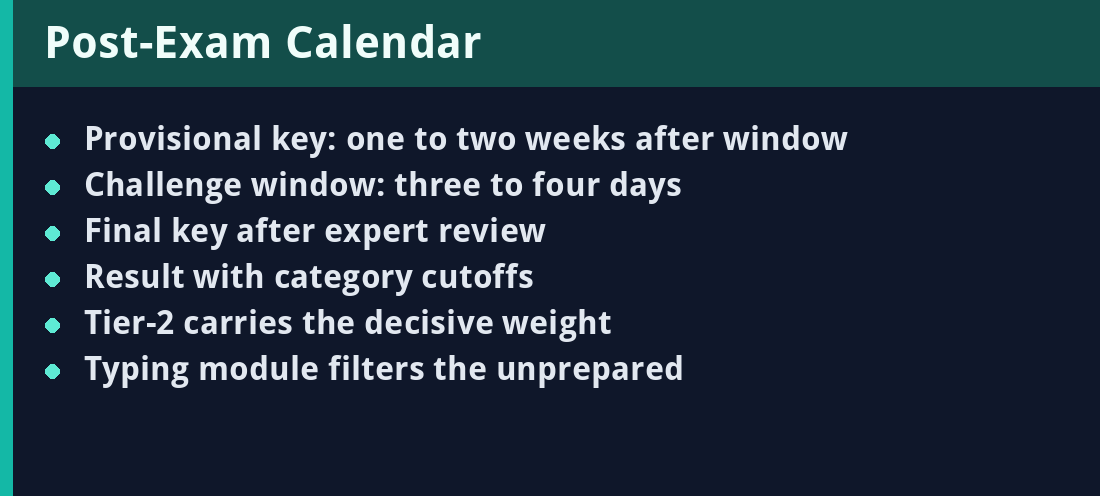
- Provisional answer keys typically release within one to two weeks of the exam window closing.
- A challenge window of three to four days invites objections with a small refundable fee per question.
- Final keys arrive after expert review, and locked scores then stand for the result.
- Results follow in sheet form with roll numbers and category cutoffs.
Moreover, save your question paper and response sheet the day they release, because every later calculation depends on them. Consequently, the first post-exam task is archiving, not celebrating or worrying. Meanwhile, genuine memory-based keys from coaching sites help you estimate within a day, however treat those estimates as provisional by definition.
Normalization, Explained Simply
Multiple shifts mean multiple papers of slightly different difficulty, therefore the commission applies an equi-percentile method: scores are converted to percentiles within each shift and mapped onto a common scale. Consequently, a harder shift does not structurally penalise its candidates. However, normalization moves scores modestly, not dramatically, therefore an honest attempt count remains the best predictor of your standing.
| Stage | What Happens | Your Action |
|---|---|---|
| Exam window closes | Response sheets archived | Download and store |
| Provisional key | Marking published | Verify, note challenges |
| Challenge window | Objections invited | Submit only with proof |
| Final key | Adjustments locked | Compute final estimate |
| Result | Cutoffs declared | Begin Tier-2 same week |
The Tier-2 Pattern at a Glance
Paper One: The Compulsory Paper
- Session one covers mathematical abilities and reasoning together.
- Session two covers English language and general awareness.
- Session three covers computer knowledge and the typing or skill test.
- Penalties run at one mark per wrong answer in most objective modules, with half-mark deductions in the skill module.
Specialist Papers
- Paper two serves the statistical investigator route with statistics questions.
- Paper three serves the assistant audit officer route with finance and economics.
- Most posts, however, need only paper one excellence.
Consequently, your post preference list should respect which papers your profile must clear. Moreover, Tier-2 carries far more weight than Tier-1 in the final merit, therefore preparation restarts immediately, not after the result. Meanwhile, typing-test practice belongs in week one for every candidate, because the skill module quietly filters the unprepared.
Tier-1 earns the ticket; Tier-2 decides the seat.
Week-One Plan After the Exam
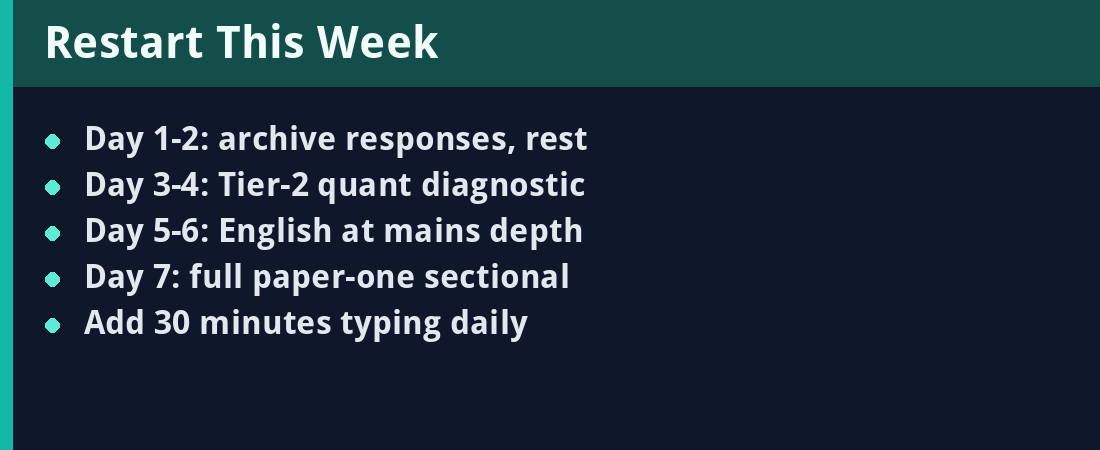
- Day 1-2: archive responses, attempt memory-based estimates, and rest deliberately.
- Day 3-4: restart quant with the Tier-2 syllabus map and one diagnostic set.
- Day 5-6: begin English vocabulary and grammar drill at mains depth.
- Day 7: take one full Tier-2 paper-one sectional and log the gap.
Furthermore, add thirty minutes of typing practice daily from day three, because the skill module rewards accumulated weeks, not last sprints. As a result, the dangerous post-exam vacuum converts into a head start over candidates who wait for results to begin.
Cutoff Arithmetic Without Anxiety
Expect the general cutoff for Tier-1 qualification to sit in the usual band suggested by recent cycles, adjusting a few marks for vacancy count and shift difficulty. Therefore, estimate your normalized score honestly, compare with the last two cycles, and hold two plans: continue preparation either way, with intensity decided by your buffer. However, avoid daily cutoff speculation threads, because they manufacture anxiety without information. In addition, remember that Tier-2 weightage means even borderline Tier-1 survivors convert strong finishes into selections.
FAQ for the Anxious Hours
When should I start Tier-2 preparation?
This week, unconditionally, because the syllabus rewards accumulated months rather than final sprints.
Do challenges ever change scores?
Yes, when questions carry demonstrable errors, therefore challenge with citations rather than hope.
Is typing practice necessary for all posts?
For every post evaluated under the skill module, yes, and early starters score it free.
Tier-2 Preparation in Depth
The Mathematical Abilities Module
- Advanced arithmetic: compound topics like mixtures, partnerships and mensuration join the prelims base.
- Algebra and geometry return at mains depth, with coordinate basics.
- Trigonometry extends to identities and heights-distance applications.
- Data interpretation doubles in weight relative to prelims.
Consequently, the module rewards candidates who rebuild from concepts instead of piling shortcuts, because question stems twist familiar setups. Therefore, allocate the largest weekly block here, roughly half of all study hours through the result month.
The English Module
- Vocabulary at mains depth: idioms, phrasal verbs and cloze collocations.
- Error spotting across full paragraphs rather than single lines.
- Reading comprehension with inference-heavy question stems.
- Active and passive voice plus direct-indirect narration return consistently.
The General Awareness and Computer Modules
General awareness under Tier-2 leans on current affairs from the full examination year plus static staples, therefore continue the daily one-liner habit without pause. Meanwhile, the computer module tests fundamentals: hardware basics, office applications, internet protocols and networking vocabulary. Consequently, two weeks of structured computer basics suffice for most candidates, however verify with the official syllabus document each cycle.
The Skill Module Deserves Respect
The typing or data-entry-speed module filters more candidacies than its marks suggest, because qualifying thresholds are absolute rather than relative. Therefore, practise on the exact passage format the commission describes, maintaining accuracy above raw speed initially. Moreover, thirty-minute daily sessions for eight weeks typically clear the threshold comfortably for regular typists. In addition, schedule typing at the same clock hour daily, since muscle memory respects routine.
Managing the Long Corridor Psychologically
The gap between Tier-1 and Tier-2 spans months, therefore momentum management becomes a skill in itself. Firstly, fix a weekly rhythm rather than daily heroics, because sustainable beats spectacular across a marathon. Secondly, join a serious peer group or test series for calibration, since isolation distorts self-assessment. Finally, reserve one rest evening weekly without guilt, because recovery is part of the training architecture, not a deviation from it.
A Sample Weekly Grid for the Tier-2 Corridor
| Day | Morning Block | Evening Block |
|---|---|---|
| Monday | Math module: algebra | Typing 30 minutes |
| Tuesday | Math module: geometry | English vocabulary |
| Wednesday | DI practice sets | Typing 30 minutes |
| Thursday | Math module: arithmetic | Computer basics |
| Friday | English grammar and RC | Typing 30 minutes |
| Saturday | Full paper-one sectional | Complete review |
| Sunday | Current affairs revision | Rest evening |
Moreover, treat the grid as a floor rather than a ceiling: busy weeks execute the floor, free weeks extend blocks, and no week renegotiates the Saturday sectional. Consequently, twelve such weeks through the result corridor build the Tier-2 base while others wait for cutoff news to begin.
Tracking Without Obsession
Keep exactly three numbers weekly: sectional score, typing accuracy, and error-log additions. Firstly, the sectional score tracks output. Secondly, typing accuracy predicts the skill module. Thirdly, error-log growth tracks input quality, since shrinking logs with rising scores signal genuine progress. However, daily score-watching distorts mood without adding information, therefore the weekly triplet stays the only dashboard.
The Community Advantage
Preparation corridors reward candidates plugged into serious peer groups, because calibration beats isolation every cycle. Therefore, join a test series community or a study circle where sectional scores are shared weekly, and let the distribution locate your true level. Moreover, teaching one topic weekly to a peer converts passive knowledge into exam-ready articulation, a benefit boards later recognise in interviews. Consequently, the corridor months build not only marks but the professional network that survives the examination itself.
Furthermore, guard the group’s tone: speculation threads about cutoffs and paper leaks drain attention without returning anything, therefore mute them deliberately. As a result, your information diet stays clean, and clean inputs compound across the months that decide selections.
The Result-Day Itself
When the result arrives, execute a fixed script: check the roll number, screenshot the status, and begin the same evening’s study block regardless of outcome. Therefore, celebration and disappointment both wait for the weekend, while the corridor plan simply continues. Moreover, selected candidates immediately download the detailed scheme of examination and block a fresh diagnostic for the following Sunday. Consequently, the day that ends one exam quietly begins the next, which is how serious careers are actually built in this examination system.
In addition, document your corridor weeks lightly: one weekly paragraph recording what worked, what drained, and what changed. Therefore, when interviews later ask about long preparation arcs, you own a written record rather than a blur, and the habit itself signals the administrative discipline every government role eventually demands.
Finally, keep one printed copy of the week-one plan inside your study folder, because paper plans outperform phone notes during the low-motivation weeks that every corridor contains. Therefore, the grid you can see is the grid you will run.
In Short: The Plain-English Summary
In short, the exam ends but the corridor starts. Therefore, archive your response sheet first. The key follows in a week or two. Challenges need proof, not hope. However, preparation restarts now. The typing module filters the unprepared. Moreover, the weekly grid holds the months together. As a result, the result day finds you mid-sprint. Finally, keep three numbers weekly. That is the framework in plain words.
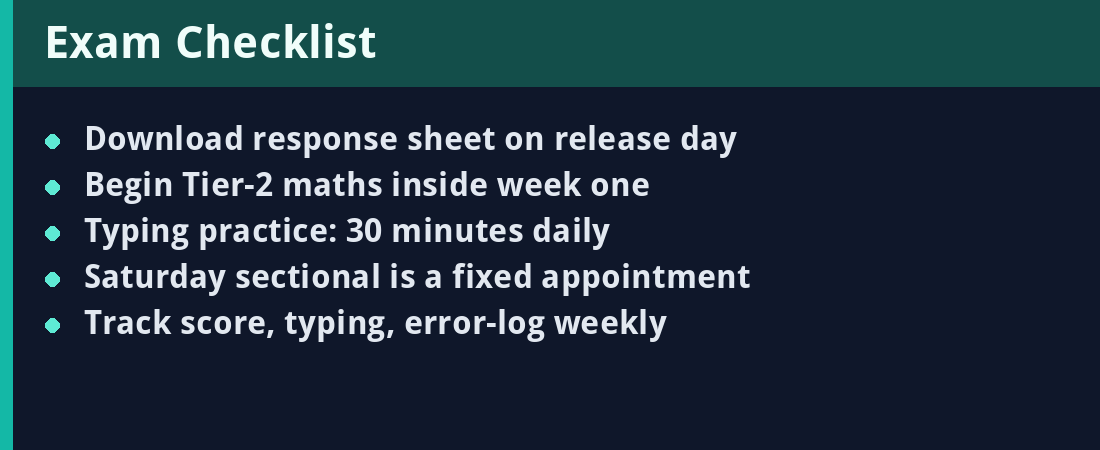
- Download response sheet on release day
- Begin Tier-2 maths inside week one
- Typing practice: 30 minutes daily
- Saturday sectional is a fixed appointment
- Track score, typing, error-log weekly
Glossary in Five Lines
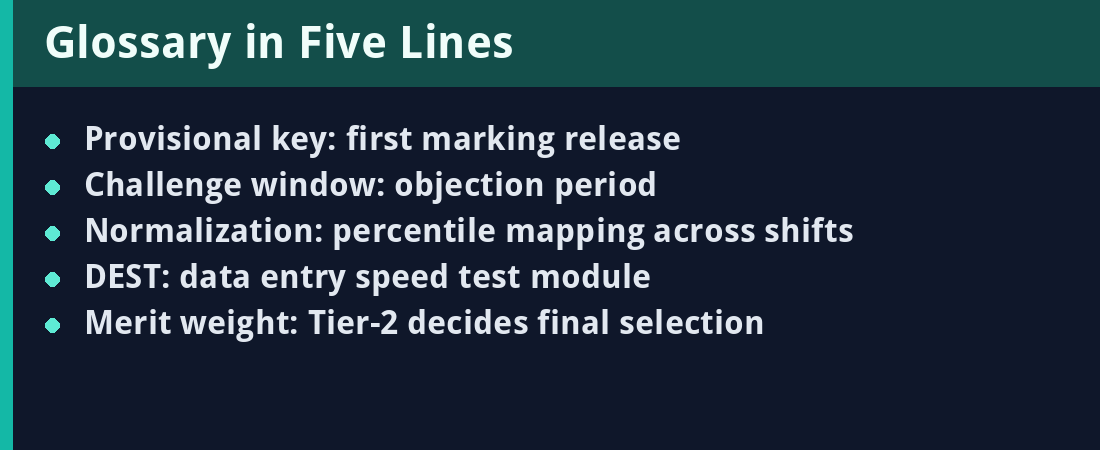
- Provisional key: first marking release
- Challenge window: objection period
- Normalization: percentile mapping across shifts
- DEST: data entry speed test module
- Merit weight: Tier-2 decides final selection
The Thirty-Second Recap
One corridor. Many weeks. Therefore, archive first. The key will come. Challenges need proof. However, preparation restarts now. Maths this week. Typing daily. Moreover, keep the Saturday sectional sacred. Track three numbers weekly. As a result, the result finds you mid-sprint. Finally, the seat goes to the steady. Be steady.
Explain It Simply: The Long Corridor for a Twelve-Year-Old
Your first exam is done, like the first lap of a long race. Now comes a wait. In a week or two, the exam board shows you its answer sheet. You can say, “I think this answer is wrong,” but you must show proof from a book. If your point is right, they fix it. Then the final sheet comes, and after that, the list of names. However, the smart runners do not stand still while they wait. They start running the next lap the same week.
The next lap is a bigger exam. It has more maths, more English, some computer facts, and a typing test. The typing part is like a music exam: your fingers learn by daily practice, not by one mad day at the end. Therefore, type a little every day. Moreover, keep one day each week for a full trial run at home, with a clock and no phone. In addition, write down three numbers each week: your score, your typing speed, and your list of slips. Finally, when the names come out, you will already be in form. The ones who waited will just be starting.
SSC Rapid-Fire: Ten Facts in Ten Lines
- Provisional key window? One to two weeks after the exam.
- Challenge window? Three to four days with proof.
- Normalization method? Equi-percentile across shifts.
- Tier-2 decisive paper? Paper one, compulsory for all.
- Penalty in objective modules? One mark per wrong answer.
- Typing practice? Thirty minutes daily, eight weeks.
- Weekly fixed test? Saturday sectional at exam timing.
- Track how many numbers? Three: score, typing, error log.
- Specialist papers? Two for statistics, three for finance.
- When to restart? This week, not after the result.
The One-Breath Version
One lap is done. More laps remain. The board will show its answer sheet soon. You may point out errors, but with proof. However, do not wait to train. The next exam is longer and wider. It has more maths, more English, a computer part, and a typing test. Therefore, start this week. Type a little each day. Keep one full trial each week with a clock. Moreover, write down three numbers: your score, your speed, and your slips. Finally, when the list of names comes, you will already be in full stride.
Abbreviations for the Post-Exam Corridor
- SSC: the Staff Selection Commission, the exam conductor.
- CGL: the Combined Graduate Level examination itself.
- OMR: the response sheet you must archive on release day.
- DEST: the data entry speed test inside the Tier-2 skill module.
- JSO: the statistical investigator route via Paper two.
- AAO: the assistant audit officer route via Paper three.
- RTI: the transparency route for any document dispute.
- DOP: the personnel nodal ministry for appointments.
- DoPT: the Department of Personnel and Training, the nodal ministry for appointments.
- CHSL: the sister SSC exam whose calendar often overlaps the CGL corridor.
- NIC: the network backbone behind commission portals.
Words From This Page Worth Keeping
- Corridor: the long months between two exam stages.
- Cadence: the weekly rhythm that keeps preparation alive.
- Diagnostic: a mock that reveals, not merely rates.
- Calibration: matching your level against serious peers.
- Buffer: the spare marks and spare weeks that absorb shocks.
- Plateau: the flat weeks where only review moves you.
- Arbitrage: gaining rank while others rest on results.
- Discipline: the only strategy that survives the corridor.
The Corridor by Numbers
- Tier-1 held: 100 questions, 200 marks, 60 minutes.
- Provisional key: 1 to 2 weeks after the window; challenge: 3 to 4 days.
- Paper-one objective modules: 1-mark penalty per error; skill module: 0.50.
- Typing practice: 30 minutes daily across 8 corridor weeks.
- Weekly grid: 6 study days, 1 sectional, 3 tracked numbers.
- Specialist routes: Paper 2 for statistics, Paper 3 for finance.
Key Takeaways
In conclusion, the post-Tier-1 corridor is administrative first, psychological second, and strategic always: archive everything, understand normalization calmly, and restart Tier-2 preparation inside a week. To summarize, the answer key follows its own calendar while your calendar should ignore it. Therefore, begin paper-one preparation now, add typing daily, and let the result find you already mid-sprint.
References: ssc.gov.in official notices for keys and timelines, and the commission’s scheme of examination document for pattern authority.
Quick revision
- Provisional answer keys typically release within one to two weeks of the exam window closing.
- A challenge window of three to four days invites objections with a small refundable fee per question.
- Final keys arrive after expert review, and locked scores then stand for the result.
- Results follow in sheet form with roll numbers and category cutoffs.
- Session one covers mathematical abilities and reasoning together.
- Session two covers English language and general awareness.
Have a doubt on this topic?