- 1. The Countdown Card: What Is Confirmed
- 2. The Pattern Card (per the official xatonline.in 2026-cycle page)
- 3. The Notification-Verification Checklist (Every October)
- 4. The 17-Week Plan (CAT-Overlap Built In)
- 5. The Score-Splitter Behaviours (95 versus 99)
- 6. How Exams Probe This Card
- The Day-Of Run-Card
- Section Strategies in Brief
- Is GK part of the percentile?
- How many mocks are enough?
- 7. Quick Revision: One-Glance Facts
- Practice Corner: Five XAT Checks (with Answers)
- The Three Classic Traps (Where Beginners Slip)
- Frequently Asked Questions
- Is XAT tougher than CAT?
- Who accepts XAT besides XLRI?
- When should a working professional start?
- What if the pattern changes in the notification?
- How many mocks are enough?
- Read more: XAT Part 1: Pattern Decoded · Learn more: 83 Days to CAT 2026 Related Exam Guides
XAT 2027 Registration Live: Exam on January 3
Can one exam section move your percentile fastest?
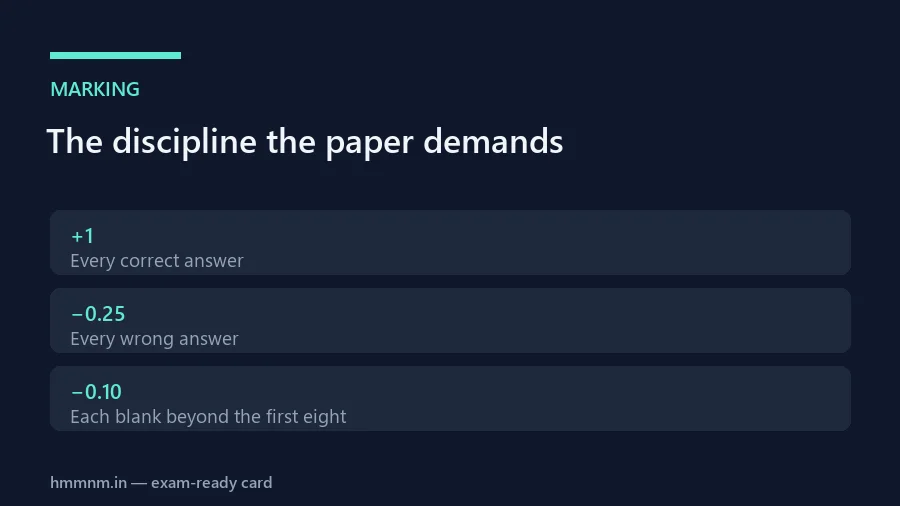
+1 per correct answer, −0.25 per wrong answer, and −0.10 per unattempted question beyond the first eight — the marking discipline the paper demands.
In one line: XAT 2027 — registration live, exam on Sunday 3 January 2027 — the countdown card, in one read.
Related: XAT Part 1: Pattern — Decision Making and the Essay
The season’s second door is open. CAT ends the November Sunday. XAT opens the January one. And for the aspirant who has built CAT discipline, it is the cheapest percentile upgrade in the calendar: one signature section (Decision Making) that rewards preparation faster than any other section anywhere, because almost nobody prepares it. This card is the 2027-cycle briefing: what is confirmed, what to verify, and what to do with the seventeen weeks the calendar has left.
.
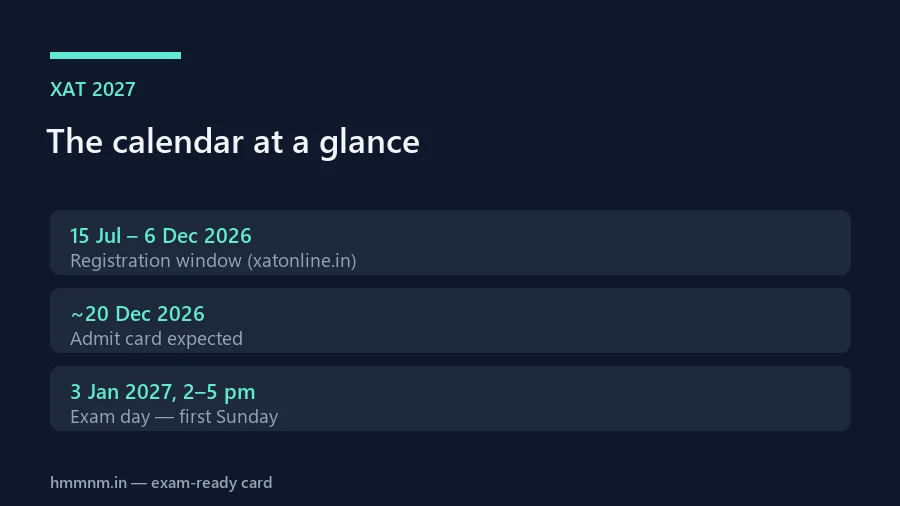
1. The Countdown Card: What Is Confirmed
| Milestone | Date | Status |
|---|---|---|
| Registration opens | 15 July 2026 | Live now (xatonline.in) |
| Registration closes | 6 December 2026 | ~13 weeks away |
| Admit card | ~20 December 2026 (tentative) | Verify on notification |
| XAT 2027 exam | Sunday, 3 January 2027, 2:00–5:00 pm | Confirmed |
| Conduct | XLRI Jamshedpur (on behalf of XAMI) | Confirmed |
| Results | Late January 2027 (expected) | Verify |
From the morning of 8 September 2026: 117 days — a shade under 17 weeks. To exam day. The registration window outlasts the CAT result for most takers; the discipline that decides the score, though, is built now, not after CAT results.
.
The house caution, repeated every cycle: XAT tweaks its pattern annually. Dates above are from the official portal; everything in Section 2 carries the notification’s authority, not this card’s.
2. The Pattern Card (per the official xatonline.in 2026-cycle page)
Part 1 — 170 minutes, ~75 questions, one composite clock, three sections:
- Verbal Ability & Logical Reasoning (~26 questions): denser, more
inferential RC than CAT’s, plus critical reasoning-and-parajumbles; the poem-and-abstract passages that surprise first-timers.
- Decision Making (~21 questions): the signature — situational
judgment, stakeholder dilemmas, managerial choice.
- Quantitative Aptitude & Data Interpretation (~28 questions):
arithmetic-and-geometry weighted like CAT with a wider spread (number systems, higher-maths flavour, DI sets).
Part 2 — 10 minutes: General Knowledge, ~20 questions (8 static + 12 current-affairs), no negative marking in this part; XLRI uses GK scores at the final-selection stage rather than for the percentile.
Marking (Part 1): +1 per correct answer, −0.25 per wrong answer, and −0.10 per question left unattempted beyond the first 8. The unattempted penalty most CAT-trained candidates forget to budget for. PwD candidates get 20 more minutes per hour.
.
The essay: the current official pattern page does not list an exam-day essay, consistent with its recent post-shortlist placement. But the stage has shifted before, so the 2027 notification decides (the Section 3 checklist carries it). Total paper: ~95 questions across 180 minutes.
.
The strategic read: no sectional locks in Part 1 means the paper is a budget-of-minutes problem. And DM is the section where an hour of method (Part 2 of our series) moves percentile fastest, because the field enters it untrained.
.
3. The Notification-Verification Checklist (Every October)
Print this, tick it when the official notification lands:
- [ ] Total duration and any sectional-time introduction
- [ ] Section-wise question counts and marks
- [ ] Essay: stage (exam-day versus post-shortlist) and word limit
- [ ] GK: restored or absent
- [ ] Negative marking scheme and any change from −0.25
- [ ] Eligibility-and-final-year rules
- [ ] XLRI programme-wise cut-off announcement pattern
- [ ] Test-city list (choose early — allocation is first-come)
4. The 17-Week Plan (CAT-Overlap Built In)
Weeks 1–6 (Sep–mid-Oct): ride the CAT lane. Quant-and-RC preparation is 70–80% shared (Part 8 of the XAT series); nothing XAT-specific yet except one habit — read one dense editorial a day at CAT pace for the VALC gap.
Weeks 7–10 (mid-Oct–Nov): add DM, one hour a day. Official past papers only (XAT’s DM answers are a house style. Third-party keys teach the wrong instinct). The framework: stakeholders listed, options scored on harm, the “and-then-what” test per option — Part 2’s method, drilled on 2015-onward papers.
.
Weeks 11–13 (November): CAT week honored, then pivot. Sit CAT; take two days off; then the pivot week. Full-length XAT mocks begin (December’s 6th is the registration deadline: register before the CAT result, not after it — city allocation is the quiet reason).
.
Weeks 14–17 (December): the XAT block. Six to eight full-length mocks, section-order experiments frozen by mock five; the −0.25 accuracy rule enforced per attempt-log; one essay per weekend for the post-shortlist stage; admit card ~20 December; the last week on revision-and-sleep, not new topics.
5. The Score-Splitter Behaviours (95 versus 99)
- DM tried first at high accuracy (the trained candidate’s
advantage), not left as the exam’s leftovers.
- VALC passages pre-read for structure (the inferential load demands
it), with tone-and-implication questions banked before detail questions.
- The −0.25 respected as CAT’s discipline AND the unattempted rule
budgeted (−0.10 each beyond 8 blanks — leave a blank only when elimination has truly failed, never by accident).
- A pre-committed minute-budget (say 55/55/55 with buffer), written on
the rough sheet in minute one.
6. How Exams Probe This Card
- Current-affairs-and-GK papers ask the dates (registration window,
exam day, conducting body).
- Aspirant-forum confusions this card settles: sectional locks (none),
GK (off exam-day), essay stage (post-shortlist, verify), negative marking (−0.25).
- The percentile maths: DM’s score-to-percentile conversion is the
friendliest — the section to over-invest in, per Part 1’s analysis.
Part 1 (170 min): VALR 26 + DM 21 + QA&DI 28 = ~75 Qs
Part 2 (10 min): GK ~20 Qs, no negative marking
marking: +1 / −0.25 / −0.10 per blank beyond 8
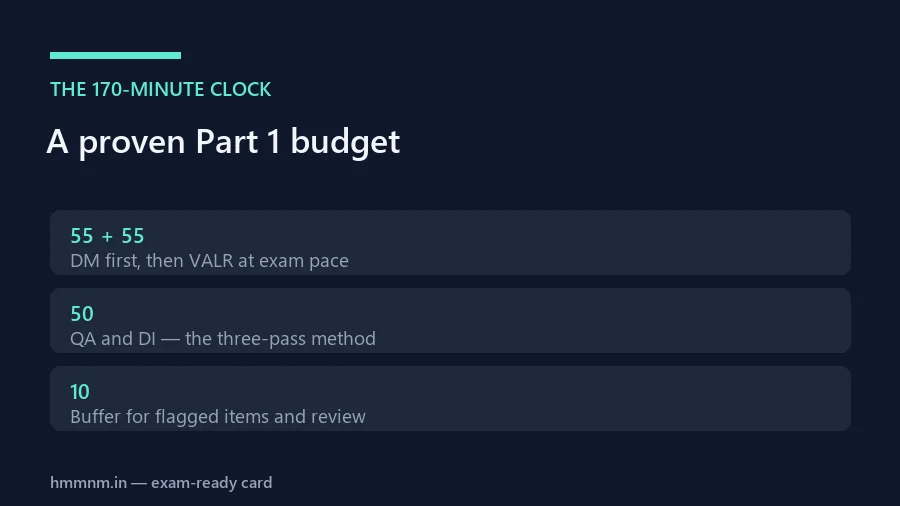
The Day-Of Run-Card
Minute one: write the budget on the rough sheet before the section
loads. A proven split for the 170-minute clock is 55 for Decision
Making first, 55 for Verbal and Logical Reasoning, 50 for Quantitative
Ability and Data Interpretation, and a 10-minute buffer to revisit
flagged items. Freeze this order by the fifth mock; exam morning is
for execution, not invention.
The attempt discipline in one line: read every question, attempt in
two passes, and leave a blank only after elimination has truly failed.
The unattempted penalty means a wild guess and a blank cost almost the
same on expectation, but a two-option elimination converts the same
guess into a positive-expectation bet. Count your blanks at the
30-minute and 100-minute marks; beyond eight, every extra blank is a
quiet donation of marks.
Between sections, the Part 2 GK block is a 10-minute sprint with no
negative marking: attempt all twenty, spend no more than thirty
seconds per question, and bank the minutes your mind needs before the
result screen. The exam rewards temperament as much as preparation;
the run-card exists so temperament has nothing left to decide.
Section Strategies in Brief
Verbal and Logical Reasoning first, or second — the choice is yours,
and the clock is one. Read the passage stem before the passage; the
questions on tone and inference reward a map of the argument, not a
photograph of its words. Parajumbles pay rent: fix the fixed pronoun
and opener, then place the rest. Poem passages reward patience; treat
the lines as evidence and the options as claims.
Decision Making is a scoring machine once you learn its grammar.
List the people affected, rank the harms, prefer options that fix the
cause over options that hide it, and distrust any choice that simply
moves the problem to a quieter desk. The paper rewards the option a
careful manager would defend in a room, not the one that sounds kind
in a hurry.
Quant and Data Interpretation reward selection above skill at the
margin. Three passes: the sitters first, the familiar forms second, the
time traps never. Arithmetic and geometry carry the paper; a modern
maths area shows up once or twice and is a choice, not a duty. In each
set, read the units, the axis and the legend before the numbers — most
DI errors are reading errors wearing a maths costume.
Is GK part of the percentile?
No — the ten-minute block feeds the XLRI selection stage rather
than the percentile, and it carries no negative marking. Attempt all
twenty; the section is a free throw, not a final shot.
How many mocks are enough?
Six to eight full papers after CAT, with the order frozen by the
fifth. Review beats volume: one paper replayed with the run-card in
hand teaches more than three fresh papers taken on autopilot.
7. Quick Revision: One-Glance Facts
| Item | Line |
|---|---|
| Exam | Sunday, 3 January 2027, 2:00–5:00 pm |
| Registration | 15 July – 6 December 2026 (xatonline.in) |
| Body | XLRI Jamshedpur |
| Sections | VALR ~26 · DM ~21 · QA&DI ~28 (Part 1, 170 min) |
| Part 2 | GK ~20 questions, 10 min, no negative marking |
| Marking | +1 · −0.25 wrong · −0.10 per unattempted beyond 8 |
| Locks | No sectional time locks — one composite clock |
| Essay | Stage shifted in past cycles — the 2027 notification decides |
| Countdown | 117 days from 8 September 2026 |
Practice Corner: Five XAT Checks (with Answers)
- XAT 2027 falls on which Sunday? 3 January 2027, 2–5 pm — the
first Sunday of the month, per the calendar’s habit.
- The last registration date? 6 December 2026 — register before
CAT results for city choice.
- The marking scheme? +1 correct, −0.25 incorrect, and −0.10 per
unattempted question beyond the first 8 in Part 1; GK carries no negative marking.
- The essay’s current stage? Not on the current official pattern
page — consistent with post-shortlist placement, but the stage has shifted before; the 2027 notification decides.
- Which section rewards preparation fastest? Decision Making — the
untrained-field effect documented in Part 1.
The Three Classic Traps (Where Beginners Slip)
- Treating XAT as CAT-plus-a-week. The DM section is a discipline,
not a topic — six weeks of official-papers method is the difference between the 85th and 95th percentiles.
- Registering after CAT results. The deadline (6 December) sits
before most result-day courage arrives — and preferred test cities fill on a first-come basis.
- Carrying CAT’s RC pace into VALR. XAT’s passages are more
inferential; the locate-the-line reflex that scores in CAT under-scores here. Structure-first reading (Weeks 1–6 habit) is the bridge.
Frequently Asked Questions
Is XAT tougher than CAT?
Different, not uniformly tougher: VALR reads denser, QA is comparable, and DM is unlike anything in CAT — which is why the overlap-aspirant converts CAT prep into an XAT dividend with targeted DM work (Parts 1–2 of the series).
Who accepts XAT besides XLRI?
160-plus institutes across the XAMI-and-associate network — XIMB, IMT, TAPMI, Great Lakes-and-many-more; the score travels widely enough to be the season’s hedge (Part 5’s cut-off analysis).
When should a working professional start?
Now: the 17-week plan’s weeks 1–6 cost nothing extra over CAT prep; the true XAT-specific load (DM + mocks) is weeks 7–17 at roughly six hours a week.
What if the pattern changes in the notification?
The card’s Section 3 checklist exists for exactly that — dates and registration are portal-confirmed; pattern inherits the notification’s authority every October.
How many mocks are enough?
Six to eight full-length XAT mocks after CAT, with section-order frozen by the fifth — quality of review over count of attempts (Part 4’s analytics method).
Read more: XAT Part 1: Pattern Decoded · Learn more: 83 Days to CAT 2026
Related Exam Guides
- XAT Parts 1–8 (the complete series)
- 83 Days to CAT 2026: The September-to-November War Plan
- CAT Part 5: Mocks, Analytics and the Retake Loop
Written and maintained by the Hmmnm Editorial Team — exam mentors and subject editors. Dates verified against xatonline.in as of 7 September 2026; the pattern card carries the notification’s authority and should be re-checked on release.
Sources: XAT 2027 — official portal · XLRI Jamshedpur
Quick revision
- Decision Making (~21 questions): the signature — situational
- [ ] Total duration and any sectional-time introduction
- [ ] Section-wise question counts and marks
- [ ] Essay: stage (exam-day versus post-shortlist) and word limit
- [ ] GK: restored or absent
- [ ] Negative marking scheme and any change from −0.25
Have a doubt on this topic?