- The Qubit: Where Every Question Begins
- The Mission Architecture and the Money
- The Targets: What “Done” Looks Like
- Why It Matters: Security, Timing, Sovereignty
- The Global Race at a Glance
- One-Sentence Answers for the Interview
- The Honest Challenges
- How Exams Ask This Card
- Syllabus Placement and Study Order
- How to Answer NQM Questions
- Common Wrong Statements to Recognise
- Quick Revision: Ten Lines
- Frequently Asked Questions
- What is quantum key distribution in one sentence?
- How is the mission different from the National Supercomputing Mission?
- Why “physical” qubits in the target?
- What is a T-Hub and who hosts which?
- Which global programmes is India racing?
- Related explainers
National Quantum Mission: Qubit Ledger Exam-Ready Notes
Why is India betting six thousand crore on a spinning coin?
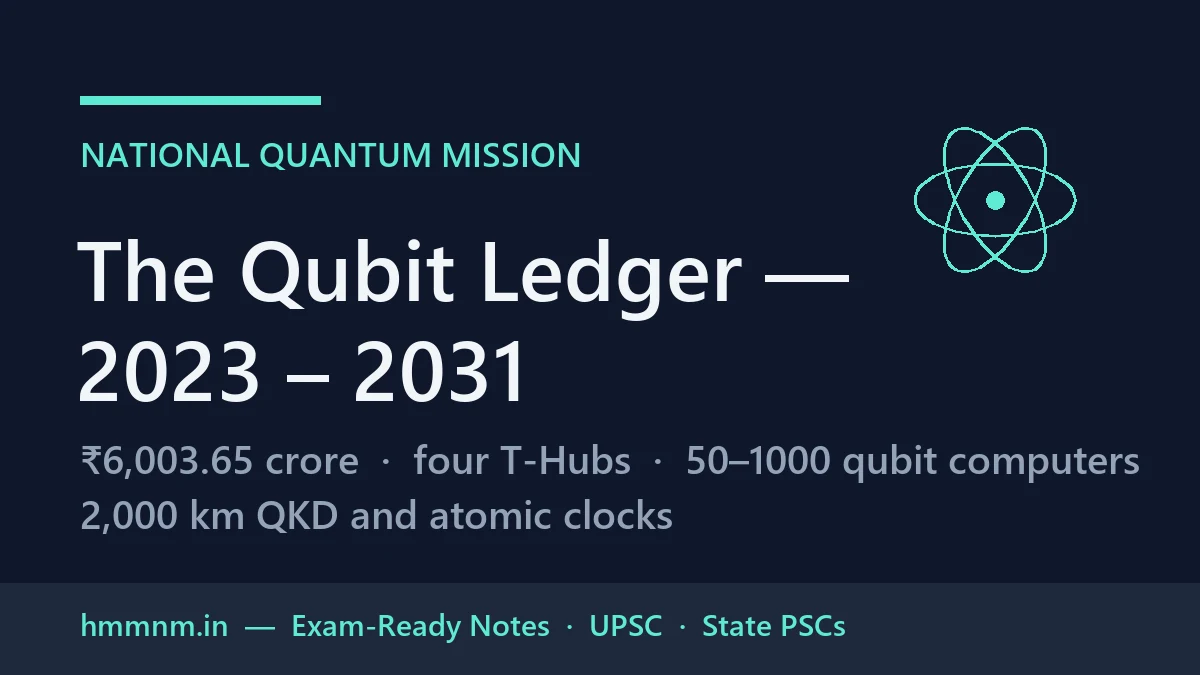
In one line: National Quantum Mission: Rs 6,003.65 crore, 2023 to 2031, four thematic hubs, 50-to-1000 qubits, 2,000-kilometre quantum keys and atomic clocks – exam-ready notes.
Related: Science & Technology Part 5: Supercomputing
thematic hubs, 50-to-1000 qubits, 2,000-kilometre quantum keys and atomic clocks — exam-ready notes.
On 19 April 2023. The Union Cabinet approved the National Quantum Mission at a cost of ₹6,003.65 crore. Running 2023-24 to 2030-31 — India’s eight year bet on the one technology where the rules, not just the leaders, are still being written. This card assembles the full exam kit: what a qubit is and why examiners now ask. The mission’s architecture and money. The four verticals with their hard targets, the T-Hub network hosting them, the global race it joins, and the honest challenges that keep it a bet rather than a fact.
The Qubit: Where Every Question Begins
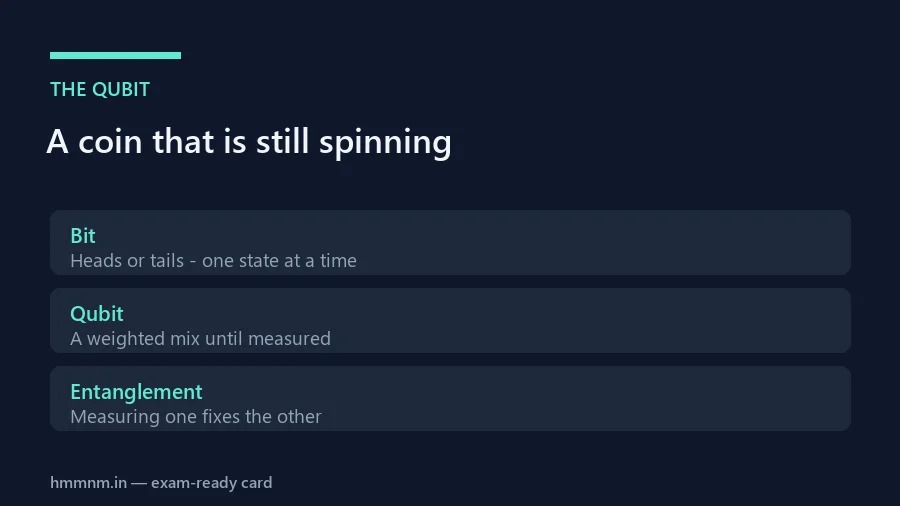
The classical bit is a coin lying flat — heads or tails, 0 or 1. The qubit is a coin still spinning: until measured. It holds a weighted mix of both. Two quantum rules make that worth ₹6,000 crore.
Superposition — the spinning coin state — lets n qubits represent 2^n states at once. A 300-qubit machine would hold more configurations than atoms in the visible universe. Entanglement — the paired coin trick — links qubits so measuring one instantly fixes the other. At any distance: the resource that powers quantum computing. Quantum communication and quantum sensing alike.
The exam line: superposition gives parallelism. Entanglement gives correlation — and both evaporate on measurement. Which is why quantum machines are not simply “faster computers” but different instruments for a specific class of problems.
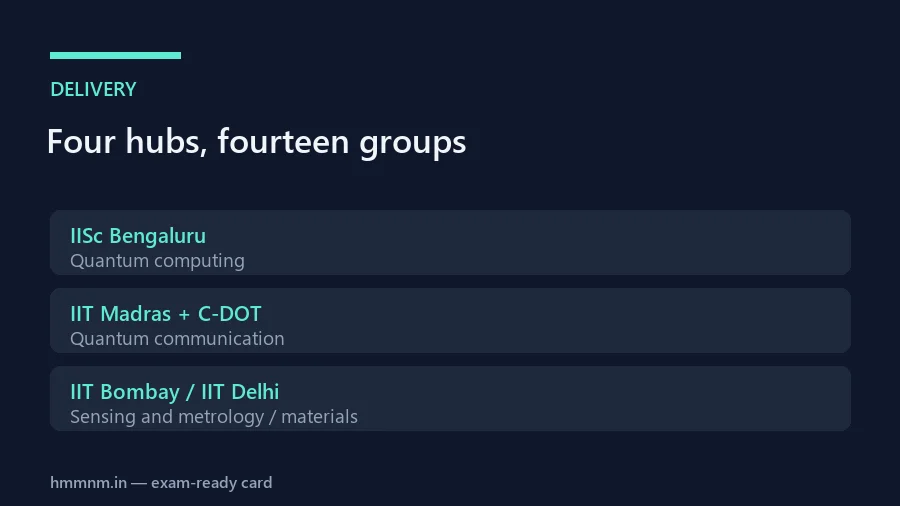
| Vertical | T-Hub host | Headline target |
|---|---|---|
| Quantum computing | IISc Bengaluru | 50-1000 physical qubits in 8 years |
| Quantum communication | IIT Madras with C-DOT | QKD over 2,000 km; multi-node networks |
| Sensing and metrology | IIT Bombay | Atomic clocks; sensitive magnetometers |
| Materials and devices | IIT Delhi | Superconductors; topological materials |
The Mission Architecture and the Money
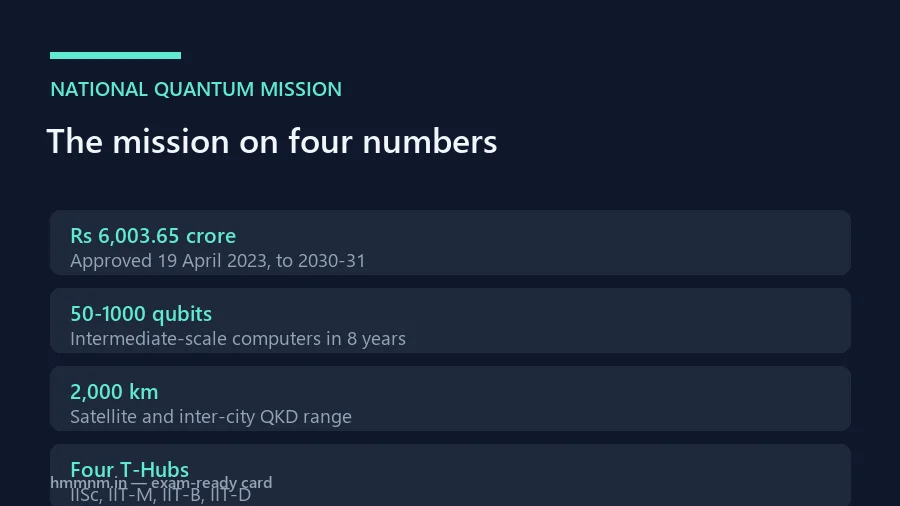
What the Cabinet approved. ₹6,003.65 crore over eight years (2023-24 to 2030-31). Steered by the Department of Science and Technology — the mission’s administrative anchor and its recurring prelims one marker.
The four verticals. Quantum computing. Quantum communication. Quantum sensing and metrology, quantum materials and devices — the mission’s official thrust areas, each with hard technical milestones (next section) rather than vague aspiration.
The delivery network. Four T-Hubs — thematic research hubs hosted by IISc Bengaluru (quantum computing). IIT Madras with C-DOT (quantum communication). IIT Bombay (quantum sensing and metrology) and IIT Delhi (quantum materials and devices) — operational with 152 researchers drawn from 43 bodies across 17 states and 2 union territories, organised into 14 technical groups. Startups are being supported through rolling T-Hub calls. And AICTE linked B.Tech (Minor) and M.Tech curricula in quantum technology are building the talent pipeline.
The exam line: outlay and period, four verticals, four host institutes and domains — the three tables that anchor every question.
The Targets: What “Done” Looks Like
Quantum computing. Intermediate scale quantum computers of 50-1000 physical qubits within eight years of mission start. On superconducting and photonic platforms — the two leading global routes. Both pursued rather than picking one. The honest framing: 50 physical qubits is a laboratory instrument; 1000 is a machine rivals notice. Error corrected logical qubits (the true prize) remain a global frontier.
Quantum communication. Satellite based secure quantum communication between ground stations over a range of 2,000 km within India. Inter city quantum key distribution (QKD) over 2,000 km; multi node quantum networks with quantum memories. Long distance secure quantum communication with other countries. The number 2,000 km is the mission’s most re-testable single fact — it appears twice. For satellite QKD and inter city QKD.
Quantum sensing and metrology. High sensitivity magnetometers in atomic systems; atomic clocks for precision timing. Communications and navigation — the quiet vertical with the nearest term payoff (a quantum clock navigation grid does not need the dramatic breakthroughs that computing does).
Quantum materials and devices. Design and synthesis of superconductors. Novel semiconductor structures and topological materials for quantum device fabrication. Plus single photon sources and detectors and entangled photon sources — the component supply chain without which the other three verticals import their way to dependency.
Why It Matters: Security, Timing, Sovereignty
The security driver. QKD’s physics guaranteed eavesdropping detection — measure the key and disturb it — answers the “harvest now. Decrypt later” threat: adversaries recording today’s encrypted traffic for tomorrow’s quantum computers to break. The mission’s communication vertical is a national security programme wearing a physics badge.
The timing driver. Atomic clocks anchor navigation (the GPS edge), telecom synchronisation and financial timestamping — a domestic quantum clock supply chain is strategic infrastructure by another name.
The sovereignty driver. The global race is real: the United States. The European Union (its Quantum Flagship). China and the United Kingdom run multi billion programmes, and export controls on quantum and adjacent technologies have arrived. The materials and devices vertical exists so India’s qubits are not hostage to another country’s component export licence — the same logic as the semiconductor mission. One abstraction layer deeper.
The Global Race at a Glance
Four programmes frame the race. The American effort runs on a
national initiative with heavy defence funding; the European bloc
spread its flagship across member labs; China pursues scale, from
satellite links to city networks; Britain concentrated on centres
tied to its universities. India enters later, smaller, and openly
collaborative – buying a seat at the table rather than a claim to
the head of it.
For an interview, the honest comparison wins: none of the four
has error-corrected machines either. The frontier is shared, the
talent market is global, and the country that industrialises
components may matter more than the one that grabs headlines. That
is why the materials vertical exists here, and why export controls
now sit beside physics in any serious account of the field.
One-Sentence Answers for the Interview
Why now? Because harvest-now-decrypt-later gives today’s recorded
traffic a shelf life. What is the deliverable? Intermediate machines,
shared keys and better clocks, on a date, under a budget. What is
missing? Error correction, depth of talent, and patience. Three
sentences, thirty seconds, and the panel moves on satisfied.
The Honest Challenges
Talent depth over breadth: the pipeline (AICTE curricula. The 43-institution network) is young. And global demand for the same skills is bottomless. Timescales: eight years to 1000 physical qubits is honest but-ambitious. Error correction — the gap between noisy physical qubits and usable logical ones — is the unsolved problem everywhere. India included. Translation: from papers to products needs patient capital and procurement, not just T-Hubs. The mains honest paragraph concedes all three and still argues the bet: the cost of arriving late at a general- purpose technology is historically far higher than the cost of the mission.
How Exams Ask This Card
- Prelims one-liners: outlay and period; conducting ministry (DST); the
four verticals; T-Hub host and domain matching (IISc computing is the favourite pair).
- Statement pairs: “QKD over 2,000 km” (true, both satellite and inter city);
“50-1000 qubits in 8 years” (true, physical qubits); “the mission targets error corrected universal quantum computers by 2031” (false — intermediate scale, physical qubits).
- Mains: the national security framing of quantum communication; the
R&D-sovereignty argument; the talent pipeline critique and fix.
- Interview: the spinning coin explanation of superposition, delivered
without jargon, is the classic cross check.
Seed, nurture and scale up scientific and industrial R&D in quantum technology – the mission goal, in the department’s own words.
computing 50-1000 qubits (8 yrs) | communication QKD 2,000 km
sensing atomic clocks | materials superconductors, topological
Syllabus Placement and Study Order
Place this mission beside two neighbours in the science-and-technology
paper: the space programme and the semiconductor mission. All three are
sovereignty stories with a budget line, and interview panels love the
comparison. Study the trio as one theme – strategic technology with a
timeline – and each becomes easier to recall.
Study order within the card: memorise the four numbers first, then
the four hubs, then the targets per vertical. Only then read the global
race and the honest challenges, because context sticks better once the
skeleton is fixed. Revise the ten-line summary last, the night before,
and let the table above be the final image in your mind.
A note on vocabulary: say physical qubits, not logical ones; say
thematic hubs, not centres; say the department of science and
technology, not the ministry of electronics. Precision of language is
half the mark in scheme questions, and this mission rewards it more
than most.
How to Answer NQM Questions
For prelims. Anchor on four numbers and four names: the outlay. The
period, the qubit range and the QKD distance. The ministry, the four
verticals and the four host institutes. Most statement questions are
built by swapping one of these eight facts. So read every option
against the list before marking.
For mains, the frame matters more than the inventory. Open with the
security driver – harvest now. Decrypt later – add the sovereignty
argument from the materials vertical. And close with the honest
challenges: talent depth, error correction, and the distance from
papers to products. One paragraph of candour earns more than a page of
cheerleading.
Common Wrong Statements to Recognise
Watch for these five twists in mock papers: the mission placed under
the wrong ministry. The qubit range quoted as logical rather than
physical; the QKD distance halved or doubled; the T-Hub hosts shuffled. And the mission period extended to 2035. Each twist is one word away
from the true card above.
Keep one more date in mind: the mission ends its eighth year in
2031, which places every target inside the next two exam cycles. A
fact that will be tested while today’s aspirants are still writing
papers is a fact worth two readings, not one.
Quick Revision: Ten Lines
- Approved: 19 April 2023 · Outlay: ₹6,003.65 crore · Period:
2023-24 to 2030-31.
- Nodal body: Department of Science and Technology.
- Four verticals: computing, communication, sensing and metrology,
materials and devices.
- Computing target: 50-1000 physical qubits in 8 years — superconducting
and photonic platforms.
- Communication target: satellite QKD over 2,000 km within India;
inter city QKD over 2,000 km.
- Plus: multi node networks with quantum memories; international
long distance secure links.
- Sensing: atomic clocks (timing, communications, navigation) and
high sensitivity magnetometers.
- Materials: superconductors, novel semiconductors, topological
materials; single photon and entangled photon sources.
- Four T-Hubs: IISc (computing) · IIT Madras-C-DOT (communication) ·
IIT Bombay (sensing/metrology) · IIT Delhi (materials/devices).
- Ecosystem: 152 researchers, 43 bodies, 17 states + 2 UTs,
14 technical groups, rolling startup calls, AICTE curricula.
Frequently Asked Questions
What is quantum key distribution in one sentence?
A key exchange method whose security follows from physics — any eavesdropper’s measurement disturbs the quantum states and reveals the intrusion — rather than from mathematical difficulty that future computers might defeat.
How is the mission different from the National Supercomputing Mission?
Supercomputing (PARAM lineage) scales classical brute force; the quantum mission targets machines whose advantage comes from superposition and- entanglement on specific problem classes — simulation of molecules, optimisation, cryptanalysis. They are complements, not rivals (see our Sci-Tech Part 5 card).
Why “physical” qubits in the target?
Because usable, error corrected “logical” qubits need many physical qubits each — the overhead quantum error correction demands. The mission’s honest 2031 milestone is intermediate scale machines, not fault tolerant ones.
What is a T-Hub and who hosts which?
A thematic research hub: IISc Bengaluru (computing), IIT Madras with C-DOT (communication), IIT Bombay (sensing and metrology), IIT Delhi (materials and devices) — the four institute pairing is the single most asked fact.
Which global programmes is India racing?
The US National Quantum Initiative, the EU Quantum Flagship, China’s national programme and the UK’s — multi billion-dollar efforts all; India’s ₹6,003.65 crore buys a seat at the table’s technical conversation, not yet the head of it.
Related explainers
- Science and Technology Part 5: Supercomputing — PARAM to the National
Knowledge Network
- Panchamrit and the Renewable Targets
- National Green Hydrogen Mission: The Big Molecule Bet
Written and maintained by the Hmmnm Editorial Team — exam mentors and subject editors. Mission figures compiled from the Department of Science and Technology’s mission pages and re-checked each cycle.
Read more: Panchamrit and the Renewable Targets · Learn more: National Green Hydrogen Mission
Written and maintained by the Hmmnm Editorial Team – exam mentors and subject editors. Every card is compiled against the official sources listed and re-checked each cycle.
Sources: Department of Science & Technology
Quick revision
- Prelims one-liners: outlay and period; conducting ministry (DST); the
- Statement pairs: “QKD over 2,000 km” (true, both satellite and inter city);
- Mains: the national security framing of quantum communication; the
- Interview: the spinning coin explanation of superposition, delivered
- Approved: 19 April 2023 · Outlay: ₹6,003.65 crore · Period:
- Nodal body: Department of Science and Technology.
Have a doubt on this topic?