- 1. The Partition and the Protest It Birthed (1905–08)
- 2. Surat and the Two Streams (1907–16)
- 3. The League, Morley-Minto and the Separate Electorate (1906–09)
- 4. The Revolutionary Underground (1902–15)
- 5. The War Years: Ghadar, Home Rule, the Declaration (1914–17)
- 6. 1917–19: Satyagraha, Montford, Rowlatt, Amritsar
- How Exams Probe This Card
- 7. Quick Revision: One-Glance Facts
- Practice Corner: Five Definition Checks (with Answers)
- The Case Lens: The 1919 Doubling
- The Three Classic Traps (Where Beginners Slip)
- Frequently Asked Questions
- Why did Curzon partition Bengal, and when was it undone?
- What made Swadeshi a “mass” method where the Moderates were not?
- How did the Ghadar movement differ from Bengal’s revolutionaries?
- What exactly was dyarchy?
- Why is Jallianwala Bagh treated as a turning point?
- Sources for This Card
- Revision Compass
- Planner’s Register
Modern India 1905–1919: Swadeshi to Rowlatt Act Exam Notes
What turns a protest into a mass movement?
“Swaraj is my birthright and I shall have it.” — Bal Gangadhar Tilak, 1916
In one line: Modern India Part 3 — Swadeshi to Rowlatt, 1905 to 1919, in one read.
Related: Modern India Part 2: The Crown’s India — 1858 to 1905
In one line: The mass movement birth century on one card. Curzon’s partition of Bengal (1905) detonating the Swadeshi and boycott method. The Surat split (1907) parting Moderates from Extremists. The Muslim League (1906) and Morley-Minto’s separate electorates (1909) hardening communal representation. The revolutionary underground from Anushilan to the Ghadar Party. The Home Rule Leagues and the Lucknow Pact (1916) reuniting the threads. Gandhi’s first satyagrahas at Champaran-Ahmedabad-Kheda (1917–18). And the twin shock of the Montagu-Chelmsford reforms and the Rowlatt Act closing in the Jallianwala Bagh year (1919). The threshold of the Gandhian mass age that Part 4 takes up.
.
The fourteen years stand on four counts. First, the method’s invention. Swadeshi and boycott as pressure from below. Second, the organisational splits and reunions. Surat 1907 to Lucknow 1916. Third, the constitutional counter moves. Morley-Minto 1909 and Montford 1919. Fourth, the new actors. The revolutionary diaspora, the Home Rule stalwarts. And the arriving Mahatma.
.
Quick Answer: Curzon’s partition of Bengal (announced July. Effective 16 October 1905) — divide and rule against a nationalist heartland. Produced the Swadeshi movement: boycott of foreign cloth. National education (Bengal National College under Aurobindo). Samitis (Swadesh Bandhab Samiti), rakhi and festival nationalism. And the Lal-Bal-Pal Extremist leadership.
The Congress split at Surat (1907) over the Bengaland- boycott resolutions. Reunited at Lucknow (1916) with the League’s pact.
The Muslim League (Dacca, 1906) and the Indian Councils Act 1909 (Morley-Minto: separate electorates. First Indian law member of the Viceroy’s executive council. S.P. Sinha) constitutionalised communal representation. The revolutionary stream ran from Anushilan and Jugantar (Khudiram Bose, 1908.
Alipore case) through the India House-Ghadar diaspora (Har Dayal. Komagata Maru 1914) to Rash Behari Bose’s plots. The war years raised the Home Rule Leagues (Tilak April, Besant September 1916).
Montagu’s declaration (August 1917) promised to blame government. Gandhi’s Indian debut. Champaran (1917, tinkathia), Ahmedabad mill (1918, hunger strike), Kheda (1918, no tax). Tested satyagraha. 1919 closed the era: the Rowlatt Act (March), the 6 April hartal, Jallianwala Bagh (13 April). And the Government of India Act 1919’s dyarchy. Reform and repression in one year, handing Gandhi his mass stage.
.
Contents: sections 1–7 below, Practice Corner, The Case Lens, The Three Classic Traps, FAQs.
1. The Partition and the Protest It Birthed (1905–08)
The measure. Curzon partitions Bengal effective 16 October 1905. The official reason administrative size (a province of seventy eight million). The working reason divide: a new Muslim majority province, East Bengal and Assam. Capital Dacca. Severed from the nationalist Hindu majority West (capital Calcutta).
The province that had produced the Congress’s loudest critique was to be split and diluted.
.
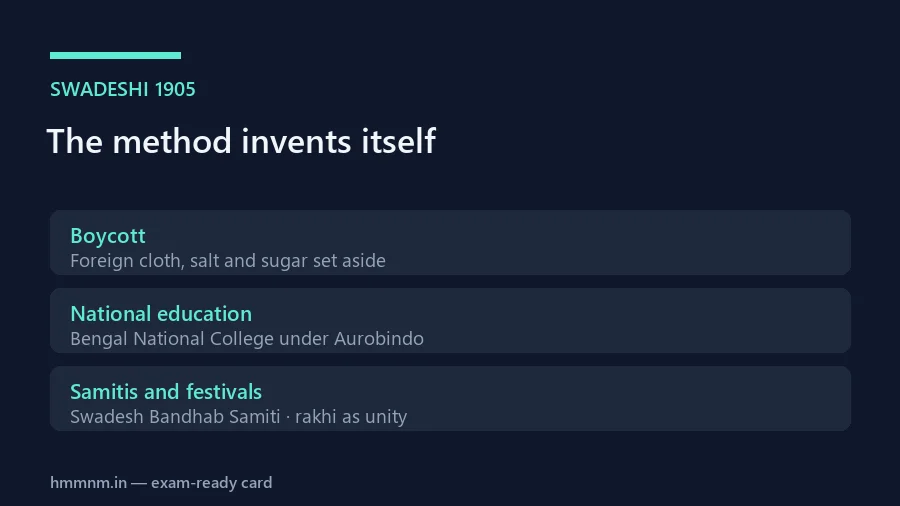
The Swadeshi answer. 16 October observed as a day of mourning; rakhi bands exchanged for unity. The boycott of British cloth, salt and sugar. “swadeshi” as positive programme (own cloth. Own schools. Own bodies) with “boycott” as its negative twin.
Rabindranath’s Amar Sonar Bangla — now Bangladesh’s anthem — belongs to this moment’s songbook.
.
The movement’s bodies. Bengal National College (Aurobindo Ghosh principal); the National Council of Education (1906); samitis — the Swadesh Bandhab Samiti of Ashwini Kumar Dutta the largest — taking the message village ward; festivals (Durga Puja and Raksha Bandhan) as mass media.
The geography and method spread. Lal-Bal-Pal (Lala Lajpat Rai, Bal Gangadhar Tilak, Bipin Chandra Pal) carry Swadeshi beyond Bengal. Punjab, Maharashtra, Madras. Students in the front row (with the repression corridor: lathi charges. Arrests. The Universities Act provocation).
The method’s exam name: “passive resistance” avant la lettre — the repertoire Gandhi would systematise.
.
Why the movement receded by 1908 — the mains checklist. Severe repression (arrests, the Swadesh Bandhab Samiti banned, Tilak to Mandalay). The leaders’ own limits. The Extremists’ hesitancy to mobilise peasants on agrarian demands (fearing disorder) capped the movement’s depth.
The Surat split (1907) robbed it of a united Congress. Communal drift in eastern Bengal after the partition’s design. No effective countrywide body to hold the local samitis together.
Annulment came anyway in 1911 — the Durbar’s grant. But by then the movement had already taught (and cost) its lessons.
.
2. Surat and the Two Streams (1907–16)
The split’s mechanics. The Calcutta session (1906) had already taken Swaraj as goal, Swadeshi and boycott as method. The Moderate old guard uneasy. At Surat (December 1907) the Rashbehari Ghosh presidency fight collapses into pandemonium. The Congress splits. Moderates keeping the body (and the next year’s constitutional. Gokhale line). The Extremists outside looking in.
The Government plays both: Tilak jailed (1908, six years, Mandalay) — the Extremist beheading.
.
The reunion’s path. The First World War changes the arithmetic. Tilak returned (1914), the Defence of India Act’s repression radicalising opinion, Annie Besant’s Congress presidency drive. At Lucknow (December 1916) the Congress reunites and signs with the League: the Lucknow Pact.
Joint constitutional demands (four fifths of elected provincial councils. Half the Viceroy’s executive council elected and Indian) with the Congress accepting separate electorates. The pact’s double face — unity’s peak and communal representation’s normalisation.
.
3. The League, Morley-Minto and the Separate Electorate (1906–09)
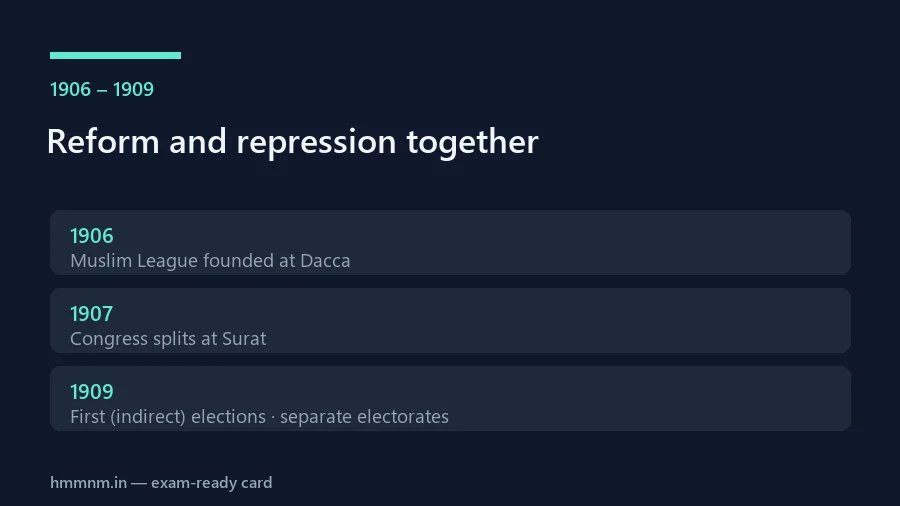
The League’s founding. The Simla Deputation (October 1906: Aga Khan’s delegation to Minto seeking separate representation) precedes the Dacca founding (30 December 1906. Nawab Salimullah’s invitation. Aga Khan president). Loyalty and constitutionalism its stated creed, Muslim political interest its organised voice.
.
The Indian Councils Act 1909 (Morley-Minto). Enlarged legislative councils (the Moderate dividend). The first (indirect) elections to the legislative councils — body now with a ballot’s shadow. The first Indian member of a Viceroy’s executive council (Satyendra Prasad Sinha, law member).
And the separate electorate for Muslims provision, the first legal recognition of communal representation in British India.
Morley’s own framing: reform to prevent revolution, not concede it. The exam line: 1892 associated Indians; 1909 elected and separated them by community; 1919 will separate power by subject.
.
4. The Revolutionary Underground (1902–15)
The Bengal matrix. Anushilan Samiti (Dacca 1902 and Calcutta currents) and Jugantar. Gymnasia as cover, bomb and pistol as argument. The Muzaffarpur attempt (30 April 1908: Khudiram Bose and Prafulla Chaki targeting Kingsford, killing the Kennedy ladies). Khudiram, eighteen, hanged. The Alipore bomb case (Aurobindo acquitted, defended by C.R.
Das). Barindra’s exile. Madan Lal Dhingra’s London killing of Curzon-Wyllie (1909) internationalises the stream.
.
The diaspora engine. Shyamji Krishna Varma’s India House (London, 1905) and The Indian Sociologist. Savarkar’s Abhinav Bharat (1904) and his The Indian War of Independence. 1857. V.D. Savarkar arrested and transported (1911). Then the Ghadar Party.
Lala Har Dayal’s San Francisco Yugantar Ashram (1913). The Urdu-Punjabi Ghadar paper’s open insurrection call. The Komagata Maru episode (1914: Baba Gurdit Singh’s chartered ship. The Vancouver exclusion. The Budge Budge clash) feeding returning emigrants into the conspiracy.
Rash Behari Bose’s and Vishnu Ganesh Pingley’s February 1915 rising plan betrayed (Kirpal Singh’s infiltration). The Lahore and Benares conspiracy cases closing the wartime chapter. And inside India, the Delhi Conspiracy Case (1912). Rash Behari Bose’s and Sachin Sanyal’s bomb on Viceroy Hardinge at Delhi’s Chandni Chowk.
Kept the underground’s calendar alive between the Alipore and Ghadar chapters.
The exam line: revolutionaries of the era sought inspiration abroad and arms at home. The Ghadar name’s literal meaning — “mutiny” — is a favourite option.
.
5. The War Years: Ghadar, Home Rule, the Declaration (1914–17)
India at war. Over a million men and vast sums committed; the Defence of India Act (1915) suspending liberties at home even as London promises reform to keep India quiet — the reform and repression dualism of the whole era in miniature.
The Home Rule Leagues. Tilak’s (April 1916, Poona. Kesari’s editor now an all India figure) and Besant’s (September 1916. Adyar — with Arundale and Wadia. The New India and Commonweal press). Parallel. Amiable competitive. Mass membership politics between Congress sessions: the leagues demanded Home Rule by name for the first time in mass politics. And made Besant the Congress president (Calcutta, 1917) — the first woman president.
.
The Montagu Declaration (20 August 1917). The Secretary of State announces the goal as “the gradual development of self governing bodies”. Responsible government by name for the first time. The Montagu-Chelmsford Report (July 1918) will draft the machinery (Part of section 6). The exam pairing: declaration 1917, report 1918, Act 1919.
.
6. 1917–19: Satyagraha, Montford, Rowlatt, Amritsar
Gandhi’s Indian apprenticeship. Champaran (1917) — the tinkathia indigo obligation broken by the first Indian satyagraha (Rajendra Prasad. Brajkishore and Anugraha Narayan Sinha the lieutenants). Ahmedabad (1918). The mill workers’ plague bonus dispute. Gandhi’s first hunger strike. Settled by arbitration with the workers awarded 35 percent of their demand.
Kheda (1918). Crop failure and the no tax demand, Vallabhbhai Patel’s organising. Three local experiments, one method validated: moral pressure through mass but disciplined non-cooperation.
.
The Government of India Act 1919 (Montford). Dyarchy in the provinces. “transferred” subjects (education, health, local government) to Indian ministers to blame to legislatures. “reserved” subjects (finance. Police. Land revenue) to the governor; a bicameral centre (Legislative Assembly and Council of State).
Separate electorates extended and communal. The exam line: dyarchy divides subjects, not sovereignty. The Act’s own Preamble goal is the 1917 declaration.
.
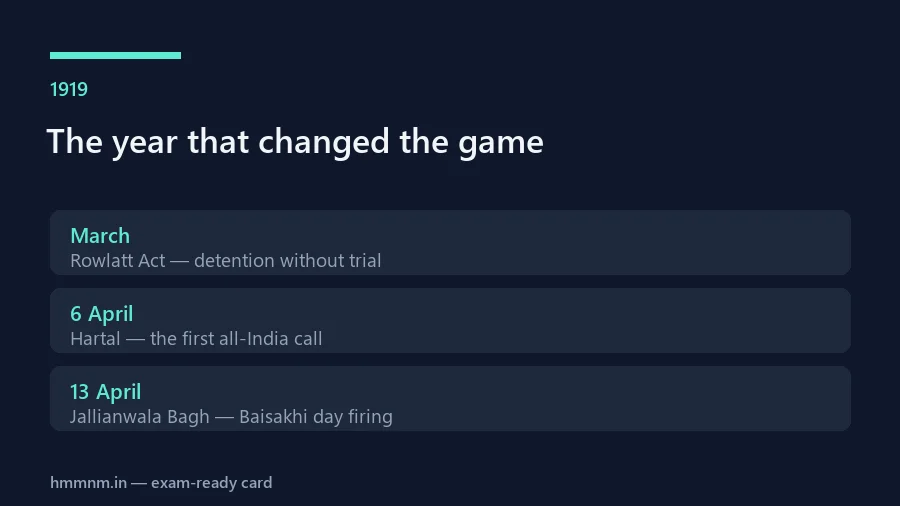
The Rowlatt year. The Rowlatt Act (March 1919. The “no dalil. No vakil. No appeal” Anarchical and Revolutionary Crimes Act: detention without trial. Wartime powers continued in peace) outrages the Moderates and the masses alike. Gandhi’s first all India call.
The 6 April 1919 hartal. The Punjab’s tense April: the Amritsar arrests of Dr Saifuddin Kitchlew and Dr Satyapal. 13 April 1919 — Baisakhi day.
General Dyer’s firing at Jallianwala Bagh (the official inquiry’s 379 dead; the Congress count higher). Martial law’s humiliations (the crawling order, public floggings). The Hunter Committee’s censure and the House of Lords’ applause; Tagore renouncing his knighthood.
Udham Singh’s revenge (Caxton Hall, 1940. On O’Dwyer, not Dyer) the long echo. The era closes with the Congress’s Nagpur and non-cooperation decisions pending (Part 4’s opening): reform had arrived and been overtaken by its own year of repression.
.
And the year’s third current: November 1919. The All-India Khilafat Conference (the Ali brothers — Mohammad and Shaukat. With Gandhi’s blessing) assembles the Muslim grievance against the post-war treatment of Turkey. The wrong that will fuse to Punjab and Rowlatt in the Non-Cooperation Movement of 1920. Part 4’s opening act.
Three currents in one twelve month: constitutional reform, mass repression, communal mobilisation. The Gandhian age is assembled from all three.
.
1905 partition → 1907 Surat split → 1909 separate electorates → 1916 Home Rule + Lucknow → 1919 Rowlatt + Jallianwala
How Exams Probe This Card
Prelims mines these fourteen years for date pairings and firsts. Expect
a sequencing item on the partition. The split. The Act and the pact; a
matching question between leaders and their leagues; and statement pairs
that swap the years of the two 1916 events. The Morley-Minto firsts
elected councils. An Indian law member. Separate electorates supply
three options from one Act, which is why examiners reuse it.
Mains rewards the frame. Not the inventory: reform and repression
travelling together. The method moving from petition to boycott to
satyagraha. And the communal wedge hardening into law. Close any answer
with the 1919 doubling. The Act that disappointed and the Act that
enraged. And the grade follows the argument.
7. Quick Revision: One-Glance Facts
| Year | Fact |
|---|---|
| 1905 | Partition of Bengal (16 Oct); Swadeshi begins |
| 1906 | Muslim League (Dacca); Calcutta session — Swaraj as goal |
| 1907 | Surat split |
| 1908 | Khudiram; Alipore case; Tilak to Mandalay |
| 1909 | Indian Councils Act — first (indirect) elections; separate electorates |
| 1912 | Delhi Conspiracy — the Hardinge bomb (Rash Behari Bose, Sachin Sanyal) |
| 1913–14 | Ghadar Party; Komagata Maru |
| 1916 | Home Rule Leagues (Tilak Apr, Besant Sep); Lucknow Pact |
| 1917 | Montagu Declaration; Champaran; Besant Congress president |
| 1918 | Ahmedabad and Kheda; Montagu-Chelmsford Report |
| 1919 | Rowlatt Act (Mar); hartal 6 Apr; Jallianwala Bagh 13 Apr; GoI Act 1919 |
Practice Corner: Five Definition Checks (with Answers)
- The Swadeshi movement’s “positive” and “negative” programmes?
Positive: own cloth, national education, samitis. Negative: boycott of foreign cloth, salt, sugar and official honours.
- What did the Lucknow Pact (1916) concede? The Congress accepted
separate electorates — unity’s price; joint Congress-League demands for legislative majorities and executive council representation.
- The Morley-Minto reforms’ “first”? The first Indian law member of
the Viceroy’s executive council (S.P. Sinha) — and the first statutory separate electorates (1909).
- Gandhi’s three pre-non-cooperation satyagrahas, in order?
Champaran (1917), Ahmedabad mill (1918), Kheda (1918).
- The Rowlatt Act’s official title and core power? The Anarchical
and Revolutionary Crimes Act (1919) — detention without trial.
The Case Lens: The 1919 Doubling
Mains framing: “Reform and repression travelled together in 1919. Discuss.” The reform half: the Montford Act’s dyarchy, bicameralism, the first franchise extension. The repression half: Rowlatt, Jallianwala, martial law. The synthesis the examiner rewards: both served the same imperial strategy.
Post-war retrenchment of the wartime promise. The Act’s elected ministries without sovereignty were meant to absorb the Home Rule energy, the Rowlatt state to liquidate its excess.
The strategy failed on both flanks: the Act disappointed and Rowlatt enraged. The combination. Not either alone. Made non-cooperation (1920) mass ready with Hindus and Muslims together. The Khilafat and Punjab wrongs fused to the constitutional one.
.
The Three Classic Traps (Where Beginners Slip)
- 1905, 1906, 1909 confusion. Partition 1905; League 1906; separate
electorates statutory 1909 — three communal milestone years, each with its own instrument. Never collapse them.
- Home Rule League dates. Tilak April 1916 (Poona); Besant September
1916 (Adyar) — same year, different cities, four months apart; prelims loves the swap.
- 1919’s two Acts. The Government of India Act 1919 (reform) and the
Rowlatt Act 1919 (repression) are different instruments of the same year — match the description to the Act, not the year alone.
Frequently Asked Questions
Why did Curzon partition Bengal, and when was it undone?
Officially to improve administration; functionally to divide the nationalist stronghold. Announced July 1905. Effective 16 October; undone by the Delhi Durbar announcement (1911) — Bengal reunified. The capital shifted to Delhi the same announcement.
What made Swadeshi a “mass” method where the Moderates were not?
Boycott and swadeshi put the movement in the household — cloth, salt, festivals, schools — converting opinion into daily practice; the Moderates’ instruments (petitions, council speeches) stayed elite.
How did the Ghadar movement differ from Bengal’s revolutionaries?
Diaspora based (North America). Openly insurrectionary (the paper named it). Banking on a wartime sepoy rising (the betrayed 1915 plan) — versus Bengal’s secret society assassinations; both fed the same “revolutionary terrorism” column of the syllabus.
What exactly was dyarchy?
The 1919 Act’s provincial split: transferred subjects to ministers answerable to legislatures; reserved subjects to the governor’s executive council — responsibility without power in the transferred. Power without responsibility in the reserved; abandoned by the 1935 Act.
Why is Jallianwala Bagh treated as a turning point?
Not the casualties alone — the martial law aftermath (the crawling order). The British establishment’s divided conscience (Hunter versus Churchill’s censure. The House of Lords’ medal vote). And the effect on Indian politics: Tagore’s knighthood returned, Gandhi’s patience ended. Non-cooperation’s 1920 launch is unintelligible without 13 April 1919.
.
Sources for This Card
Compiled against the standard syllabus readings: NCERT Spectrum’s
brief history of modern India for the spine; Sumit Sarkar for the
Swadeshi detail and its limits; R.C. Majumdar for the revolutionary
stream; and the collected Kesari and New India editorials for the Home
Rule flavour. Every date above cross-checks against the standard
chronologies that prelims keys reuse.
Revision Compass
Study this card in three sweeps. Sweep one. Names and dates only:
learn the league founders. The session cities. The Act years. Sweep
two, cases: why each grant followed pressure, why each
repression followed hope. Sweep three. Essay drill: pick any decade
between 1905 and 1919 and argue both its reform case and its revolt
case in two paragraphs. Candidates who revise by sweeps remember
structure, not trivia; structure is what the examiner rewards.
Planner’s Register
Flag these keywords when you scan any paper on this era: annulment. Sedition. Franchise. Despatch, gazette, ordinance, statute, quorum,
referendum, dominion, martial law, detention, exile, amnesty,
insurgency, propaganda, volunteers, hartal, boycott, swadeshi,
franchise, suffrage, nominee, portfolio. Each maps to one section of
this card; each has appeared as either an option or a keyword in past
papers. Build your own register as you revise — the habit of collecting
terms is itself exam training.
Read more: Modern India Part 2: The Crown’s India — 1858 to 1905 · Learn more: Partition 1947: The Largest Migration
Related explainers
- Modern India Part 1: Plassey to 1857
- Modern India Part 2: The Crown’s India — 1858 to 1905
- Partition 1947: The Largest Migration
Written and maintained by the Hmmnm Editorial Team — exam mentors and subject editors. Every card is compiled against the official sources listed and re-checked each cycle.
Sources: NCERT history textbooks · Indian Parliament — india.gov.in
Quick revision
- The Morley-Minto reforms’ “first”?: The first Indian law member of
- 1905, 1906, 1909 confusion.: Partition 1905; League 1906; separate
- Home Rule League dates.: Tilak April 1916 (Poona); Besant September
- 1919’s two Acts.: The Government of India Act 1919 (reform) and the
- Modern India Part 1: Plassey to 1857
- Modern India Part 2: The Crown’s India — 1858 to 1905
Have a doubt on this topic?