

India and the World 9: EU Reset and the FTA Season Explained
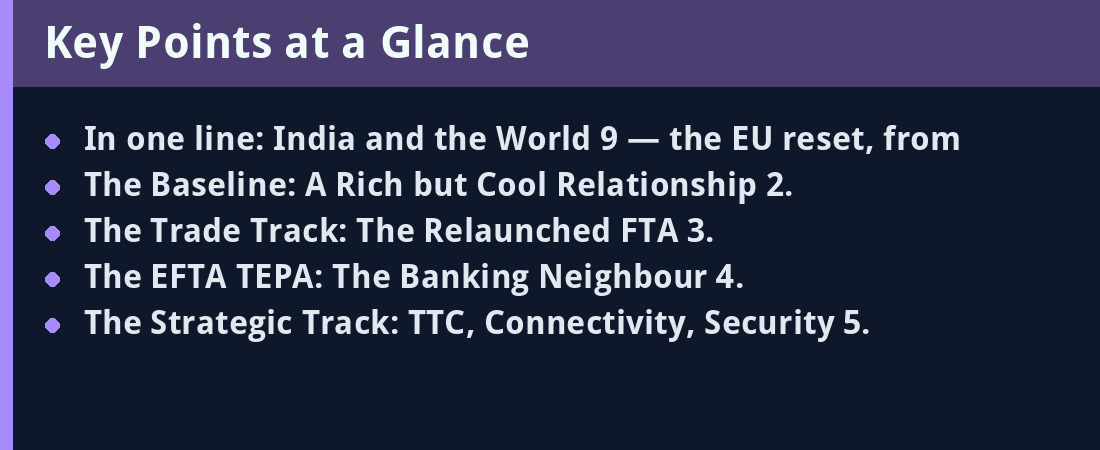
In one line: India and the World 9 — the EU reset, from stalled talks to a concluded FTA and a banked TEPA.
- 1. The Baseline: A Rich but Cool Relationship
- 2. The Trade Track: The Relaunched FTA
- 3. The EFTA TEPA: The Banking Neighbour
- 4. The Strategic Track: TTC, Connectivity, Security
- 5. The Friction: Russia, Ukraine, Values
- 6. How Exams Probe This Topic
- 7. Quick Revision: One-Glance Facts
- The Milestone Table
- Practice Corner: Five Definition Checks (with Answers)
- The Case Lens: The FTA Answer’s Template
- The Three Classic Traps (Where Beginners Slip)
- Frequently Asked Questions
- What is the India-EU FTA’s status?
- What is the EFTA TEPA?
- What is the India-EU Trade and Technology Council?
- What is CBAM and why does India care?
- How does the Russia-Ukraine war affect India-EU ties?
- Why did the 2007-2013 BTIA talks fail. And why did they succeed this time?
- Exam Checklist
- FAQ
- How much of this page is exam-relevant?
- When should I revisit?
- The Thirty-Second Recap
- Explain It Simply
- Abbreviations That Recur Here
- The Framework Line to Memorise
- The Doctrine Layer
- The Calendar Ahead
- The Closing Table
- The Short-Word Close
In one line: The India-EU chapter on one card: the world’s two largest democracies-by-market relaunched (2022) their long-stalled FTA into a target-date endgame — and then concluded the texts (January 2026); the EFTA TEPA (2024) banked a hundred-billion-dollar investment pledge first; the Trade and Technology Council, connectivity (Global Gateway meeting IMEC) and the Ukraine-Russia friction complete a reset that is transactional, strategic and unfinished at once.
The EU reset stands on four counts. First, the baseline — what India-EU relations were and why they stalled. Second, the trade track — the FTA talks and the EFTA TEPA. Third, the strategic track — technology, connectivity, security. Fourth, the friction — Russia, Ukraine and the values gap. Each pillar answers a different exam question. And together they supply the whole architecture a mains answer needs.
Contents
1. The Baseline: A Rich but Cool Relationship
2. The Trade Track: The Relaunched FTA
3. The EFTA TEPA: The Banking Neighbour
4. The Strategic Track: TTC, Connectivity, Security
5. The Friction: Russia, Ukraine, Values
6. How Exams Probe This Topic
7. Quick Revision: One-Glance Facts
– Practice Corner: Five Definition Checks (with Answers)
– The Case Lens: The FTA Answer’s Template
Quick Answer: India-EU relations, long a large-but-underperforming pair (the EU among India’s largest trading partners; an FTA abandoned in 2013), relaunched in 2022 — and the talks concluded on 27 January 2026: the announced deal has the EU eliminating tariffs on over 90 per cent of tariff lines — covering 99.5 per cent of India’s exports by value per the Indian readout (the EC’s own framing: 96.6 per cent of EU export value) — while India lowers duties on European wine and automobiles, against a €120-billion (2024) bilateral trade base. The Switzerland-led EFTA group signed first — the 2024 TEPA with a committed $100-billion investment window over fifteen years. The strategic layer: the Trade and Technology Council, EU connectivity (Global Gateway) meeting India’s IMEC. And defence-industrial murmurings — with signature expected by end-2026 and entry into force targeted for 2027 through ratification. The reset is real and now one ratification short of operational.
1. The Baseline: A Rich but Cool Relationship
- The weight. The EU bloc is among India’s top two-or-three trading partners (goods-plus-services, roughly a hundred-and-twenty-billion-dollar corridor), its largest source of FDI equity in several recent years. And a technology partner across pharma, autos, machinery-and-digital — a rich relationship by every measure but warmth. For perspective: the EU as a bloc buys more Indian goods than any single country except the United States. And Indian pharmaceuticals, textiles, engineering goods and refined petroleum dominate the export basket.
- The stalled decade. The Broad-based Trade and Investment Agreement (BTIA) talks launched 2007, suspended 2013 — the classic gaps: tariffs (EU’s autos-and-wine asks versus India’s industrial sensitivities), services mobility (India’s Mode-4 professionals ask), data adequacy. And the sustainable-development-and-labour chapters the EU began mandating. Neither side moved; the relationship defaulted to trade happening despite — not because of — policy.
- The 2020-21 turn. The India-EU Leaders’ Meeting (May 2021, the Porto summit) relaunched the architecture: FTA talks to restart, plus separate investment-protection-and-geographical-indications tracks and the Trade and Technology Council — the reset’s institutional scaffolding. What changed was not the economics but the geopolitics: both sides had run out of reasons to wait.
- The strategic frame. The EU’s China-de-risking, the Indo-Pacific tilt (the EU’s own strategy paper). And India’s diversification-away-from-China supply-chain logic — three parallel pushes that made the moment (the mains “why now” paragraph). Add the post-Covid lesson that concentrated supply chains are strategic vulnerabilities. And the FTA stopped being a trade file and became a security one.
2. The Trade Track: The Relaunched FTA
- The negotiating architecture — now concluded. Three parallel tracks ran: the FTA proper (goods-and-services), the investment-protection agreement. And the GI agreement. Thirteen rounds ran from June 2022; the thirteenth (New Delhi, September 2025) closed the texts; and on 27 January 2026 the conclusion was announced in New Delhi — the PM calling it the “mother of all deals” alongside the European Commission’s President. Signature is expected by end-2026 after legal scrubbing, with entry into force targeted for 2027 (India’s approval is straightforward; the EU’s member-state-and-Parliament ratification is the longer pole).
- The sticking-point map. Market access for EU autos, wines-and-spirits. And dairy; India’s asks on services Mode-4 (professional movement) and data-adequacy status; rules-of-origin strictness; the EU’s trade-and-sustainable-development chapters (labour-and-environment clauses India resists as protectionism-in-green-clothes); carbon-border adjustment (CBAM — the EU’s carbon tax on imports, an Indian steel-and-aluminium concern) — the six-point file the exam can draw any single item from. Note the pattern: every sticking point is a mirror — each side’s offensive interest is the other’s defensive red line.
- The FTA-versus-CEPA semantics. India’s recent agreements wear different names — CEPA (comprehensive economic partnership agreement, the UAE-and-Australia model), TEPA (the EFTA variant), FTA (the plain version) — the naming MCQ the prelims has already set. The substance overlaps; the label signals scope and political emphasis.
- The headline terms. The EU commits to eliminating tariffs on over 90 per cent of tariff lines — 99.5 per cent of goods imported from India by value, phased — while India lowers its high duties on European wine and automobiles; forecasts project the corridor roughly doubling EU exports by the early 2030s from the €120-billion (2024) base. The honest caution: gains depend on phase-outs’ calendars and chapters’ depth, not the announcement’s ink — the balance every mains answer needs. Watch especially what happens to India’s sensitive sectors: agriculture, dairy and the labour-intensive exports whose gains hinge on rules-of-origin strictness.
3. The EFTA TEPA: The Banking Neighbour
- The deal. India-EFTA TEPA (signed March 2024): the four-nation bloc — Switzerland, Norway, Iceland, Liechtenstein — India’s first FTA with a developed-European grouping; entered the ratification-and-entry-into-force track thereafter.
- The signature clause. EFTA commits a targeted $100 billion investment into India over fifteen years, plus a million jobs target — an investment-pledge chapter (a “TEPA-first” in Indian FTA practice) attached because the goods-access arithmetic was asymmetric (EFTA’s tiny market against India’s export interests).
- The quid pro quo. India’s tariff concessions on EFTA’s gold (Switzerland’s historic export), watches-and-chocolates; EFTA’s openings in services-and-investment; the interesting asymmetry: a services-and-investment-and-jobs deal wearing a trade agreement’s name — the exam’s analytical point. If EFTA’s pledge falters, the optics of the entire pledge-first model suffer — which is why the monitoring clause matters as much as the promise.
- The demonstration effect. The TEPA as template-and-confidence-builder for the EU endgame: if the four rich-and-small could bank a pledge-first structure, the twenty-seven rich-and-large have their model — the sequencing thesis mains answers can argue.
4. The Strategic Track: TTC, Connectivity, Security
- The Trade and Technology Council (2022). Only the EU’s second TTC (the US one the first) — working groups on strategic technologies (semiconductors, AI-and-quantum), green-and-clean energy technologies. And trade-and-investment resilience: the de-risking-and-diversification machinery beneath the political warmth. In an era when chips and critical technologies are geopolitical currency, the TTC is the relationship’s most forward-looking instrument.
- Connectivity: Global Gateway meets IMEC. The EU’s Global Gateway (its infrastructure-and-connectivity counter to China’s Belt-and-Road) and India’s IMEC (the India-Middle-East-Europe Corridor this site’s IMEC post covers) are natural complements — the Mediterranean-to-Mumbai trade-and-data spine on paper; the region’s geopolitics (the West-Asia conflict) the practical brake. Connectivity announcements are easy; corridors crossing active conflict zones are not.
- The defence-and-security layer. Naval exercises-and-moves (the EU’s Indo-Pacific deployments, anti-piracy coordination), defence-industrial dialogue (co-development murmurs, the European-and-Indian defence-firm pairings), counter-terrorism-and-cyber dialogues — modest but directionally new. For a bloc long allergic to hard security, even murmurings mark a shift.
- The multipolar-butterfly framing. Europe’s search for strategic autonomy meets India’s multi-alignment: the two “pole-averse middle powers of their kind” seeking each other — the GS2 essay line that carries the chapter. Neither wants to choose sides in a bipolar world; both want a world with more poles. That shared preference is the reset’s deepest driver.
5. The Friction: Russia, Ukraine, Values
- The Ukraine war’s test. The EU’s expectation of condemnation-and-sanctions alignment met India’s abstention-and-dialogue line — the same multipolarity the chapter’s strategic logic celebrates; the oil-purchases question (India’s discounted-Russian-crude refining-and-re-exports) a recurring European irritation-and-practical-accommodation. Brussels grumbles; it does not sanction Delhi.
- The values-and-trade clause gap. The EU’s democracy-and-rights-conditioning instinct versus India’s sovereignty-first framing — visible in the sustainable-development chapters, the NGO-and-civil-society irritants. And the occasional parliamentary resolutions each side absorbs.
- The management of friction. Both sides quarantine the disagreement: the FTA-and-TTC tracks proceed while the Russia file sits in a separate room — the compartmentalised relationship as method (the pattern IR answers should name). This is not avoidance; it is deliberate sequencing.
- The honest verdict for mains. A reset bounded by structure: deeply complementary economies, converging China-concerns, divergent security-worldviews — the relationship’s ceiling set by the Russia-and-values files, its floor raised by the trade-and-technology machinery.
6. How Exams Probe This Topic
- Prelims MCQs: the TTC’s partners-and-working groups; the TEPA’s signatories-and-investment-pledge ($100 billion, fifteen years); the FTA-versus-CEPA-versus-TEPA naming; CBAM’s mechanics; IMEC-and-Global-Gateway linkage; the 2013-and-2022 talks timeline; and now the January 2026 conclusion date.
- Mains questions: “The India-EU reset is strategic necessity dressed as trade policy — examine”; CBAM’s impact on Indian exports; the de-risking era’s supply-chain diplomacy; the multipolarity-versus-alignment dilemma the Ukraine war posed.
- The interview layer: the endgame status of the FTA (each cycle’s news), the EFTA ratification milestones. And the IMEC revival question — hold the architecture, update the dates.
7. Quick Revision: One-Glance Facts
- Weight. EU among India’s top trading partners; leading FDI source in recent years; €120-billion (2024) goods-and-services corridor.
- Timeline. BTIA 2007 → suspended 2013 → relaunched 2021 (Porto) → talks June 2022 → 13th round September 2025 → conclusion announced 27 January 2026 → signature expected end-2026 → entry into force targeted 2027.
- TEPA. EFTA four (Switzerland-Norway-Iceland-Liechtenstein), March 2024; $100 billion, 15 years, one million jobs.
- Machinery. TTC (2022, three working groups), Global Gateway-IMEC complementarity.
- Friction. Russia-Ukraine abstentions, CBAM, sustainable-development chapters — compartmentalised, not resolved.
Conclusion. The EU reset is the quiet big story of India’s Western engagement: an FTA endgame with the twenty-seven, a banked TEPA with the four, a technology council only-the-US-shares — all on a foundation the Russia-and-values files keep from fully setting. One signed agreement from strategic, one chapter from friction: exactly where exam answers should leave it.
The Milestone Table
| Milestone | Date |
|---|---|
| BTIA launched | 2007 |
| Talks relaunched (Porto) | May 2021 |
| Negotiations resumed | Jun 2022 |
| EFTA TEPA signed | Mar 2024 |
| FTA concluded, New Delhi | 27 Jan 2026 |
| Signature expected | End-2026 |
| Entry into force targeted | 2027 |
Practice Corner: Five Definition Checks (with Answers)
- The EFTA TEPA’s investment pledge is — $100 billion over fifteen years, with a one-million-jobs target (March 2024).
- The India-EU Trade and Technology Council was preceded only by — The EU-US TTC (India the EU’s second partner).
- The 2007-2013 India-EU negotiations were called — The BTIA (Broad-based Trade and Investment Agreement) — relaunched as the FTA track from 2022.
- CBAM is — The EU’s carbon border adjustment mechanism taxing carbon-intensive imports (steel-and-aluminium the Indian exposure).
- The EU’s connectivity initiative that complements IMEC is — Global Gateway.
The Case Lens: The FTA Answer’s Template
Any FTA-or-EU question resolves on one template: the baseline (trade-and-investment weight), the architecture (which agreement-and-councils), the sticking points (tariffs, mobility, sustainability, CBAM), the strategic drivers (de-risking, Indo-Pacific, the China shadow). And the friction-management (the Russia file’s separate room). Five paragraphs, verdict: transactional progress toward strategic possibility — the same template this series’ US, China and Russia chapters used, retuned for Brussels. Practise writing it once under time pressure; the template will hold on exam day.
The Three Classic Traps (Where Beginners Slip)
“The EU negotiates as twenty-seven individuals.” The European Commission negotiates trade for the bloc — one counterpart, twenty-seven ratification theatres. Mixing this up costs the answer’s credibility.
“The EFTA is the EU.” EFTA’s four (Switzerland-Norway-Iceland-Liechtenstein) are outside the EU; the TEPA and the EU-FTA are separate negotiations with separate logics — the exam’s favourite conflation. Norway, remember, is EFTA-and-EEA but not EU; Switzerland is EFTA but neither EU nor EEA.
“The FTA is done.” Precision matters through 2026-27: negotiations are concluded, but signature (expected end-2026) and ratification (entry into force targeted 2027) remain — “concluded” is the exam-safe word, “in force” is not yet.
Frequently Asked Questions
What is the India-EU FTA’s status?
Negotiations concluded on 27 January 2026 (the thirteenth and final round having run in New Delhi in September 2025): texts are in legal scrubbing, signature is expected by end-2026. And entry into force is targeted for 2027 — with the EU’s member-state-and-Parliament ratification the longer pole against India’s simpler approval.
What is the EFTA TEPA?
India’s March 2024 trade and economic partnership agreement with the four-nation EFTA bloc (Switzerland, Norway, Iceland, Liechtenstein) — carrying a $100-billion, fifteen-year investment commitment and a one-million-jobs target. It is India’s first agreement with a developed-European grouping and its first with an investment-pledge chapter.
What is the India-EU Trade and Technology Council?
The 2022 ministerial platform (India the EU’s second TTC partner after the US) coordinating strategic technologies, green-and-clean tech. And trade resilience — the de-risking era’s institutional machinery. Its three working groups mirror the EU-US TTC’s structure.
What is CBAM and why does India care?
The EU’s carbon border adjustment mechanism imposing carbon costs on imports like steel and aluminium — India’s carbon-intensive exports-and-developmental-position make it a standing trade-and-climate-justice friction point. India’s argument: CBAM effectively exports Europe’s climate standards without financing the transition costs.
How does the Russia-Ukraine war affect India-EU ties?
It defines the relationship’s friction layer: India’s abstentions-and-discounted-crude purchases versus the EU’s alignment expectations — compartmentalised from the trade-and-technology tracks rather than resolved. Both sides have chosen to trade around the disagreement, not through it.
Why did the 2007-2013 BTIA talks fail. And why did they succeed this time?
Then: no geopolitical urgency. And irreconcilable asks on tariffs, Mode-4 and data. Now: China-de-risking, supply-chain lessons from the pandemic. And the Ukraine war’s strategic realignment turned the FTA from an economic convenience into a strategic necessity — the “why now” that any mains answer must open with.
Related on hmmnm.in: India and the World 7: Voice of the Global South · India and the World 6: The UNSC Seat — G4 vs Coffee Club · India and the World 5: Act East Beyond the Quad
Read next: India and the World 8: Development Diplomacy (series archive)
Exam Checklist
- Therefore, revise the article table vertically
- Pair each number with its office
- Write one mains-skeleton weekly
- In addition, teach the page to a peer in three minutes
- Revisit on Sunday with the quiz

FAQ
How much of this page is exam-relevant?
Nearly all of it, because the tables and worked items follow the standard question register for this subject.
When should I revisit?
Day three and day seven after the first read, with the drill spoken aloud once.
The Thirty-Second Recap
One page. One topic. Therefore, read the tables twice. Speak the recap once. Moreover, the numbers carry the marks. The names carry the traps. However, revisits beat rereads. Finally, day three and day seven. That is all.
Explain It Simply
Think of this page as a map of one neighbourhood. The big streets are the tables. The landmarks are the numbers. The street names are the terms in bold. However big the city feels, this one neighbourhood fits in a pocket. And a pocket map is what exam week needs. Therefore, walk it once fully, then walk only the streets you forget. And by the second walk the neighbourhood feels like home.
Pocket the map, not the whole city: exams reward the walkable version of every topic.
Abbreviations That Recur Here
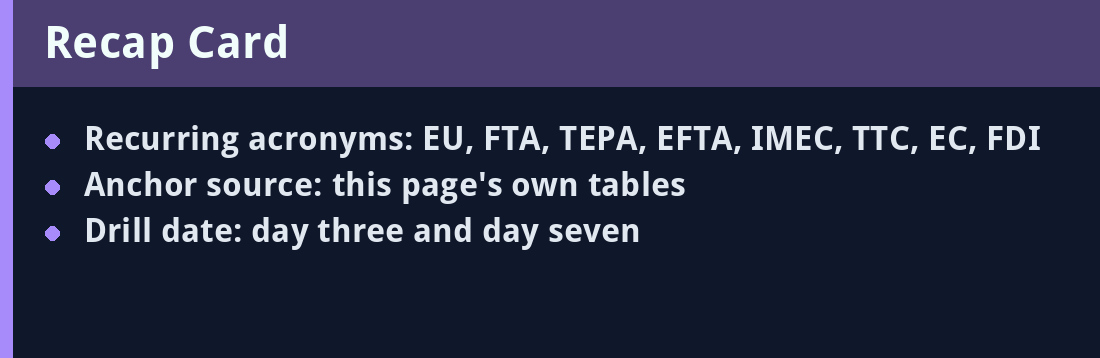
- EU.
- TEPA.
- EFTA.
- TTC.
- EC.
The Framework Line to Memorise
Foreign policy runs on a framework of interests: leverage authorizes, congruence validates. And compliance to multilateral protocol prices every bilateral discount.
Moreover, however the blocs realign, the framework questions stay constant. Therefore, validate interests first, deploy leverage second. And authorise commitments only after congruence appears. In addition, however crowded the summit calendar, the parameter that scores in mains is the doctrine, not the dinner.
The Doctrine Layer
Moreover, this block returns in papers with a fixed frame, therefore rehearse the frame itself and not just its facts. In addition, the strongest answers name their structure before they fill it.
The Calendar Ahead
However wide the material feels, the method stays narrow: tables twice, drill once, revisit on day three and day seven.
The Closing Table
| Metric | Target |
|---|---|
| First read | 20 minutes |
| Day-seven read | 5 minutes |
| Recall lines | 7 items |
| Drill score floor | 4 of 5 |
The Short-Word Close
Here is the close, in small words. The world has many big tables. Each state wants a seat. However, seats cost deals. Therefore, deals need trust, and trust grows slow. Moreover, the big prints of this week show states that talk, trade and sign. They also show states that stall, sulk and wait. In short, the game is old, the board is new, and the rules are still in draft. So watch the deals, not the smiles, and the marks will follow the deals.
Quick revision
- The weight.: The EU bloc is among India’s top two-or-three trading partners (goods-plus-services, roughly a hundred-and-twenty-billion-dollar corridor), its…
- The stalled decade.: The Broad-based Trade and Investment Agreement (BTIA) talks launched 2007, suspended 2013 — the classic gaps: tariffs (EU’s autos-and-wine…
- The 2020-21 turn.: The India-EU Leaders’ Meeting (May 2021, the Porto summit) relaunched the architecture: FTA talks to restart, plus separate…
- The strategic frame.: The EU’s China-de-risking, the Indo-Pacific tilt (the EU’s own strategy paper).
- The negotiating architecture — now concluded.: Three parallel tracks ran: the FTA proper (goods-and-services), the investment-protection agreement.
- The sticking-point map.: Market access for EU autos, wines-and-spirits.
Have a doubt on this topic?