Radicalisation Online and the CVE Playbook: Internal Security Part 9
In one line: Internal Security Part 9 — the online radicalisation funnel and the CVE playbook.
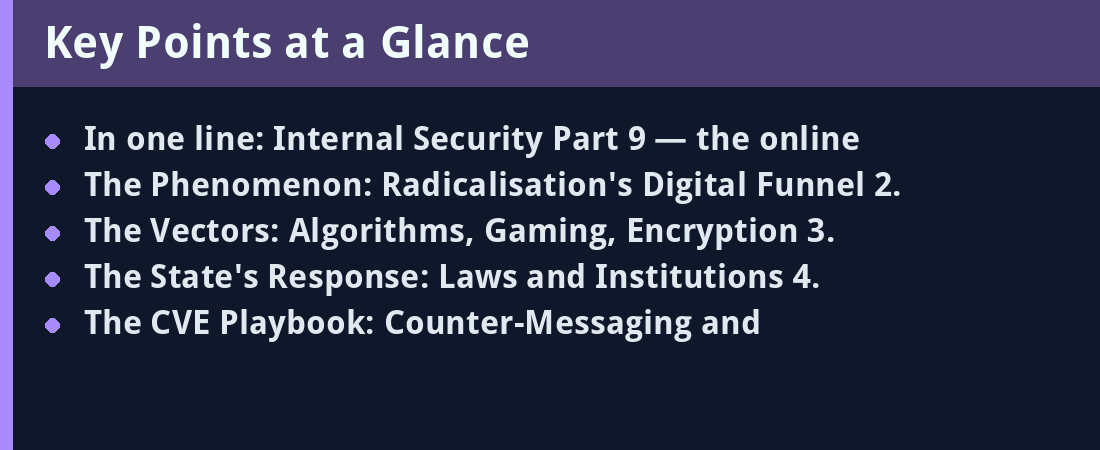
- 1. The Phenomenon: Radicalisation’s Digital Funnel
- 2. The Vectors: Algorithms, Gaming, Encryption
- 3. The State’s Response: Laws and Institutions
- 4. The CVE Playbook: Counter-Messaging and Deradicalisation
- 5. The Liberties Balance: The Democratic Constraint
- 6. How Exams Probe This Topic
- 7. Quick Revision: One-Glance Facts
- The Funnel
- Practice Corner: Five Definition Checks (with Answers)
- The Case Lens: The CVE Answer’s Framework
- The Three Classic Traps (Where Beginners Slip)
- Frequently Asked Questions
- What is online radicalisation?
- What is CVE?
- Which institutions lead India’s response?
- What are India’s deradicalisation models?
- How does the encryption debate figure here?
- Exam Checklist
- FAQ
- How much of this page is exam-relevant?
- When should I revisit?
- The Thirty-Second Recap
- Explain It Simply
- Abbreviations That Recur Here
- The Framework Line to Memorise
- The Staircase Model
- The Counter-Architecture
- The Closing Table
- The Ratio Table
In one line: The online-radicalisation chapter on one card: the digital funnel (grievance to echo chamber to encrypted cell); the platform layer — algorithms, gaming chats, encrypted apps; the state’s legal-and-institutional response (UAPA, NIA, the I4C-and-IT-rules machinery); and the counter-violent-extremism playbook — counter-messaging, deradicalisation programmes, community policing and the civil-society layer.
The CVE chapter stands on four counts. First, the phenomenon — what online radicalisation actually is, mechanically. Second, the vectors — platforms, gaming, encryption. Third, the state’s response — legal, institutional, operational. Fourth, the playbook beyond policing — deradicalisation, prevention, the balance with liberties.
Contents
1. The Phenomenon: Radicalisation’s Digital Funnel
2. The Vectors: Algorithms, Gaming, Encryption
3. The State’s Response: Laws and Institutions
4. The CVE Playbook: Counter-Messaging and Deradicalisation
5. The Liberties Balance: The Democratic Constraint
6. How Exams Probe This Topic
7. Quick Revision: One-Glance Facts
– Practice Corner: Five Definition Checks (with Answers)
– The Case Lens: The CVE Answer’s Framework
Quick Answer: Online radicalisation is a funnel: grievance-and-identity needs meet curated propaganda, algorithmic echo chambers. And encrypted small-group grooming — moving individuals from sympathy through justification to violence, faster and lonelier than the offline era. The state responds with the legal arsenal (UAPA’s framework, the NIA’s investigations) and the institutional layer (I4C for cyber coordination, platform governance under the IT rules), while the CVE playbook adds what policing cannot: counter-messaging, deradicalisation-and-rehabilitation programmes (the Maharashtra-and-Kerala models), community policing, education-and-employment interventions — all inside the democratic constraint that the fight against extremism cannot adopt extremism’s methods.
1. The Phenomenon: Radicalisation’s Digital Funnel
- The definition discipline. Radicalisation is the process (beliefs shifting toward justifying violence), not the endpoint (terrorism); extremism is the belief-position; violent extremism the readiness to act. The three-term ladder is the vocabulary every answer needs. Precision here matters because examiners routinely test whether candidates can distinguish a process from an outcome — answers that use the terms interchangeably lose the definitional mark at the very first step.
- The funnel’s stages (the mainstream model). Grievance-and-identity needs (alienation, discrimination-perception, status-seeking) → exposure (curated propaganda finding the vulnerable) → socialisation (echo chambers, online “communities” supplying belonging) → indoctrination (us-versus-them worldviews, justifying narratives) → mobilisation (tasking, logistics, the leap to violence). The funnel is gradual, individual and largely invisible until its last stages. This invisibility is the core policy problem: by the time the state sees an individual, the individual has already passed through the stages the state could most cheaply have interrupted.
- The digital acceleration. What changed online: speed (months replacing years of physical grooming), reach (borderless propaganda), isolation (self-radicalisation in bedrooms). And replicability (lone-actor attacks instructed remotely) — the four-way delta the mains answer names. Offline radicalisation required physical contact, a mentor, a safe house; online radicalisation requires only a smartphone, a grievance and a search history. The gardener-and-gym analogies used in security literature capture the point: radicalisation grows quietly in private before it shows publicly.
- The Indian manifestation. The IS-and-al-Qaeda online recruitment waves (the Kerala-and-Kashmir cases the NIA’s charge-sheets documented), the online conversion-and-grooming networks documented in NIA charge-sheets, the left-and-right violent-extremism fringes. And the cyber-enabled ethnic-and-communal incitement — the spectrum the exam should hold as “radicalisation’s Indian faces”. Note the spread: the phenomenon is not confined to one ideology or one region. Which is precisely why a single-agency, single-law response cannot suffice.
2. The Vectors: Algorithms, Gaming, Encryption
- The algorithmic amplifier. Engagement-optimised feeds push users down recommendation rabbit-holes; the platform-economics point for mains: the radicalisation risk is a design externality, not merely a content problem. The same engagement metrics that sell advertising also reward outrage and extremity — meaning the business model itself, not just individual bad actors, feeds the funnel. Regulatory answers (transparency in recommendation systems, risk assessments for large platforms) follow directly from this framing.
- Gaming-and-adjacent spaces. Game chats, voice servers and streaming platforms as grooming-and-recruitment venues (the ISIS-and-other networks’ documented use) plus gamification inside propaganda (first-person-shooter-style videos) — the vector parents-and-policy discovered a decade late. The recruitment logic is blunt: young audiences already spend hours inside these spaces. And the recruiter arrives where the audience already is, offering status, camaraderie and purpose.
- The encryption layer. End-to-end encrypted apps hosting small-group indoctrination-and-tasking; the legitimate privacy shield versus the operational darkness — the traceability-and-encryption debate (the IT-rules originator-tracking litigation) the GS2-and-GS4 crossover cites. Remember the two-sided point for balance: the same encryption protects journalists, dissidents and ordinary citizens. Which is why “just break encryption” is not an answer a democracy can give without a proportionality argument.
- The new-tools frontier. Deepfakes-and-synthetic media (incitement-and-impersonation at scale — this site’s deepfakes post covers the information-integrity layer), cryptocurrency financing. And AI-assisted propaganda-and-lone-actor instruction — the chapter’s frontier questions the interview board loves. The cost of producing convincing propaganda has collapsed; what once required a media wing now requires a laptop and a prompt.
3. The State’s Response: Laws and Institutions
- The legal arsenal (this series’ Part 3 territory, refreshed). UAPA (1967, amended through 2019): terrorism offences, stricter bail-and-remand regimes, designation powers; the NIA Act (2008, amended 2019 widening the schedule-and-scope) with the NIA as the apex investigating agency (radicalisation-linked cases its core docket); the IT Act’s 66F (cyberterrorism) and the IT Rules (2021-and-after) platform-takedown-and-due-diligence framework. Together these cover the offence, the investigator and the platform — the three points any intervention must touch.
- The institutional layer. The I4C (Indian Cyber Crime Coordination Centre) as the cybercrime-and-threat coordination hub; Cyber Crime Complaint Centre-and-reporting (the 1930 helpline); the Multi-Agency Centre (MAC) for intelligence sharing; state ATS units as the operational provincial arm — the four-institution list for any response answer. The design logic: cyber threats cross state boundaries, so coordination bodies sit above provincial police forces while the provinces retain the ground-level operational role.
- The operational record. NIA charge-sheets documenting online-recruitment modules; terror-funding-and-crypto-tracing cases; de-radicalisation engagements by police-and-agencies (the quiet successes the MHA’s annual reports note) — evidence-layer facts for mains. Citing charge-sheets and annual reports converts a generic answer into an evidence-backed one; examiners reward the specificity.
- The international layer. FATF’s standards (financing suppression), bilateral cyber-and-CT cooperation, INTERPOL’s notice machinery — the beyond-borders paragraph. Because radicalisation’s vectors are borderless while policing is territorial, the international layer is not decorative; it is where the funding trails and the takedown requests travel.
4. The CVE Playbook: Counter-Messaging and Deradicalisation
- The doctrine’s premise. Arrests interdict actors; only prevention-and-rehabilitation interdict production — CVE (countering violent extremism) addresses the pipeline, not the output. The prevention-rehabilitation-reintegration triad. The economics are simple: every individual prevented from entering the funnel saves the state an investigation, a prosecution and a prison term. And saves a family a radicalised member.
- Counter-and-alternative messaging. State counter-narratives (credible voices, not ministry handles) and alternative narratives (identity-belonging-and-aspiration content competing for the same audience); the civics-and-media-literacy layer in schools — the “inoculation” approach the research backs. The credibility point is decisive: propaganda is defeated not by contradiction from officials but by credible peers — former extremists, respected community figures, creators with organic audiences.
- Deradicalisation programmes. Maharashtra’s-and-Kerala’s police-run counselling models (psychological-and-religious counselling, family engagement, follow-up); the prison-and-probation dimension (radicalisation’s prison-risk and the rehabilitation-and-monitor balance); international comparisons (Saudi-and-Singapore’s programmes the comparative MCQ). The common design across all successful models: counselling plus family plus follow-up — none of the three works alone. And follow-up is where most programmes fail.
- The community-and-development layer. Community policing (trust as intelligence’s precondition), youth engagement-and-employment (the grievance-supply reduction), education-and-religious-leadership partnerships — the whole-of-society paragraph every GS answer closes with. Where communities trust the police, early-warning information flows; where they fear it, the funnel operates undisturbed. Trust is not a soft add-on — it is the intelligence architecture.
5. The Liberties Balance: The Democratic Constraint
- The dilemma’s shape. Encryption-breaking, mass-surveillance, content-criminalisation and preventive detention all trade liberty for security — and all carry overreach-and-misuse risks (UAPA’s bail regime and its misuse debates the exam expects balanced treatment of).
- The proportionality frame. The Puttaswamy-privacy doctrine’s test (legality, legitimate aim, proportionality. And procedural safeguards against abuse) applied to surveillance-and-takedown powers; judicial oversight-and-sunset clauses as the institutional safeguards — the constitutional-essay layer. The test converts an abstract values clash into a four-question checklist any measure must pass; quoting the checklist is the surest way to structure a GS2 or GS4 answer.
- The counter-productivity evidence. Overbroad crackdowns feed the grievance narratives they fight (the “martyr-and-persecution” frames); community-alienation is radicalisation’s ally — the strategic argument for the CVE-balance, not merely the moral one. This is the answer’s sharpest edge: restraint is not a concession to extremists but a denial of their recruitment pitch.
- The mains verdict. A democracy’s counter-extremism is judged by both effectiveness and restraint; the playbook’s civil-society half is not the soft option but the sustainable one.
6. How Exams Probe This Topic
- Prelims MCQs: institution-to-function matching (NIA, I4C, MAC, ATS); UAPA-and-NIA-Act amendment years; the radicalisation-stages ordering; the deradicalisation models’ states; IT-rules-and-traceability provisions.
- Mains questions: “Online radicalisation is a design-and-society problem, not merely a policing one — examine”; the CVE playbook’s components; encryption-versus-security; social media’s role in communal violence (with case references); the prison-radicalisation risk. Note the pattern: nearly every mains phrasing rewards the design-externality framing and penalises a pure-policing answer.
- The interview-and-current-affairs layer: each terror-module bust, deepfake incident and platform-regulation development lands on this chapter’s pegs — hold the funnel-and-playbook framework and the news files itself.
7. Quick Revision: One-Glance Facts
- Ladder. Radicalisation (process) → extremism (belief) → violent extremism (action-readiness).
- Funnel. Grievance → exposure → socialisation → indoctrination → mobilisation — online accelerates all five stages.
- Vectors. Algorithmic amplification, gaming-and-voice platforms, E2EE small groups, deepfakes-and-crypto financing.
- Response stack. UAPA + NIA (legal), I4C + MAC + ATS (institutional), IT-rules (platform), FATF (international).
- Playbook. Counter-messaging, deradicalisation (Maharashtra-Kerala models), community policing, education-and-employment — inside the proportionality constraint.
Conclusion. Online radicalisation is a funnel the internet greased: grievances meet algorithms meet encryption. And the state’s policing interdicts outputs while CVE’s playbook — messaging, mentoring, rehabilitation, community — works the pipeline. The chapter’s exam truth is its final constraint: a democracy fights extremism with both effectiveness and restraint, because the fight’s methods are the fight’s stakes.
The Funnel
| Stage | Marker |
|---|---|
| 1 — Grievance | Perceived injustice |
| 2 — Exposure | Propaganda contact |
| 3 — Framing | Us-vs-them narrative |
| 4 — Identification | In-group belonging |
| 5 — Action | Mobilisation to violence |
Practice Corner: Five Definition Checks (with Answers)
- The I4C is — The Indian Cyber Crime Coordination Centre — the national hub coordinating cyber-threat-and-crime response.
- Deradicalisation programmes’ Indian exemplars run in — Maharashtra and Kerala (police-run counselling-and-follow-up models).
- The radicalisation funnel’s order is — Grievance → exposure → socialisation → indoctrination → mobilisation.
- The apex counter-terror investigating agency, created 2008, is — The National Investigation Agency (NIA).
- The proportionality test for surveillance powers flows from — The Puttaswamy privacy doctrine (legality, legitimate aim, proportionality).
The Case Lens: The CVE Answer’s Framework
Any radicalisation-or-extremism question — a recruitment-module bust, a deepfake-driven riot, an encryption debate — resolves on one framework: the funnel (which stage the news concerns), the vector (which platform-or-technology), the response (which law-and-institution), the playbook (which prevention-and-rehabilitation layer applies). And the balance (which liberty interest is at stake). Five panels; every headline slots into one; the conclusion always pairs effectiveness with restraint. Practise by taking this week’s security headlines and forcing each one into a panel — if a headline resists all five, you have probably missed a dimension of the story.
The Three Classic Traps (Where Beginners Slip)
“Radicalisation equals terrorism.” Radicalisation is the process; violent action is the endpoint. Conflating them turns a sociology answer into a policing one — and misses the prevention logic entirely.
“The answer is takedowns-and-arrests.” They interdict actors, not the pipeline. The CVE literature’s core finding — production outpaces interdiction — is the analytical step the exam rewards.
“Security-and-liberty is either-or.” The constitutional frame is proportionality-with-oversight; overreach is not merely illiberal but counter-productive (grievance-feeding). Both halves carry marks; slogans do not.
Frequently Asked Questions
What is online radicalisation?
The process by which individuals move toward extremist beliefs — and potentially violent action — through digital exposure: propaganda, algorithmic echo chambers, encrypted small-group grooming and remote tasking, faster and more isolated than offline radicalisation.
What is CVE?
Countering violent extremism — the non-pure-policing playbook against the radicalisation pipeline: counter-and-alternative messaging, deradicalisation-and-rehabilitation programmes, community policing, education-and-employment interventions.
Which institutions lead India’s response?
The NIA (apex investigations under the NIA Act), the I4C (cyber coordination), the MAC (intelligence sharing), state ATS units. And the platform-governance framework under the IT Act-and-rules — with UAPA as the principal legal arsenal.
What are India’s deradicalisation models?
State-level programmes — Maharashtra’s and Kerala’s prominent — combining psychological-and-religious counselling, family engagement and follow-up monitoring; prison-and-probation interventions; international parallels in Saudi-and-Singapore programmes.
How does the encryption debate figure here?
End-to-end encryption shields both privacy and operational secrecy; the traceability-and-breakdown debates (originator-tracking under the IT rules) embody the dilemma — the proportionality-and-oversight frame being the constitutional way through.
Related on hmmnm.in: Internal Security Part 7: SAGAR, Piracy, Gulf of Guinea · Internal Security Part 6: Commands and Theatre Debate · Internal Security Part 5: Golden Crescent Drug Routes
Read next: Internal Security Part 8: Police and CAPF Reforms (series archive)
Exam Checklist
- Therefore, revise the article table vertically
- Pair each number with its office
- Write one mains-skeleton weekly
- In addition, teach the page to a peer in three minutes
- Revisit on Sunday with the quiz

FAQ
How much of this page is exam-relevant?
Nearly all of it, because the tables and worked items follow the standard question register for this subject.
When should I revisit?
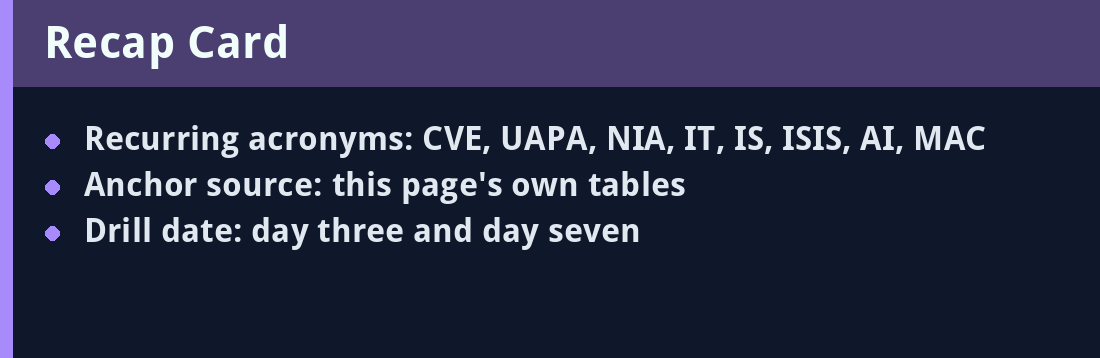
Day three and day seven after the first read, with the drill spoken aloud once.
The Thirty-Second Recap
One page. One topic. Therefore, read the tables twice. Speak the recap once. Moreover, the numbers carry the marks. The names carry the traps. However, revisits beat rereads. Finally, day three and day seven. That is all.
Explain It Simply
Think of this page as a map of one neighbourhood. The big streets are the tables. The landmarks are the numbers. The street names are the terms in bold. However big the city feels, this one neighbourhood fits in a pocket. And a pocket map is what exam week needs. Therefore, walk it once fully, then walk only the streets you forget. And by the second walk the neighbourhood feels like home.
Pocket the map, not the whole city: exams reward the walkable version of every topic.
Abbreviations That Recur Here
- CVE.
- NIA.
- IT.
- ISIS.
- AI.
The Framework Line to Memorise
Online radicalisation follows a staged protocol: grievance, echo, validation, action – and the counter-framework intervenes earliest, before authorization of violence feels like belonging.
The Staircase Model
Moreover, this block returns in papers with a fixed frame, therefore rehearse the frame itself and not just its facts. In addition, the strongest answers name their structure before they fill it.
The Counter-Architecture
However wide the material feels, the method stays narrow: tables twice, drill once, revisit on day three and day seven.
The Closing Table
| Metric | Target |
|---|---|
| First read | 20 minutes |
| Day-seven read | 5 minutes |
| Recall lines | 7 items |
| Drill score floor | 4 of 5 |
The Ratio Table
| Item | Count |
|---|---|
| Staircase stages | 4 |
| Case dilemmas | 10 |
| Drill items | 5 |
| Values to name | 10 |
| Words per answer | 200 |
However the paper frames the dilemma, therefore walk the staircase. Moreover, name the stage. In addition, name the value. However, finally, therefore, the answer closes itself in one line.
Quick revision
- The definition discipline.: Radicalisation is the process (beliefs shifting toward justifying violence), not the endpoint (terrorism); extremism is the belief-position; violent…
- The funnel’s stages (the mainstream model).: Grievance-and-identity needs (alienation, discrimination-perception, status-seeking) → exposure (curated propaganda finding the vulnerable) →…
- The digital acceleration.: What changed online: speed (months replacing years of physical grooming), reach (borderless propaganda), isolation (self-radicalisation in bedrooms).
- The Indian manifestation.: The IS-and-al-Qaeda online recruitment waves (the Kerala-and-Kashmir cases the NIA’s charge-sheets documented), the online…
- The algorithmic amplifier.: Engagement-optimised feeds push users down recommendation rabbit-holes; the platform-economics point for mains: the radicalisation risk is a design…
- Gaming-and-adjacent spaces.: Game chats, voice servers and streaming platforms as grooming-and-recruitment venues (the ISIS-and-other networks’ documented use) plus…
Have a doubt on this topic?