JEE/NEET Physics · Moving Charges & Magnetism series · Part 7 of 8 · All parts →
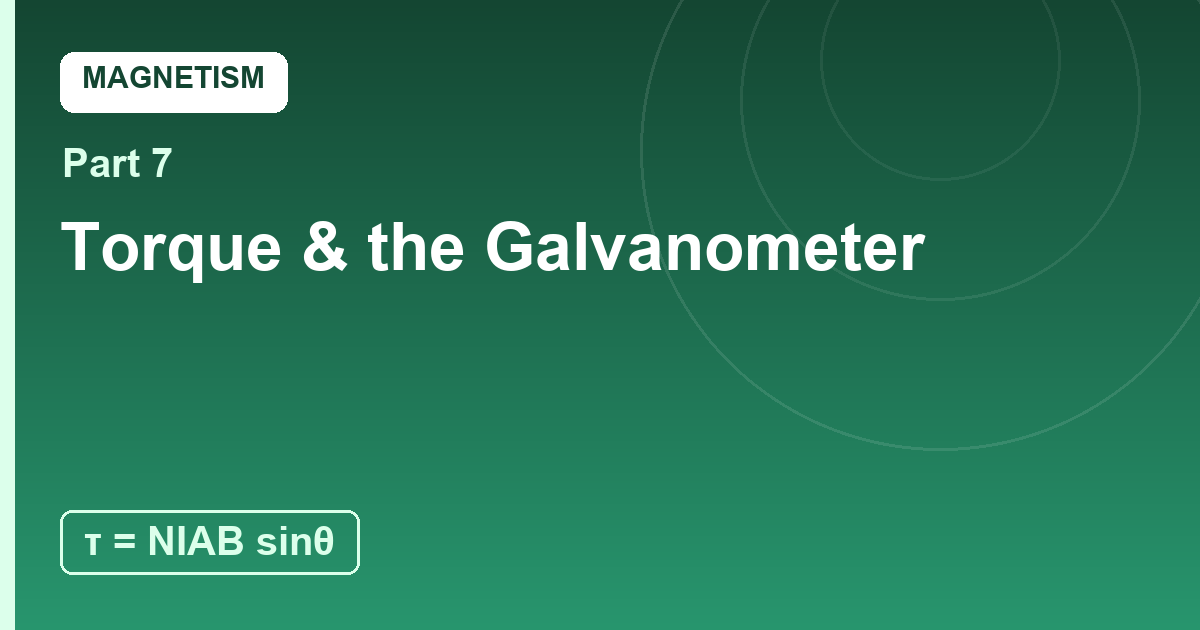
- Current loop in field B feels torque: τ = NIAB sinθ — the motor principle
- Maximum torque when the loop’s plane is parallel to B; zero when ⊥
- DC motors: torque + commutator flips = continuous rotation
- Galvanometer: springs make deflection ∝ current — a meter is born
- Conversions: ammeter = shunt (parallel low R); voltmeter = series high R
Push two opposite sides of a coil with opposite forces and it turns — that’s every motor. Add a spring so the turn fights back proportionally, and the angle itself becomes a current reading — that’s every meter. One torque, two inventions. Part 7 of the Moving Charges & Magnetism series.
- The twisting pair of forces
- Torque formula
- Motors: keeping the spin
- Galvanometer: measuring by twisting
- Ammeter and voltmeter conversions
- Solved examples
- Common mistakes
- This physics in your daily life
- Practice set
- Recap
The Twisting Pair of Forces
In field B, a loop’s two long sides feel equal and opposite BIl forces (their currents run opposite ways) — not a cancellation but a COUPLE: pure torque. The other two sides contribute nothing (their currents lie along B).
Torque Formula
Motors: Keeping the Spin
Left alone, torque would oscillate the loop to alignment and stall. A commutator — a clever split-ring contact — reverses the current every half-turn, keeping torque always in the rotational sense: continuous spin. Every fan, drill, and EV traction motor descends from this trick.
Galvanometer: Measuring by Twisting
Replace the commutator with a hair-spring: the coil twists until spring torque (kφ) balances magnetic torque (NIAB): φ ∝ I. A needle on the coil reads current directly — the galvanometer, ancestor of all analog meters.
Ammeter and Voltmeter Conversions
| Want | Add | Result |
|---|---|---|
| Ammeter (full I) | tiny shunt R in parallel | low total R, I splits by inverse R |
| Voltmeter (full V) | big multiplier R in series | high total R, V = I·R_total |
Solved Examples
τ = NIAB = 50×2×20×10⁻⁴×0.1 = 2×10⁻³ N·m.
✔
Answer: 2 mN·m
Shunt carries 0.999 A at 0.1 V: R = 0.1/0.999 ≈ 0.1 Ω.
✔
Answer: ≈0.1 Ω
Full-scale needs 10 V across 100 Ω + R with 1 mA: R = 10/0.001 − 100 = 9900 Ω.
✔
Answer: 9.9 kΩ
- θ definition slip. Torque’s θ is between the NORMAL and B: plane parallel to B = normal ⊥ B = MAXIMUM torque.
- Shunt in series. Shunts go PARALLEL (bypass); multipliers SERIES (share voltage) — the reversals ruin meters.
- Believing meters are perfect. Every ammeter adds series resistance; every voltmeter draws current: ideal limits, real perturbations.
- Forgetting N. Loop torque scales with turns: coils stack torque like they stack field.
This Physics in Your Daily Life
- Every fan, mixer, drill and EV — torque τ = NIAB + commutation: the rotating machine economy runs on this card.
- Washing machines and water pumps — induction-coupled cousins of the same torque principle: households full of spinning loops.
- Analogue dashboard gauges (fuel, speed) — galvanometer movements reading sensor currents: springs balancing torque since the 1880s.
- Digital multimeters’ ancestry — their ‘volt/ohm/amp’ lineage runs directly through moving-coil conversions: the shunt/multiplier logic survives in silicon.
- Hard-disk drive voice coils — torque loops positioning read heads with micron precision: this card still serving data.
Put a paddle-wheel in a river: opposite sides feel opposite pushes and the wheel turns. A current loop in a field is an electromagnetic paddle-wheel — opposite sides carry opposite currents, feel opposite pushes, and rotation is the only possible response.
100-turn coil, 10 cm², 1 A, 0.2 T: τ = 0.02 N·m — enough to spin small loads. Multiply area by 100 (bigger coil): 2 N·m — motor-scale. Geometry (N, A) is the engineer’s torque dial, no stronger field needed.
Draw the loop side-on: two force arrows, one up on the front edge, one down on the back — a twisting pair. Rotate the drawing: when the loop’s plane is parallel to B, the lever arms are longest and torque peaks; aligned, forces pull outward and cancel harmlessly — the picture explains the sinθ.
Practice set (answers hidden — try first)
(NEET-level) Torque is max when loop plane is
(JEE Main-level) N=100, A=25 cm², I=1 A, B=0.4 T: τ =
(NEET-level) An ammeter uses a galvanometer plus
(Concept) The commutator’s job:
(JEE Main-level) 50 Ω, 5 mA meter → 5 V voltmeter: multiplier =
- loop torque: τ = NIAB sinθ
- couple of forces, no net push
- commutator → continuous spin
- spring-balance → galvanometer
- shunt/multiplier conversions
- 🔁 torque formula and angle meaning
- 🔁 motor commutation logic
- 🔁 galvanometer principle
- 🧠 Chant: ‘opposite sides, opposite pushes, pure twist’.
- 🧠 Meter rule: ‘shunt parallel, multiplier series’.
- 🏠 Daily: fans and EVs spin by NIAB.
- 🏠 Daily: fuel gauges = springs vs torque.
Quick revision
- Current loop in field B feels torque: τ = NIAB sinθ — the motor principle
- Maximum torque when the loop’s plane is parallel to B; zero when ⊥
- DC motors: torque + commutator flips = continuous rotation
- Galvanometer: springs make deflection ∝ current — a meter is born
- Conversions: ammeter = shunt (parallel low R); voltmeter = series high R
- The twisting pair of forces
Have a doubt on this topic?