
JEE/NEET Physics · Kinetic Theory series · Part 2 of 4 · All parts →
- Gas pressure = total drumbeat of molecular collisions on the walls
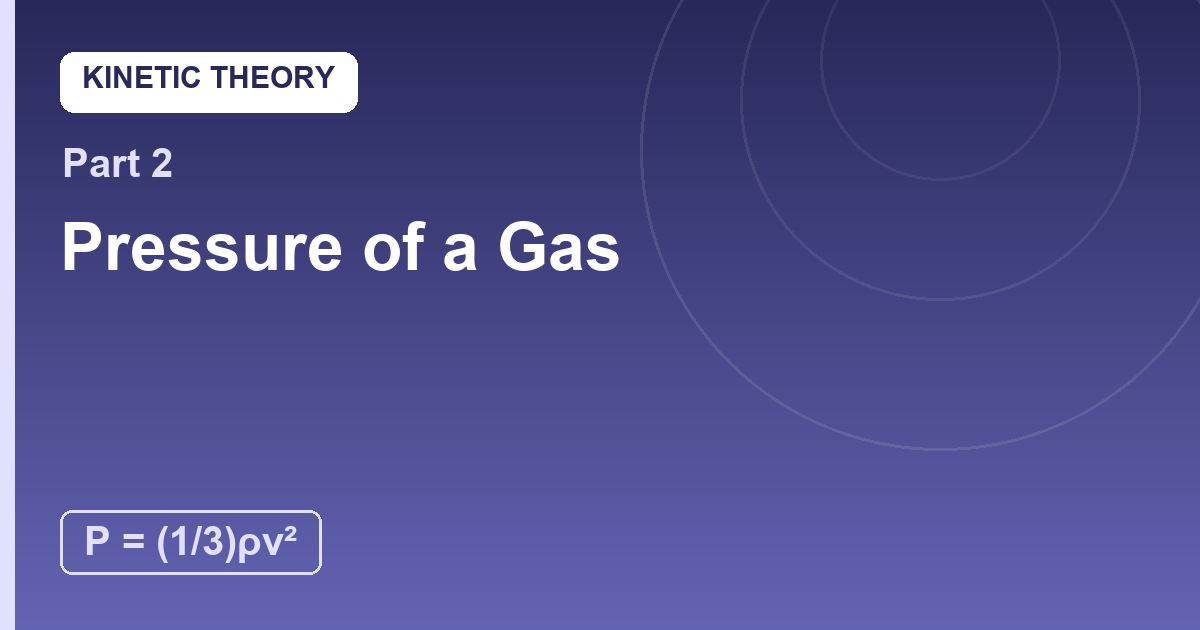
- Derivation core: P = (1/3)ρv²_rms — pressure from density and molecular speed
- Equivalent forms: PV = (1/3)Mv²_rms and ⟨KE⟩ = (3/2)PV/N
- Boyle’s, Charles’s, Gay-Lussac’s laws all fall out of this one derivation
- Temperature is truly nothing but molecular kinetic energy
Why does air push on everything it touches? Because trillions of tiny bullets are hitting it every second. Pressure isn’t a mysterious fluid property — it’s the arithmetic of molecular collisions. Watch the derivation fall out of Newton’s own laws. Part 2 of the Kinetic Theory series.
- Collisions make pressure
- The (1/3)ρv² result
- The gas laws, re-derived
- Temperature unmasked
- Solved examples
- Common mistakes
- This physics in your daily life
- Practice set
- Recap
Collisions Make Pressure
One molecule hitting a wall bounces elastically — momentum reverses, and Newton’s second law says the wall felt a force. Multiply by 10²³ molecules arriving randomly but steadily: a smooth, constant pressure. Pressure is the riot, averaged.
The (1/3)ρv² Result
| Letter | What it means (plain words) | Value / unit |
|---|---|---|
| ρ | gas density = mass per volume | kg/m³ |
| v²_rms | mean-square molecular speed | (m/s)² |
| (1/3) | the geometry factor: motion shares among 3 axes | pure counting |
The Gas Laws, Re-Derived
| Law | Condition | Falls out as |
|---|---|---|
| Boyle | T fixed | P ∝ 1/V (v² fixed) |
| Charles | P fixed | V ∝ T (v² ∝ T) |
| Gay-Lussac | V fixed | P ∝ T |
| Avogadro | same P, T, V | same N — every gas! |
Temperature Unmasked
Combine P = (1/3)ρv² with PV = NkT and temperature reveals itself: (1/2)mv²_rms = (3/2)kT. Temperature IS average molecular kinetic energy — the thermometer is a speedometer for the invisible. Absolute zero (0 K) is the full stop of molecular motion.
Solved Examples
P = (1/3)ρv² = (1/3)(1.2)(250,000) = 10⁵ Pa — one atmosphere, computed from pure molecular motion.
✔
Answer: 10⁵ Pa
v_rms = √(3kT/m) = √(3 × 1.38×10⁻²³ × 300 / 6.7×10⁻²⁷) ≈ 1370 m/s.
Light molecule, blazing speed at the same temperature. ✔
Answer: ≈1370 m/s
KE = (3/2)nRT = 1.5 × 8.31 × 300 ≈ 3.74 kJ — for ANY gas: helium, oxygen, or uranium vapour.
✔
Answer: ≈3.74 kJ (any gas!)
- Losing the 1/3. It comes from three axes sharing motion — forgetting it doubles/triples pressure instantly.
- Using average speed instead of rms. The derivation needs mean SQUARE speed; v_avg ≠ v_rms.
- kg vs g for molecular mass. Molar mass in kg/mol in v = √(3RT/M): 32 g/mol must become 0.032.
- Treating pressure as weight-related. Unlike liquids’ ρgh, gas pressure is collision-made — a completely different mechanism.
This Physics in Your Daily Life
- Car tyres hold their shape — nothing structural inside, just molecules drumming the rubber at ~500 m/s: form kept by drumbeat.
- Party balloons feel firm — slightly faster molecules inside (warm breath) drum harder than the outside air: inflation by statistics.
- Vacuum-packaged coffee goes ‘hiss’ when opened — you release a wall for trapped molecules to drum against: pressure released as sound.
- Lighter gases leak fastest from tyres and balloons — v ∝ 1/√m: the reason hydrogen and helium escape everything.
- Weather pressure maps — highs and lows are molecular-drumbeat censuses: the riot’s statistics read as tomorrow’s rain.
One raindrop on a tin roof: a tick. A million raindrops per second, arriving at random: a steady roar. Individual molecular hits are unpredictably random, but 10³² of them per second average into the smoothest push in nature — pressure is the law of large numbers made tactile.
Air at 1 atm: 10⁵ Pa = 10⁵ newtons on every square metre — a 10-tonne drumbeat, painless only because it pushes from all sides equally. Halve the volume (Boyle) and the wall-hit rate doubles: 2 atm. Double the temperature and √2-faster hits arrive √2-harder: pressure × 2 — every gas law from one formula.
Draw a cube with one molecule bouncing between walls; tick marks at each impact. Now a thousand arrows doing the same: the wall receives a continuous push. Label the push ‘P = (1/3)ρv²’ — the picture IS the derivation.
Practice set (answers hidden — try first)
(NEET-level) P = (1/3)ρv² with ρ = 3 kg/m³, v = 100 m/s:
(JEE Main-level) T rises 300 K → 1200 K: v_rms
(NEET-level) Boyle’s law holds when what is fixed?
(Concept) Gas pressure originates from:
(JEE Main-level) 2 mol gas at 400 K: total translational KE =
- pressure = averaged molecular drumbeat
- P = (1/3)ρv²_rms
- all gas laws re-derive from it
- ⟨KE⟩ = (3/2)kT — temperature unmasked
- absolute zero = motion’s full stop
- 🔁 collision origin of pressure
- 🔁 the 1/3 factor’s meaning
- 🔁 derived gas laws
- 🧠 Chant: ‘one-third rho vee-squared’.
- 🧠 Thermometer: ‘a speedometer for the invisible’.
- 🏠 Daily: tyre shape kept by drumbeat.
- 🏠 Daily: coffee hiss = drumbeat released.
Quick revision
- Gas pressure = total drumbeat of molecular collisions on the walls
- Derivation core: P = (1/3)ρv²_rms — pressure from density and molecular speed
- Equivalent forms: PV = (1/3)Mv²_rms and ⟨KE⟩ = (3/2)PV/N
- Boyle’s, Charles’s, Gay-Lussac’s laws all fall out of this one derivation
- Temperature is truly nothing but molecular kinetic energy
- This physics in your daily life
Have a doubt on this topic?