JEE/NEET Physics · Laws of Motion series · Part 6 of 8 · All parts →
- Top of a vertical loop: gravity itself helps push you centre-ward
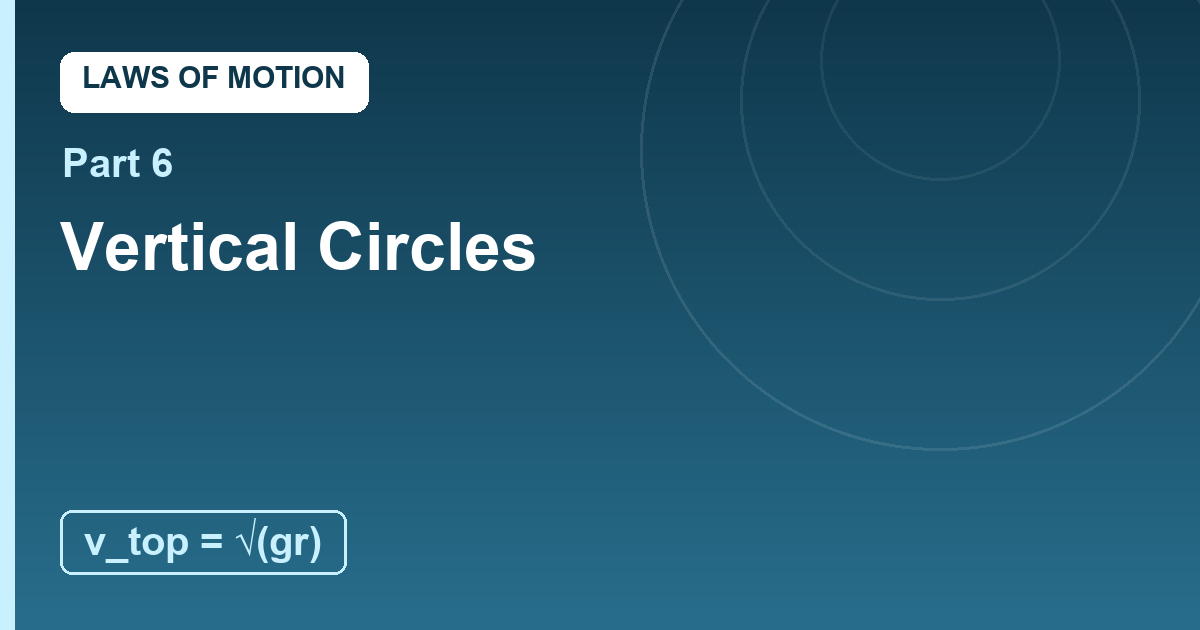
- Minimum top speed: gravity alone supplies mv²/r → v_top = √(gr)
- Bottom of the loop: the track must fight gravity AND turn you → N = m(v²/r + g), the heaviest point
- Critical case (just maintaining contact): v_top = √(gr), N_top = 0
- Bucket-over-head and loop-the-loop: the same three equations
Swing a bucket of water over your head and the water stays in. Drive a loop-the-loop and your seat pushes hardest at the bottom, almost nothing at the top. Vertical circles are where circular motion feels like a carnival. Part 6 of the Laws of Motion series.
- Gravity joins the team
- The top: gravity helps
- The bottom: gravity opposes
- The critical speed
- Solved examples
- Common mistakes
- This physics in your daily life
- Practice set
- Recap
Gravity Joins the Team
In a vertical circle, the required centre-ward force mv²/r stays the same idea, but gravity now points TOWARD the centre at the top and AWAY from it at the bottom. The supplier (track or string or bucket-bottom) must adjust dramatically around the loop.
The Top: Gravity Helps
At the summit, gravity points down — i.e. centre-ward. So the push needed from the seat is reduced: N + mg = mv²/r. In the critical case, gravity alone suffices: N = 0 and v_top = √(gr) — the minimum speed to maintain the circle (string taut, water in bucket).
The Bottom: Gravity Opposes
At the base, gravity pulls AWAY from the centre: the track must overcome it AND turn you: N = mv²/r + mg — the heaviest you’ll feel all ride. Fighter pilots blackout here; roller-coaster riders scream here.
| Letter | What it means (plain words) | Value / unit |
|---|---|---|
| v_top | speed at the loop’s summit | m/s |
| √(gr) | critical summit speed for contact/tautness | m/s |
| N | push from track/seat (or string tension) | N |
The Critical Speed
Below √(gr) at the top, neither gravity nor any push (string can’t push) can supply the needed centre-force → the object leaves the circle and becomes a projectile (Part 3 of the previous series!). Water buckets and looping aeroplanes obey identically.
Solved Examples
v = √(gr) = √10 ≈ 3.16 m/s.
✔
Answer: ≈3.16 m/s
Bottom: N = 500(400/10 + 10) = 500 × 50 = 25,000 N.
Top: N = 500(196/10 − 10) = 500 × 9.6 = 4800 N.
Same cart: five times heavier at the base than the summit. ✔
Answer: 25 kN bottom; 4.8 kN top
Energy from bottom to top: ½mv_b² = ½mv_t² + mg(2r) with v_t = √(gr).
v_b² = gr + 4gr = 5gr = 100 → v_b = 10 m/s.
The famous √(5gr) — every looping problem’s skeleton key. ✔
Answer: √(5gr) = 10 m/s
- Using v_top = √(gr) as a general speed. It’s the MINIMUM summit speed only; faster is fine (N grows).
- Uniform speed assumption. Real vertical circles trade speed for height (energy!): the bottom is fastest unless a motor evens it out.
- N at top = 0 always. Only in the critical minimum case; generally N = mv²/r − mg can be any positive value.
- Forgetting gravity flips roles. Top: gravity centripetal-helper; bottom: gravity’s enemy. One sign change, entirely different seat-feel.
This Physics in Your Daily Life
- Roller-coaster loops are engineered so v_top comfortably exceeds √(gr): the safety margin is the difference between a thrill and a lawsuit.
- Water-bucket swing — every village fair trick: above √(gr) at the top, the water stays; the ‘centrifugal feeling’ is just the bucket failing to push you where inertia wants to go.
- Aerobatic pilots pull several g at loop-bottom (blood drains from head, grey-out) and near-zero g over the top (red-out’s opposite): vertical-circle physiology.
- Laundry machine spin drums — clothes ride vertical circles; water leaves through holes whenever the drum can’t supply the centripetal force: Part 6 doing the drying.
- Gymnasts’ giant swings on high bars — accelerate at the bottom (muscles + gravity), coast over the top above √(gr): every kip is this card.
At the top, ask ‘what’s pushing the water DOWN into the bucket?’ Nothing needs to — that’s the trick. The water WANTS to go straight (inertia), and the bucket’s floor curves away beneath it; to follow the circle, the water needs a centre-ward (downward here) force, and gravity is already supplying exactly that. No floor needed; the floor is a bonus.
1 m radius, g = 10: critical top speed √10 ≈ 3.16 m/s. At 5 m/s the floor still pushes (N = m(25 − 10)/1 = 15m newtons); at 3.16 the floor’s job is zero; below it, gravity over-supplies the turn — the water curves tighter than the bucket and detaches. One number decides everything.
Rear-view the loop: at the top, draw mg and N both pointing down toward centre; at the bottom, mg down (away from centre) and N up. The arrow balance visibly flips between the two stations — the picture explains why the bottom seat-crush and the top weightlessness are the same physics, 180° apart.
Practice set (answers hidden — try first)
(NEET-level) r = 0.5 m, g = 10: critical top speed =
(JEE Main-level) Bottom speed needed for a taut 1 m circle (g=10):
(NEET-level) At loop top at critical speed, N =
(Concept) The seat feels heaviest at the loop’s:
(JEE Main-level) v_top = 2√(gr) on r = 5 m (g=10): N =
- top: gravity helps centre-ward
- critical: v_top = √(gr), N_top = 0
- bottom: N = mv²/r + mg — heaviest point
- below critical → leaves circle, becomes projectile
- release speed for full circle: √(5gr) at bottom
- 🔁 vertical circle: gravity flips role
- 🔁 v_top(min) = √(gr)
- 🔁 N_bottom = mv²/r + mg
- 🧠 Chant: ‘top is √gr, bottom is five-gr’.
- 🧠 Feel map: ‘crushed at the bottom, floating at the top’.
- 🏠 Daily: bucket swing = free gravity donation.
- 🏠 Daily: pilots grey-out at loop-bottom g’s.
Quick revision
- Top of a vertical loop: gravity itself helps push you centre-ward
- Minimum top speed: gravity alone supplies mv²/r → v_top = √(gr)
- Bottom of the loop: the track must fight gravity AND turn you → N = m(v²/r + g), the heaviest point
- Critical case (just maintaining contact): v_top = √(gr), N_top = 0
- Bucket-over-head and loop-the-loop: the same three equations
- The bottom: gravity opposes
Have a doubt on this topic?