Quick Answer
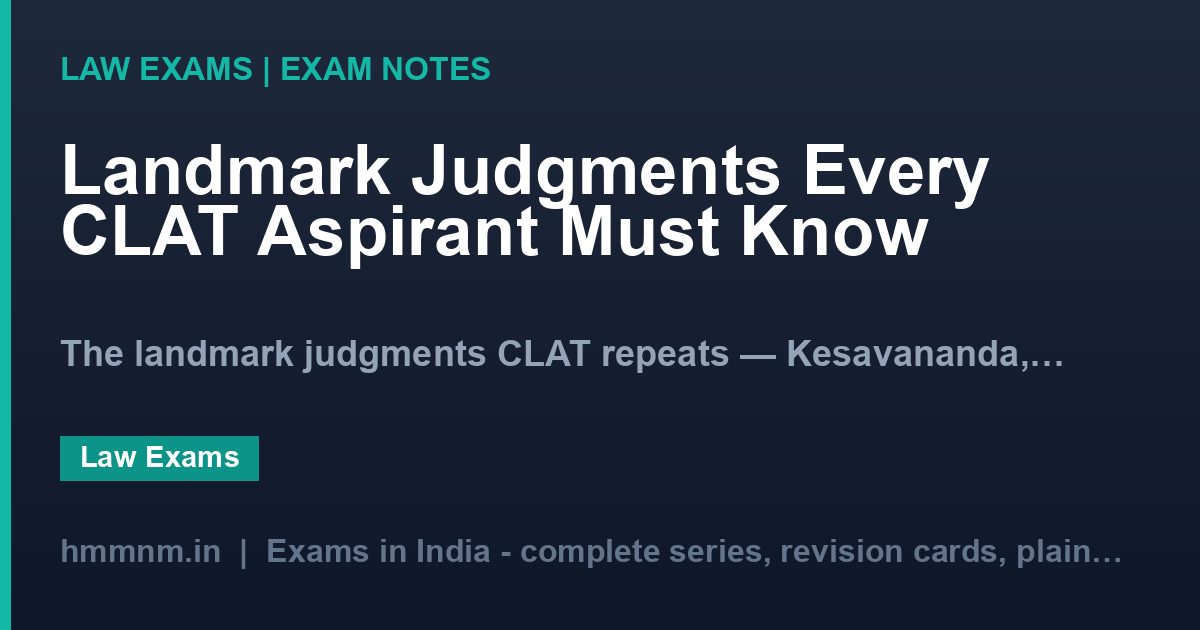
10 Landmark Judgments Every CLAT Aspirant Must Know for Exam Success
Landmark judgments define doctrines exams repeat: Kesavananda (basic structure), Maneka Gandhi (fair procedure under Article 21), Puttaswamy (privacy as a fundamental right), Shreya Singhal (online speech), Vishaka (workplace guidelines) — know the case, the doctrine and one sentence of its effect.
Visual Summary
- Kesavananda 1973 — amendment cannot destroy basic structure.
- Maneka 1978 — Article 21 demands fair, just procedure.
- Puttaswamy 2017 — privacy is a fundamental right (9 judges).
- Shreya Singhal 2015 — struck down online-speech censorship.
The Constitutional Landmarks
Kesavananda Bharati (1973) created the basic-structure limit on amendment. Maneka Gandhi (1978) read Article 21’s procedure as fair, just and reasonable — collapsing the compartmental view of rights. Puttaswamy (2017), by nine judges, declared privacy intrinsic to Article 21, overruling older narrow readings and grounding data-protection law. Shreya Singhal (2015) struck down Section 66A as vague and overbroad — protecting online speech. Vishaka (1997) read workplace-harassment guidelines into Article 21 until legislation filled the gap.
Why They Repeat in Exams
Legal-reasoning passages borrow these doctrines as their principles: proportionality (Puttaswamy), fair procedure (Maneka), the open basic-structure list (Kesavananda). Knowing the case, year and one-sentence effect converts a passage question into a recall question. The pattern: case name → doctrine → how later facts apply it.
Exam Angle
Build a one-page case map: name, year, doctrine, effect sentence. Test yourself against the CLAT passages — each doctrine reappears in a fresh fact costume. Practise in the CLAT mock and sectional.
FAQ
How many Puttaswamy judges sat?
Nine — a unanimous bench declared privacy a fundamental right.
What did Shreya Singhal strike down?
Section 66A of the IT Act — punishing online statements — as unconstitutional for vagueness.
Related reading
- New Criminal Laws of India: BNS, BNSS and BSA Explained
- Union-State Legislative Relations Under the Constitution
Exam angle
How exams use this: CLAT/AILET test comprehension application, not statute memory — accuracy-per-minute in passages is the skill. Test it under exam conditions →
Quick revision
- Kesavananda 1973: — amendment cannot destroy basic structure.
- Maneka 1978: — Article 21 demands fair, just procedure.
- Puttaswamy 2017: — privacy is a fundamental right (9 judges).
- Shreya Singhal 2015: — struck down online-speech censorship.
- New Criminal Laws of India: BNS, BNSS and BSA Explained
- Union-State Legislative Relations Under the Constitution
Have a doubt on this topic?