Quick Answer
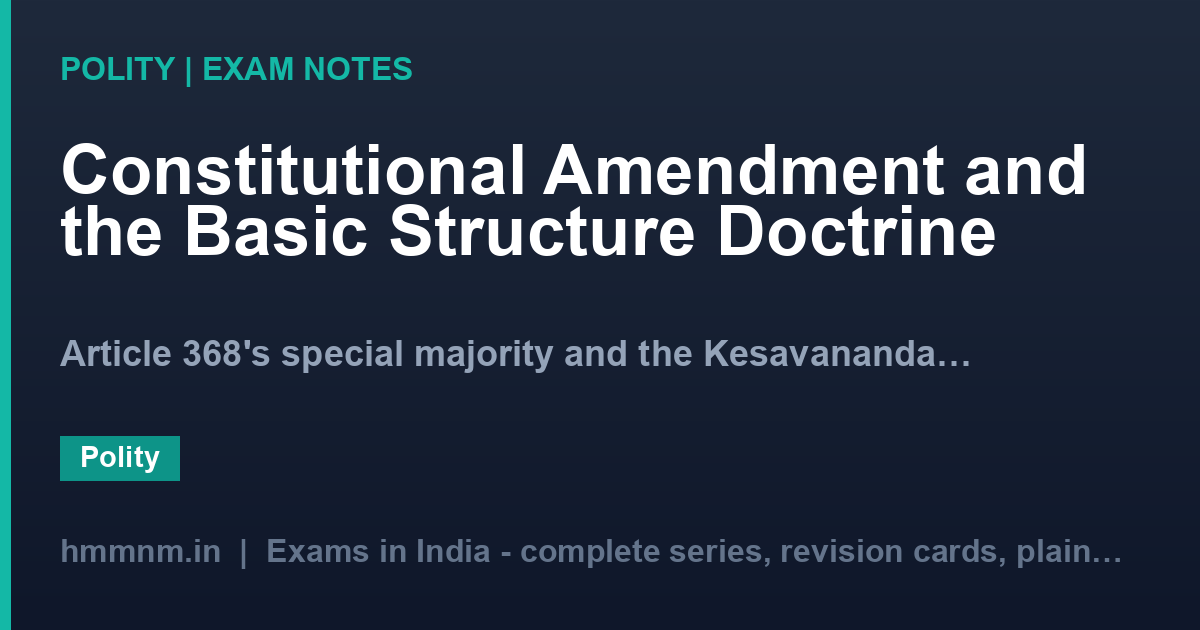
Constitutional Amendment and the Basic Structure Doctrine Explained
Article 368 lets Parliament amend the Constitution by special majority — and, since Kesavananda Bharati (1973), without destroying the basic structure: the doctrine that some features (supremacy of the Constitution, judicial review, federalism, secularism) stand beyond the amending power.
Visual Summary
- Special majority — total-majority plus two-thirds present and voting.
- Kesavananda — amendment power cannot destroy basic structure.
- Examples — supremacy, judicial review, federalism, secularism.
- Procedure — each House separately; federal clauses need states.
The Amendment Procedure
Article 368 requires a special majority in each House separately — majority of the total membership plus two-thirds of members present and voting. Amendments touching the federal distribution need ratification by half the state legislatures. A simple majority suffices only where the Constitution expressly allows it (creating new states, citizenship rules) — such changes are not Article 368 amendments.
The Basic Structure Doctrine
Kesavananda Bharati (1973) answered the amendment-power question: Parliament may amend any provision but cannot abrogate the Constitution’s IDENTITY. The identified features include the supremacy of the Constitution, the republican and democratic form, separation of powers, judicial review, federalism, secularism and the rule of law — an open list courts apply case by case. Minerva Mills (1980) extended it: even the amendment power’s limitation cannot be removed, for unlimited power would itself destroy the structure.
Exam Angle
Passages stage an amendment that touches a candidate feature and ask its validity — test against the open list, then procedure. Practise in the CLAT mock and sectional.
FAQ
Can the basic structure list grow?
Yes — it is an open list; courts have added features case by case.
Did Minerva Mills change the doctrine?
It applied and deepened it — striking the clause that immunised amendments from judicial review.
Related reading
- Fundamental Rights One-Pager: Articles 12-35, Key Cases, and UPSC Traps
- Tuesday Polity Sprint Quiz: 15 Constitution and Governance MCQs Solved in 12 Minutes
Exam angle
How exams use this: Prelims tests Polity through statement-sets on Articles, amendments and judgments — exact wording, not vibes, decides the mark. Test it under exam conditions →
Quick revision
- Special majority: — total-majority plus two-thirds present and voting.
- Kesavananda: — amendment power cannot destroy basic structure.
- Examples: — supremacy, judicial review, federalism, secularism.
- Procedure: — each House separately; federal clauses need states.
- Fundamental Rights One-Pager: Articles 12-35, Key Cases, and UPSC Traps
- Tuesday Polity Sprint Quiz: 15 Constitution and Governance MCQs Solved in 12 Minutes
Have a doubt on this topic?