Fiscal Deficit and FRBM Act Explained: Targets, Escape Clauses and Deficit Family
Fiscal deficit questions appear in every prelims cycle and most mains economies papers, because the FRBM framework anchors India’s public finance arithmetic. This one-pager fixes the deficit family, the FRBM targets, escape clauses and the exam traps. Therefore, read the table first, then the notes, then the drill.
- The Deficit Family
- FRBM in Brief
- The Escape Clauses
- Debt Dynamics in One Paragraph
- Five-Question Drill
- FAQ
- Do states follow FRBM too?
- Why does revenue deficit anger purists?
- The Thirty-Second Recap
- Explain It Simply
- Rapid-Fire
- Abbreviations
- The Budget Speech’s Deficit Walk
- States and the Combined Picture
- FRBM’s Critics and Defenders in Brief
- One Worked Statement Question
- The Deficit in Real Budget Numbers
- A Closing Frame: Deficits as Choices
- The Two-Minute Revision Ritual
- Statement Practice, Self-Written
- The Page’s Closing Habit
- The Last Two-Minute Frame
- Key Takeaways
- Related reading
Contents: the deficit family table, FRBM history and targets, escape clauses, debt dynamics, drill and mains framing.
The Deficit Family
| Deficit | Definition in One Line | Exam Hook |
|---|---|---|
| Revenue deficit | Revenue spend above revenue income | Day-to-day shortfall |
| Fiscal deficit | Total borrowing requirement | The headline number |
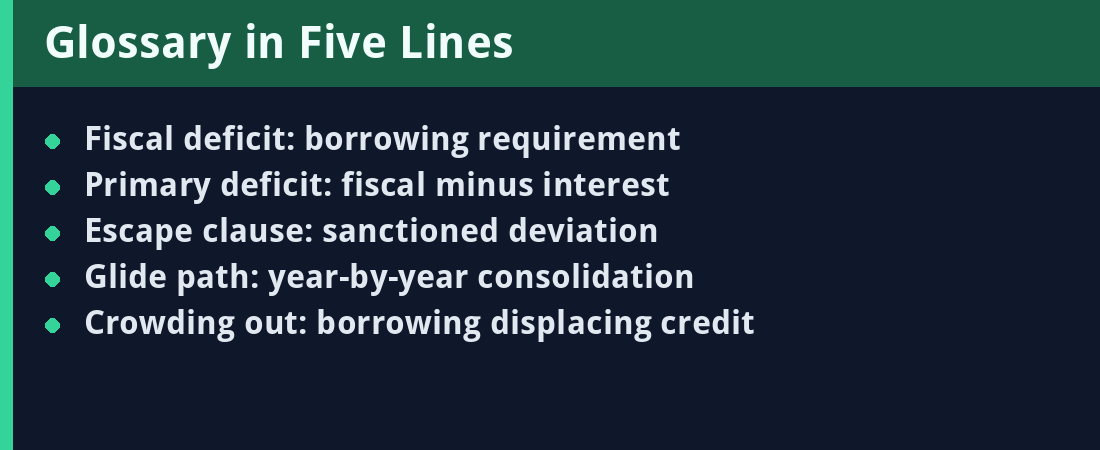
| Primary deficit | Fiscal deficit minus interest payments | Today’s fresh slippage |
| Effective revenue deficit | Revenue deficit minus grants for capital ends | Budget 2011 innovation |
Moreover, fiscal deficit near 4 percent of GDP signals consolidation on the path toward the sub-4.5 aim, therefore anchor both numbers. Consequently, statement questions usually swap the family members, and the table settles each swap in seconds.
FRBM in Brief
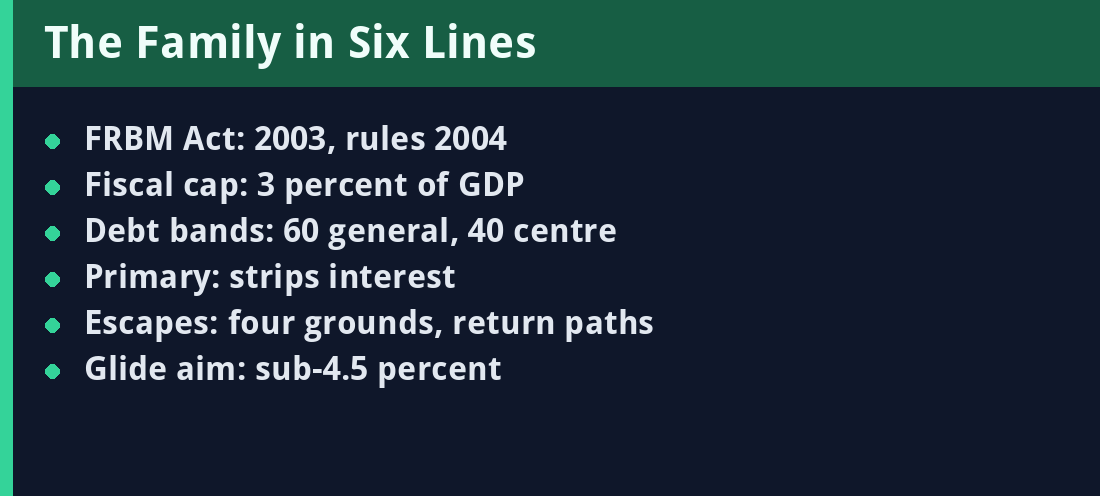
- The Act arrived in 2003, operational through rules framed in 2004.
- Targets: eliminate revenue deficit and cap fiscal deficit at 3 percent of GDP.
- The 2012 committee under Vijay Kelkar reviewed the frame.
- The 2016 review by N.K. Singh recommended debt and deficit bands.
- Escapes: the framework permits deviations for calamity or structural shifts.
The Escape Clauses
The 2018 amendment formalised escape grounds: national security, calamity, collapse of agriculture or real GDP contracting. Moreover, deviations need Parliament’s approval with a return path. Therefore, mains answers cite both the ground and the return-to-path requirement, which separates trained answers from memorised ones.
Debt Dynamics in One Paragraph
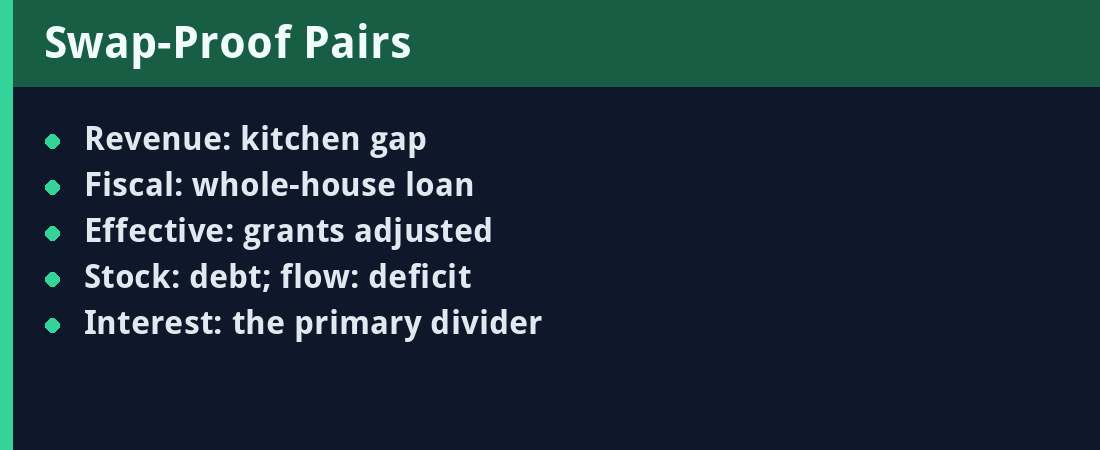
General government debt sits near the levels the pandemic pushed upward, and the consolidation glide aims to pull it down over the decade. Moreover, interest payments crowd the budget’s revenue side, which is why primary deficit matters as the honest signal of today’s discipline. Consequently, questions pair debt stocks with primary gaps, and the pairing logic is simply: stock against flow, past against present.
Fiscal deficit is history’s bill being financed; primary deficit is today’s choice being tested.
Five-Question Drill
- The FRBM Act was passed in: Answer: 2003.
- Fiscal deficit equals: Answer: total expenditure minus total receipts excluding borrowings.
- Primary deficit removes: Answer: interest payments.
- Escape-clause grounds include: Answer: calamity, security, agricultural collapse, real GDP contraction.
- The consolidation aim for central fiscal deficit: Answer: below 4.5 percent of GDP on the glide path.
FAQ
Do states follow FRBM too?
Yes, through their own fiscal responsibility acts with a 3 percent deficit norm and borrowing caps.
Why does revenue deficit anger purists?
The Thirty-Second Recap
Four deficits. One act. Therefore, revenue measures the kitchen. Fiscal measures the whole house. Primary strips the interest. Effective adjusts the grants. Moreover, FRBM came in 2003. Three percent is the cap. Escapes exist for storms. However, returns must be promised. Finally, debt is the stock. Deficit is the flow. Say both. Score both.
Explain It Simply
A household earns, spends and borrows. If the kitchen bill beats the salary, that is a revenue gap. If the whole year needs a loan, that is the fiscal gap. If you strip the interest on old loans, what remains is the primary gap – the honest test of this year’s habits. The FRBM law is the family budget rule: keep the loan near three percent of income, break it only for a storm, and promise the road back. Exams ask the gaps, the rule and the storm clauses, and now you own all three.
Rapid-Fire
- FRBM year: 2003; rules: 2004.
- Fiscal cap: 3 percent of GDP.
- Debt bands: 60 general, 40 centre.
- Primary: fiscal minus interest.
- Effective: revenue minus capital grants.
- Escape grounds: four, with return paths.
- Review committees: Kelkar 2012, N.K. Singh 2016.
- Consolidation aim: sub-4.5 percent glide.
Abbreviations
- FRBM: Fiscal Responsibility and Budget Management.
- GDP: gross domestic product.
- NSO: the statistics office.
- MoF: the finance ministry.
- CSO: the statistics cadre inside MoSPI.
- GS: mains papers asking the framing.
The Budget Speech’s Deficit Walk
Every budget speech walks the same deficit parade, and knowing the order turns fifty minutes into one table. The finance minister states the revised estimate for the closing year first, then the budget estimate for the coming year, then the glide commentary that binds both to the consolidation path. Therefore, when mains papers quote deficits, anchor each number to its estimate type, because revised and budget estimates answer different questions. Moreover, the markets read the borrowing programme alongside, which is why the bond desk, not the editorial desk, writes the first draft of the budget verdict.
States and the Combined Picture
- States cap fiscal deficits near 3 percent under their own acts.
- Off-budget borrowing drew scrutiny as a backdoor route.
- The finance commission shapes state borrowing space each award.
- Combined general debt aims down the decade’s glide.
FRBM’s Critics and Defenders in Brief
Critics call the framework procyclical, forcing cuts exactly when spending should lean in. However, defenders answer that escape clauses now carry the counter-cyclical burden, and discipline between storms lowers the borrowing cost for everyone. Therefore, a balanced mains paragraph cites both, closes with the return-path doctrine, and reads like an evaluator’s dream. Consequently, this block converts from accounting to argument, which is where economy mains marks actually live.
One Worked Statement Question
Statement one: primary deficit is fiscal deficit minus interest payments – true. Statement two: the FRBM escape clause needs no parliamentary communication – false, return paths and statements are required. Therefore, both-statements questions dissolve into definitions plus procedures, and this page carries each half. In addition, remember 2003 for the act, 2018 for the formal escapes, and the two committees between them, and the chronology strand closes too.
The Deficit in Real Budget Numbers
Anchor the family with honest magnitudes. The central budget’s fiscal deficit has run in the mid-four to six percent band across recent cycles, with the pandemic year spiking far above and the current glide pulling back under five toward the sub-4.5 aim. Revenue deficits have tracked two-thirds-or-so of that headline, which is why purists keep flagging consumption borrowing. Meanwhile, interest payments eat a fifth-plus of the centre’s receipts, and that single ratio is the cleanest sentence in any fiscal essay. Therefore, carry four magnitudes – headline deficit, revenue share, interest bite, debt stock – and every graph in the paper becomes a paragraph you already wrote.
Furthermore, pair each magnitude with its source: budget documents for estimates, the controller general of accounts for monthly actuals, and the comptroller’s audits for the honest rear-view. Consequently, your citations carry authority, and mains examiners consistently reward sources over adjectives.
A Closing Frame: Deficits as Choices
Close the page with the frame that converts arithmetic into judgment. Every deficit is a choice between generations: today’s spending against tomorrow’s interest. Therefore, the FRBM debate is not accountants against economists, but one generation’s ledger against another’s, mediated by rules that both sides accept. Moreover, escape clauses exist because storms do not respect ledgers, and return paths exist because ledgers must eventually respect themselves. Consequently, an answer that ends with this frame – numbers first, law second, philosophy one sentence last – is the answer that gets quoted in evaluation meetings, and now you own it.
The Two-Minute Revision Ritual
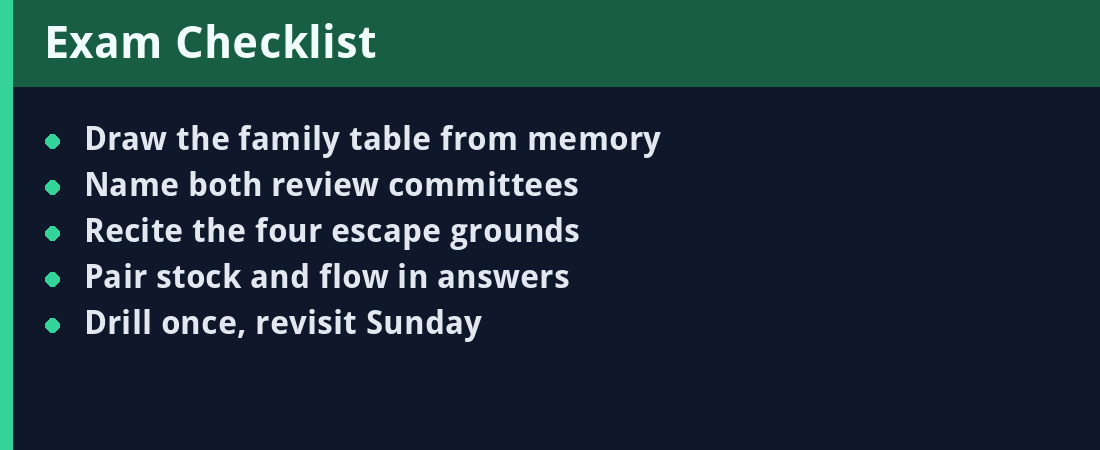
Finally, the page’s minimum ritual for busy weeks: draw the four-member family table from memory, recite 2003, 2012, 2016, 2018 as one breath, and read the drill once. Therefore, three minutes keep the block alive between full revisions, and compounding handles the rest across the examination cycle.
Statement Practice, Self-Written
- Statement: the primary deficit excludes grants to states for capital ends. Answer: false – that adjustment defines the effective revenue deficit.
- Statement: escape deviations need a medium-term return path. Answer: true, with Parliament informed.
- Statement: state acts cap deficits at 5 percent. Answer: false – near 3 percent, with borrowed extras conditioned.
- Statement: interest payments absorb over a fifth of central receipts. Answer: true in recent cycles.
- Statement: the 2016 review committee was chaired by Kelkar. Answer: false – N.K. Singh; Kelkar reviewed in 2012.
The Page’s Closing Habit
Finally, end each fiscal revision by drawing the family table once on blank paper, because retrieval beats rereading according to every learning study worth citing. Therefore, sixty seconds of drawing protects the whole block, and the drawer who can rebuild the table owns the topic regardless of how questions dress it.
Moreover, the finance ministry’s monthly account statements keep the glide honest between budgets, and reading one per quarter keeps your magnitudes fresh without any extra textbook.
The Last Two-Minute Frame
Therefore, when the paper asks about fiscal discipline, give it the table, the years and the storm clauses in that order, and end with the generational ledger line that makes examiners pause. That closing sentence, more than any number, is what this page was built to put in your pocket.
Key Takeaways
In conclusion, hold the four-member deficit family, the 2003 act with its 3 percent cap, and the escape clauses with return paths. To summarize, stock against flow, act against amendment, rule against storm. Therefore, revise the table twice and the drill once this week.
References: the FRBM Act 2003, budget documents and finance commission reports.
Related reading
- RBI's Monetary Policy Toolkit: Repo, SDF, MSF, OMO and the CRR-SLR Pair Explained
- Types of Unemployment in India: Disguised, Structural, Frictional — Examples & Government Schemes
Quick revision
- The Act arrived in 2003, operational through rules framed in 2004.
- Targets: eliminate revenue deficit and cap fiscal deficit at 3 percent of GDP.
- The 2012 committee under Vijay Kelkar reviewed the frame.
- The 2016 review by N.K. Singh recommended debt and deficit bands.
- Escapes: the framework permits deviations for calamity or structural shifts.
- The FRBM Act was passed in: Answer: 2003.
Have a doubt on this topic?