Banking Awareness for IBPS and RRB: Account Types and KYC Basics
Banking awareness questions on account types and KYC appear in every IBPS, SBI and RRB cycle, yet most candidates answer them on instinct rather than framework. This page builds that framework: the account matrix, the KYC architecture, and the compliance vocabulary examiners lift directly from RBI directions. Therefore, read the tables twice before attempting the drill.
- The Deposit Account Matrix
- NRI Account Variants
- The Three Doors
- The KYC Framework
- Components and Documents
- e-KYC and Video KYC
- Risk Categories and Small Accounts
- Comparison Table for Rapid Recall
- Solved Drill
- FAQ
- Is KYC mandatory for small accounts?
- Do RRB exams ask PMLA details?
- Payment and Settlement Systems
- Deposit Protection and Inclusion Rails
- DICGC Cover
- Institutional Rails
- Second Drill: Payments and Protection
- Memory Hooks That Stick
- How Banks Actually Open an Account Today
- Careful Distinctions Examiners Exploit
- A Closing Framework for Revision
- The Ten-Minute Morning Ritual
- Sources Worth Bookmarking
- In Short: The Plain-English Summary
- Glossary in Five Lines
- The Thirty-Second Recap
- Explain It Simply: Bank Basics for a Twelve-Year-Old
- Key Takeaways
RBI Monetary Policy 2026: Repo Hold at 5.25%, Exam Notes
IBPS PO Prelims 2026: The English 30-Marks Scoring Plan in 18 Days
Contents: deposit account matrix, NRI account variants, the KYC framework with e-KYC and video KYC, PMLA obligations, a comparison table, a solved drill and memory hooks.
The Deposit Account Matrix
- Savings accounts suit individuals with interest on balances and withdrawal limits.
- Current accounts serve businesses with unlimited transactions and nil or minimal interest.
- Term deposits lock funds for a fixed tenor at contracted rates, with premature penalties.
- Recurring deposits build savings monthly, with interest close to term-deposit rates.
- Salary accounts are zero-balance variants created under corporate arrangements.
| Account | Best For | Key Feature |
|---|---|---|
| Savings | Individuals | Interest with liquidity |
| Current | Business | Unlimited transactions |
| Term deposit | Parking | Fixed tenor, higher rate |
| Recurring | Disciplined saving | Monthly instalments |
Moreover, examiners test purpose-matching rather than definitions. For example, a question on overdraft eligibility points to current accounts, therefore practise mapping products to needs. Meanwhile, note that interest rates on savings accounts are deregulated, a recurring mains point.
NRI Account Variants
The Three Doors
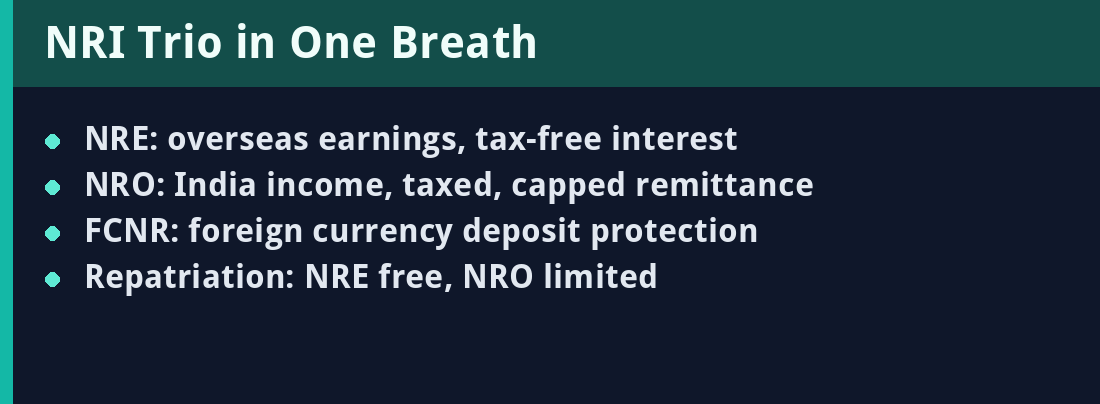
- NRE accounts hold overseas earnings in rupees, fully repatriable, with tax-free interest.
- NRO accounts hold India-sourced income, with repatriation limits and applicable tax.
- FCNR deposits keep foreign currency, protecting against exchange movement.
Consequently, questions pair repatriability against taxability to separate the three. In addition, remember that NRE principal and interest both return abroad freely, whereas NRO flows follow the remittance scheme framework.
The KYC Framework
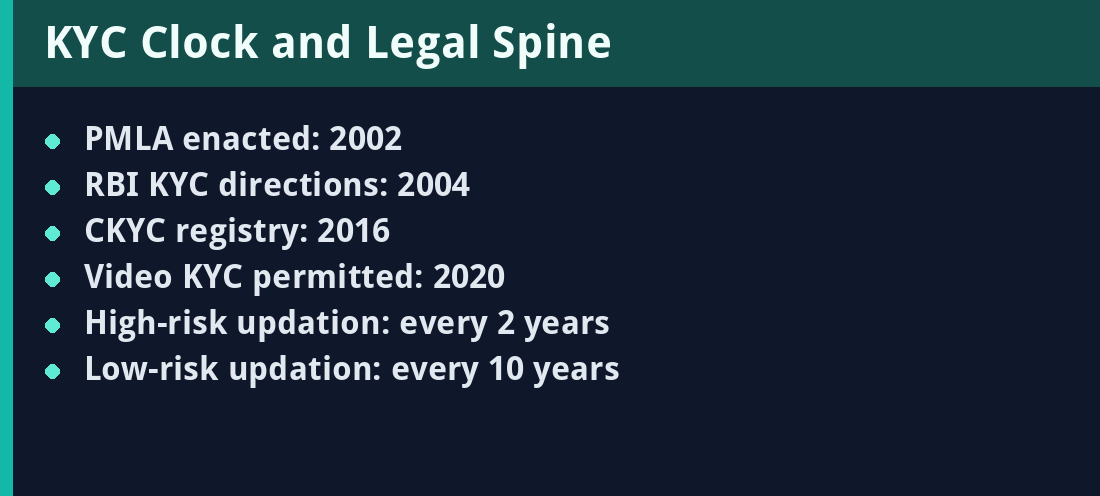
Know Your Customer norms flow from the Prevention of Money Laundering Act, 2002, operationalised through RBI directions issued in 2004 and updated repeatedly. KYC means verifying a customer’s identity and address before account opening. Therefore, the framework’s two pillars are identification and authentication of proof documents.
Components and Documents
- Officially valid documents include passport, driving licence, Aadhaar, voter card and NREGA job card.
- PAN or Form 60 links tax identity to the account file.
- Recent photographs and address proof complete the physical file where applicable.
e-KYC and Video KYC
Aadhaar OTP-based e-KYC enables paperless onboarding with biometric or OTP validation. Meanwhile, the video customer identification process, permitted from 2020, completes verification through a live video call under a secure protocol. Consequently, banks scale onboarding without branch visits, while compliance teams retain audit trails. In addition, central KYC registry records, introduced in 2016, let a customer open a second account without resubmitting documents.
Risk Categories and Small Accounts
- Banks classify customers into low, medium and high risk for periodic updation.
- Low-risk files refresh every ten years, medium every eight, high every two.
- Small accounts open with self-declaration, capped at balance and credit limits.
- Periodic updation failure can restrict debits after due notice.
However, restrictions lift once the customer completes re-verification. Therefore, framing matters: questions ask about the consequence sequence, not just the interval. Similarly, authorisation language distinguishes debits blocked from the whole account frozen.
Banking awareness is a vocabulary exam in uniform – master the terms and the questions dissolve.
Comparison Table for Rapid Recall
| Item | Anchor Fact |
|---|---|
| PMLA enactment | 2002 |
| RBI KYC directions | 2004 |
| Video KYC permitted | 2020 |
| CKYC registry | 2016 |
| NRE interest | Tax-free, repatriable |
| High-risk updation | Every 2 years |
Solved Drill
- Interest on NRE accounts is: Answer: tax-free and repatriable.
- KYC derives legal force from: Answer: the PMLA, 2002.
- Video KYC was permitted from: Answer: 2020.
- High-risk customer files require updation every: Answer: two years.
- Unlimited transactions characterise: Answer: current accounts.
FAQ
Is KYC mandatory for small accounts?
Simplified norms apply, with self-declaration and limits, therefore KYC still frames the file.
Do RRB exams ask PMLA details?
Yes, chiefly the 2002 year and the updation intervals.
Payment and Settlement Systems
- RTGS settles high-value transfers individually and instantly, minimum two lakh rupees, available round the clock since December 2020.
- NEFT processes batched transfers with no minimum, running continuously since December 2019.
- IMPS offers instant mobile banking transfers around the clock with modest caps.
- UPI, operated by NPCI, links accounts across banks through virtual addresses.
- Cheque truncation converts paper instruments to electronic images at the clearing stage.
| System | Nature | Minimum | Hours |
|---|---|---|---|
| RTGS | Real-time, gross | Rs 2 lakh | 24×7 |
| NEFT | Batched, deferred net | None | 24×7 |
| IMPS | Instant retail | None | 24×7 |
| UPI | Instant, address-based | None | 24×7 |
Consequently, a single confusion pair dominates questions: RTGS against NEFT. Therefore, anchor gross versus net settlement, and the two-lakh floor, and the pair dissolves. Meanwhile, UPI’s zero minimum and merchant ubiquity explain its exam popularity.
Deposit Protection and Inclusion Rails
DICGC Cover
The Deposit Insurance and Credit Guarantee Corporation insures deposits up to five lakh rupees per depositor per bank, covering principal and interest together. Moreover, the cover applies across branches of the same bank, not per branch. Therefore, questions test the per-bank cap and the inclusion of interest, both frequent traps.
Institutional Rails
- Priority sector lending directs a fixed credit share to agriculture, MSME and weaker sections.
- Business correspondent models extend banking to unbanked villages with biometric devices.
- Jan Dhan accounts anchor direct benefit transfer architecture.
- Financial literacy centres support the inclusion mission’s demand side.
However, inclusion questions increasingly test outcomes – RuPay card usage, overdraft uptake – rather than scheme names. As a result, pair every rail with one usage statistic for mains-ready answers.
Second Drill: Payments and Protection
- RTGS minimum transaction value is: Answer: two lakh rupees.
- DICGC insurance covers each depositor up to: Answer: five lakh rupees per bank.
- UPI is operated by: Answer: the National Payments Corporation of India.
- NEFT became 24×7 effective: Answer: December 2019.
- Gross settlement characterises: Answer: RTGS only.
Memory Hooks That Stick
Firstly, chain the years as a story: PMLA 2002 armed the law, RBI 2004 operationalised it, CKYC 2016 centralized it, and video KYC 2020 humanised it. Secondly, visualise the NRI trio as doors: NRE opens outward freely, NRO opens inward with a queue, and FCNR keeps foreign shoes at the door. Consequently, a single mental corridor holds the entire banking awareness block.
How Banks Actually Open an Account Today
A modern onboarding journey stitches together everything on this page, and questions increasingly describe that journey rather than isolated rules. The candidate submits an officially valid document, the bank runs it through verification, and the central registry avoids duplicate paperwork at the next institution. Meanwhile, risk classification sets the file’s review calendar, and transaction monitoring continues for the relationship’s lifetime. Consequently, the process reads as one pipeline: identity, address, classification, monitoring, updation.
Furthermore, digital rails changed the paperwork’s face without changing the compliance spine. For example, video verification replaces the branch counter, yet the officer’s obligations, the audit trail and the refusal rules remain identical. Therefore, when a question contrasts traditional and digital onboarding, answer that the framework is unchanged while the interface evolved. In addition, remember that small accounts remain the exception lane, opened on self-declaration with caps rather than full documentation.
Careful Distinctions Examiners Exploit
- Savings interest accrues daily on balances under current rules, a change from earlier quarterly practice.
- Overdrafts attach to current accounts, while cash credits typically finance inventory for businesses.
- Nomination routes funds after death, whereas joint holding decides ownership during life.
- lien lets a bank retain securities against dues, but set-off actually applies balances against debt.
- Solvent closure differs from write-off, because recovery rights survive the latter.
Moreover, these five pairs cover most statement-style traps in recent papers. Therefore, read each pair aloud once, and mark the stronger verb, since the verb usually carries the mark. Meanwhile, mains candidates should convert each pair into a two-line explainer with one banking example.
A Closing Framework for Revision
Finally, arrange the entire page as four shelves in your mind: products, onboarding, protection and payments. Firstly, products hold the account matrix and the NRI trio. Secondly, onboarding holds KYC from PMLA to video verification. Thirdly, protection holds DICGC and deposit rights. Fourthly, payments hold the RTGS to UPI spectrum. Consequently, any exam question finds its shelf instantly, and recall stops depending on luck.
The Ten-Minute Morning Ritual
Top banking-exam candidates run a fixed morning ritual on awareness topics: five minutes reading one framework page, three minutes reciting its tables aloud, and two minutes attempting a five-question drill. Therefore, this page is built exactly for that ritual, with its matrix, registry years and settlement spectrum arranged for spoken recall. Moreover, rotating four such pages across the week covers the entire awareness syllabus without notes piling up. Consequently, awareness stops being the section you postpone and becomes the section that warms up every study day.
Sources Worth Bookmarking
For every rule stated here, the master direction on the central bank’s website carries the binding text, and reading one full direction before the exam builds unmatched comfort with the register. Meanwhile, the banking regulator’s annual reports reframe the same rules with data, which mains answers can cite for authority. Therefore, bookmark the master direction page, the deposit insurer’s frequently asked questions, and the payments corporation’s product pages as your three primary references.
In Short: The Plain-English Summary
In short, this page builds a shelf system. Products sit on the first shelf. Onboarding sits on the second. Protection sits on the third. Payments sit on the fourth. Therefore, any question finds its shelf fast. The compliance rules flow from one act. Moreover, the years tell the story: 2002, 2004, 2016, 2020. However, verbs decide trap answers. So learn the pairs aloud. As a result, banking awareness stops being guesswork. That is the framework in plain words.
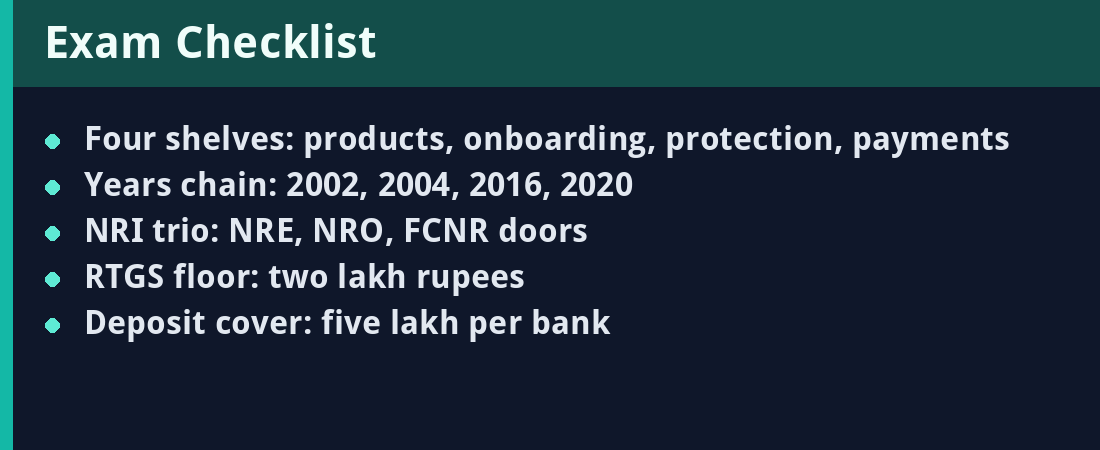
- Four shelves: products, onboarding, protection, payments
- Years chain: 2002, 2004, 2016, 2020
- NRI trio: NRE, NRO, FCNR doors
- RTGS floor: two lakh rupees
- Deposit cover: five lakh per bank
Glossary in Five Lines
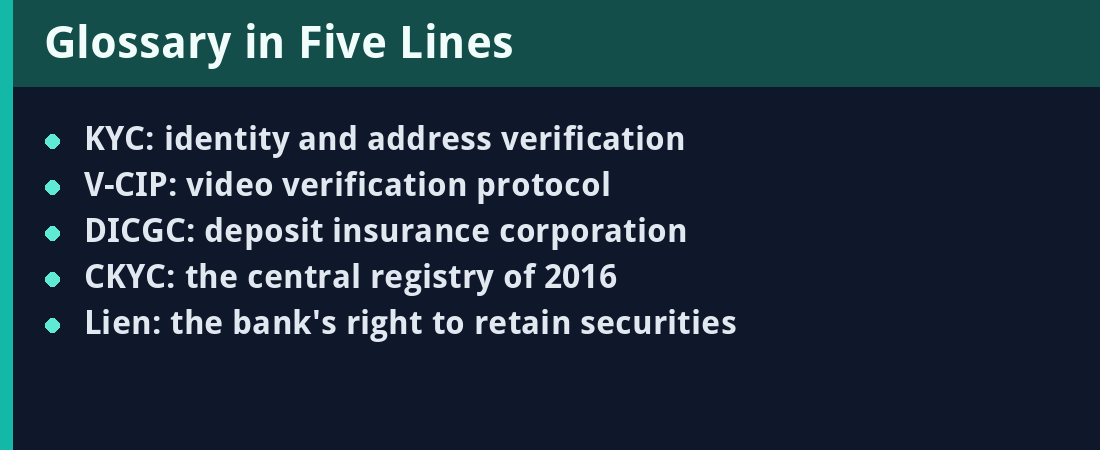
- KYC: identity and address verification
- V-CIP: video verification protocol
- DICGC: deposit insurance corporation
- CKYC: the central registry of 2016
- Lien: the bank’s right to retain securities
The Thirty-Second Recap
Four shelves. One page. Therefore, sort every question fast. Products first. Onboarding second. Protection third. Payments fourth. Moreover, chain the years. Two thousand two. Two thousand four. Twenty sixteen. Twenty twenty. However, verbs decide traps. So learn the pairs aloud. As a result, banking stops being guesswork. Finally, the shelf holds. So trust the shelf.
Explain It Simply: Bank Basics for a Twelve-Year-Old
A bank is a safe box with rules. You keep money in it. The bank pays you a small fee for saving with it. That fee is called interest. There are four kinds of boxes. One box is for daily saving. One box is for firms that pay and get paid all day. One box locks your money for a fixed time at a higher fee. One box takes a small sum each month and grows it. However, before you get any box, the bank must know who you are. This check is called KYC. You show a card with your photo and address. Aadhaar works for this.
Some checks now happen on video. An officer sees you on a screen and nods you in. Moreover, one central record keeps your check on file from 2016, so a new bank need not ask again. The rules come from a law of 2002. It fights dirty money. Therefore, banks must also keep an eye on odd flows. If your money stays safe but the bank fails, an insurer pays you back up to five lakh rupees. Finally, for quick transfers, the UPI rail moves money in seconds. That is the whole system in plain words: boxes, checks, safety nets, and fast rails.
Key Takeaways
In conclusion, master four structures: the account matrix, the NRI trio, the KYC pyramid from PMLA to video verification, and the risk-based updation clock. To summarize, tables beat paragraphs here, and drills lock the anchors. Therefore, revise this page twice this week and the banking awareness block yields its marks quietly.
References: rbi.org.in KYC master direction, income tax notifications on NRE interest, ibps.in pattern documents.
Quick revision
- Savings accounts suit individuals with interest on balances and withdrawal limits.
- Current accounts serve businesses with unlimited transactions and nil or minimal interest.
- Term deposits lock funds for a fixed tenor at contracted rates, with premature penalties.
- Recurring deposits build savings monthly, with interest close to term-deposit rates.
- Salary accounts are zero-balance variants created under corporate arrangements.
- NRE accounts hold overseas earnings in rupees, fully repatriable, with tax-free interest.
Have a doubt on this topic?