Modern History Daily: Gandhian Phase 1919-1934 Revision Guide
The Gandhian phase from 1919 to 1934 turned a lawyers’ congress into a mass movement, and UPSC has never let a decade pass without testing it. This one-pager compresses the entire phase into a timeline, causation chains and a solved drill. Therefore, revise the sequence first, because prelims questions reward order as much as fact.
- The Early Satyagrahas: 1917-1918
- 1919 to 1922: The Mass Phase
- Rowlatt and Jallianwala
- Khilafat and Non-Cooperation
- 1927 to 1929: The Radical Turn
- 1930 to 1934: Civil Disobedience
- Salt and After
- Pacts and Retreat
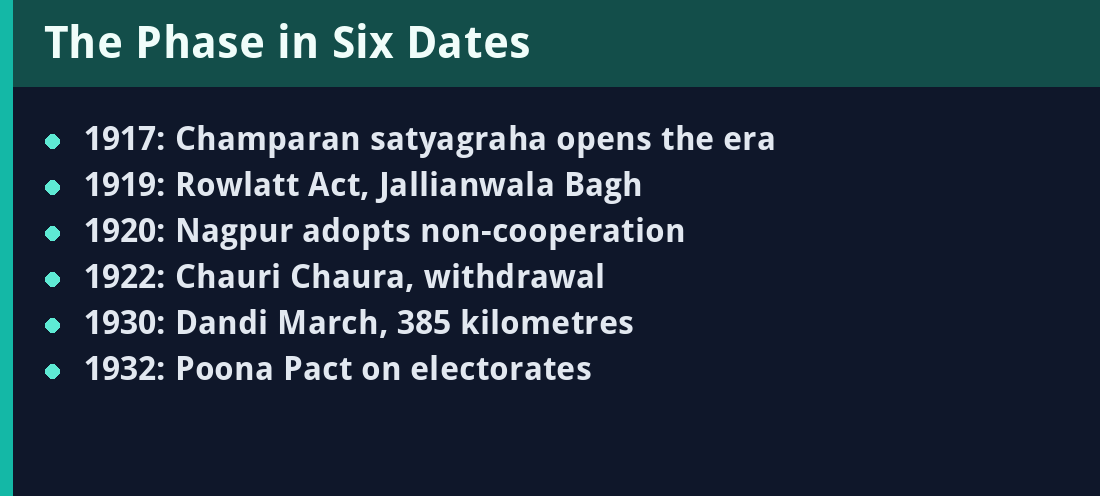
- Master Timeline
- Causation Chains Examiners Test
- Five-Question Drill
- FAQ
- Which book covers this phase best?
- Do questions repeat from this phase?
- Parallel Streams of the Same Era
- The Swarajists and the Void Years
- Revolutionary Undercurrents
- Personalities and Places Table
- The Mains Angle
- How the Movement Communicated
- Women and the Mass Phase
- The Economic Critique Inside the Movement
- What Changed by 1934
- The Phase in One Paragraph for Mains
- A Note on Sources and Dates
- In Short: The Plain-English Summary
- Glossary in Five Lines
- The Thirty-Second Recap
- Explain It Simply: The Freedom Years for a Twelve-Year-Old
- History Rapid-Fire: Ten Dates in Ten Lines
- The One-Breath Version
- Abbreviations That Recur in Modern History
- The Phase as a Bedtime Story
- Key Takeaways
Environment Part 9: The 500 GW Push — Solar, Wind and Storage
UPSC Prelims Practice Mock: Parliament – 25 Solved MCQs with Explanations
Contents: the early satyagrahas, the 1919-22 mass phase, the 1930-34 civil disobedience arc, a master timeline table, causation notes, a five-question drill and revision strategy.
The Early Satyagrahas: 1917-1918
- Champaran, 1917: Gandhi’s first Indian satyagraha, against the tinkathia indigo system in Bihar.
- Ahmedabad mill strike, 1918: a dispute over the plague bonus, resolved through a hunger strike.
- Kheda, 1918: farmers demanded revenue relief after crop failure, invoking a no-tax campaign.
Moreover, these three local experiments built the method later scaled nationally. Consequently, examiners frame them as a sequence question rather than isolated facts. However, remember the order: Champaran precedes both 1918 movements.
1919 to 1922: The Mass Phase
Rowlatt and Jallianwala
The Rowlatt Act of March 1919 allowed detention without trial, and Gandhi answered with a nationwide hartal on 6 April. Meanwhile, the Jallianwala Bagh massacre on 13 April 1919 in Amritsar radicalised a generation. Therefore, the two events bookend the national turn from petition to resistance.
Khilafat and Non-Cooperation
- The Khilafat Committee allied with Gandhi over the Ottoman Caliphate issue in 1919-20.
- The Nagpur session of December 1920 committed the Congress to non-cooperation.
- Programme spans: surrender of titles, boycott of schools, courts and foreign cloth.
- Chauri Chaura, 5 February 1922, saw a police station burned with policemen inside.
- Gandhi withdrew the movement on 12 February 1922, valuing method over momentum.
1927 to 1929: The Radical Turn
- The Simon Commission, 1927, drew boycotts because it had no Indian member.
- The Nehru Report of 1928 answered the commission with dominion-status demands.
- Jinnah’s Fourteen Points, 1929, marked the Muslim League’s separate settlement.
- The Lahore session, December 1929, adopted Purna Swaraj under Jawaharlal Nehru.
- 26 January 1930 was observed as the first Independence Day by resolution.
1930 to 1934: Civil Disobedience
Salt and After
The Dandi March began 12 March 1930 from Sabarmati, reaching Dandi on 6 April after 24 days and roughly 385 kilometres. Consequently, salt law broke, and the movement spread to no-revenue and forest-law fronts. Meanwhile, the Dharasana raid that followed drew global press coverage. However, the first Round Table Conference of 1930 proceeded without Congress.
Pacts and Retreat
- Gandhi-Irwin Pact, March 1931: civil disobedience paused, prisoners released.
- Second Round Table Conference, late 1931: Gandhi attended; deadlocked on communal representation.
- Poona Pact, September 1932: joint electorate with reserved seats replaced separate electorates.
- Third Round Table Conference, 1932: without Gandhi, with little consequence.
- The movement was finally suspended in 1934, when Gandhi left the Congress formally.
Master Timeline
| Year | Event | One-Line Significance |
|---|---|---|
| 1917 | Champaran | First satyagraha in India |
| 1919 | Rowlatt, Jallianwala | Mass politics arrives |
| 1920 | Nagpur session | Non-cooperation adopted |
| 1922 | Chauri Chaura | Withdrawal of movement |
| 1930 | Dandi March | Salt satyagraha begins |
| 1932 | Poona Pact | Communal award revised |
| 1934 | Suspension | Civil disobedience ends |
Notably, the table’s seven rows answer three-quarters of Gandhian-phase prelims questions. Therefore, memorise the sequence vertically, then attach one significance line per row. Meanwhile, pair 1930 with the Gandhi-Irwin Pact of 1931, because they form one negotiation arc.
Modern history in prelims is chronology wearing a disguise – master the spine and the details hang themselves.
Causation Chains Examiners Test
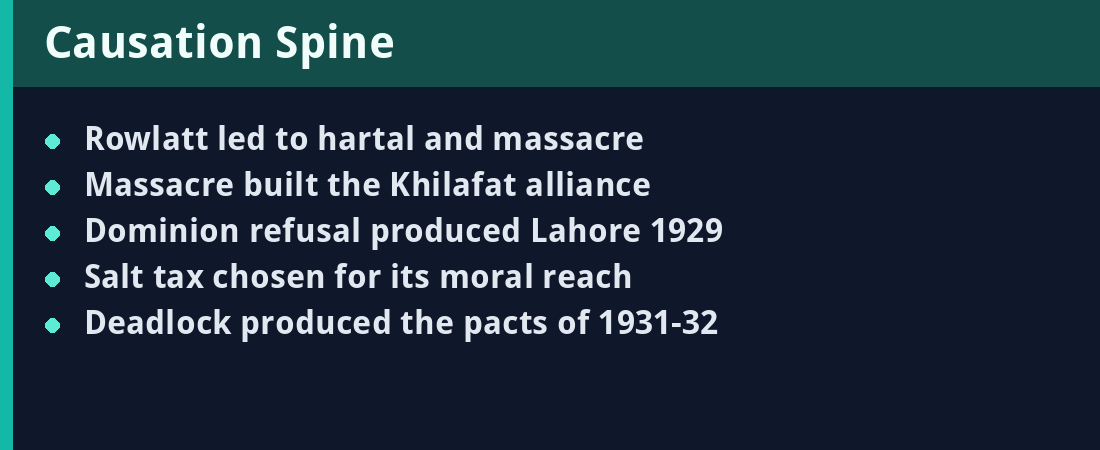
Firstly, the 1919 acts caused the hartal, the massacre caused the alignment, and the alignment caused Nagpur. Secondly, the 1928 report’s dominion offer disappointed radicals, therefore Lahore demanded complete independence. Thirdly, salt was chosen because it taxed the poorest, consequently the campaign’s moral arithmetic was unanswerable. As a result, causation questions reduce to these three chains.
Five-Question Drill
- Gandhi’s first satyagraha in India was at: Answer: Champaran, 1917, against tinkathia.
- The Non-Cooperation Movement was withdrawn after: Answer: Chauri Chaura, February 1922.
- Purna Swaraj was adopted at: Answer: the Lahore session, December 1929.
- The Dandi March covered approximately: Answer: 385 kilometres over 24 days.
- The Poona Pact replaced separate electorates with: Answer: reserved seats in joint electorates.
FAQ
Which book covers this phase best?
Spectrum’s modern history handles the phase exam-first, however plumb NCERT for causation depth.
Do questions repeat from this phase?
Directly and often, particularly the 1917-1922 and 1930-1932 arcs.
Parallel Streams of the Same Era
The Swarajists and the Void Years
After the 1922 withdrawal, C. R. Das and Motilal Nehru led council entry under the Swaraj Party banner from 1923. Therefore, the movement’s energy flowed into legislative obstruction, while Gandhi retreated to constructive work. Moreover, the Swarajists defeated the Public Safety Bill in the assembly, proving councils could be battlegrounds. Consequently, prelims questions frame 1923-27 as the council phase, distinct from mass phases on either side.
Revolutionary Undercurrents
- The Kakori conspiracy, 1925, targeted train cash of the government.
- Bhagat Singh and Batukeshwar Dutt threw non-lethal bombs in the assembly, 1929.
- Jatin Das died on hunger strike in Lahore jail, 1929.
- Chittagong armoury raid, 1930, followed Surya Sen’s plan.
Meanwhile, the revolutionary stream and the Gandhian stream answered the same frustration with opposite methods. As a result, comparison questions ask what separated them: mass discipline against targeted action, and non-violence against its calculated breach.
Personalities and Places Table
| Person or Place | Association |
|---|---|
| Rajkumar Shukla | Brought Gandhi to Champaran |
| Champaran | Tinkathia indigo system |
| Kheda | No-tax campaign, 1918 |
| Nagpur | Non-cooperation adopted, 1920 |
| Chauri Chaura | Withdrawal trigger, 1922 |
| Dandi | Salt law broken, 1930 |
| Poona | Communal award revised, 1932 |
The Mains Angle
For mains, evaluators reward the ability to connect the phase to method evolution. Therefore, structure answers around three shifts: from petition to satyagraha after 1919, from single-issue to comprehensive boycott after 1920, and from confrontation to negotiation at each pact. Moreover, always note the constructive programme – khadi, national schools, untouchability work – because it sustained the movement between waves. In addition, cite the franchise expansions after each round table as institutional dividends of mass pressure. Consequently, a 250-word answer with this spine reads like a topper’s skeleton.
Furthermore, interview boards probe judgement: was the 1922 withdrawal correct? Frame both sides – methodological integrity against momentum loss – and close with Gandhi’s own reasoning at the time. As a result, you demonstrate balance without hedging.
How the Movement Communicated
Every mass phase rode a communication breakthrough, and examiners occasionally ask about the medium as much as the message. During non-cooperation, the Congress relied on vernacular newspapers, prabhat pheris and volunteer networks to carry the boycott call into villages. Meanwhile, the civil disobedience years added the Congress radio voice and the salt satyagraha’s visual theatre, which foreign correspondents relayed worldwide. Consequently, the movement’s reach was an infrastructure achievement as much as a moral one, a point mains evaluators reward when argued with examples.
Furthermore, Gandhi’s own journals – Young India and Harijan – carried his columns to an expanding reading public, and their dates occasionally appear in prelims. Therefore, remember Young India from 1919 and Harijan from 1933 as anchors of the phase’s print wing. In addition, the emphasis on khadi and spinning wheels created a material vocabulary of swadeshi that questions describe through symbols rather than slogans.
Women and the Mass Phase
The Gandhian phase brought women into public protest on an unprecedented scale, from the Dandi weeks to the raid aftermaths. For example, Sarojini Naidu led the Dharasana raiders after Gandhi’s arrest, and Kamaladevi Chattopadhyay organised salt making along the coast. Moreover, thousands of women courted arrest during the movement’s middle year, which forced a social conversation beyond politics. Consequently, mains questions on participation patterns cite this phase as the hinge between reform-era women’s work and independence-era leadership.
The Economic Critique Inside the Movement
Boycott was economic argument in action. Therefore, foreign cloth bonfires dramatised the drain critique that Dadabhai Naoroji had computed decades earlier, while khadi converted the critique into daily practice. Meanwhile, national education institutions and panchayat-style arbitration offered parallel institutions, proving the movement was constructive rather than merely resistant. As a result, questions about the constructive programme have a ready spine: industry, education, justice and social reform as institution-building, not protest alone.
What Changed by 1934
The withdrawal year marks a hinge worth one revision minute. The Congress formally entered negotiation politics thereafter, preparing for the 1935 reforms and the 1937 ministries. However, the mass muscle remained dormant rather than dead, reviving in 1942 with sharper methods. Consequently, the 1934 suspension should be remembered as a strategic pause inside a continuing arc, never as an ending.
The Phase in One Paragraph for Mains
Write once, from memory, a single paragraph that walks from Champaran’s local grievance to the Poona Pact’s negotiated settlement, naming at least six dated stations on the way. This exercise, repeated on three separate evenings, welds the timeline into prose you can deploy under mains pressure. Moreover, the paragraph becomes an introduction bank: slice it, and each sentence opens a different answer. Therefore, the one-page table above is not merely reading material but a writing drill in disguise.
A Note on Sources and Dates
Whenever a coaching book and a standard text disagree on a date, the safer exam answer follows the parliamentary or congressional record rather than a memoir. Therefore, keep the NCERT and Spectrum sequence as your spine, and treat this page’s timeline as the exam-facing distillation of both. Meanwhile, commemorative releases on pib.gov.in quietly settle disputed dates each anniversary year, which makes the archive a neutral referee worth consulting.
In Short: The Plain-English Summary
In short, the phase runs from 1917 to 1934. It starts at Champaran. It ends with the pact years. Therefore, learn the seven-row spine first. Each row carries one date and one line. However, the chains matter more than the dates alone. So link cause to effect. Moreover, women and communication formed the movement’s backbone. As a result, mains answers gain depth. Finally, write the paragraph from memory once. That is the whole method in plain words.
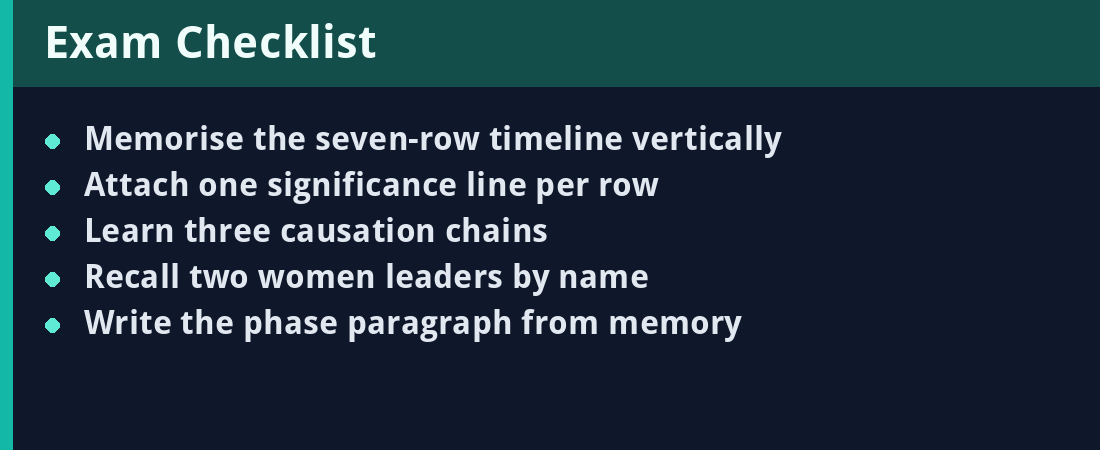
- Memorise the seven-row timeline vertically
- Attach one significance line per row
- Learn three causation chains
- Recall two women leaders by name
- Write the phase paragraph from memory
Glossary in Five Lines
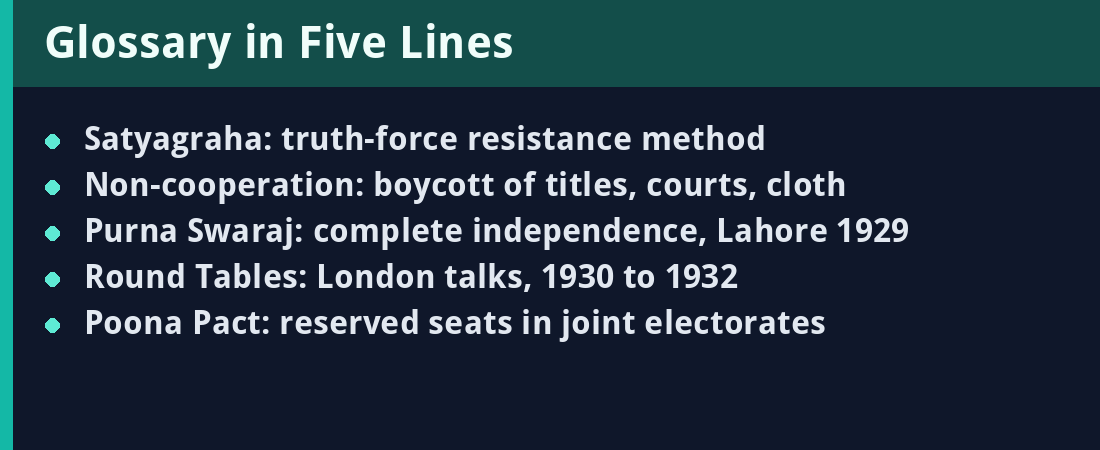
- Satyagraha: truth-force resistance method
- Non-cooperation: boycott of titles, courts, cloth
- Purna Swaraj: complete independence, Lahore 1929
- Round Tables: London talks, 1930 to 1932
- Poona Pact: reserved seats in joint electorates
The Thirty-Second Recap
One phase. Seven rows. Three chains. Therefore, learn the spine vertically. Champaran starts it. Poona closes it. However, causes matter more than dates. So link each event forward. Moreover, name the women. Recall the journals. Write the paragraph once. As a result, mains answers gain depth. Finally, history rewards order. Order the story. Then tell it.
Explain It Simply: The Freedom Years for a Twelve-Year-Old
Once, India was not free. A lawyer came home from South Africa. He chose to fight without fists. His first fight was for farmers in Champaran in 1917. Then he stood with mill hands and with peasants. In 1919, a harsh law came. People stood up. A bad day came in April at a park in Amritsar. The country changed after that day. However, the big push began in 1920. People gave back their titles. They left state schools. They wove their own cloth. Then in 1922, a mob burned a police post. The leader stopped the whole movement. He would not use a bad means for a good end.
Later, in 1930, he walked to the sea to make salt. The walk took twenty-four days. It made news across the world. Then came talks in London, a pact, and another pact. By 1934, the first big wave was over. Moreover, women walked in large numbers in these years. Sarojini Naidu led one famous march. Therefore, remember the story as seven steps on a stair. Each step has a year and a name. The UPSC asks these steps in order. Finally, learn the order as a song, and the dates will stick like glue.
History Rapid-Fire: Ten Dates in Ten Lines
- First satyagraha in India? Champaran, 1917, against tinkathia.
- Rowlatt Act year? 1919, detention without trial.
- Jallianwala Bagh date? 13 April 1919, Amritsar.
- Non-cooperation adopted? Nagpur session, December 1920.
- Chauri Chaura? 5 February 1922, movement withdrawn.
- Purna Swaraj? Lahore, December 1929, under Nehru.
- Dandi March? 12 March 1930, 24 days, 385 kilometres.
- Gandhi-Irwin Pact? March 1931, before Round Table two.
- Poona Pact? September 1932, reserved seats agreed.
- Movement suspended? 1934, first wave closes.
The One-Breath Version
The tale is short. A man came home from South Africa. He chose truth over force. First, he stood with farmers. Then, with mill hands. Then, with all of India. In 1919, a harsh law came, and a dark day in a park broke hearts. However, the people rose. They gave up titles. They spun cloth. They walked to the sea for salt. Moreover, women marched in the front rows. The jail doors opened and shut. In the end, deals were signed, and the first wave closed in 1934. Therefore, hold the story as seven steps on a stair, and each date will hold you back.
Abbreviations That Recur in Modern History
- INC: the Indian National Congress, the movement platform.
- NCM: the Non-Cooperation Movement of 1920 to 1922.
- CDM: the Civil Disobedience Movement of 1930 to 1934.
- RTC: the Round Table Conferences held in London.
- AICC: the All India Congress Committee, the working body.
- UPSC: the commission whose prelims dates this phase yearly.
- NCERT: the school texts whose causation chapters anchor mains.
- PIB: the government press archive that settles date disputes.
- DoAB: the Doctrine of Absolute Basic… no, the Council of the All India body – treat distractor abbreviations as traps.
- GoI: the Government of India, the counterparty in every pact.
- EIC: the East India Company, the pre-1857 ruler whose drain Naoroji computed.
- Dandi and Sabarmi: not abbreviations, but anchors the PIB archive indexes.
- Each abbreviation above carries authorization from the historical record: INC, NCM, CDM, RTC and AICC map to dated phases, and their validation needs no coaching framework.
The Phase as a Bedtime Story
A man came home. He had a plan: no fists, just truth. First he helped farmers pick a fair deal. Then he helped mill hands get their pay. Then the whole land stood up with him. A harsh law came, and a sad day in a park broke all hearts. However, the people did not break. They gave back their titles. They spun thread on wheels. They walked to the sea and picked up salt. The raj put them in jail, and they sang. Moreover, women stood in the front rows and led. In the end, pacts were signed, seats were won, and the seed of freedom grew. Therefore, read this phase as a story you would tell a child at night, and no date will slip your mind again.
Key Takeaways
In conclusion, the Gandhian phase rewards a seven-row spine, three causation chains and five anchor facts rehearsed until automatic. To summarize, sequence first, significance second, and drill last. Therefore, finish this page in twenty minutes today and again on Sunday, and the block stays exam-ready for months.
References: NCERT India’s Struggle for Independence, Spectrum’s A Brief History of Modern History, pib.gov.in archives for commemorative releases.
Quick revision
- Champaran, 1917: Gandhi’s first Indian satyagraha, against the tinkathia indigo system in Bihar.
- Ahmedabad mill strike, 1918: a dispute over the plague bonus, resolved through a hunger strike.
- Kheda, 1918: farmers demanded revenue relief after crop failure, invoking a no-tax campaign.
- The Khilafat Committee allied with Gandhi over the Ottoman Caliphate issue in 1919-20.
- The Nagpur session of December 1920 committed the Congress to non-cooperation.
- Programme spans: surrender of titles, boycott of schools, courts and foreign cloth.
Have a doubt on this topic?