Quick Answer
Master Verbal Section Triage and Guess Discipline for Higher Scores
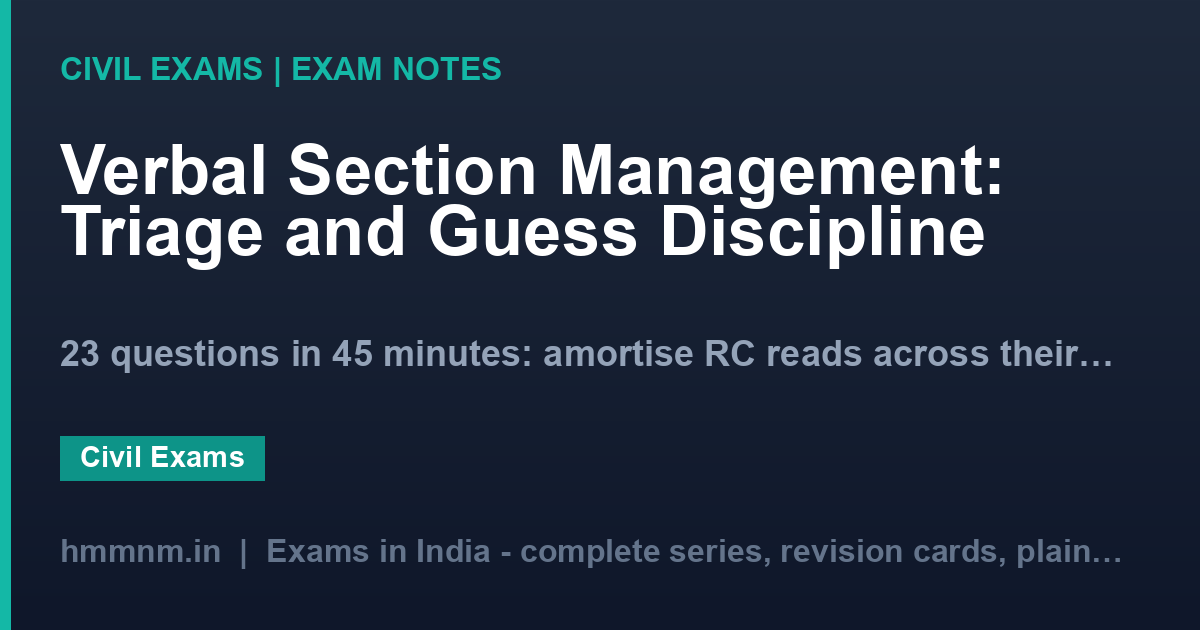
Verbal’s 23 questions in 45 minutes reward triage: RC passage investment is paid back across 4 questions, CR items are single-serve — bank time on shortcuts and spend it on the questions that award accuracy per minute.
Visual Summary
- RC amortises — read time pays across all its questions.
- CR is single-serve — cap per-item time hard.
- Two-pass scan — skip and flag the brutal ones.
- Late guess beats blank — never run out on unanswered items.
The Time Budget
Roughly 2 minutes per item average, but distribute unevenly: an RC set (passage + 4 questions) deserves 7-8 minutes total — the 2-minute read is amortised over 4 payouts — while a CR short-argument item should rarely exceed 2:15. Track your rhythm in batches of five: if a batch ran long, the NEXT batch tightens; you cannot recover time you already spent, only stop the bleeding. Section-locked timing means the clock never rolls into another section — unused Verbal seconds simply die.
Two-Pass Triage
First pass: answer everything that yields within ~90 seconds, flag the rest and move. Second pass: return with a full picture of what remains. The psychology matters — a hard item attacked fresh at minute 40 with three others pending feels different from the same item at minute 44 as your last. Boldface and complete-the-argument stems are reliable time sinks: if the stem type historically eats you, flag it on sight rather than “just trying” for two minutes first.
Guess Discipline
An educated guess after elimination beats a rushed full analysis: eliminate the two clearly wrong choices, pick between the survivors by scope-fit, and file it as done. Because the section is item-adaptive overall scoring, one hard item matters less than the five easy ones you’d rush by over-investing. Practise guessing AS A SKILL — deciding “this is a guess, here’s my 30-second elimination, moving on” — so that exam-day guessing is execution, not panic.
Exam Angle
Train full-section triage in the GMAT mock — the 45-minute Verbal clock is where pacing strategy becomes score.
FAQ
How long may an RC read take?
About 2 minutes — it pays back across 3-5 questions.
Is flag-and-return better than grinding?
Yes — grinding one item taxes every later item’s accuracy.
Related reading
- UPSC Prelims 2027: The 6-Month Master Plan (November to May)
- UPSC DAF 2026: Complete Guide for 2,526 Interview Candidates
Quick revision
- RC amortises: — read time pays across all its questions.
- CR is single-serve: — cap per-item time hard.
- Two-pass scan: — skip and flag the brutal ones.
- Late guess beats blank: — never run out on unanswered items.
- UPSC Prelims 2027: The 6-Month Master Plan (November to May)
- UPSC DAF 2026: Complete Guide for 2,526 Interview Candidates
Have a doubt on this topic?