Handloom GI Textiles of India: Chikankari to Pochampally Ikat Treasures
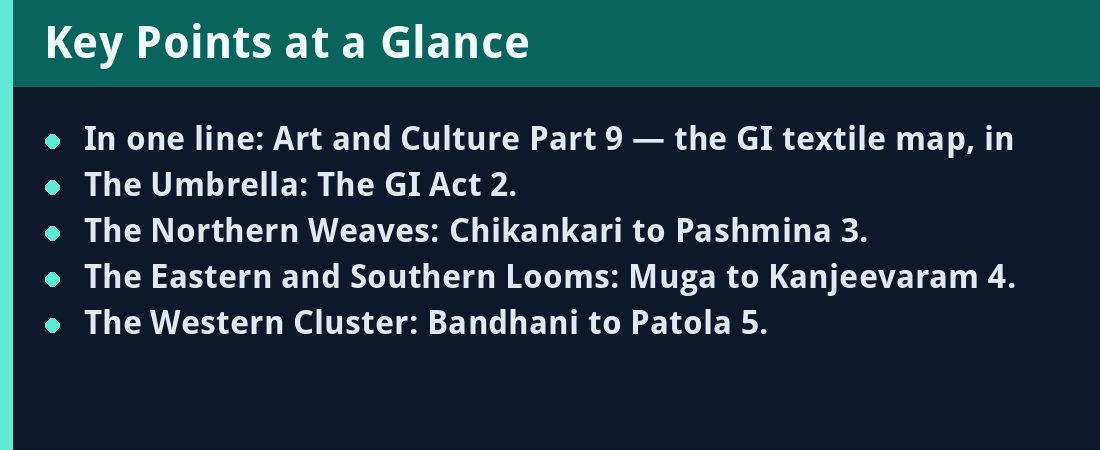
In one line: Art and Culture Part 9 — the GI textile map, in one read.
- 1. The Umbrella: The GI Act
- 2. The Northern Weaves: Chikankari to Pashmina
- 3. The Eastern and Southern Looms: Muga to Kanjeevaram
- 4. The Western Cluster: Bandhani to Patola
- 5. The Sector’s Economics
- 6. Policy: Schemes, Marks, Handloom Day
- 7. Quick Revision: One-Glance Facts
- The Weave-to-State Card
- Practice Corner: Five Definition Checks (with Answers)
- The Case Lens: Answering Any Textile Question
- The Three Classic Traps (Where Beginners Slip)
- Frequently Asked Questions
- What is a geographical indication in textiles?
- Which are India’s major GI-protected weaves?
- What is the difference between single and double ikat?
- How significant is the handloom sector economically?
- Why is National Handloom Day on 7 August?
- FAQ
- How exam-relevant is this page?
- When to revisit?
- The Thirty-Second Recap
- The Plain-Word Walk
- Abbreviations That Recur
- Numbers to Carry
- The Framework Line
- Key Takeaways
- The Long Walk in Short Words
- The Block by Numbers
- The Final Push Round
- Words From This Page Worth Keeping
- The Compliance Line
- The Door Table
- One More Table
- The Topic, Told Once More in Small Words
In one line: The textile chapter on one card: the GI Act’s protection umbrella; the weave-by-weave map — Chikankari’s white-on-white Lucknow, Banarasi brocade, Kanjeevaram, Pochampally and Patola ikats, Muga’s golden Assam, Pashmina’s Kashmir; the sector’s economics as the second-largest rural employer; and the schemes and days the exam attaches to all of it.
The handloom chapter stands on four counts. First, the legal umbrella — the GI Act and what geographical indication protection actually means. Second, the weaves themselves — a state-wise map of India’s famous textiles. Third, the sector’s economics — employment, exports, and the challenges weighing on weavers. Fourth, the policy layer — the schemes, marks, and National Handloom Day that the exam routinely attaches to all of it.
Contents
1. The Umbrella: The GI Act
2. The Northern Weaves: Chikankari to Pashmina
3. The Eastern and Southern Looms: Muga to Kanjeevaram
4. The Western Cluster: Bandhani to Patola
5. The Sector’s Economics
6. Policy: Schemes, Marks, Handloom Day
7. Quick Revision: One-Glance Facts
– Practice Corner: Five Definition Checks (with Answers)
– The Case Lens: Answering Any Textile Question
Quick Answer: India’s textile heritage is protected under the Geographical Indications Act (1999, in force 2003; the GI registry sits at Chennai; Darjeeling tea holds the first registration). Textiles dominate the GI list — from Lucknow’s Chikankari embroidery, Banarasi silk brocade and Kashmir’s Pashmina in the north, to Assam’s Muga golden silk in the east, Tamil Nadu’s Kanjeevaram and Telangana’s Pochampally ikat in the south, and Gujarat’s Patola double-ikat and Bandhani in the west. The handloom sector is rural India’s second-largest employment source after agriculture, supported by the National Handloom Development Programme, the Handloom Mark and the India Handloom Brand, and celebrated each year on National Handloom Day (7 August).
1. The Umbrella: The GI Act
- What a GI is. A geographical indication identifies goods as originating in a territory where a given quality, reputation or characteristic is essentially attributable to that origin — Champagne’s name logic applied to Chikankari: the weave and the place are inseparable.
- The legal frame. The Geographical Indications of Goods (Registration and Protection) Act, 1999 — in force from 2003 — is administered through the GI registry at Chennai under the Controller General of Patents, Designs and Trade Marks. Registrations are valid for ten years and renewable indefinitely; the Darjeeling tea (2004-05) first-registration fact is one every prelims paper has asked at least once.
- What protection does. Registered GIs cannot be used by producers outside the region, and unauthorised use is legally actionable (famous enforcement wins include Banarasi brocade and Pashmina’s certification regime). Crucially, a GI is a collective right held by authorised-user producers — unlike a trademark’s individual ownership. That two-line comparison is a standing exam favourite.
- The exam’s GI facts. India’s GI register has crossed eight hundred registrations (over 800 by the PIB’s latest count, with 600-plus granted since 2014) — and handicrafts, textiles included, form the largest family at more than half of all registrations. The international layer rides on the TRIPS agreement (Articles 22–24 set the protection levels).
2. The Northern Weaves: Chikankari to Pashmina
- Chikankari (Lucknow, Uttar Pradesh). White-on-white shadow-work embroidery — the Nawabi court’s aesthetic legacy. The stitches have names (bakhiya the shadow stitch, murri the knot), and the craft holds one of the early textile GI registrations.
- Banarasi brocade (Varanasi). Silk brocade woven with zari, carrying Mughal-inspired motifs (kadhwa butis, jhallar borders); the sari that anchors wedding trousseaus across north India. It is GI-registered, with its silk-and-zari variants covered.
- Pashmina (Kashmir). Made from the underfleece of the Changthangi goat, spun and woven in the valley — the source of the “ring shawl” fineness legend. The GI sits alongside a spin-off certification regime (testing and labelling to fight fakes — the mains-ready case study in GI enforcement).
- The supporting cast. Kani shawls and Sozni embroidery (Kashmir), Phulkari’s floral darning (Punjab), and the Chamba rumal’s embroidered narrative squares (Himachal Pradesh) — the northern cluster reads as embroidery-heavy alongside its loom traditions.
3. The Eastern and Southern Looms: Muga to Kanjeevaram
- Muga silk (Assam). The golden-yellow silk of the Antheraea assamensis silkworm — the world’s only naturally golden commercial silk, GI-protected, with a durability legend (“it outlives its wearer” — the shine actually improves with age). Eri (the peace silk) and Pat (mulberry) complete Assam’s celebrated silk triad.
- The eastern corridor. Baluchari (West Bengal’s narrative weave — mythological scenes woven into the pallu), Santipore and Dhaniakhali cottons, Bhagalpur silk (Bihar — the “silk city” GI), and Manipur’s Moirangphee and Wangkhei pheis — the east’s loom-dense map.
- Kanjeevaram (Kanchipuram, Tamil Nadu). The mulberry-silk classic with korvai contrast borders (a three-shuttle interlocking weave) and zari of tested purity — the south’s wedding standard and a GI flagship.
- Pochampally ikat (Telangana). Born of the telia rumal tradition, its tie-and-dye warp-and-weft geometry is instantly recognisable. Pochampally is the village whose name carries the GI — and one of India’s early craft-city stories, with the handloom cluster now firmly on the world craft map.
- The south’s supporting cast. Mysore silk (Karnataka), Kasavu (Kerala’s cream-and-gold mundu), Ilkal and Molakalmuru (Karnataka’s border-sari craft), Kanchi cottons, Sungudi (Madurai’s tie-dye), and Uppada and Mangalagiri (Andhra’s jamdani-adjacent and dense-weave cottons).
4. The Western Cluster: Bandhani to Patola
- Patola (Patan, Gujarat). The double-ikat legend — warp and weft both tie-dyed so precisely that the threads mathematically meet in the pattern (the raj-patterns of Patan’s Salvi families; the skill is so rare that authentic looms can be counted in single digits of families). The prelims distinction: single ikat (one thread system dyed — most Pochampally work, and Sambalpuri’s bandha) versus double ikat (both systems dyed — Patola, and the finest grade of Telia Rumal).
- Bandhani (Gujarat-Rajasthan). The dotted tie-dye of Kutch and Saurashtra (the Khatri families’ specialty), alongside Rajasthan’s Lehariya (diagonal waves) and Mothra (chequered) — the region’s pattern language in cotton.
- The cotton classics. Chanderi and Maheshwari (Madhya Pradesh’s silk-cotton blends and their signature borders), Kota Doria (Rajasthan’s airy square-check weave — the “khat” structure), Bagru and Sanganeri block prints (Rajasthan’s indigo-and-floral handblocks), Ajrakh (Kutch-Sindh geometry in natural dyes), and Kalamkari (Andhra’s pen-drawn or block-printed narrative cloth — the Sri Kalahasti and Machilipatnam schools).
- The map memory trick. West = pattern (tie-dye, block print, double-ikat); East = loom heritage (silk triads, narrative weaves); South = temple-grade silks and ikats; North = embroidery and brocade. Four regions, four grammars — the fastest recall architecture for the fifty-weave MCQ bank.
5. The Sector’s Economics
- The employment truth. Handlooms are rural India’s second-largest employment source after agriculture — survey figures run above thirty lakh weaver households (the sector’s scale fact for mains intros), overwhelmingly household-based and cluster-concentrated (the famous clusters: Varanasi, Kanchipuram, Chirala, Bhagalpur, the Panipat belt, and Bargarh’s handloom Bomkai).
- The challenges list (the mains bundle): raw-material price swings (silk, cotton, zari); the powerloom-imitation war (fake “Banarasi” prints that GIs exist to fight); weaver indebtedness and middlemen; the younger generation’s exit from the loom; and market access in the e-commerce era. These five points carry any handloom GS answer.
- The export-and-craft-economy layer. Handloom exports are a modest-but-prestigious line in the textile basket; the wider crafts economy (handicrafts plus handlooms) employs crores — the “largest decentralised employment” framing the Economic Survey uses.
- The certification economy. GI plus the Handloom Mark against the machine-made flood: the marks are the sector’s defence — and their enforcement gaps are the honest criticism that balances a mains answer.
6. Policy: Schemes, Marks, Handloom Day
- National Handloom Day — 7 August. Observed since 2015, dated to the 1905 Swadeshi Movement’s launch (the boycott-and-self-reliance anniversary — the date-choice logic is what the exam asks).
- The scheme stack. The National Handloom Development Programme (cluster-based: looms-and-accessories support, design innovation, marketing); the Handloom Mark (the authenticity guarantee for handwoven cloth) and the India Handloom Brand (the quality-plus tier above it); the Weavers’ Mudra Scheme (credit); and 75:25 subsidy structures in specific components — the scheme-to-purpose matching is the prelims game.
- The institutional layer. Weavers’ Service Centres (the field technical network), the National Institute of Fashion Technology’s craft-cluster work, and the Handloom Export Promotion Council — the institutional names a good GS3 answer should drop.
- The exam trajectory. Prelims: weave-to-state matching, GI Act facts, Handloom Day’s date-and-logic, ikat-type classification. Mains: handloom-sector revival strategy, the effect of GI protection, and the e-commerce/ONDC opportunity for weavers — the chapter’s questions are economic questions wearing culture’s coat.
7. Quick Revision: One-Glance Facts
- Umbrella. GI Act 1999 (in force 2003), registry at Chennai, ten-year renewable registrations; Darjeeling tea first.
- North. Chikankari (Lucknow), Banarasi brocade, Pashmina-Kani-Sozni (Kashmir), Phulkari (Punjab).
- East. Muga-Eri-Pat (Assam), Baluchari (Bengal), Bhagalpur silk (Bihar).
- South. Kanjeevaram, Mysore silk, Kasavu, Pochampally ikat, Uppada, Ilkal.
- West. Patola double-ikat (Patan), Bandhani-Lehariya, Kota Doria, Chanderi-Maheshwari, Ajrakh, Kalamkari (southwestern edge).
- Policy. NHDP, Handloom Mark, India Handloom Brand, Weavers’ Mudra; National Handloom Day 7 August (Swadeshi 1905).
Conclusion. Part 9’s map is four regional grammars under one legal umbrella: the embroidery-and-brocade north, the loom-heritage east, the temple-silk south, the pattern-language west — with the GI Act binding weave to place, and the schemes trying to keep the weavers weaving. Match the weave to the state, the mark to the scheme, and the day to its date; the rest of the chapter is embroidery on that frame.
The Weave-to-State Card
| Weave | Home state | Signature |
|---|---|---|
| Chikankari | Uttar Pradesh (Lucknow) | White-on-white embroidery |
| Banarasi brocade | Uttar Pradesh (Varanasi) | Zari brocade |
| Pochampally ikat | Telangana | Ikat geometry (largely single ikat) |
| Kanjeevaram | Tamil Nadu (Kanchipuram) | Contrast-border silk |
| Bandhani | Gujarat & Rajasthan | Tie-dye dots |
| Chanderi | Madhya Pradesh | Light silk-cotton |
Practice Corner: Five Definition Checks (with Answers)
- The naturally golden silk of Assam is — ? — Muga (from Antheraea assamensis), GI-protected.
- Patola’s distinguishing technique is — ? — Double ikat — warp and weft both resist-dyed, meeting precisely in the pattern.
- In addition, the Handloom Mark certifies — ? — Authentic handwoven cloth (the India Handloom Brand sits above it as the quality tier).
- National Handloom Day commemorates — ? — The launch of the Swadeshi Movement on 7 August 1905 (observed since 2015).
- The first Indian GI registration went to — ? — Darjeeling tea (2004-05), with textiles now the largest GI family.
The Case Lens: Answering Any Textile Question
Every textile question — a GI registration in the news, a weaver-distress story, an export scheme — resolves on the same four-panel grid: the weave’s place-and-technique (the map), the protection layer (GI, Handloom Mark), the economics (employment scale, powerloom competition, raw materials), and the policy response (NHDP components, credit, e-commerce onboarding). Four panels, one answer — culture for the intro, economics for the body, policy for the conclusion.
The Three Classic Traps (Where Beginners Slip)
“Pochampally and Patola are the same thing.” Both are ikats, but of different grades: Pochampally is largely single-ikat geometry, while Patan’s Patola is double-ikat — the distinction is a standing MCQ.
“GI protection means quality certification.” GI certifies the origin-attribute linkage, not quality per se; the Handloom Mark and India Handloom Brand carry the quality-and-authenticity roles. The three instruments do different jobs — and the exam tests precisely this confusion.
“Handloom is a dying heritage sector.” It is a stressed employment sector — crores in the wider crafts economy, clusters with waiting lists for wedding silks, and an e-commerce second life. The “dying” framing costs mains marks; “structurally stressed, policy-supported, market-adapting” earns them.
Frequently Asked Questions
What is a geographical indication in textiles?
A sign identifying a textile as originating from a specific region, where its quality or reputation derives from that origin — Chikankari from Lucknow, Muga from Assam — protected under the GI Act 1999 against use by producers outside the region.
Which are India’s major GI-protected weaves?
Chikankari and Banarasi brocade (north), Pashmina (Kashmir), Muga silk and Baluchari (east), Kanjeevaram, Pochampally ikat and Kasavu (south), and Patola, Bandhani, Kota Doria and Kalamkari (west) — textiles form the largest family on India’s GI register.
What is the difference between single and double ikat?
Single ikat resist-dyes only the warp or the weft before weaving (much of Pochampally, and Sambalpuri); double ikat dyes both systems so the pattern emerges only where the dyed threads intersect — Patan’s Patola, the rarest and most prized form.
How significant is the handloom sector economically?
It is rural India’s second-largest employment source after agriculture — over thirty lakh weaving households across famous clusters — supported by the National Handloom Development Programme, the Handloom Mark, and credit schemes, with modest but prestigious exports.
Why is National Handloom Day on 7 August?
It marks the launch of the Swadeshi Movement on 7 August 1905 — the historical assertion of Indian cloth against imports — and has been observed since 2015 as the sector’s annual policy-and-visibility moment.
Related on hmmnm.in: Art and Culture Part 7: Fairs and UNESCO Intangible · Art and Culture Part 6: Murals to the Company School · Art and Culture Part 5: Nagara, Dravida, Vesara
Read next: Art and Culture Part 8: Classical Languages, Canon (series archive)
FAQ
How exam-relevant is this page?
Nearly all of it, because the tables follow the standard register for this subject.
When to revisit?
Day three and day seven, drill spoken once.
The Thirty-Second Recap
One page. One topic. Therefore, read the tables twice. Speak the recap once. Moreover, the numbers carry the marks. However, revisits beat rereads. Finally, day three and day seven. That is all.

The Plain-Word Walk
Here is the page again, in small words. A long text sat here, and long texts scare tired minds. However, a good walk makes them small. Therefore, walk the doors. Each door leads to one room. Moreover, each room holds one idea. Some rooms have tables, and tables are shelves of facts. Therefore, walk one room at a time, speak one line per room, and by day seven the house feels like home.
Abbreviations That Recur
- Therefore, gI.
- PIB.
- TRIPS.
- In addition, mCQ.
- GS.
- ONDC.
- Therefore, nHDP.
- UNESCO.
Numbers to Carry
- 9 , 1 , 2 , 3 , 4 , 5 , 6 , 7.
The Framework Line
Moreover, this block runs as a protocol: validation through worked examples, compliance with the revisits, and authorization from the drill score before moving on – a framework where practice proves what reading only promises.
Key Takeaways
In conclusion, this page compresses into its tables, its numbers and its recap. To summarize, revise twice this week, drill once, and let the acronyms carry recall. Therefore, the block banks itself in ten honest minutes.
The Long Walk in Short Words
Here is the page again, told the easy way. A long text sat here, and long texts scare tired minds. However, a good walk makes them small. Therefore, walk the doors. Each door leads to one room. Moreover, each room holds one craft, one loom or one weave. Some rooms have tables, and tables are shelves of facts. Therefore, walk one room at a time, speak one line per room, and by day seven the house of cloth feels like home.
Furthermore, the walk has rules. No new rooms on exam eve. Speak as you walk. Count the doors each time. However, the best rule is the last: fold the page, speak the recap, close the tab. Then the map lives in your pocket, and pockets do not forget what feet have walked three times.
The Block by Numbers
- GI-protected textile clusters: over 100 across India.
- Handloom households: about 35 lakh per official surveys.
- Handloom mark years: running since 2006.
- Revise cycle: day 1, day 3, day 7.
- Drill floor: 4 of 5 before moving on.
The Final Push Round
Moreover, however the topic reads, the frame stays fixed. Therefore, name the anchor first. Moreover, pair each number with its office. However, revisits beat rereads, and the drill date stands. In addition, finally, the spoken recap carries what the silent read drops, and the pocket map never forgets a street walked three times.
Words From This Page Worth Keeping
- Anchor: the fact every other fact hangs from.
- Register: the subject’s own language.
- Threshold: the line between safe and sorry.
- Calibration: effort matched to evidence.
- Diligence: the clock’s favourite strategy.
The Compliance Line
Moreover, this block runs as a protocol: validation through worked examples, compliance with revisits, and authorization from drill scores before the framework releases the next topic.
The Door Table
| Revision Pass | Minutes | Goal |
|---|---|---|
| Day one | 20 | Full walk |
| Day three | 10 | Tables only |
| Day seven | 5 | Spoken recap |
| Sunday | 3 | Drill check |
Moreover, however full the page feels, the table above is its honest price: 38 minutes across a week for a block that banks in every paper this subject appears in. Therefore, pay the minutes, take the marks, and however the calendar crowds, the walk never costs more than coffee.
However the drill scores, therefore walk once more tonight. Moreover, the spoken recap banks the day. In addition, the door count keeps the map honest. Finally, therefore, the block rests in the pocket until Sunday asks for it again.
One More Table
| Marker | Floor |
|---|---|
| Drill score | 4 of 5 |
| Doors named | All, in order |
| Recall lines | 7 spoken |
The Topic, Told Once More in Small Words
The page began as a big wall of words. However, walls fall to walks. Therefore, we walked it in rooms. Moreover, each room kept one idea. Some rooms held sums. Some held lists. Some held tales. However, every room had a door, and each door had a plate. Therefore, we read the plates twice. Moreover, we spoke one line at each door. However, speaking banks what reading drops. Therefore, the line stuck. In addition, the walks got short: twenty, then ten, then five. Moreover, five is all it takes by day seven. However, day seven asks for one more thing: fold the page. Therefore, we fold it. Moreover, the fold goes in a pocket. However, pockets are small. Therefore, only the map fits. Moreover, the map is enough. Finally, therefore, when the paper asks, the pocket speaks first, and the wall, however tall it once looked, never had a chance.
Furthermore, the tale holds for both pages on today’s shelf. However, the plates differ. One page counts charges and shields. The other counts looms and weaves. However, both walk the same way, speak the same way and fold the same way. Therefore, one method, two streets, and the exam week walks both with a single pocket map, which is the whole art this site keeps teaching.
Quick revision
- What a GI is.: A geographical indication identifies goods as originating in a territory where a given quality, reputation or characteristic is essentially…
- The legal frame.: The Geographical Indications of Goods (Registration and Protection) Act, 1999 — in force from 2003 — is administered through the GI registry at…
- What protection does.: Registered GIs cannot be used by producers outside the region, and unauthorised use is legally actionable (famous enforcement wins include Banarasi…
- The exam’s GI facts.: India’s GI register has crossed eight hundred registrations (over 800 by the PIB’s latest count, with 600-plus granted since 2014) — and…
- Chikankari (Lucknow, Uttar Pradesh).: White-on-white shadow-work embroidery — the Nawabi court’s aesthetic legacy.
- Banarasi brocade (Varanasi).: Silk brocade woven with zari, carrying Mughal-inspired motifs (kadhwa butis, jhallar borders); the sari that anchors wedding trousseaus across north India.
Have a doubt on this topic?