CSAT PYQ Analysis: Master Five Years of Question Papers
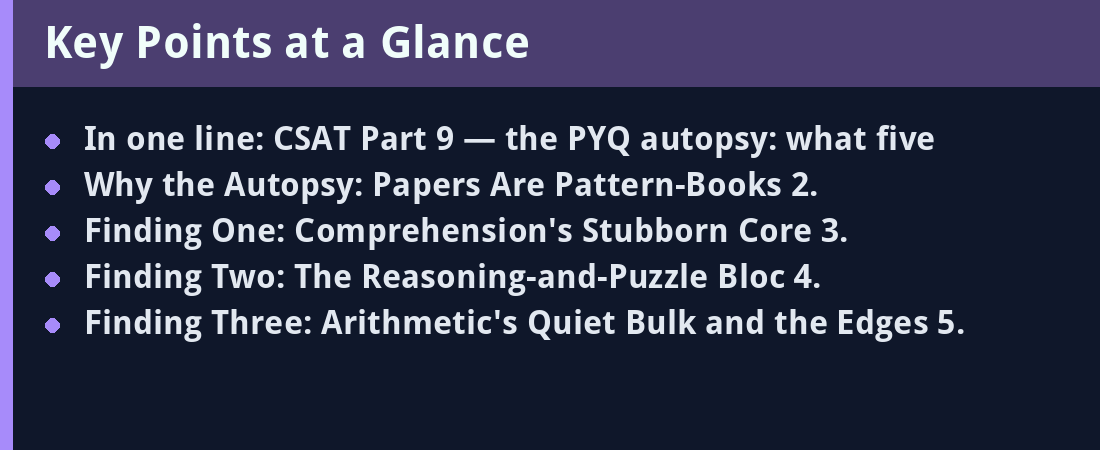
In one line: CSAT Part 9 — the PYQ autopsy: what five years of previous-year papers actually teach, and how to convert that reading into a practice plan.
- 1. Why the Autopsy: Papers Are Pattern-Books
- 2. Finding One: Comprehension’s Stubborn Core
- 3. Finding Two: The Reasoning-and-Puzzle Bloc
- 4. Finding Three: Arithmetic’s Quiet Bulk and the Edges
- 5. The Trap: Qualifying Is Not Passing
- 6. The Protocol: PYQ-First Practice
- 7. Quick Revision: One-Glance Facts
- Three Worked PYQs — attempt before the solutions
- The Three Families
- Practice Corner: Five Definition Checks (with Answers)
- The Case Lens: Running Your Own Autopsy
- The Three Classic Traps (Where Beginners Slip)
- Frequently Asked Questions
- What does the CSAT paper consist of?
- Why do strong GS candidates fail CSAT?
- How much time should CSAT preparation take?
- Are previous-year questions enough for CSAT?
- What is the safest CSAT target?
- Exam Checklist
- FAQ
- How much of this page is exam-relevant?
- When should I revisit?
- The Thirty-Second Recap
- Explain It Simply
- Abbreviations That Recur Here
In one line: The practicum on one card: what five years of CSAT papers actually contain — reading comprehension’s stubborn core, the reasoning-and-puzzle bloc, arithmetic’s quiet bulk, the DI-and-decision edges; the difficulty drift that turned a “qualifying formality” into a real filter; and the practice protocol (PYQ-first, sectional-second, mock-third) that fixes it.
The PYQ practicum stands on four counts. First, the autopsy method — how to read a paper backwards. Second, the findings — the pattern-by-pattern read of recent CSATs. Third, the trap — the qualifying-marks arithmetic that catches the unprepared. Fourth, the protocol — the practice plan the autopsy implies.
Contents
1. Why the Autopsy: Papers Are Pattern-Books
2. Finding One: Comprehension’s Stubborn Core
3. Finding Two: The Reasoning-and-Puzzle Bloc
4. Finding Three: Arithmetic’s Quiet Bulk and the Edges
5. The Trap: Qualifying Is Not Passing
6. The Protocol: PYQ-First Practice
7. Quick Revision: One-Glance Facts
– Practice Corner: Five Definition Checks (with Answers)
– The Case Lens: Running Your Own Autopsy
Quick Answer: Five years of CSAT papers teach three things: reading comprehension holds a stubborn two-fifth-ish share of questions regardless of difficulty; the reasoning-and-puzzle bloc (series, arrangements, blood relations, syllogisms) plus arithmetic’s percentage-ratio-time-and-work engine form the paper’s scoreable bulk; and difficulty has drifted upward — DI sets grow fiddlier, puzzles grow layered, and the “just qualify” folklore has sunk serious candidates. The qualifying line is 33 per cent (66.67/200), but the wise target is 90-plus for safety; the protocol is PYQ-first (five years, twice), sectional drills on the weak family, and full mocks to train the two-hour clock.
1. Why the Autopsy: Papers Are Pattern-Books
- The premise. An exam taken for a decade-and-a-half has a stable genome: section shares, question families, difficulty habits and trap architectures repeat. The PYQ set is the only sample that cannot lie — coaching projections and mock-paper fashions drift; the paper’s own history does not. When a mock series and the actual papers disagree, the actual papers win.
- The method. Take the last five years’ CSATs; classify every question into a family tree (comprehension, interpersonal-including-empathy-and-decision-making under the old head, logical-and-analytical reasoning with its sub-families, quantitative-and-basic-numeracy with its arithmetic core, and data interpretation-and-sufficiency); count; read the counts. Half a day’s work, the whole strategy.
- The output discipline. The autopsy produces three numbers per family (share, accuracy-at-your-hand, time-per-question) — strategy is then arithmetic, not opinion. “I’m weak at reasoning” becomes “puzzles cost me 3.5 minutes each at 40 per cent accuracy; syllogisms cost 40 seconds at 90 per cent” — a sentence you can act on.
- The refresh rule. Redo the autopsy each February–May cycle after the new paper joins the set: one paper changes the trend table; five years’ drift is real signal.
2. Finding One: Comprehension’s Stubborn Core
- The share. Reading comprehension has held the single largest family share through the decade — passages drawn from humanities-and-social-science writing (ethics, education, society, philosophy-adjacent prose), four to six passages a paper, three-to-six questions each. No difficulty cycle has dislodged it.
- The difficulty signature. The passages are not hard for vocabulary; they are hard for inference — the “author would agree”, “the passage implies” stems punish keyword-matching and reward line-by-line argument tracking. Two passages are often deliberately dense (the philosophy-flavoured ones) — the paper’s built-in time sinks.
- The scoring logic. Comprehension is the highest accuracy-per-hour family for a practised reader: no formulas, no tricks — just disciplined passage-first, question-second reading with elimination discipline. The autopsy’s verdict for most candidates: this is the floor score; build it first, because it stabilises the rest of the paper.
- The practice implication. Daily passage work (two passages, timed) beats weekly cramming; the sources that transfer are editorials-and-essays (the dense-essay register), not light news briefs. Track not just right-and-wrong but the elimination chain: which two options died first, and why.
3. Finding Two: The Reasoning-and-Puzzle Bloc
- The families. Series-and-codes (number-and-letter series, coding-decoding, symbol-and-statement puzzles), arrangements-and-puzzles (seating — linear-and-circular, scheduling, matching), blood relations-and-directions, syllogisms-and-logical-connectives (the statement-conclusion family, including the negative-framing traps), and the oddball analytical sets (cube-and-dice residues, Venn problems).
- The drift. The puzzle layering has thickened across recent papers: two-condition puzzles became four-condition; seating sets carry additional attribute grids (city-profession-hobby matrices). Difficulty has moved from single-step deduction to constraint-satisfaction — the bank-exam infiltration of the civil-services paper.
- The selection doctrine. Every puzzle is a bid: solvable-in-four-minutes or a swamp. The autopsy-trained candidate pre-classifies (read the conditions, count the attributes, bid or skip) — selection, not genius, is the puzzle section’s real skill. A skipped swamp that funds three clean syllogisms is a net gain.
- The scoring logic. Syllogisms-and-series remain formula-learnable (a week of rules-and-drills to stability); the puzzles reward practice volume. Between them, the bloc is the paper’s second pillar.
4. Finding Three: Arithmetic’s Quiet Bulk and the Edges
- The arithmetic core. Basic numeracy’s engine: percentages, ratio-proportion, averages, profit-loss-and-simple-interest, time-and-work, speed-distance-time (the trains-and-boats residue), number system’s HCF-LCM-and-remainder basics — Class 6–8 mathematics wearing an aptitude exam’s clothes. Familiar, and therefore dangerous: familiarity invites speed, and speed invites execution errors.
- The DI-and-sufficiency edge. Data interpretation sets (tables, charts, caselets — often two-to-three sets a paper, grown fiddlier with multi-table cross-references) plus data-sufficiency’s format questions; the sufficiency stems reward structure-recognition over computation — ask “is the data enough?” before computing anything.
- The forgotten family. Decision-making-and-interpersonal questions — the once-scoring, no-negative-marking family (from the paper’s design era) — have thinned to near-absence in recent papers; the ancient guides still teaching it heavily are teaching a ghost. Check the last three papers before buying any book’s table of contents.
- The scoring logic. Arithmetic is accuracy-business: the formula set is small, the trap surface is execution (units, percentage-points-versus-per-cent, the base-of-the-percentage switch). The autopsy’s arithmetic verdict: highest marks-per-preparation-hour for the rusty quantitative candidate.
5. The Trap: Qualifying Is Not Passing
- The arithmetic. CSAT is qualifying at 33 per cent — 66.67 of 200 marks — and its marks do not count in the merit total. The folklore reads: “a formality”. The recent papers’ difficulty drift has converted that folklore into a casualty list: serious GS candidates — 100-plus scorers — failing the paper they never practised, year after year.
- The margin mathematics. A 27-question-correct day scores 67.5 — above the 66.67 cutoff only with zero wrong answers: at one-third negative marking (0.833 per wrong), even three errors drag 67.5 to 65.0, a fail. One dense comprehension set plus two swamped puzzles, and the comfortable 27 becomes 22-and-a-heartbreak. The safety line every autopsy lands on: prepare to 90-plus (36-plus correct), sit the paper at 75-plus comfort.
- The strategic consequence. CSAT deserves real calendar time — a third of prelims preparation for the maths-averse, a fifth for the comfortable — decided by the autopsy’s accuracy numbers, not by folklore from either side.
- The triage table. Comprehension-first build, arithmetic formulas second, reasoning rules third, puzzle practice throughout — the order the paper’s structure itself recommends.
6. The Protocol: PYQ-First Practice
- Phase one — the autopsy (a week). Five years, untimed, family-tagged, error-logged: the personal trend table that sets every later decision.
- Phase two — the repair loop (six-to-eight weeks). Family-wise drilling against the error log: comprehension daily, arithmetic formulas weekly-by-block, reasoning rules by family, puzzles three-a-week — each with time-per-question tracking.
- Phase three — the clock (four-to-six weeks). Full PYQ papers as timed mocks (the two-hour, 80-question reality), then one fresh-mock series for unfamiliar-paper exposure; the PYQs first because they calibrate the exam’s true register, the mocks second to break memory’s comfort.
- The error log’s discipline. Every wrong answer tagged: knowledge-gap, trap-fall, or time-press. The three tags have three medicines (study, pattern-review, selection-doctrine) — and the log’s ratio decides the next week’s plan. A log dominated by trap-falls calls for pattern-review sessions, not more syllabus.
7. Quick Revision: One-Glance Facts
- Paper. 80 questions, 200 marks, two hours; qualifying 33 per cent; negative marking one-third.
- Families. Comprehension (largest, inference-heavy), reasoning-and-puzzles (growing layered), arithmetic (the marks-engine), DI-and-sufficiency (the fiddly edge); decision-making (the ghost).
- Drift. Difficulty rising — puzzles multi-condition, DI multi-table, passages denser; “just-qualify” folklore is the paper’s chief killer.
- Target. Prepare to 90-plus; sit comfortable above 75.
- Protocol. Autopsy → family repair → timed PYQs → fresh mocks; the error log drives the calendar.
Conclusion. Five years of CSAT papers, read as one document, tell you everything: comprehension is the floor, arithmetic the engine, puzzles the swamp-selection game — and the qualifying line is a trap for anyone who mistook it for a promise. Autopsy first, repair by family, then the clock. The paper is beatable; it is only unbeatable unpractised.
Three Worked PYQs — attempt before the solutions
- Percentage. A batch’s pass rate rises from 60% to 75% at constant size. The percentage increase in the number of passes is: (a) 15% (b) 20% (c) 25% (d) 75%. Solution: passes per 100 go 60 to 75; an increase of 15 on a base of 60 is 25% — (c). Trap (a) subtracts percentages instead of comparing counts — the base-of-the-percentage switch in miniature.
- Ratio. Rs 4,200 is divided among A, B and C in the ratio 2 : 3 : 2. B’s share exceeds A’s by: (a) Rs 600 (b) Rs 700 (c) Rs 800 (d) Rs 900. Solution: 7 parts means Rs 600 per part; B = Rs 1,800, A = Rs 1,200 — difference Rs 600 (a). Trap (b) reads ‘exceeds’ as ‘is’.
- Reading inference. Passage: ‘The ministry’s claim rested on a survey whose response rate fell below ten per cent; no second survey was commissioned.’ Which is safest to infer? (a) the claim is false (b) the claim is well-supported (c) the claim rests on thin evidence (d) surveys are unreliable. Solution: (c) — the passage supports an evidence-quality judgement, not a truth judgement; (a) over-reads, (b) contradicts, (d) over-generalises — the three classic inference-option archetypes.
The Three Families
| Family | Role | Strategy |
|---|---|---|
| Comprehension | The floor | Questions-first reading |
| Arithmetic | The engine | Percentages, ratios to reflex |
| Reasoning & DI | The bid | Set-selection discipline |
Practice Corner: Five Definition Checks (with Answers)
- CSAT’s qualifying threshold is — 33 per cent (66.67 of 200), merit-neutral but elimination-real.
- The largest single question family across recent papers is — Reading comprehension (inference-stemmed, humanities-register passages).
- The drift in the puzzle bloc is — Multi-condition layering — seating-and-matching grids with several attribute dimensions.
- The once-scoring, now near-absent family is — Decision-making/interpersonal questions.
- The autopsy’s three error tags are — Knowledge-gap, trap-fall, time-press — each with its own medicine.
The Case Lens: Running Your Own Autopsy
Take the last five papers this weekend. Untimed, tag every question by family; mark every wrong answer with one of the three tags; compute each family’s accuracy and time-per-question. The output is a personal trend table — your comprehension floor, your arithmetic engine’s compression ratio, your puzzle swamp-rate — and the next eight weeks’ calendar writes itself from it. Repeat after the May paper: one new paper, refreshed strategy. The autopsy costs one weekend; skipping it costs an attempt.
The Three Classic Traps (Where Beginners Slip)
“CSAT is qualifying; skip the practice.” The difficulty drift made that sentence the single most expensive sentence in prelims preparation. The casualty lists are annual and GS-strong — the paper filters the unpractised, not the unintelligent.
“PYQs repeat; memorise them.” Families repeat; questions rarely. The PYQ value is calibration-and-pattern, not recall — memorised answers inflate mock scores and deflate real ones.
“Solve every puzzle.” The puzzle bloc is a bidding market: four-minute solutions or skips. The candidate who attempts all puzzles finishes nothing else — selection discipline is a taught skill, not a temperament.
Frequently Asked Questions
What does the CSAT paper consist of?
Reading comprehension, logical-and-analytical reasoning (series, puzzles, syllogisms, blood relations), quantitative-and-basic numeracy (arithmetic-dominated), and data interpretation-and-sufficiency — 80 questions, 200 marks, two hours, qualifying at 33 per cent with one-third negative marking.
Why do strong GS candidates fail CSAT?
Difficulty drift: puzzles grew multi-condition, DI fiddlier, passages denser — while the folklore (“just qualifying, no practice needed”) persisted. The paper now filters the unpractised regardless of GS strength.
How much time should CSAT preparation take?
Set by the autopsy: roughly a third of prelims time for the maths-averse, a fifth for the comfortable — anchored by daily comprehension, arithmetic formula repair, puzzle practice and timed PYQ mocks.
Are previous-year questions enough for CSAT?
Nearly — five years of PYQs, done twice (untagged-study then timed), plus one fresh mock series for unfamiliar-paper exposure. The PYQs calibrate the exam’s true register; mocks break memory’s comfort.
What is the safest CSAT target?
Prepare to 90-plus marks; aim to sit the paper at 75-plus comfort. The qualifying line is 66.67 — margins absorb the bad-puzzle day that would otherwise eliminate a strong GS candidate.
Related on hmmnm.in: CSAT Part 1: Reading Comprehension Method · CSAT Part 7: Decision Making — The Qualifying Plan · CSAT Part 6: Blood Relations, Directions, Puzzles
Read next: CSAT Part 8: The Two-Hour Paper Plan (series archive)
Exam Checklist
- Therefore, revise the article table vertically
- Pair each number with its office
- Write one mains-skeleton weekly
- In addition, teach the page to a peer in three minutes
- Revisit on Sunday with the quiz
FAQ
How much of this page is exam-relevant?
Nearly all of it, because the tables and worked items follow the standard question register for this subject.
When should I revisit?
Day three and day seven after the first read, with the drill spoken aloud once.
The Thirty-Second Recap
One page. One topic. Therefore, read the tables twice. Speak the recap once. Moreover, the numbers carry the marks. The names carry the traps. However, revisits beat rereads. Finally, day three and day seven. That is all.
Explain It Simply
Think of this page as a map of one neighbourhood. The big streets are the tables. The landmarks are the numbers. The street names are the terms in bold. However big the city feels, this one neighbourhood fits in a pocket, and a pocket map is what exam week needs. Therefore, walk it once fully, then walk only the streets you forget, and by the second walk the neighbourhood feels like home.
Pocket the map, not the whole city: exams reward the walkable version of every topic.

Abbreviations That Recur Here
- CSAT.
- DI.
- HCF.
- GS.
Quick revision
- The premise.: An exam taken for a decade-and-a-half has a stable genome: section shares, question families, difficulty habits and trap architectures repeat.
- The method.: Take the last five years’ CSATs; classify every question into a family tree (comprehension, interpersonal-including-empathy-and-decision-making…
- The output discipline.: The autopsy produces three numbers per family (share, accuracy-at-your-hand, time-per-question) — strategy is then arithmetic, not opinion.
- The refresh rule.: Redo the autopsy each February–May cycle after the new paper joins the set: one paper changes the trend table; five years’ drift is real signal.
- The share.: Reading comprehension has held the single largest family share through the decade — passages drawn from humanities-and-social-science writing…
- The difficulty signature.: The passages are not hard for vocabulary; they are hard for inference — the “author would agree”, “the passage implies”…
Have a doubt on this topic?