JEE/NEET Physics · Motion in a Plane series · Part 5 of 6 · All parts →
- Uniform circular motion: constant SPEED, continuously changing VELOCITY (direction turns)
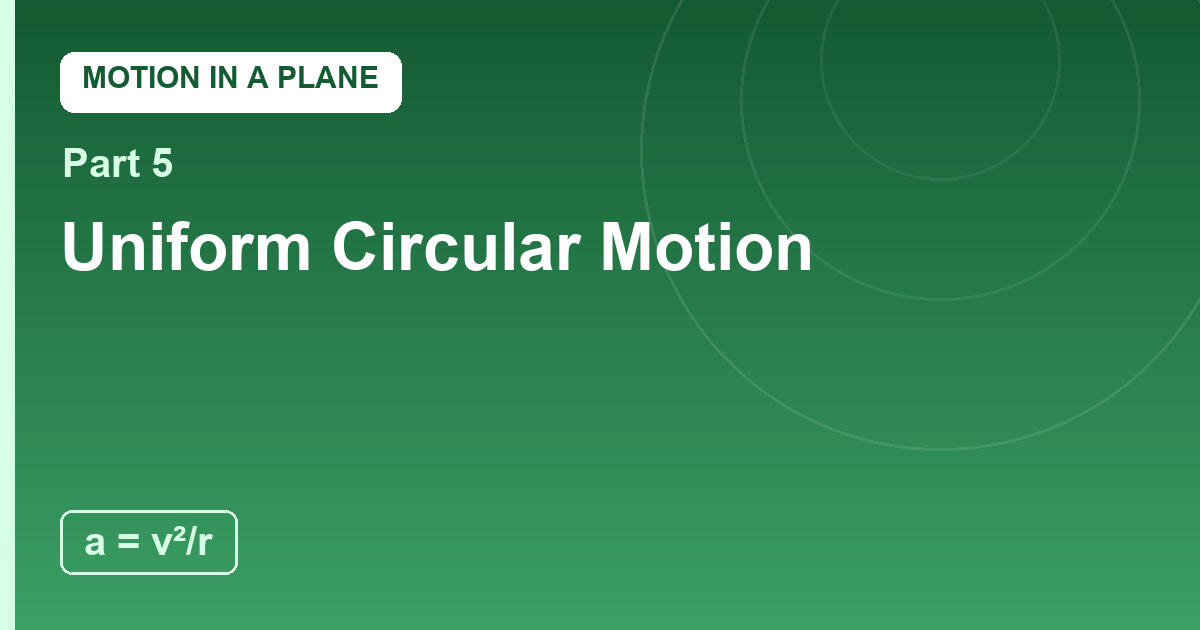
- Because velocity changes, there IS acceleration — centripetal, a_c = v²/r, always pointing to the centre
- It is NOT constant acceleration: the direction of a keeps rotating
- Period and speed link: v = 2πr/T
- Centripetal force is a ROLE, not a new force: gravity, tension, friction supply it in different scenes
A car rounding a bend at a steady 60 km/h is accelerating — its speedometer hasn’t moved, but its velocity is turning, and turning velocity is acceleration. There’s nowhere to hide from a = change-in-velocity. Part 5 of the Motion in a Plane series.
- Speed constant, velocity not
- Centripetal acceleration
- The v²/r surprise
- Period, frequency, speed
- Who plays the centripetal role?
- Solved examples
- Common mistakes
- This physics in your daily life
- Practice set
- Recap
Speed Constant, Velocity Not
Drive around a circle at exactly 20 m/s. After a quarter turn, your velocity is 20 m/s north instead of east: same speed, different direction — so the velocity CHANGED, and changed velocity means accelerated motion. Uniform circular motion is acceleration in its purest disguise.
Centripetal Acceleration
| Letter | What it means (plain words) | Value / unit |
|---|---|---|
| a_c | centripetal acceleration (magnitude) | m/s², aimed at the centre |
| v | constant speed along the circle | m/s |
| r | radius of the circle | m |
| T | period — time for one full lap | s |
The v²/r Surprise
Double your speed → FOUR times the needed acceleration. Halve the radius (tighter turn) → double it. This is why tight bends have low speed limits and why the second before a crash punishes speed so brutally: the v² grows violently.
Period, Frequency, Speed
One lap covers 2πr in time T: v = 2πr/T. The Earth’s orbit: 2π × 1.5×10¹¹ m over a year → 30 km/s — the same formula, solar-system scale.
Who Plays the Centripetal Role?
| Scene | Force providing the centripetal pull |
|---|---|
| Ball on a string | tension |
| Car on a flat bend | friction (tyres) |
| Moon around Earth | gravity |
| Electron around nucleus (classic picture) | electrostatic attraction |
| Clothes in a spin dryer | the drum’s normal push |
Solved Examples
a_c = 25/25 = 1 m/s²; F = 60 N toward the centre.
✔
Answer: 1 m/s²; 60 N
mg·μ = mv²/r → μ = 400/(50 × 10) = 0.8.
At 28 m/s it would need μ = 1.57 — impossible on dry asphalt: the v² has spoken. ✔
Answer: μ = 0.8
Same ω → a_c = ω²r: B has 4× the radius → a_B = 4 a_A.
But at the same LINEAR speed, B would have a QUARTER of A’s. Same letter pair, opposite outcomes — the question’s phrasing decides. ✔
Answer: a_B = 4a_A (same ω); a_B = a_A/4 (same v)
- ‘Constant speed means no acceleration.’ Only in straight lines; on any curve, direction-change alone is acceleration.
- Centrifugal fantasy. In the ground frame there is no outward force — the outward ‘shove’ you feel is your body’s inertia obeying Newton’s first law while the car turns inward.
- Treating a_c as constant acceleration. Its magnitude is constant, its direction rotates every instant — the Part 2 equations do NOT apply to circles.
- Inventing a new force. ‘Centripetal force’ is a job description: tension, friction, or gravity must already exist to take the job.
This Physics in Your Daily Life
- Seatbelts exist because of v²/r — in a bend, the car turns (friction supplies a_c) while your body tries to continue straight: the belt plays the centripetal role your seat refuses to.
- Clothes dryers fling water outwards-through-the-holes — the drum turns the clothes; the water, lacking a centripetal supplier, continues straight and escapes: ‘spin dry’ is Newton’s first law doing laundry.
- Cemetery bends, hairpin mountain roads — engineers reduce r only as much as friction allows: every advisory speed sign is a_c = v²/r solved for you.
- Satellites and the ISS — gravity IS the centripetal force: 8 km/s of speed falling around the planet forever (the Gravitation series told this story).
- Cyclists and bikers lean into turns — leaning lines up gravity + normal force through the centre of the curve: your body finds the resultant that supplies a_c.
A passenger with closed eyes in a steadily turning car can’t see the turn — but feels it: something keeps nudging them sideways. The speedometer says nothing changed; the body says everything did. What changed is direction, and the body, unlike the speedometer, tracks velocity — a full vector.
At 10 m/s on a 20 m circle: a_c = 100/20 = 5 m/s² — half a g, felt clearly. Double the speed to 20: 20 m/s² — two g, bone-shaking. Same bend, same car: the acceleration quadrupled because only the direction-turning rate demanded it. Tighten to r = 10: doubles again.
Draw the velocity arrows at successive moments around the circle: all the same length, each aimed along a new tangent. Copy them tip-to-tail: their differences are tiny arrows all pointing INWARD — the vector change in velocity per second is a centripetal arrow. The picture literally derives v²/r.
Practice set (answers hidden — try first)
(NEET-level) v = 6, r = 1.8: a_c =
(JEE Main-level) a_c = 8 m/s², r = 2: v =
(NEET-level) Direction of a_c in UCM:
(Concept) Speed doubles on the same circle: a_c becomes
(JEE Main-level) r = 0.5 m, 120 rpm: v =
- constant speed, changing velocity = acceleration
- a_c = v²/r, centre-pointing, ⊥ velocity
- double speed → 4× a_c
- v = 2πr/T links period and speed
- centripetal force is a role played by real forces
- 🔁 UCM: |v| constant, direction rotates
- 🔁 a_c = v²/r = ω²r = 4π²r/T²
- 🔁 centripetal ⊥ velocity, never changes speed
- 🧠 Chant: ‘turning is acceleration; sideways, not faster’.
- 🧠 v²/r: ‘speed squared over radius — the violence of fast, tight turns’.
- 🏠 Daily: seatbelts play the centripetal role in bends.
- 🏠 Daily: spin dryers = water obeying Newton’s first law.
Quick revision
- Uniform circular motion: constant SPEED, continuously changing VELOCITY (direction turns)
- Because velocity changes, there IS acceleration — centripetal, a_c = v²/r, always pointing to the centre
- It is NOT constant acceleration: the direction of a keeps rotating
- Period and speed link: v = 2πr/T
- Centripetal force is a ROLE, not a new force: gravity, tension, friction supply it in different scenes
- Speed constant, velocity not
Have a doubt on this topic?