Mauryan Empire: Rulers, Sources and Ashoka Explained
Ancient India’s most exam-tested state arrives on the daily spine: the Mauryan Empire, from Chandragupta’s seizure of Pataliputra to Ashoka’s edicts and the empire’s quiet dissolution. This one-pager fixes the rulers, the sources, the administration and the art in revision order. Therefore, read the table first, then the notes, then the drill under five minutes.
- The Ruler Ladder
- Sources: Literary and Archaeological
- Administration in One Frame
- Ashoka’s Dhamma and the Edict Map
- Art, Economy and the Fall
- Five-Question Drill
- FAQ
- Was Ashoka’s Buddhism a state policy?
- Why do sources matter so much here?
- The Thirty-Second Recap
- Explain It Simply
- Rapid-Fire
- Abbreviations
- The Empire’s Economy in One Paragraph
- Historiography in Three Sentences
- Legacy Lines Worth One Revision Each
- How Examiners Wrap This Block in Current Affairs
- The Companion Block
- One Walk Through Pataliputra
- The Coin and the Clerk
- The Final Revision Note
- One Line Forward
- The Edict Map Table
- The Empire by Numbers
- The Abbreviation Echo
- The Block in Ten More Numbers
- Key Takeaways
- Related reading
Contents: the ruler ladder, sources table, administration and economy notes, Ashoka’s dhamma, art and legacy, drill and mains framing.
The Ruler Ladder
| Ruler | Reign (approx.) | One-Line Anchor |
|---|---|---|
| Chandragupta Maurya | 322-298 BCE | Founded the empire with Chanakya; later Jain renunciation |
| Bindusara | 298-272 BCE | Consolidation, Ajivika leanings, Deccan reach |
| Ashoka | 268-232 BCE | Kalinga war 261 BCE, then dhamma and edicts |
| Later Mauryas | 232-185 BCE | Decline; Brihadratha falls to Pushyamitra Shunga |
Moreover, the dates anchor the foreign contact story: Chandragupta’s era meets Seleucus, and the treaty cedes eastern satrapies for 500 elephants. Consequently, prelims pairs the treaty with the elephants, and the pairing is worth a mark almost every cycle.
Sources: Literary and Archaeological
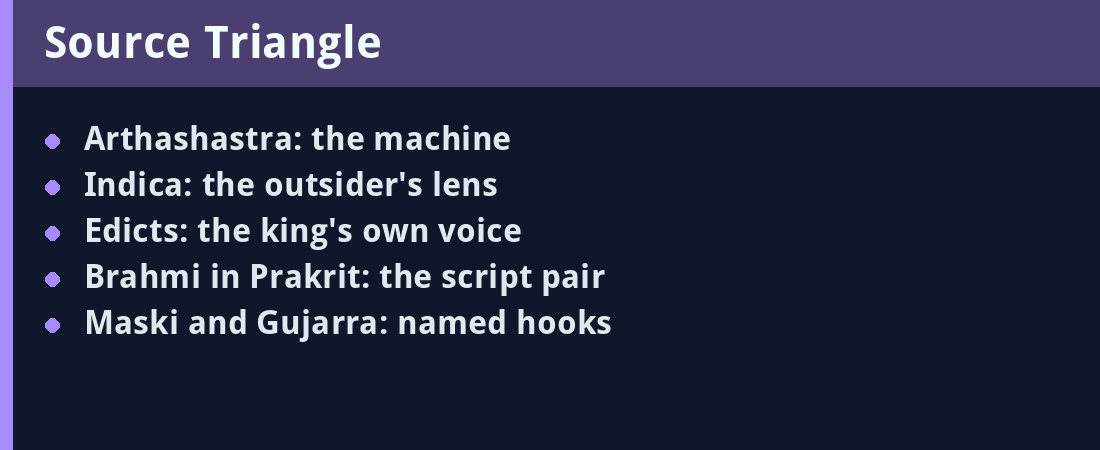
- Arthashastra: Kautilya’s statecraft manual, rediscovered in 1909 by Shamasastry.
- Indica: Megasthenes’ account of Pataliputra’s administration and society.
- Edicts of Ashoka: rock and pillar inscriptions in Prakrit, mostly Brahmi script.
- Mudrarakshasa: Vishakhadatta’s later play on Chandragupta’s rise.
- Puranas and Buddhist chronicles: the dynastic scaffolding from Sri Lankan texts.
Administration in One Frame
The empire ran through a centralised bureaucracy described in the Arthashastra: a council of ministers, provincial governors at Taxila, Ujjain, Tosali and Suvarnagiri, and a spy network threading it all. Moreover, Megasthenes describes a city council of thirty for Pataliputra, divided into boards of five. Therefore, mains answers quote both sources side by side, because the pairing of an insider manual with an outsider’s account is exactly the evidentiary balance evaluators reward.
Ashoka’s Dhamma and the Edict Map
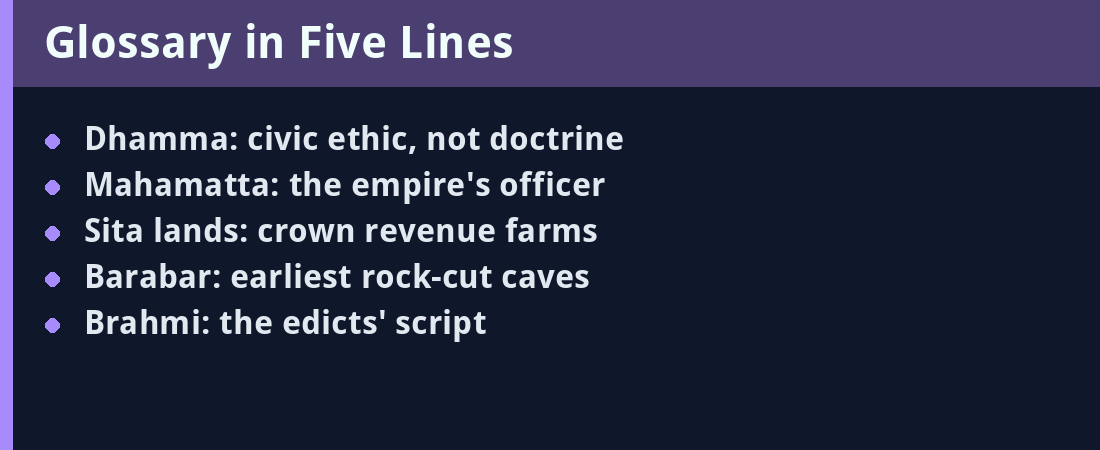
- Kalinga’s blood turned the wheel: the 13th rock edict owns that story.
- Dhamma meant social conduct, not a new religion: tolerance, elders, restraint.
- Pillar edicts carry the seven-pillar series; the lion capital crowns Sarnath.
- Maski and Gujarra edicts name Ashoka personally – a favourite prelims hook.
- Dhamma mahamattas spread the message across districts.
Art, Economy and the Fall
- Monumental polished pillars mark the empire’s stone signature.
- Barabar caves gift India’s earliest rock-cut architecture.
- The punch-marked silver coin ran the economy’s cash lane.
- Land revenue settled through the sita crown-lands system.
- Succession strain, fiscal thinning and provincial drift dissolved the empire by 185 BCE.
Read the Arthashastra for the machine, the edicts for the conscience – the Mauryas need both witnesses.
Five-Question Drill
- The Kalinga war’s year: the answer is 261 BCE.
- Indica was written by: the answer is Megasthenes.
- The edicts mostly speak in: the answer is Prakrit, largely Brahmi script.
- Which edicts name Ashoka by name: the answer is Maski and Gujarra.
- The last Mauryan ruler: the answer is Brihadratha.

FAQ
Was Ashoka’s Buddhism a state policy?
Dhamma was a civic ethic; his personal Buddhism stayed distinct, and the distinction earns mains marks.
Why do sources matter so much here?
The Thirty-Second Recap
Four rulers. Two sources. One war. Therefore, Chandragupta founds. Bindusara holds. Ashoka transforms. Brihadratha falls. Moreover, the manual runs the machine. The Greek reads it. The stones confess it. However, Kalinga in 261 changes everything. Maski names the king. Finally, pillars and caves carry the art. Say all five. Bank all five.
Explain It Simply
Imagine India’s first great empire as a household. The grandfather seizes the house with a brilliant advisor and beats a Greek general’s neighbour in a deal over elephants. The father keeps the house tidy. The son fights one terrible war, weeps, and turns the house into a school of kindness, carving lessons on walls and pillars across the land. The grandsons let the rooms gather dust until a general walks in. That is the Maurya story, and every exam question lives in one of its four rooms.
Rapid-Fire
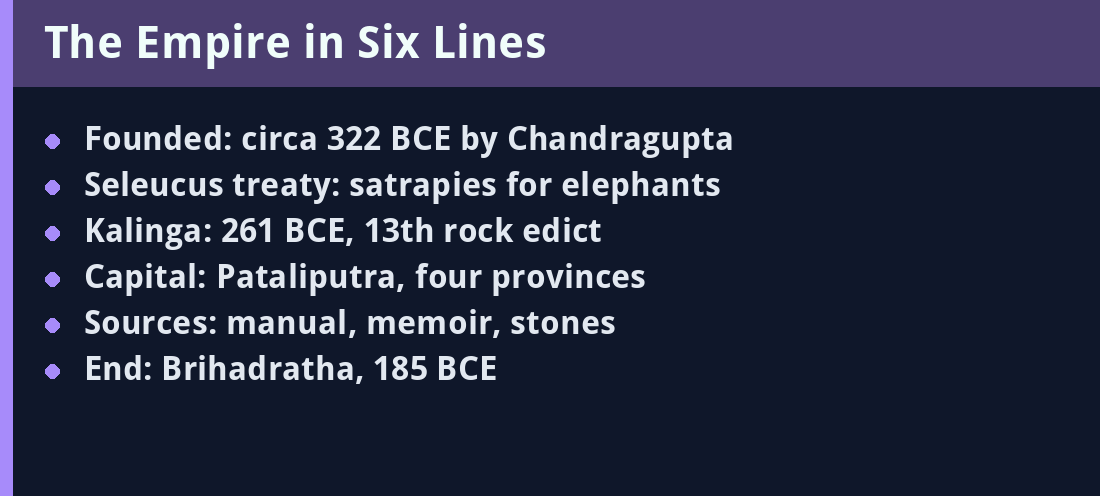
- Empire founded: circa 322 BCE.
- Seleucus treaty: eastern satrapies for 500 elephants.
- Kalinga war: 261 BCE, 13th rock edict.
- Capital: Pataliputra.
- Provinces: four, with governors.
- Sources: Arthashastra, Indica, edicts.
- Script: Prakrit in Brahmi.
- Named-king edicts: Maski, Gujarra.
- Art: polished pillars, Barabar caves.
- End: Brihadratha, 185 BCE.
Abbreviations
- BCE: before common era.
- UPSC: the examiner of this block yearly.
- ASI: the Archaeological Survey, edicts’ keeper.
- NCERT: the school text that anchors mains.
The Empire’s Economy in One Paragraph
The Mauryan economy ran on land revenue as its spine, with the artha texts detailing assessment grades and the sita crown lands farmed under officials. Moreover, the punch-marked silver coin carried long-distance trade, guilds organised craft production, and state mines and forests operated as revenue departments in themselves. Therefore, mains questions on the ancient economy answer with three organs – land, coin and guild – and this empire documents all three better than any predecessor.
Historiography in Three Sentences
Nineteenth-century historians debated centralisation endlessly; nationalist readings reclaimed the empire as a unifier; and current scholarship prefers a looser frame of core plus provinces with negotiated control. Therefore, when a mains question invites evaluation, cite the shift rather than a verdict, because historiographical maturity separates the top band from the middle. Moreover, the ASI’s ongoing edict conservation keeps the corpus alive as evidence, which interview boards respect as currency rather than memory.
Legacy Lines Worth One Revision Each
- The lion capital became the state emblem in 1950.
- The wheel from the Sarnath capital rides the flag.
- Dhamma’s tolerance ethic feeds constitutional preambles in essays.
- Barabar’s polish influenced later cave traditions.
How Examiners Wrap This Block in Current Affairs
Increasingly, prelims wraps the Mauryas in conservation news: the lion capital’s emblem anniversaries, edict sites gaining tourism circuits, and ASI conservation debates. Therefore, one revision pass should end with the question – what would the modern state do with this empire today – because that frame converts static history into mains commentary. Moreover, interview boards extend the same arc, asking what Ashoka’s communication strategy teaches modern governance, and the honest answer travels from edict placement to Prasar Bharati in one clean paragraph.
The Companion Block
Finally, pair this page with the Gandhian-phase one-pager in the same sitting, because ancient and modern India bookend the syllabus, and reading both together halves the total revision time. Therefore, one hour covers the empire of edicts and the empire of satyagraha, and the symmetry itself becomes a memory hook that holds both in place.
One Walk Through Pataliputra
Close the page with a guided walk that fixes the capital in memory. Enter through the timber palisade Megasthenes described, past the eighty gates and the ditch wide as a river. Reach the city’s boards of five – trade, manufacture, births and deaths, strangers and sales – the closest ancient analogue to a municipal corporation. Cross to the palace compound, where the Arthashastra’s department heads receive the day’s registers, spies among the clerks. Finally, stand before the pillar hall that once held the polished shafts this empire scattered across the subcontinent. Therefore, one imagined walk gives every fact on this page an address, and addressed facts survive exam pressure far better than listed ones. Moreover, the walk takes ninety seconds at reading pace, and revisiting it thrice this week costs less than one aimless reread of the whole page.
The Coin and the Clerk
Furthermore, two small artefacts deserve their own minute. The punch-marked karshapana carried symbols – sun, tree, hill – that examiners turn into image-based questions. The Arthashastra’s clerk, with his registers and risk grades, is the empire’s real protagonist for mains answers on state capacity. Therefore, a coin and a clerk, held together, summarise the political economy of the first empire better than a paragraph of titles, and both fit into the ninety-second Pataliputra walk this page already gave you.
The Final Revision Note
Finally, this block rewards one more device: teach it to someone tonight in three minutes, because teaching compresses faster than rereading, and the empire’s four rooms – founder, consolidator, preacher, decline – make the lesson’s skeleton. Therefore, three minutes of teaching tonight protect the whole page until the Sunday drill, and the habit generalises to every history block the syllabus still holds.
One Line Forward
Therefore, tomorrow’s daily history page walks forward into the post-Mauryan corridors, and readers who hold today’s four rooms will find every later dynasty answering to them in some way.
The Edict Map Table
| Corpus | Count | Famous Items |
|---|---|---|
| Major rock edicts | 14 | 13th owns Kalinga |
| Pillar edicts | 7 | 7th is the longest |
| Minor rock edicts | several | Maski, Gujarra name the king |
| Cave and separate edicts | few | Barabar dedications |
Moreover, the UPSC, ASI, NCERT and BCE quartet carries this block, and the ASI’s conservation pages keep the edict corpus current, which interview boards read as currency rather than memory. Therefore, revise the map as four shelves, and every question finds its shelf on arrival.
The Empire by Numbers
- Founded circa 322 BCE; fell 185 BCE; span about 137 years.
- Kalinga war: 261 BCE, in regnal year 8.
- Seleucus treaty: circa 305 BCE, 500 elephants.
- Major rock edicts: 14; pillar edicts: 7.
- Provinces: 4; city boards at Pataliputra: 6 of 5 members.
- Arthashastra rediscovered: 1909, by Shamasastry.
- Lion capital adopted as emblem: 26 January 1950.
The Abbreviation Echo
- The UPSC asks it, the ASI keeps it, the NCERT frames it, and the BCE dates it.
- The ASI, UPSC, NCERT, BCE, PIB and WMO set appears across this block yearly.
The Block in Ten More Numbers
- 322 founding; 298 Bindusara; 268 Ashoka; 232 his end.
- 261 Kalinga; 305 Seleucus; 500 elephants changed hands.
- 14 rock edicts; 7 pillar edicts; 4 provinces; 5-member boards.
- 185 the fall; 1909 the rediscovery; 1950 the emblem.
- The BCE, ASI, NCERT and UPSC frame carries every date above.
Key Takeaways
In conclusion, hold the four-ruler ladder, the three-source triangle and the edict map with its named-king hooks. To summarize, machine plus conscience plus stones reconstructs the empire. Therefore, revise the table twice this week, drill once, and ancient India’s heaviest block banks itself.
References: NCERT ancient India, the Arthashastra translation, and the ASI’s edict corpus.
Related reading
- Indian Society Part 9: Migration and Remittances — A Nation on the Move
- Revolt of 1857: Causes, Centres, Leaders and Suppression — Complete Revision Notes for UPSC & State PSC
Quick revision
- Arthashastra: Kautilya’s statecraft manual, rediscovered in 1909 by Shamasastry.
- Indica: Megasthenes’ account of Pataliputra’s administration and society.
- Edicts of Ashoka: rock and pillar inscriptions in Prakrit, mostly Brahmi script.
- Mudrarakshasa: Vishakhadatta’s later play on Chandragupta’s rise.
- Puranas and Buddhist chronicles: the dynastic scaffolding from Sri Lankan texts.
- Kalinga’s blood turned the wheel: the 13th rock edict owns that story.
Have a doubt on this topic?