Ramsar Sites and Wetland Conservation: The Complete Exam Frame
Wetlands are the most examined environment topic after forests, and the Ramsar convention supplies the frame: an international treaty, a national count that keeps rising, and site-based questions that reward a list habit. This page fixes the convention, the count, the star sites and the exam angles in one revision pass. Therefore, read the table, then the notes, then the drill.
- The Convention in Brief
- India’s Ramsar Story
- The Wise-Use Principle
- Threats and Laws in One Frame
- Five-Question Drill
- FAQ
- Does Ramsar listing restrict fishing?
- Which state has the most sites?
- The Thirty-Second Recap
- Explain It Simply: Ramsar for a Twelve-Year-Old
- Rapid-Fire: Ten Anchors in Ten Lines
- Abbreviations That Recur
- How Sites Get Selected
- Wetland Types Examiners Name
- Recent Years in One Paragraph
- Wetlands in the Exam Season: How Questions Are Framed
- The One-Minute Map
- Two Minutes on Flyways and Flags
- A Last Note on Counting
- The Bedtime Version
- The Abbreviation Echo
- Sites and States in Ten Lines
- Key Takeaways
Contents: the convention in brief, India’s Ramsar story, star sites table, the wise-use principle, threats and laws, a drill and mains framing.
The Convention in Brief
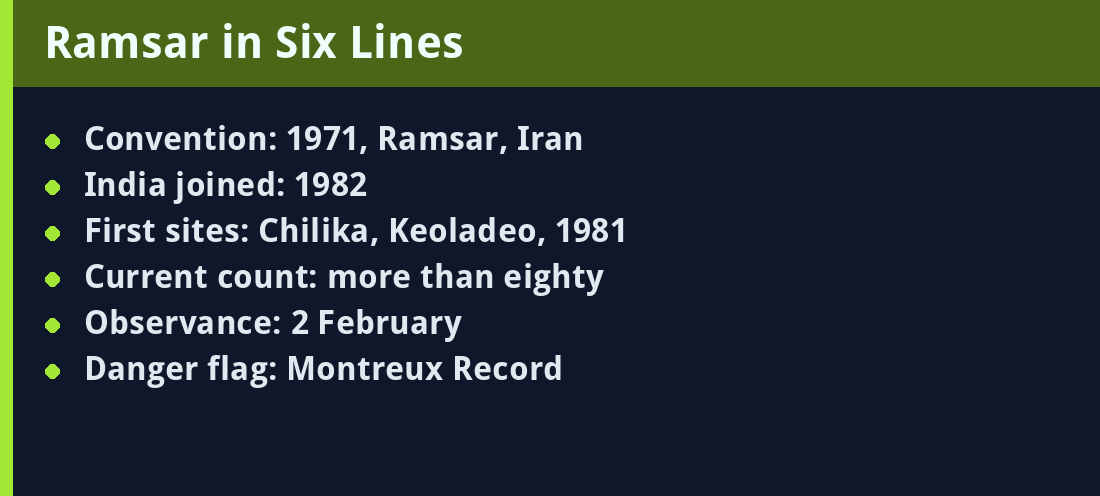
- Signed in 1971 at Ramsar, Iran, the treaty is the oldest modern global environmental agreement.
- Membership crossed 170 parties, with more than 2,500 listed sites worldwide.
- India joined in 1982, and Chilika and Keoladeo were the first two designated sites.
- World Wetlands Day is observed on 2 February, marking the treaty’s adoption.
- The Montreux Record flags sites under ecological threat, a favourite prelims hook.
India’s Ramsar Story
India’s designated sites now exceed eighty, placing the country among the top ranks in Asia for site count. Moreover, Tamil Nadu leads the state tally, while recent additions have clustered in Bihar, Odisha and the north-eastern wetlands. Consequently, questions increasingly test the newest batch, therefore refresh the count with each official announcement through the year.
| Site | State | Exam Hook |
|---|---|---|
| Chilika | Odisha | First Indian site, brackish lagoon, Irrawaddy dolphin |
| Keoladeo | Rajasthan | First pair, bird sanctuary, Montreux exit |
| Sundarbans | West Bengal | Largest delta, mangroves, tiger habitat |
| Wular | Jammu and Kashmir | Largest freshwater lake by area frame |
| Loktak | Manipur | Floating phumdis, Keibul Lamjao link |
The Wise-Use Principle
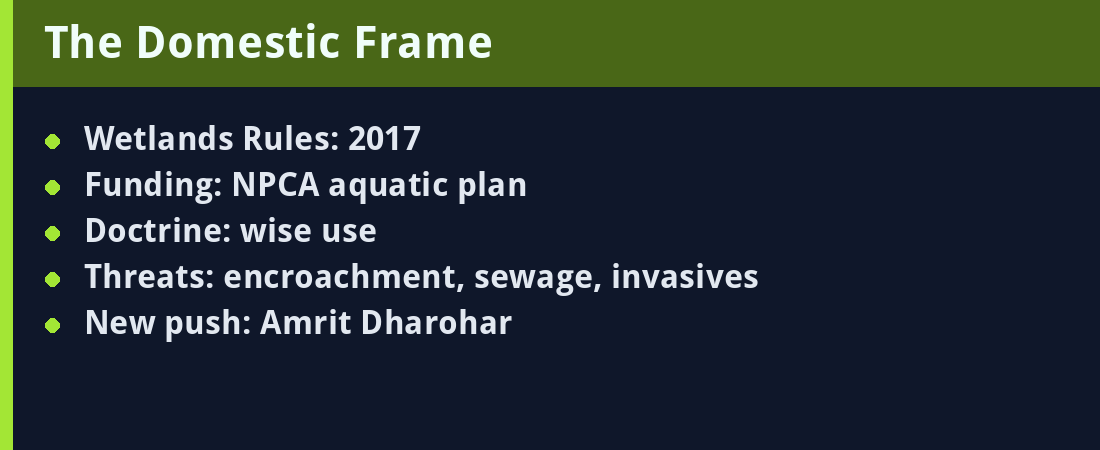
The convention’s core doctrine is wise use: conservation and sustainable use together, not exclusion of people. Therefore, Ramsar listing does not fence communities out; it commits management plans to ecological character maintenance. Moreover, India operationalises this through the Wetlands (Conservation and Management) Rules, 2017, with state authorities and a central roster. Consequently, mains answers score when they pair the treaty’s doctrine with the domestic rules and cite one site example.
Threats and Laws in One Frame
- Threats: encroachment, eutrophication, invasive species, and urban sewage loads.
- Wetland Rules 2017: notification, management plans, prohibited activities.
- National Plan for Conservation of Aquatic Ecosystems funds restoration.
- Amrit Dharohar promotes wise-use values at Ramsar sites.
- Biodiversity Act layers heritage-value protections at key sites.
A Ramsar tag is a promise of management, not a medal; the exam rewards candidates who know the difference.

Five-Question Drill
- The Ramsar Convention was signed in: Answer: 1971, at Ramsar in Iran.
- India’s first two Ramsar sites were: Answer: Chilika and Keoladeo, designated in 1981.
- World Wetlands Day falls on: Answer: 2 February.
- The Montreux Record lists: Answer: wetlands under ecological threat, including Keoladeo historically.
- The domestic framework rule year is: Answer: 2017, the Wetlands Conservation and Management Rules.
FAQ
Does Ramsar listing restrict fishing?
No; wise use sustains livelihoods within ecological character limits.
Which state has the most sites?
The Thirty-Second Recap
One treaty. Nineteen seventy-one. Iran. Therefore, wise use is the doctrine. India joined in eighty-two. Chilika first. Keoladeo beside it. Moreover, the count now exceeds eighty. Tamil Nadu leads states. Two February is the day. However, Montreux flags danger. Rules of 2017 govern at home. Finally, listing means management. Not medals.
Explain It Simply: Ramsar for a Twelve-Year-Old
Imagine the world agreed in 1971 to protect its sponges – the lakes, marshes and swamps that soak up floods, feed birds and clean water. Each country promises to take good care of its best sponges and lists them in a big register. India’s register now holds more than eighty sponges. The rule is not to lock people out; it is to use the sponge without squeezing it dry, which the treaty calls wise use. Moreover, if a sponge starts dying, it goes on a danger list called Montreux, so everyone notices. Finally, every 2 February the world remembers the promise, and every exam season asks you to remember it too.
Rapid-Fire: Ten Anchors in Ten Lines
- Convention year: 1971, Ramsar, Iran.
- World Wetlands Day: 2 February.
- India joined: 1982.
- First sites: Chilika and Keoladeo, 1981.
- Current count: more than eighty sites.
- Leading state: Tamil Nadu.
- Danger list: Montreux Record.
- Domestic rules: Wetlands Rules, 2017.
- Funding scheme: NPCA aquatic conservation.
- Doctrine: wise use with ecological character.
Abbreviations That Recur
- RAMSAR: the Iranian city lending the treaty its name.
- MoEFCC: the environment ministry steering the national roster.
- NPCA: the national plan funding aquatic ecosystems.
- IUCN: the union whose red-list logic neighbours site listing.
- COP: the conference of parties guiding the treaty.
- GS: the mains papers where wise-use framing scores.
How Sites Get Selected
Ramsar listing follows criteria: a wetland must meet at least one of nine ecological standards, from hosting twenty thousand waterbirds to supporting a threshold percentage of a population of a species. Moreover, the national authority prepares a dossier, the convention bureau reviews it, and the designation enters the Montreux-tracked register. Therefore, mains answers score when they cite the criteria logic, not merely the count. Consequently, recent Indian additions have leaned on waterbird thresholds and rare-species habitat values, which is why bird count data appears in every official announcement.
Wetland Types Examiners Name
| Type | Example Frame | Exam Hook |
|---|---|---|
| Inland natural | Lakes, marshes | Wular, Loktak |
| Coastal and marine | Lagoons, estuaries | Chilika, Sundarbans |
| Man-made | Reservoirs, tanks | Recent northern designations |
| Peatlands and high-altitude | Alpine marshes | Himalayan cluster additions |
Recent Years in One Paragraph
The last few cycles saw clustered additions, with the convention bureau announcing batches that lifted India past eighty sites and into Asia’s top rank. Moreover, the newest names have travelled beyond the classic bird lakes to reservoirs and high-altitude marshes, showing the register’s widening ecological frame. Therefore, track two moments each year: the February observance announcements and the monsoon-season dossiers. In addition, the Amrit Dharohar initiative ties Ramsar sites to tourism and livelihood programming, which converts static facts into mains-ready policy commentary.
Wetlands in the Exam Season: How Questions Are Framed
Wetland questions arrive in three costumes, and knowing them converts fear into marks. Firstly, the date costume: convention year, joining year, observance day – pure recall. Secondly, the site costume: first sites, state leaders, newest batch, Montreux entries – recall with a refresh habit. Thirdly, the policy costume: wise use against exclusion, the 2017 rules’ prohibited activities, and Amrit Dharohar’s livelihood framing – comprehension, which mains prefers. Therefore, prepare one line per costume and both papers are covered.
Moreover, interview boards push one step further, asking how a candidate would balance bird habitat with fisher livelihoods at a listed site. The wise-use doctrine answers precisely: management plans within ecological character limits, with community participation rather than displacement. Consequently, the same page serves prelims, mains and the boardroom, which is the hallmark of a genuinely high-yield topic.
The One-Minute Map
Finally, draw India’s wetland map mentally from coast to Himalaya: Chilika on the east coast, the Sundarbans in the delta, Wular in the valley, Loktak in the hills, and the desert tanks of the west. Therefore, geography questions about distribution resolve by picture rather than list, and the map doubles as a revision peg for migratory flyways, which examiners love to attach to these same five frames.
Two Minutes on Flyways and Flags
Migratory flyways convert wetland facts into geography marks. India sits under the Central Asian Flyway, and its Ramsar cluster along the coasts and the Himalayan wetlands serves as the chain of resting stations that questions describe. Moreover, flagship species anchor site identity: the Irrawaddy dolphin at Chilika, the sangai at Loktak’s floating meadows, and the tiger inside the Sundarbans mangroves. Therefore, attach one species to each star site, and both prelims matching questions and mains examples arrive pre-assembled, which is the smallest possible packaging this topic allows.
A Last Note on Counting
Finally, refresh the site count from the environment ministry page each quarter, because the number moves with every designation batch, and exams test the current tally rather than the historic one.
The Bedtime Version
Long ago, towns saw that their sponges were dying. So the world made a pact in the year 1971 by a lake in Iran. India signed in 1982. Now more than eighty of our sponges wear the pact’s badge. The rule is simple: use them, but do not kill them. If one starts to fade, it goes on a watch list so all can see. Each year on the second of February we recall the pact. That is the tale, told in short words, and it holds every mark this topic gives.
The Abbreviation Echo
- The MoEFCC and its CPCB partner track water health at the sites.
- The NPCA funds the work; the COP guides the treaty; the IUCN next door lists the species.
- The GS papers ask it as policy, while prelims asks it as dates.
Sites and States in Ten Lines
- Convention year 1971; India’s accession in 1982.
- First pair: Chilika in Odisha, Keoladeo in Rajasthan, 1981.
- Count crossed 75 sites in 2024, then 80 in the next batch.
- Tamil Nadu leads with about 18 designated sites.
- Uttar Pradesh follows with over 10 sites, led by the gharial stretches.
- Loktak in Manipur floats on phumdis at 1,500 hectares core zone scale.
- Wular in Kashmir ranks among Asia’s largest freshwater lakes.
- Chilika spans about 1,100 square kilometres of brackish lagoon.
- Sundarbans mangroves cover roughly 10,000 square kilometres across the delta.
- World Wetlands Day: 2 February; Montreux list: the danger flag.
Key Takeaways
In conclusion, hold the 1971-1982-1981 spine, the wise-use doctrine, the Montreux hook and the 2017 rules as one frame, and wetland questions bank quietly every cycle. To summarize, dates first, doctrine second, domestic law third, sites as garnish. Therefore, revise this page twice this week and refresh the site count monthly.
References: the Ramsar convention official site, MoEFCC announcements for new designations, and the Wetlands Rules 2017 text.
Quick revision
- Signed in 1971 at Ramsar, Iran, the treaty is the oldest modern global environmental agreement.
- Membership crossed 170 parties, with more than 2,500 listed sites worldwide.
- India joined in 1982, and Chilika and Keoladeo were the first two designated sites.
- World Wetlands Day is observed on 2 February, marking the treaty’s adoption.
- The Montreux Record flags sites under ecological threat, a favourite prelims hook.
- Threats: encroachment, eutrophication, invasive species, and urban sewage loads.
Have a doubt on this topic?