President of India: Powers, Articles and Discretion Debates Explained
The President of India anchors more prelims questions than any other constitutional office, because the post concentrates executive power, discretion debates and emergency provisions in one place. This one-pager fixes the articles, the powers and the famous controversies in revision order. Therefore, read the table first, then the discretion notes, then attempt the drill under a five-minute timer.
- Constitutional Anchors
- Executive and Legislative Powers
- The Veto Map
- The Discretion Debates
- Ordinances: The 123 Notes
- Five-Question Drill
- FAQ
- Is the President bound by advice?
- Can the President be removed for policy?
- The Thirty-Second Recap
- Explain It Simply: The President for a Twelve-Year-Old
- Rapid-Fire: Ten Anchors in Ten Lines
- Abbreviations That Recur
- The Election Arithmetic in Plain Terms
- The Emergency Bridge
- President Against Governor: The Exam’s Favourite Table
- The Office in Practice: A Day in the Rashtrapati Bhavan Frame
- Two Minutes on the Residence and the Records
- A Last Note on Revision
- The Bedtime Version
- The Abbreviation Echo
- The Flag and the Two Clocks
- Ten Abbreviations, One Breath
- The Pocket-Veto Rhyme
- A Simple Close
- Words From This Page Worth Keeping
- The Framework Sentence to Memorise
- Legal Maxims That Travel With This Office
- Key Takeaways
Contents: constitutional anchors table, executive and legislative powers, the discretion debates, ordinance and veto notes, a five-question drill and mains framing.
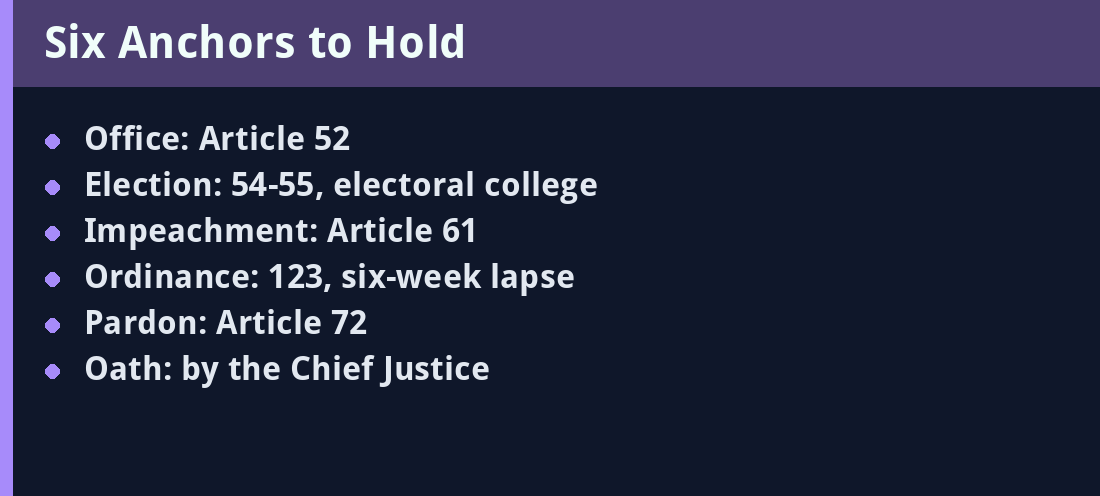
Constitutional Anchors
| Item | Article | One-Line Note |
|---|---|---|
| Office of the President | 52 | There shall be a President |
| Election | 54-55 | Indirect, electoral college, proportional representation |
| Impeachment | 61 | Violation of the Constitution, two-stage process |
| Term and re-election | 56-57 | Five years, re-election permitted |
| Ordinances | 123 | When either House is not in session |
| Pardons | 72 | Executive clemency, including court-martial cases |
Executive and Legislative Powers
- All executive action runs in the President’s name, however the aid-and-advice clause binds the office.
- Appointments: the Prime Minister and council, governors, judges, commissioners and services chiefs.
- Summons, prorogues and addresses Parliament; dissolves the Lok Sabha on advice.
- Nominates twelve Rajya Sabha members for eminence in letters, science, arts and social service.
- Gives assent to bills, with veto varieties that exams test by name.
The Veto Map
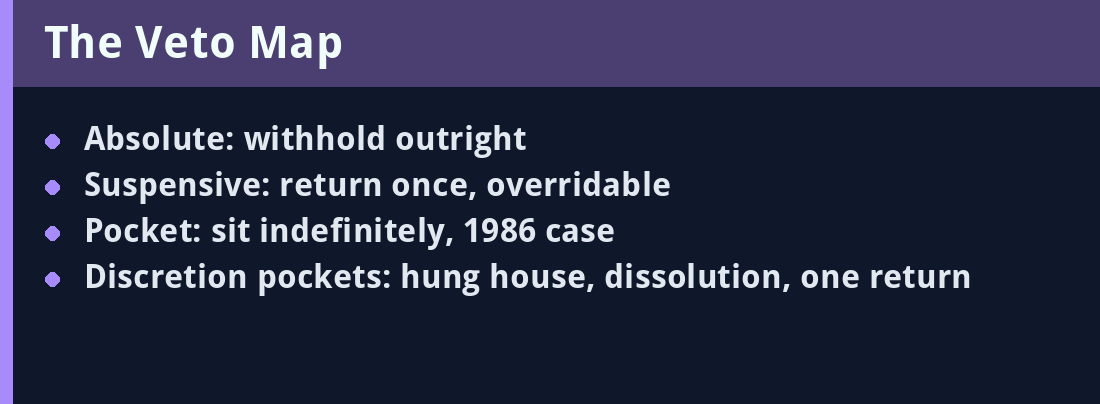
- Absolute veto: withholding assent outright, used for private members’ bills at times.
- Suspensive veto: returned once; an override by simple majority enacts the bill.
- Pocket veto: sitting on a bill indefinitely, famously used in 1986 on the Indian Post Office (Amendment) Bill.
- No veto for constitutional amendment bills beyond assent, per settled practice.
The Discretion Debates
The office is constitutional head, not executive driver, however three situations invite measured discretion. Firstly, appointing a Prime Minister when no party holds a majority, where the President judges who can prove majority strength. Secondly, advising dissolution when a ministry loses confidence. Thirdly, returning advice once for reconsideration, after which the advice binds. Therefore, mains answers score by naming these pockets precisely rather than claiming general discretion. Moreover, the pocket veto episode and the assent delays on state bills have kept the debate alive in current-affairs framing.
The President is the head of state; the Prime Minister is the head of government – and every exam question lives in the gap between those phrases.
Ordinances: The 123 Notes
- Promulgated when either House is not in session, on ministerial advice.
- Carry the force of law, however must be laid before Parliament and expire in six weeks from reassembly.
- Re-promulgation was checked by the Supreme Court as a fraud on the Constitution.
- The 44th Amendment tightened the earlier advice-and-reconsideration position.
Five-Question Drill
- The President is elected by: Answer: an electoral college of MPs and MLAs, by proportional representation with a single transferable vote.
- The President’s pardon power flows from: Answer: Article 72, distinct from the Governor’s Article 161.
- Ordinances lapse within: Answer: six weeks from the reassembly of Parliament.
- The pocket veto was famously used on: Answer: the Indian Post Office (Amendment) Bill, 1986.
- Nominated Rajya Sabha members number: Answer: twelve, for eminence in stated fields.
FAQ
Is the President bound by advice?
Yes, after one reconsideration return, per the 42nd and 44th Amendment scheme.
Can the President be removed for policy?
The Thirty-Second Recap
One office. Many articles. Therefore, anchor fifty-two. Fifty-four fifty-five for election. Sixty-one for impeachment. One twenty-three for ordinances. Seventy-two for pardons. Moreover, vetoes come in three flavours. Pocket. Suspensive. Absolute. However, discretion lives in pockets. Hung house. Dissolution advice. One return. Finally, the President reigns. The cabinet rules.
Explain It Simply: The President for a Twelve-Year-Old
Think of the country as a big ship. The President is the captain’s flag – the highest honour on the ship, shown to every port. However, the steering is done by the Prime Minister and the crew of ministers. The flag-captain signs the ship’s orders, and almost always signs what the crew decides. Yet in a storm – say, no crew has a majority – the flag-captain quietly chooses whom to invite first to form a crew. Moreover, when the crew wants a rule made while Parliament sleeps, the captain can ring it in as an ordinance, but it melts in six weeks after Parliament wakes. Finally, the captain can forgive punishments, which is why the pardon power makes exam questions every single year.
Rapid-Fire: Ten Anchors in Ten Lines
- Office article: 52.
- Election: 54-55, electoral college, single transferable vote.
- Impeachment: 61, violation of the Constitution.
- Term: five years under Article 56.
- Ordinance: 123, six-week lapse.
- Pardon: 72, including court-martial cases.
- Nominated RS members: twelve.
- Qualification age: thirty-five years.
- Pocket veto case: 1986 postal bill.
- Oath administered by: the Chief Justice of India.
Abbreviations That Recur
- LS and RS: the two Houses of Parliament.
- PM: the Prime Minister, head of government.
- CJI: the Chief Justice of India, who administers the oath.
- CoM: the council of ministers advising the President.
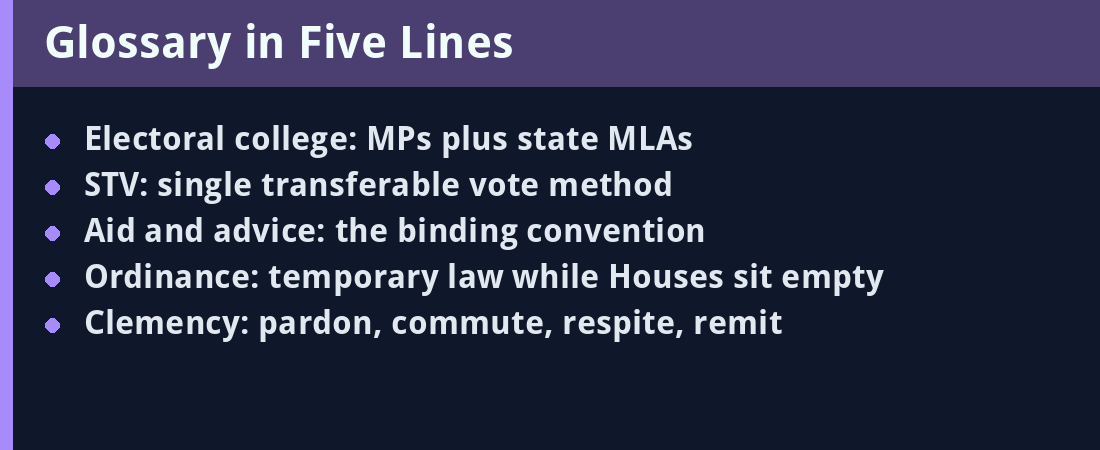
- STV: single transferable vote, the election method.
- UPSC: the commission whose polity papers adore these articles.
The Election Arithmetic in Plain Terms
The President is chosen indirectly, and the arithmetic explains the balance the framers intended. Every elected MP’s vote carries one uniform value, while each MLA’s value depends on the state’s population and assembly strength, so that a big state’s legislator counts more than a small state’s. Moreover, the value formula divides the state’s population by its assembly seats and a fixed quotient, keeping federal weights proportional. Therefore, candidates must win across states, not merely in Delhi’s corridors, which is why campaigns tour state capitals. Consequently, questions on value parity between MPs of both Houses, and the exclusion of nominated members from the college, appear repeatedly in prelims cycles.
The Emergency Bridge
- National emergency: Article 352, proclaimed on cabinet’s written advice.
- President’s rule: Article 356, on a report or otherwise, subject to judicial review since 1994.
- Financial emergency: Article 360, never yet invoked.
- The 44th Amendment made parliamentary approval stricter and Lok Sabha revocation possible.
However, the emergency powers belong to the Union cabinet in practice, therefore mains answers frame the President as the formal instrument, not the author. Moreover, the 2021 Supreme Court rulings on Article 356 presidential proclamations reaffirmed judicial review, which keeps this bridge a current-affairs staple.
President Against Governor: The Exam’s Favourite Table
| Feature | President | Governor |
|---|---|---|
| Pardon over death sentences | Yes | No, only suspension and commutation routes |
| Ordinance power | Article 123 | Article 213, state level |
| Election | Electoral college | Appointed by the President |
| Discretion | Narrow pockets | Wider, especially in hung houses |
Notably, examiners lift rows straight from this comparison, therefore read it as pairs rather than isolated cells. Meanwhile, the Governor’s assent options with bills add their own traps, which deserve a separate one-pager in this series.
The Office in Practice: A Day in the Rashtrapati Bhavan Frame
To make the office concrete, walk one day of it. Morning files carry appointments and international treaties awaiting ratification instruments, each moved on ministerial advice. Midday may hold a bill returned once for reconsideration or an ordinance proposal cleared by the cabinet for promulgation before a session gap. Evening engagements include addresses and visitors, while the military and judicial papers arrive under their own constitutional tracks. Moreover, every action runs through the secretariat to the President’s desk, which is why the aid-and-advice clause structures the entire day. Consequently, mains answers describing the office as a working constitutional head, not a ceremonial ornament, gain immediacy from exactly this frame.
Furthermore, contrast days explain discretion better than doctrines: a normal majority-government day binds the office completely, while a hung-house morning or a caretaker afternoon opens the narrow pockets this page listed. Therefore, learn the office through its two calendars, and every convention question resolves into one of them.
Two Minutes on the Residence and the Records
The office’s physical and documentary worlds also yield marks. The Rashtrapati Bhavan estate hosts the secretariat that processes every file the constitution routes through the desk, and the presidential library preserves decisions that researchers cite in mains essays. Moreover, the oath text carries a constitutional weight of its own, committing the office to preserve, protect and defend the Constitution and the law, words the Chief Justice administers. Therefore, when a mains question asks how the office embodies constitutional morality, the oath formula plus the aid-and-advice clause plus the reconsideration pocket form a complete three-part answer, and each part traces to a provision rather than an opinion.
A Last Note on Revision
Finally, revise this office alongside the Governor page in the same sitting, because pairs outperform singles in polity, and the comparison table above halves your total revision time for both offices together.
The Bedtime Version
The ship has one flag. The flag signs what the crew writes. One time a year the flag reads the big speech. When the crew sleeps, the flag can ring a bell for six weeks. If the crew splits, the flag picks who speaks first. The flag cannot steer. The flag can wait, once, and ask the crew to think again. Then the flag signs. That is the whole job, told in short words.
The Abbreviation Echo
- The LS and RS meet under the flag; the PM and CoM advise it; the CJI swears it in; the STV elects it.
- The UPA and NDA eras both tested the office’s hung-house pocket.
The Flag and the Two Clocks
The job has two clocks. On a calm clock, the flag signs what the crew brings. Fast, clean, done. On a storm clock, the flag asks two things: who can show a crowd’s backing, and should the house be asked again. The storm clock rings once or twice in a decade. When it rings, the world watches the flag, and books are written on what the flag did next. So learn the two clocks. The calm clock fills the term; the storm clock fills the case books. Both clocks hang in the same hall, and the exam asks which clock each story used.
Ten Abbreviations, One Breath
- LS: Lok Sabha; RS: Rajya Sabha; the two Houses.
- PM: Prime Minister; CoM: council of ministers.
- CJI: Chief Justice of India, oath giver.
- STV: single transferable vote, election method.
- EC: Election Commission, conducts the poll.
- SC: Supreme Court, impeachment referee.
- MP and MLA: the college’s voters.
- UPA and NDA: the two coalition eras that tested the pockets.
The Pocket-Veto Rhyme
- Assent can wait: the 1986 postal bill waited forever, and the SC and EC kept notes.
- One return, then bind: the PM and CoM resubmit, the SC affirms, the EC moves on.
- Hung house asks: the UPA and NDA cases both reached the CJI’s law notebooks.
A Simple Close
The flag is not the wheel. The flag is the seal. A seal must be firm, clean and rare in its own acts. Learn the seal this way, in small words, and the big articles will follow you home.
Words From This Page Worth Keeping
- Prerogative: a discretionary right the office guards narrowly.
- Proclamation: the formal instrument behind emergencies.
- Prorogue: ending a session without ending the term.
- Clemency: mercy in its legal dress.
- Quorum: the minimum presence that makes acts valid.
- Sequencing: the order of reconsideration that tests conventions.
- Travails: the ordeal-heavy word mains scripts borrow for hung houses.
- Scrutiny: what judicial review gives proclamations since 1994.
- Sanctuary: what the constitution gives the office’s dignity.
The Framework Sentence to Memorise
- The Article 356 framework requires written cabinet authorization, judicial validation after proclamation, and compliance with the aid-and-advice convention – a protocol the Supreme Court has tightened since 1994.
- The same validation architecture governs ordinances and assent returns, which is why one sentence serves three questions.
Legal Maxims That Travel With This Office
- Mandamus, certiorari, prohibition and quo warranto: the four writs the courts issue against officialdom.
- Habeas corpus guards liberty; amicus curiae assists benches; sub judice restrains public debate.
- Audi alteram partem and nemo judex in causa sua frame natural justice.
- Prima facie, sine die and ultra vires complete the office’s working Latin.
Moreover, these maxims recur in every chapter of the polity syllabus. However, they appear in the President’s chapter with special force, because the writs issue in the state’s name. For example, habeas corpus answers the mercy power’s edge cases. In addition, ultra vires bounds the ordinance route. Finally, therefore, learn the Latin once and spend it across five chapters.
Key Takeaways
In conclusion, hold the article table, the veto map and the three discretion pockets as one picture, and this block yields two to three prelims questions every cycle. To summarize, anchor the numbers, name the famous episodes, and frame the head-of-state against head-of-government distinction in mains language. Therefore, revise this page twice this week and the drill once more on Sunday.
References: the Constitution of India, Articles 52-78 and 123, and standard polity texts for the settled conventions.
Quick revision
- All executive action runs in the President’s name, however the aid-and-advice clause binds the office.
- Appointments: the Prime Minister and council, governors, judges, commissioners and services chiefs.
- Summons, prorogues and addresses Parliament; dissolves the Lok Sabha on advice.
- Nominates twelve Rajya Sabha members for eminence in letters, science, arts and social service.
- Gives assent to bills, with veto varieties that exams test by name.
- Absolute veto: withholding assent outright, used for private members’ bills at times.
Have a doubt on this topic?