
SSC CGL Tier-1 Honest Review, Cutoff Analysis and Tier-2 Plan
The SSC CGL Tier-1 window has closed, and every aspirant now owns the same three assets: a memory of the paper, a response sheet on the way, and a Tier-2 syllabus that rewards early movers. This page converts those assets into a plan. Therefore, read the review section once, score yourself honestly, and start the week-one blocks the same evening.
- Self-Review Without Rumour
- The Answer-Key Calendar
- Cutoff Arithmetic Across Categories
- How to Read the Bands
- Tier-2 Week-One Plan: Start Before the Key
- The Selection Arithmetic of Tier-2
- FAQ for the Restless Week
- Should I challenge every doubtful question?
- When do typing results matter?
- Is one month enough for Tier-2 maths?
- The Thirty-Second Recap
- Explain It Simply: The Waiting Game for a Twelve-Year-Old
- Rapid-Fire: Ten Anchors in Ten Lines
- Abbreviations for the Post-Exam Week
- Section-Wise Tier-2 Starts
- Mathematics First, Always
- English at Mains Depth
- General Awareness and Computers
- The Psychology of the Gap Week
- The Companion Resources on This Site
- A Worked Week: How the Plan Looks on Paper
- The Corridor by Numbers
- Key Takeaways
Contents: how to self-review without rumours, the answer-key calendar, cutoff arithmetic across categories, the Tier-2 week-one plan, and a FAQ for the restless week.

Self-Review Without Rumour
Memory-based answer keys circulate within hours, however they mix genuine recall with confident error. Therefore, mark only those questions you are certain about, and leave the rest blank in your estimate. Consequently, your floor score is trustworthy while your ceiling stays open. Moreover, avoid the cutoff threads entirely until the official provisional key, because speculation multiplies anxiety without adding information.
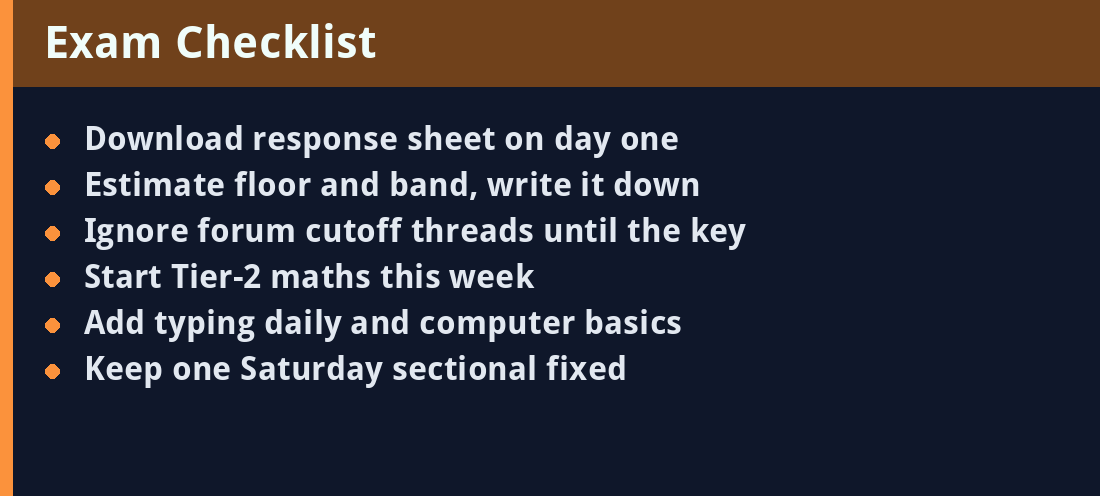
- Count certain-correct answers first; that is your floor.
- Add probable-correct answers separately; that is your estimate band.
- Apply 0.50 negative marking per confirmed wrong answer only.
- Compare the band with the last two cycles, not with forum polls.
- Write the number down and close the notebook until the official key.
The Answer-Key Calendar
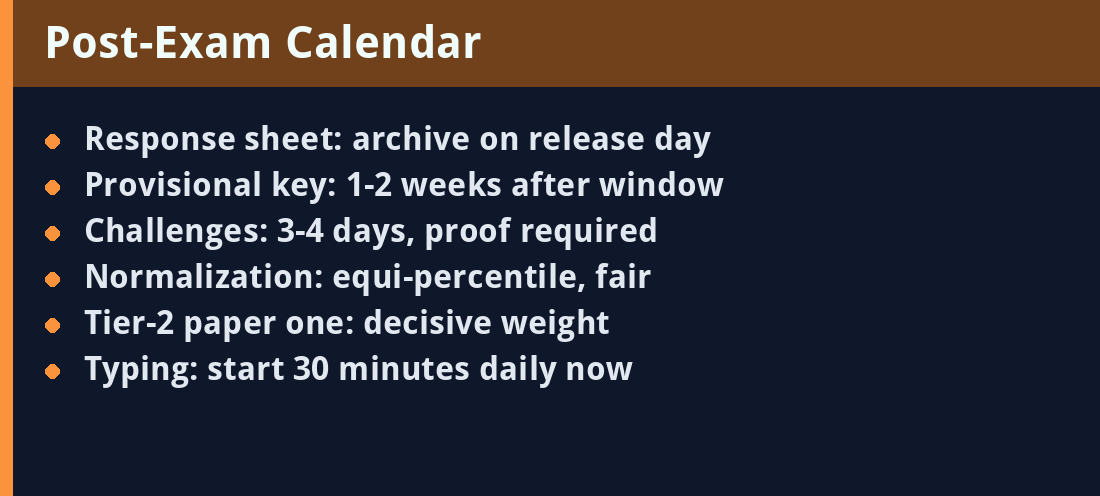
| Stage | Typical Timing | Your Action |
|---|---|---|
| Response sheet release | Within days of window close | Download and archive |
| Provisional key | About one to two weeks after | Verify each marked answer |
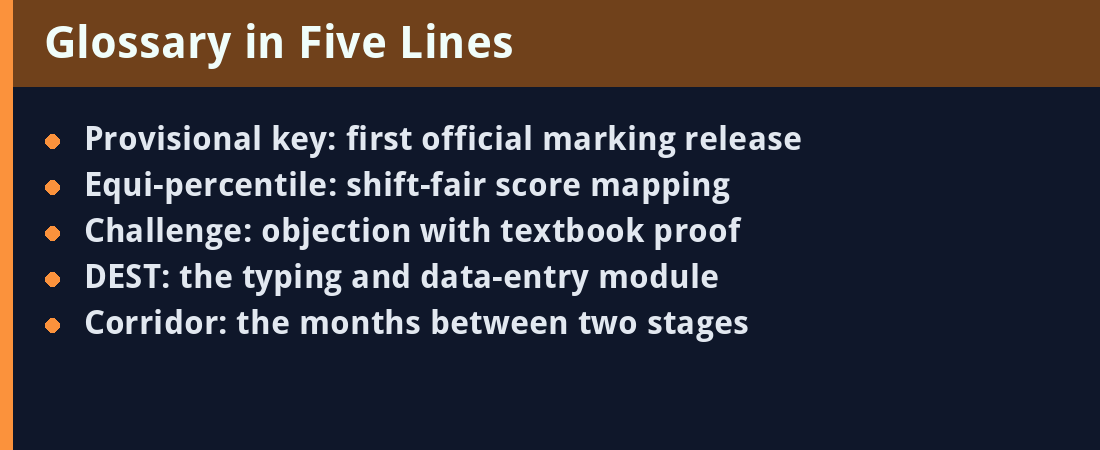
| Challenge window | Three to four days | Object only with textbook proof |
| Final key and result | After expert review | Compute final score, plan Tier-2 |
Moreover, normalization applies across shifts through an equi-percentile method, therefore mild shifts in scores are expected and fair. However, normalization rewards honest attempt quality, not luck. In addition, save every PDF the commission publishes, because documentation settles disputes months later.
Cutoff Arithmetic Across Categories
How to Read the Bands
Historic Tier-1 cutoffs move within a band set by vacancy count and paper difficulty. For example, when vacancies rise, bands relax by a few marks, and when a section surprises candidates, bands tighten similarly. Therefore, position yourself by percentile instinct rather than single-mark predictions. Meanwhile, reserved-category bands sit below the general band by margins published with each result, so compare within your own category always.
Cutoffs are a distribution, not a deadline; preparation for Tier-2 is the only variable you control.
Tier-2 Week-One Plan: Start Before the Key
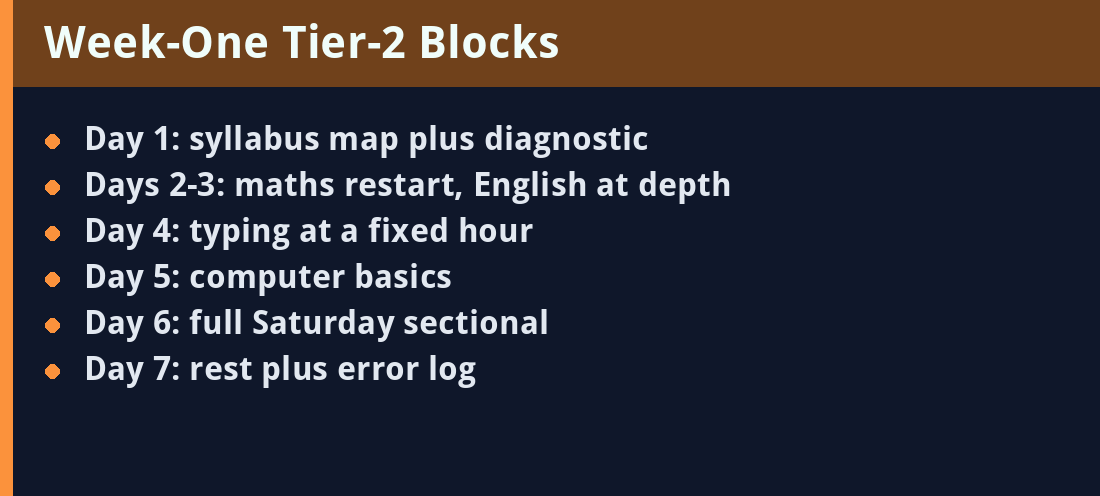
- Day 1: print the paper-one syllabus map and take one diagnostic sectional.
- Day 2: restart mathematics with the modules the diagnostic flagged.
- Day 3: begin English at mains depth – idioms, collocations, paragraph error spotting.
- Day 4: add thirty minutes of typing practice at a fixed clock hour.
- Day 5: computer knowledge basics from the official syllabus document.
- Day 6: one full paper-one sectional at exam timing, reviewed the same evening.
- Day 7: rest evening plus error-log reading, no fresh topics.
Consequently, the dangerous gap week converts into a head start, while others wait for result news to begin. Furthermore, the reasoning module carries forward from Tier-1 preparation with minor additions, therefore most hours should flow to mathematics and English, where Tier-2 weight concentrates.
The Selection Arithmetic of Tier-2
Tier-2 carries the decisive weight in the final merit, and its paper one spans mathematical abilities, reasoning, English, general awareness and the computer plus skill modules. Therefore, a mediocre Tier-1 survives through strong Tier-2 months, while a brilliant Tier-1 wastes without them. In other words, the result you await is a checkpoint, not a verdict.
FAQ for the Restless Week
Should I challenge every doubtful question?
No. Challenges with weak proof fail and cost fees, therefore back each objection with a standard textbook citation.
When do typing results matter?
Is one month enough for Tier-2 maths?
A focused month lifts a prepared base significantly, but two months converts comfortably, therefore start now.
The Thirty-Second Recap
One window closed. One key is coming. Therefore, archive first. Estimate honestly. Ignore the rumour mills. Moreover, normalization is fair. The band is your guide. However, Tier-2 decides seats. So start maths this week. Add typing daily. Keep one sectional each Saturday. Track three numbers. Finally, the early mover wins the corridor.
Explain It Simply: The Waiting Game for a Twelve-Year-Old
Imagine you ran a race, and the judges will show the photo finish in a week or two. You cannot change the photo now. However, the next race is longer, and its date is already fixed. Therefore, the smart runner trains for the next race while others stand at the board arguing about the last one. You may point out a mistake in the photo, but only with real proof, like a rulebook page. Meanwhile, the judges also fix the weather advantage for each lane, so no lane was unfair. Finally, the trophy comes from the second race, not the first. So lace up.
Rapid-Fire: Ten Anchors in Ten Lines
- Tier-1 paper: 100 questions, 200 marks, 60 minutes.
- Negative marking in Tier-1: 0.50 per wrong answer.
- Provisional key window: 1 to 2 weeks after the exam.
- Challenge window: 3 to 4 days with proof.
- Normalization method: equi-percentile across shifts.
- Tier-2 paper one: compulsory for every post.
- Objective module penalty in Tier-2: 1 mark per error.
- Skill module penalty: 0.50 per error.
- Typing practice target: 30 minutes daily, 8 weeks.
- Weekly anchors: one Saturday sectional plus three tracked numbers.
Abbreviations for the Post-Exam Week
- SSC: the Staff Selection Commission, the conducting body.
- CGL: the Combined Graduate Level examination.
- OMR: the response sheet released for your archive.
- DEST: the data entry speed test in the skill module.
- JSO: the statistical route through Paper two.
- AAO: the finance route through Paper three.
- DoPT: the nodal ministry for appointments.
Section-Wise Tier-2 Starts
Mathematics First, Always
- Arithmetic core: percentages, ratio, profit and loss, time and work, mixtures.
- Algebra: identities, quadratic framing and surds at mains depth.
- Geometry and mensuration: triangles, circles and solids carry heavy weight.
- Trigonometry: identities plus heights and distances applications.
- Data interpretation: tables and caselets double relative to Tier-1.
Therefore, distribute roughly half of all study hours here through the result month, because mathematics separates merit ranks more than any other module. Moreover, the diagnostic from day one should drive the split, not a fixed timetable copied from toppers.
English at Mains Depth
- Idioms and phrasal verbs in daily doses of ten, with usage sentences.
- Spotting errors across full paragraphs rather than single lines.
- Cloze passages with collocation reasoning.
- Reading comprehension with inference and vocabulary-in-context drills.
- Narration and voice transformations, which return every cycle.
General Awareness and Computers
General awareness under Tier-2 spans the full exam year, therefore continue the daily one-liner habit without pause, and back it with a monthly digest read. Meanwhile, the computer module tests fundamentals only: hardware, office applications, internet basics and networking vocabulary. Consequently, two structured weeks suffice, however verify scope against the official syllabus each cycle.
The Psychology of the Gap Week
The gap week tempts two failure modes: obsessive score speculation and total rest. However, both leak the momentum built across months. Therefore, treat this week as a scheduled mesocycle: six study days at reduced hours, one full rest day, and a written weekly plan pinned where you study. Moreover, sleep and exercise protect recall far better than late-night panic revision. Consequently, candidates who run the mesocycle enter the key week fresh while the speculators enter exhausted.
The Companion Resources on This Site
This corridor plan works best paired with three companions. Firstly, the answer-key and normalization page from exam evening explains the calendar above in depth. Secondly, the Tier-2 English starter page maps the highest-weight module for the very week you are entering. Thirdly, the daily one-liner capsule keeps general awareness ticking in ten minutes each morning. Therefore, bookmark the SSC category, and let the site’s sequence carry the corridor structure for you. Moreover, the Sunday quiz rehearses awareness in exactly the disguised forms the mains paper prefers, so the habit closes the loop from reading to marks.
Furthermore, serious candidates add one accountability layer: a weekly message to a peer listing the six executed study days. Consequently, the corridor months leave a written trail, which interviews later read as discipline rather than luck.
A Worked Week: How the Plan Looks on Paper
To make the week concrete, walk through it once as if executed. Monday evening holds ninety minutes: the diagnostic sectional, its scoring, and the syllabus map annotated with three weak zones. Tuesday splits into forty-five minutes of percentage and ratio drill plus forty-five minutes of error-spotting practice, followed by the first typing block at the fixed clock hour. Wednesday repeats the split with algebra and idioms, and adds fifteen minutes of one-liner revision for general awareness. Thursday covers geometry fundamentals and a cloze set, with typing again at the same hour. Friday holds the computer module’s first pass and a reading comprehension drill. Saturday morning carries the full paper-one sectional at exam timing, and the evening belongs to its review, question by question, with every miss classified into the error log. Sunday closes the week with rest, the error log reread once, and next week’s plan written in ten minutes.
Notice what the week does not contain: no cutoff threads, no fresh strategy videos, and no mock marathons. Therefore, the plan stays executable beside a job or a college day, because each block fits a single sitting. Moreover, the written trail from Saturday to Saturday lets you audit the corridor honestly, which is precisely the discipline the examination system rewards in the end.
The Corridor by Numbers
- Tier-1 paper: 100 questions, 200 marks, 60 minutes.
- Negative marking: 0.50 per error in Tier-1.
- Key window: 1 to 2 weeks; challenges: 3 to 4 days.
- Tier-2 objective penalty: 1 mark; skill module: 0.50.
- Typing: 30 minutes daily across 8 weeks.
- Weekly grid: 6 study days, 1 sectional, 3 tracked numbers.
- The SSC, CGL, OMR, DEST, JSO, AAO and DoPT set recurs in every notice.
Key Takeaways
In conclusion, the post-exam week rewards three behaviours: archival, honest estimation and immediate Tier-2 starts. To summarize, download everything, estimate with certainty bands, and begin mathematics, English and typing this week. Therefore, when the key arrives, it will find you mid-preparation rather than mid-panic, and the corridor months will compound quietly in your favour.
References: ssc.gov.in notices for keys and timelines, and the commission’s scheme-of-examination document for pattern authority.
Quick revision
- Count certain-correct answers first; that is your floor.
- Add probable-correct answers separately; that is your estimate band.
- Apply 0.50 negative marking per confirmed wrong answer only.
- Compare the band with the last two cycles, not with forum polls.
- Write the number down and close the notebook until the official key.
- Day 1: print the paper-one syllabus map and take one diagnostic sectional.
Have a doubt on this topic?