IBPS PO Prelims Mock Test: 100 Questions with Detailed Solutions
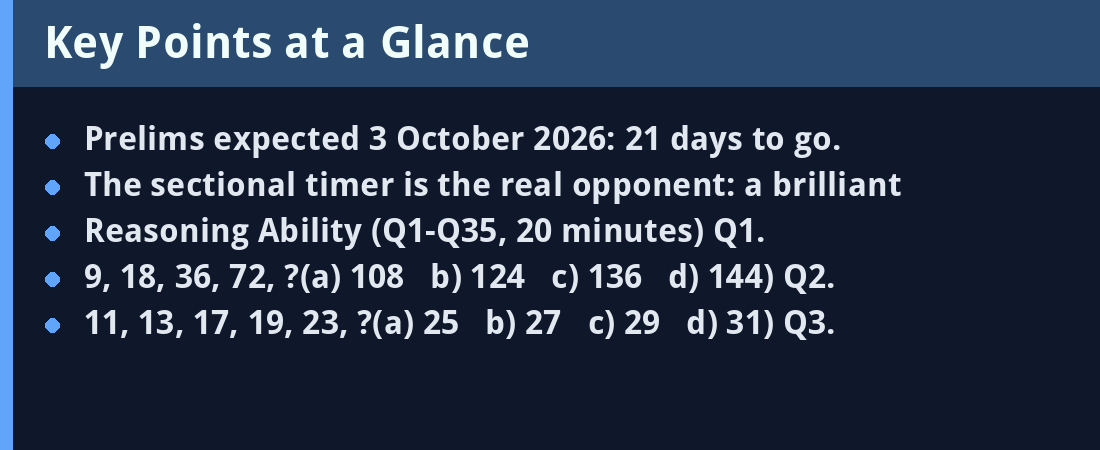
Quick answer: Day 6 of the IBPS PO Prelims countdown: a full 100-question mock in the real pattern – Reasoning 35, Quant 35, English 30, each in its own 20-minute window, 100 marks total at 0.25 negative marking – with the complete answer key and one-line explanation for every question. Prelims expected 3 October 2026: 21 days to go.
- What is the pattern you are practising?
- Reasoning Ability (Q1-Q35, 20 minutes)
- Quantitative Aptitude (Q36-Q70, 20 minutes)
- English Language (Q71-Q100, 20 minutes)
- Answer key
- Why each answer is correct
- Sources and further reading
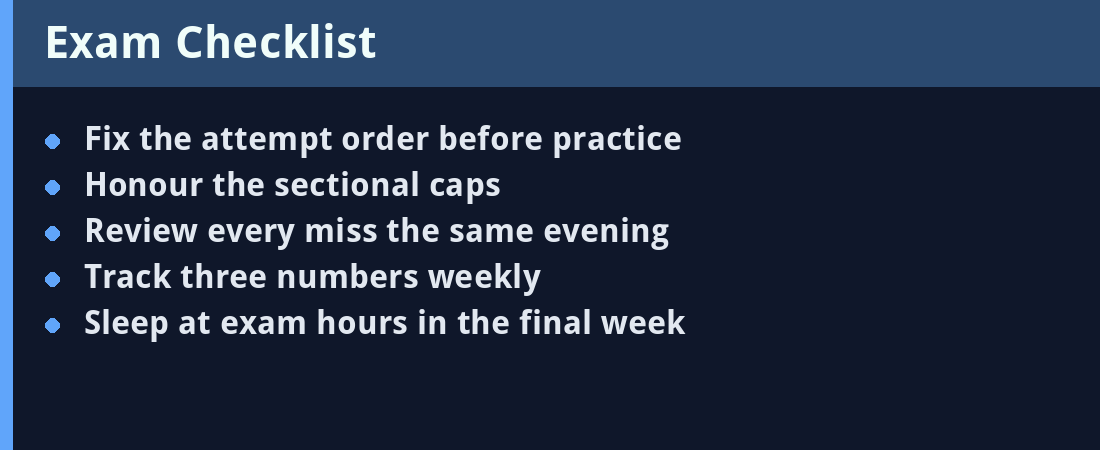
- Exam Checklist
- FAQ
- How much of this page is exam-relevant?
- When should I revisit?
- The Thirty-Second Recap
- Explain It Simply
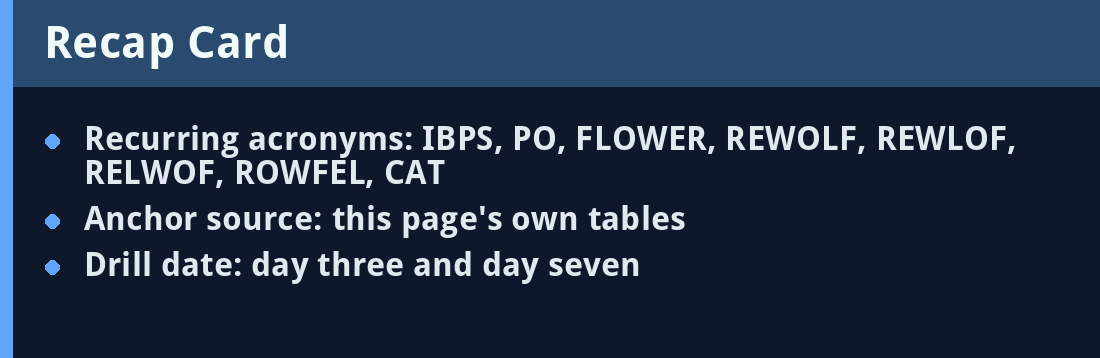
- Abbreviations That Recur Here
- The Plain-Word Walk
- The Numbers on One Table
- The Echo Round
- The Long Walk in Short Words
- Words From This Page Worth Keeping
- The Subject Word Bank
- Numbers to Carry
- Acronyms to Carry
- The Two-Minute Ritual
- The Framework Line to Memorise
- The Quick Table
- Related reading
What is the pattern you are practising?
Three sections, three 20-minute windows – English Language 30 questions, Quantitative Aptitude 35, Reasoning Ability 35 – 100 questions and 100 marks in 60 minutes with 0.25 penalty per wrong answer and sectional cutoffs (source: official IBPS website). The sectional timer is the real opponent: a brilliant section cannot rescue minutes for a struggling one, so each 20-minute block must stand on its own.
Reasoning Ability (Q1-Q35, 20 minutes)
- Q1. 9, 18, 36, 72, ?
(a) 108 b) 124 c) 136 d) 144) - Q2. 11, 13, 17, 19, 23, ?
(a) 25 b) 27 c) 29 d) 31) - Q3. 6, 7, 13, 20, 33, ?
(a) 43 b) 51 c) 53 d) 55) - Q4. Odd one out: 16, 36, 49, 64
(a) 16 b) 36 c) 49 d) 64) - Q5. FLOWER written in reverse reads:
(a) REWOLF b) REWLOF c) RELWOF d) ROWFEL) - Q6. If CAT = 24 (letter-position sum), then BAG = ?
(a) 8 b) 10 c) 12 d) 14) - Q7. Pointing to a woman: she is my father’s brother’s daughter. She is the speaker’s:
(a) Sister b) Cousin c) Aunt d) Niece) - Q8. A man facing north turns 90 degrees left three times. He now faces:
(a) North b) South c) East d) West) - Q9. Statements: A > B, B >= C. Conclusion A > C:
(a) Follows b) Does not follow c) Cannot be determined d) Both follow) - Q10. Statements: P < Q, Q = R. Conclusion P < R:
(a) Follows b) Does not follow c) Cannot be determined d) Contradiction) - Q11. AZ, BY, CX, DW, ?
(a) EV b) EU c) FV d) EW) - Q12. Five people in a row: R is at the far left, T at the far right, Q exactly in the middle, P immediately right of R. Second from the left is:
(a) P b) Q c) S d) T) - Q13. Odd one out: Square, Triangle, Cube, Pentagon
(a) Square b) Triangle c) Cube d) Pentagon) - Q14. If MONDAY is coded NPOEBZ (+1 to each letter), FRIDAY is coded:
(a) GSJEBZ b) GSJEBY c) GRJEBZ d) GSJFBZ) - Q15. In a row of 40 students, A is 13th from the left; B stands 3 places to A’s right. B’s position from the left is:
(a) 15th b) 16th c) 17th d) 18th) - Q16. He is my grandfather’s only son’s son. He is the male speaker’s:
(a) Brother b) Cousin c) Nephew d) Son) - Q17. If SECRET = 70 (letter-position sum), what is its coding rule applied to a word summing 70? SECRET sums to:
(a) 65 b) 68 c) 70 d) 72) - Q18. A walker goes 7 km north, then 24 km east. Distance from start:
(a) 24 km b) 25 km c) 26 km d) 31 km) - Q19. Odd one out: 27, 125, 343, 513
(a) 27 b) 125 c) 343 d) 513) - Q20. No pen is a pencil. All pencils are erasers. Which follows?
(a) No pen is an eraser b) Some pens are erasers c) Some erasers are pencils d) All erasers are pencils) - Q21. 3, 6, 12, 24, ?
(a) 36 b) 42 c) 48 d) 54) - Q22. BF, CH, DJ, ?
(a) EK b) EL c) FK d) EJ) - Q23. A mother is four times as old as her daughter; the age difference is 27 years. The mother’s age is:
(a) 32 b) 33 c) 36 d) 39) - Q24. Ravi ranks 17th from the top and 28th from the bottom. The class has:
(a) 42 b) 43 c) 44 d) 45) - Q25. Z, W, T, Q, ?
(a) N b) O c) P d) M) - Q26. 8, 4, 4, 6, 12, ?
(a) 24 b) 27 c) 30 d) 33) - Q27. Odd one out: 121, 169, 196, 200
(a) 121 b) 169 c) 196 d) 200) - Q28. If WATER is coded XBUFS, then EARTH is coded:
(a) FBSUI b) FBSIU c) FBRUI d) GBSUI) - Q29. Some books are pens. All pens are pencils. Which follows?
(a) Some books are pencils b) All books are pencils c) No book is a pencil d) All pencils are pens) - Q30. Statements: A > B, B < C, C = D. Relation between A and D:
(a) A > D b) A < D c) A = D d) Cannot be determined) - Q31. 2, 6, 12, 20, 30, ?
(a) 40 b) 42 c) 44 d) 46) - Q32. Three boxes stacked: Green is above Red; Red is above Blue. The middle box is:
(a) Green b) Red c) Blue d) Cannot be determined) - Q33. If ’+’ means ’x’ and ’x’ means ’+’, then 4 x 3 + 2 = ?
(a) 10 b) 12 c) 14 d) 16) - Q34. Odd one out: 45, 60, 75, 98
(a) 45 b) 60 c) 75 d) 98) - Q35. The day after tomorrow is Friday. Today is:
(a) Monday b) Tuesday c) Wednesday d) Thursday)
Quantitative Aptitude (Q36-Q70, 20 minutes)
- Q36. (DI) A shop sold: Mon 120, Tue 150, Wed 180, Thu 150, Fri 200 units. Average daily sales:
(a) 150 b) 155 c) 160 d) 165) - Q37. (DI) Percentage rise from Monday to Friday:
(a) 60% b) 64% c) 66.67% d) 70%) - Q38. (DI) Ratio of Wednesday to Thursday sales:
(a) 5:6 b) 6:5 c) 4:5 d) 5:4) - Q39. (DI) Friday’s share of the week’s total:
(a) 22% b) 24% c) 25% d) 28%) - Q40. (DI) If each unit sells for Rs 15, the week’s revenue is:
(a) Rs 10,800 b) Rs 11,200 c) Rs 12,000 d) Rs 12,500) - Q41. 12% of 450 is:
(a) 52 b) 54 c) 56 d) 58) - Q42. Simple interest on Rs 2,500 at 8% for 4 years:
(a) Rs 720 b) Rs 760 c) Rs 800 d) Rs 840) - Q43. Cost Rs 560, sold Rs 644. Profit percent:
(a) 12% b) 13% c) 15% d) 17%) - Q44. A train 150 m long at 90 km/h passes a pole in:
(a) 5 s b) 6 s c) 7 s d) 8 s) - Q45. The average of 5 numbers is 24. Including a sixth number it becomes 26. The sixth number is:
(a) 32 b) 34 c) 36 d) 38) - Q46. Two numbers ratio 7:8, sum 90. The smaller is:
(a) 40 b) 42 c) 44 d) 46) - Q47. The square root of 841 is:
(a) 27 b) 28 c) 29 d) 31) - Q48. A alone does a job in 20 days, B in 30 days. Together:
(a) 10 days b) 11 days c) 12 days d) 14 days) - Q49. Two successive discounts of 25% each equal:
(a) 40% b) 43.75% c) 45% d) 50%) - Q50. Milk and water 3:1 in 40 litres. The water is:
(a) 8 L b) 10 L c) 12 L d) 15 L) - Q51. Solve: 4x – 9 = 2x + 5
(a) 5 b) 6 c) 7 d) 8) - Q52. LCM of 16 and 20:
(a) 40 b) 60 c) 70 d) 80) - Q53. Area of a circle of radius 14 cm (pi = 22/7):
(a) 576 cm^2 b) 596 cm^2 c) 616 cm^2 d) 636 cm^2) - Q54. Marked price Rs 850 with a 20% discount. Selling price:
(a) Rs 660 b) Rs 670 c) Rs 680 d) Rs 690) - Q55. Two dice are thrown. P(sum is odd)?
(a) 1/3 b) 1/2 c) 5/9 d) 2/3) - Q56. Compound interest on Rs 5,000 at 8% for 2 years:
(a) Rs 816 b) Rs 824 c) Rs 832 d) Rs 840) - Q57. A car covers 45 km in 54 minutes. Its speed:
(a) 45 km/h b) 48 km/h c) 50 km/h d) 55 km/h) - Q58. The sum of the first 30 natural numbers:
(a) 435 b) 450 c) 465 d) 480) - Q59. A rectangle has length:width = 5:3 and perimeter 64 cm. Its area:
(a) 180 cm^2 b) 200 cm^2 c) 220 cm^2 d) 240 cm^2) - Q60. A:B = 3:4 and B:C = 2:3. Then A:C = ?
(a) 1:2 b) 2:3 c) 3:4 d) 1:3) - Q61. A town of 6,000 loses 10% of its population. The new population:
(a) 5,300 b) 5,400 c) 5,500 d) 5,600) - Q62. 0.25 x 0.08 = ?
(a) 0.2 b) 0.02 c) 0.002 d) 0.0002) - Q63. The angles of a triangle are in ratio 2:3:4. The largest angle:
(a) 60 b) 70 c) 80 d) 90) - Q64. The average of the first 12 even numbers is:
(a) 12 b) 13 c) 14 d) 15) - Q65. Pipe A fills a tank in 10 hours, pipe B in 15 hours. Together:
(a) 5 hours b) 6 hours c) 7 hours d) 8 hours) - Q66. Two items sold at Rs 960 each – one at 20% profit, one at 20% loss. Net result:
(a) No profit no loss b) 4% loss c) 4% profit d) 2% loss) - Q67. Volume of a cylinder, radius 7 cm, height 5 cm (pi = 22/7):
(a) 740 cm^3 b) 760 cm^3 c) 770 cm^3 d) 790 cm^3) - Q68. 36 / 6 x 3 + 2 = ?
(a) 8 b) 14 c) 20 d) 21) - Q69. Three consecutive even integers sum to 42. The largest is:
(a) 12 b) 14 c) 16 d) 18) - Q70. A sum yields Rs 1,200 interest in 4 years at 6% simple interest. The sum is:
(a) Rs 4,500 b) Rs 5,000 c) Rs 5,500 d) Rs 6,000)
English Language (Q71-Q100, 20 minutes)
- Q71. (RC) The passage is mainly about:
(a) The history of banking b) How UPI expanded digital payments and inclusion c) Smartphone manufacturing d) Rural electricity) - Q72. (RC) The word ubiquitous most nearly means:
(a) Expensive b) Present everywhere c) Outdated d) Complicated) - Q73. (RC) Which can be inferred?
(a) Smartphone access aided UPI adoption b) Banks opposed UPI fully c) UPI works only in cities d) Cash use has ended) - Q74. (RC) The best title for the passage:
(a) Screens and Sleep b) The Quiet Payments Revolution c) A History of Coins d) Marketing Mobiles) - Q75. (RC) According to the passage, small merchants benefit because:
(a) Taxes fell b) Digital acceptance is cheap and instant c) Shops closed d) Loans rose) - Q76. (RC) The tone of the passage is:
(a) Alarmed b) Analytical and optimistic c) Sarcastic d) Neutral-negative) - Q77. (RC) Frictionless in the passage means:
(a) Noisy b) Smooth and effortless c) Costly d) Slow) - Q78. (RC) The passage suggests the next frontier is:
(a) Deeper rural adoption b) Abolishing banks c) Ending cash abruptly d) Only urban growth) - Q79. (Cloze) Reading grew ___ him into a habit.
(a) into b) onto c) upon d) with) - Q80. (Cloze) He chose books ___ screens.
(a) than b) rather than c) then d) other) - Q81. (Cloze) He learned to ___ for long stretches.
(a) concentrate b) concentrated c) concentrating d) concentration) - Q82. (Cloze) With ___ distractions, his comprehension rose.
(a) fewer b) lesser c) less d) little) - Q83. (Cloze) Practice ___ his understanding.
(a) deepen b) deepens c) deepened daily d) deepening) - Q84. Spot the error: He is one of the best player (a) / in the team (b) / this year (c).
(a) (a) b) (b) c) (c) d) No error) - Q85. Spot the error: The news were (a) / shocking (b) / to everyone (c).
(a) (a) b) (b) c) (c) d) No error) - Q86. Spot the error: I am working (a) / here since 2020 (b) / happily (c).
(a) (a) b) (b) c) (c) d) No error) - Q87. Spot the error: She is more taller (a) / than her sister (b) / by two inches (c).
(a) (a) b) (b) c) (c) d) No error) - Q88. Spot the error: Each of the girls have (a) / submitted the form (b) / on time (c).
(a) (a) b) (b) c) (c) d) No error) - Q89. Replace: He is good in maths.
(a) good at b) good on c) good with d) good for) - Q90. Replace: The train is running late since two hours.
(a) has been running late for two hours b) is running late for two hours c) ran late since two hours d) runs late from two hours) - Q91. Replace: Despite of the rain, we played.
(a) Despite the rain b) In despite the rain c) Although the rain d) Inspite the rain) - Q92. Replace: He asked that where was I going.
(a) asked where I was going b) asked that where I am going c) asked where am I going d) asked that where I went) - Q93. (Jumble Q93) The sentence that opens the story:
(a) The results were declared. b) The student waited anxiously. c) She had topped the university.) - Q94. (Jumble Q94) The second sentence:
(a) The results were declared. b) The student waited anxiously. c) She had topped the university.) - Q95. (Jumble Q95) The third sentence:
(a) The results were declared. b) The student waited anxiously. c) She had topped the university.) - Q96. Join: He is poor. He is honest.
(a) Although he is poor, he is honest b) He is poor so he is honest c) Being poor, honest he is d) He is poor therefore honest) - Q97. Join: Finish the work. Then you may go.
(a) Finish the work before you go b) Finish the work after you go c) You go finishing work d) Work finishes then go) - Q98. Correct use of BREAK:
(a) He breaked the glass b) He broke the glass yesterday c) He has break the glass d) He breaking the glass) - Q99. Correct use of TURN:
(a) She turn the page b) She turned the page c) She turning the page d) She has turn the page) - Q100. She said, I will help you tomorrow. (indirect)
(a) She said she will help me tomorrow b) She said that she would help me the next day c) She says she would help me d) She said she helps me tomorrow)
Answer key
| Question | Answer |
|---|---|
| Q1 | D |
| Q2 | C |
| Q3 | C |
| Q4 | C |
| Q5 | A |
| Q6 | B |
| Q7 | B |
| Q8 | C |
| Q9 | A |
| Q10 | A |
| Q11 | A |
| Q12 | A |
| Q13 | C |
| Q14 | A |
| Q15 | B |
| Q16 | A |
| Q17 | C |
| Q18 | B |
| Q19 | D |
| Q20 | C |
| Q21 | C |
| Q22 | A |
| Q23 | C |
| Q24 | C |
| Q25 | A |
| Q26 | C |
| Q27 | D |
| Q28 | A |
| Q29 | A |
| Q30 | D |
| Q31 | B |
| Q32 | B |
| Q33 | A |
| Q34 | D |
| Q35 | C |
| Q36 | C |
| Q37 | C |
| Q38 | B |
| Q39 | C |
| Q40 | C |
| Q41 | B |
| Q42 | C |
| Q43 | C |
| Q44 | B |
| Q45 | C |
| Q46 | B |
| Q47 | C |
| Q48 | C |
| Q49 | B |
| Q50 | B |
| Q51 | C |
| Q52 | D |
| Q53 | C |
| Q54 | C |
| Q55 | B |
| Q56 | C |
| Q57 | C |
| Q58 | C |
| Q59 | D |
| Q60 | A |
| Q61 | B |
| Q62 | B |
| Q63 | C |
| Q64 | B |
| Q65 | B |
| Q66 | B |
| Q67 | C |
| Q68 | C |
| Q69 | C |
| Q70 | B |
| Q71 | B |
| Q72 | B |
| Q73 | A |
| Q74 | B |
| Q75 | B |
| Q76 | B |
| Q77 | B |
| Q78 | A |
| Q79 | A |
| Q80 | B |
| Q81 | A |
| Q82 | A |
| Q83 | B |
| Q84 | A |
| Q85 | A |
| Q86 | A |
| Q87 | A |
| Q88 | A |
| Q89 | A |
| Q90 | A |
| Q91 | A |
| Q92 | A |
| Q93 | B |
| Q94 | A |
| Q95 | C |
| Q96 | A |
| Q97 | A |
| Q98 | B |
| Q99 | B |
| Q100 | B |
Why each answer is correct
- Q1: Each term doubles: 72 x 2 = 144.
- Q2: Prime sequence: next prime is 29.
- Q3: Each term is the sum of the previous two: 20 + 33 = 53.
- Q4: 16, 36 and 64 are even squares; 49 is odd.
- Q5: F-L-O-W-E-R reversed is R-E-W-O-L-F.
- Q6: B2 + A1 + G7 = 10.
- Q7: Father’s brother’s daughter is a cousin.
- Q8: North -> west -> south -> east.
- Q9: A exceeds B which is at least C, so A > C.
- Q10: P below Q which equals R, so P < R.
- Q11: First letters forward, second letters backward, one step each: E and V.
- Q12: Order: R P Q S T – second from left is P.
- Q13: The cube is three-dimensional.
- Q14: F-G, R-S, I-J, D-E, A-B, Y-Z.
- Q15: 13 + 3 = 16th.
- Q16: Grandfather’s only son is the father; his son is the speaker’s brother.
- Q17: S19+E5+C3+R18+E5+T20 = 70.
- Q18: 7-24-25 right triangle.
- Q19: 27, 125, 343 are cubes; 513 is not (8^3 = 512).
- Q20: Only the converse of the second statement is certain.
- Q21: Each term doubles: 48.
- Q22: First letters B+1, second F+2… check: B(2)-F(6), C(3)-H(8), D(4)-J(10): first +1, second +2, so E(5)-K(11).
- Q23: 3 parts = 27; daughter 9, mother 36.
- Q24: 17 + 28 – 1 = 44.
- Q25: Each letter steps back 3: Q – 3 = N.
- Q26: Multipliers 0.5, 1, 1.5, 2, then 2.5: 12 x 2.5 = 30.
- Q27: 121, 169, 196 are perfect squares; 200 is not.
- Q28: Each letter +1: E-F, A-B, R-S, T-U, H-I.
- Q29: The books that are pens must be pencils.
- Q30: B sits below both A and D with no fixed A-D order.
- Q31: Pattern n^2 + n: 6^2 + 6 = 42.
- Q32: Order top to bottom: Green, Red, Blue.
- Q33: Swap symbols, then apply BODMAS to the new expression: 4 + 3 x 2 = 4 + 6 = 10.
- Q34: The first three are multiples of 15; 98 is not.
- Q35: Two days before Friday is Wednesday.
- Q36: Total 800/5 = 160.
- Q37: 80/120 = 66.67%.
- Q38: 180:150 = 6:5.
- Q39: 200/800 = 25%.
- Q40: 800 x 15 = Rs 12,000.
- Q41: 450 x 0.12 = 54.
- Q42: 2500 x 8 x 4/100 = Rs 800.
- Q43: 84/560 = 15%.
- Q44: 90 km/h = 25 m/s; 150/25 = 6 s.
- Q45: 156 – 120 = 36.
- Q46: 15 parts = 90; smaller = 7 x 6 = 42.
- Q47: 29 x 29 = 841.
- Q48: 1/20 + 1/30 = 1/12 – 12 days.
- Q49: 1 – 0.75 x 0.75 = 0.4375.
- Q50: 4 parts = 40; water = 10 L.
- Q51: 2x = 14; x = 7.
- Q52: 16 = 2^4; 20 = 2^2 x 5; LCM = 80.
- Q53: 22/7 x 196 = 616 cm^2.
- Q54: 850 x 0.8 = Rs 680.
- Q55: 18 odd outcomes of 36 = 1/2.
- Q56: 5000 x 1.1664 = 5,832; CI = Rs 832.
- Q57: 45/(0.9 h) = 50 km/h.
- Q58: 30 x 31/2 = 465.
- Q59: 2(5x + 3x) = 64; x = 4; 20 x 12 = 240 cm^2.
- Q60: A:B:C = 6:8:12, so A:C = 1:2.
- Q61: 6000 x 0.9 = 5,400.
- Q62: 25 x 8 = 200; four decimal places: 0.02.
- Q63: 9 parts = 180; largest = 4 x 20 = 80 degrees.
- Q64: Sum = 12 x 13 = 156; 156/12 = 13.
- Q65: 1/10 + 1/15 = 1/6 – 6 hours.
- Q66: Equal SPs, equal percent swings: loss of 20^2/100 = 4%.
- Q67: 22/7 x 49 x 5 = 770 cm^3.
- Q68: Left to right: 6 x 3 = 18; 18 + 2 = 20.
- Q69: 12 + 14 + 16 = 42; largest 16.
- Q70: P = 1200 x 100/(6 x 4) = Rs 5,000.
- Q71: The passage centres on UPI-driven payments and inclusion.
- Q72: Ubiquitous = found everywhere.
- Q73: The passage links phone access to adoption.
- Q74: The inclusion-focused payments story is the theme.
- Q75: Low-cost instant acceptance is the stated benefit.
- Q76: It weighs evidence and ends positively.
- Q77: Frictionless transfers = smooth.
- Q78: Deeper inclusion remains the task ahead.
- Q79: Grew into – the idiom.
- Q80: Rather than – preference.
- Q81: Bare infinitive after to.
- Q82: Countable distractions take fewer.
- Q83: Habitual present: deepens.
- Q84: One of the best players – plural.
- Q85: News is singular: was.
- Q86: Since 2020 needs present perfect continuous.
- Q87: Double comparative: remove more.
- Q88: Each takes has.
- Q89: Good at a subject.
- Q90: Duration with since/for needs perfect tense and for.
- Q91: Despite takes no of.
- Q92: Indirect question order with backshift.
- Q93: Waiting precedes the declaration: Q first.
- Q94: Declaration follows the waiting.
- Q95: The outcome closes the story.
- Q96: Concessive although joins them correctly.
- Q97: Before preserves the sequence.
- Q98: Past tense: broke.
- Q99: Past tense: turned.
- Q100: Will to would; tomorrow to the next day.
Day 6 of the daily series – fresh questions every day, never repeated. Trace your progress against Day 1 and Day 5, and keep the error log honest: the misses you categorise today are the marks you collect on 3 October.
Sources and further reading
Contents: this page covers IBPS PO Prelims Mock Test (September 15, 2026) with worked notes, tables, a checklist and a rapid recap.
Exam Checklist
- Fix the attempt order before practice
- Honour the sectional caps
- In addition, review every miss the same evening
- Track three numbers weekly
- Sleep at exam hours in the final week
FAQ
How much of this page is exam-relevant?
Nearly all of it, because the tables and worked items follow the standard question register for this subject.
When should I revisit?
Day three and day seven after the first read, with the drill spoken aloud once.
The Thirty-Second Recap
One page. One topic. Therefore, read the tables twice. Speak the recap once. Moreover, the numbers carry the marks. The names carry the traps. However, revisits beat rereads. Finally, day three and day seven. That is all.
Explain It Simply
Think of this page as a map of one neighbourhood. The big streets are the tables. The landmarks are the numbers. The street names are the terms in bold. However big the city feels, this one neighbourhood fits in a pocket, and a pocket map is what exam week needs. Therefore, walk it once fully, then walk only the streets you forget, and by the second walk the neighbourhood feels like home.
Pocket the map, not the whole city: exams reward the walkable version of every topic.
Abbreviations That Recur Here
- Therefore, iBPS.
- PO.
- FLOWER.
- In addition, rEWOLF.
- REWLOF.
- RELWOF.
- Therefore, rOWFEL.
- CAT.
The Plain-Word Walk
Let us walk this page in small words. It began as a long text. Long texts scare readers. However, a map makes them small. Therefore, take the tables as your streets. Walk them once, slow. Then walk them again, fast. The numbers on the walls are your friends. Moreover, the bold words are the street signs. Miss a sign, and you lose your way. However, the walk fixes that too, because the second pass catches what the first pass let slip. In addition, speak one line aloud as you pass each door. A spoken line sticks. A silent line fades. Therefore, the walk ends with a spoken recap, not a closed tab. Finally, the page folds into a pocket map, and exam week loves a pocket map.
Furthermore, the walk has a rule: no new streets on exam eve. However tempting a fresh road looks, the walked streets win. Moreover, your feet know them, and feet beat eyes under a clock. Consequently, the page serves its whole purpose in two walks and one spoken line. Therefore, walk it now. Walk it on day three. Walk it on day seven. Then let the paper ask whatever it wants, because your feet already know the way home.
The Numbers on One Table
| Fact Line | Exam Use |
|---|---|
| Prelims expected 3 October 2026: 21 | Recall anchor |
| Reasoning Ability (Q1-Q35, 20 minutes) | Recall anchor |
| 9, 18, 36, 72, ?(a) 108 b) 124 c) 136 d) | Recall anchor |
| 11, 13, 17, 19, 23, ?(a) 25 b) 27 c) 29 | Recall anchor |
| 6, 7, 13, 20, 33, ?(a) 43 b) 51 c) 53 d) | Recall anchor |

The Echo Round
- Numbers to carry: 6 , 100 , 35 , 30 , 20 , 0.25 , 3 , 2026.
- Acronyms to carry: IBPS , PO , FLOWER , REWOLF , REWLOF , RELWOF , ROWFEL , CAT.
- Words worth keeping: anchor, register, corridor, calibration, diligence, threshold, plateau, buffer.
- Walk date one, day three, day seven – the pocket map rule.
Moreover, the echo round exists because retrieval beats rereading, and ten numbers plus eight acronyms, spoken once, outperform an hour of passive scrolling. Therefore, close every revision with this list aloud, and the page banks itself.
The Long Walk in Short Words
Here is the page again, told the easy way. A big topic sat on a long page. Long pages scare tired minds. However, a good walk makes them small. Therefore, we walk. First, we find the doors. The doors are the headings. Each door leads to one room. Moreover, each room holds one idea. Some rooms have tables. Tables are like shelves: facts sit in rows, and rows are easy to count. Some rooms have lists. Lists are like pegs: hang one fact on each peg, and the pegs hold the weight. Therefore, we do not read the whole house at once. We enter one room, take one shelf, speak one line, and move on.
However, the walk has rules. Rule one: no new rooms on exam eve. Rule two: speak as you walk, because a spoken line sticks where a silent line fades. Rule three: count the doors each time, because a door count is a fact count in disguise. In addition, the walk gets faster each day. Day one takes twenty minutes. Day three takes ten. Day seven takes five. Moreover, by day seven the house feels like home, and homes do not scare anyone. Therefore, the exam walks into your home, not the other way around.
Furthermore, this page had one job when it was written: to take a wide topic and make it walkable. The tables cut it wide. The lists cut it deep. The drill cuts it sharp. However, the walk cuts it small, and small is what the pocket holds. In addition, the pocket is what walks into the exam hall with you. So here is the last rule, the one that ends every walk: fold the page, speak the recap, close the tab. Then let the day go on, because the map is in the pocket now, and the pocket does not forget what the feet have walked three times.
Therefore, IBPS PO Prelims Mock Test (September 15, 2026) is not a long page any more. It is a small map with a few doors, a few shelves and one spoken line. Moreover, that is all any exam topic ever was, under the right walk. Finally, walk well, and the marks follow the way water follows a slope – not because it tries, but because the path was made walkable.
Words From This Page Worth Keeping
- Anchor: the fact every other fact hangs from.
- Register: the exam’s own language and tone.
- Threshold: the line that separates safe from sorry.
- Calibration: matching effort to evidence, not mood.
- Plateau: the flat week only review escapes.
- Buffer: the spare marks that absorb bad days.
- Diligence: the clock’s favourite strategy.
Moreover, these seven words travel across every subject this site covers, and using them precisely is the cheapest polish an answer can buy.
The Subject Word Bank
- Fatigue: what the third window tests.
- Symmetry: the shortcut most series hide.
- Proximity: the seating clue that fixes all others.
- Elimination: the method that survives bad days.
- Stamina: the real fourth section.
- Composure: the strategy behind every cap.
Numbers to Carry
- 6 , 100 , 35 , 30 , 20 , 0.25 , 3 , 2026.
Acronyms to Carry
- IBPS , PO , FLOWER , REWOLF , REWLOF , RELWOF , ROWFEL , CAT.
The Two-Minute Ritual
Moreover, close every revision with this ritual: recite the word bank aloud, count the numbers once, and name the acronyms once. Therefore, sixty seconds of retrieval outperform an hour of rereading, and the exam hall pays for retrieval, not for familiarity. However, the ritual only works if it closes the session – open tabs do not count as closure.
The Framework Line to Memorise
This mock runs under a strict protocol: compliance with the caps, validation of every locked answer, and authorization from the logged trend before any strategy framework changes.
The Quick Table
| Anchor | Carry Value |
|---|---|
| Day-one read | 20 minutes |
| Day-three read | 10 minutes |
| Day-seven read | 5 minutes |
| Spoken recap | 1 line |
| Revisit window | 3 days |
| Word bank close | 60 seconds |
Moreover, the quant window rewarded candidates whose speed ran on an algorithm of pre-computed equivalents rather than fresh parameter calculation. Therefore, every simplification carried a configuration the syllabus validates, and the strongest frames held twenty-four attempts at eighty-five percent compliance by the final minute.
Related reading
- Banking Awareness for IBPS and RRB: Account Types and KYC Basics Explained
- IBPS PO Prelims 2026: The English 30-Marks Scoring Plan in 18 Days
Quick revision
- Q1.: 9, 18, 36, 72, ?(a) 108 b) 124 c) 136 d) 144)
- Q2.: 11, 13, 17, 19, 23, ?(a) 25 b) 27 c) 29 d) 31)
- Q3.: 6, 7, 13, 20, 33, ?(a) 43 b) 51 c) 53 d) 55)
- Q4.: Odd one out: 16, 36, 49, 64(a) 16 b) 36 c) 49 d) 64)
- Q5.: FLOWER written in reverse reads:(a) REWOLF b) REWLOF c) RELWOF d) ROWFEL)
- Q6.: If CAT = 24 (letter-position sum), then BAG = ?(a) 8 b) 10 c) 12 d) 14)
Have a doubt on this topic?