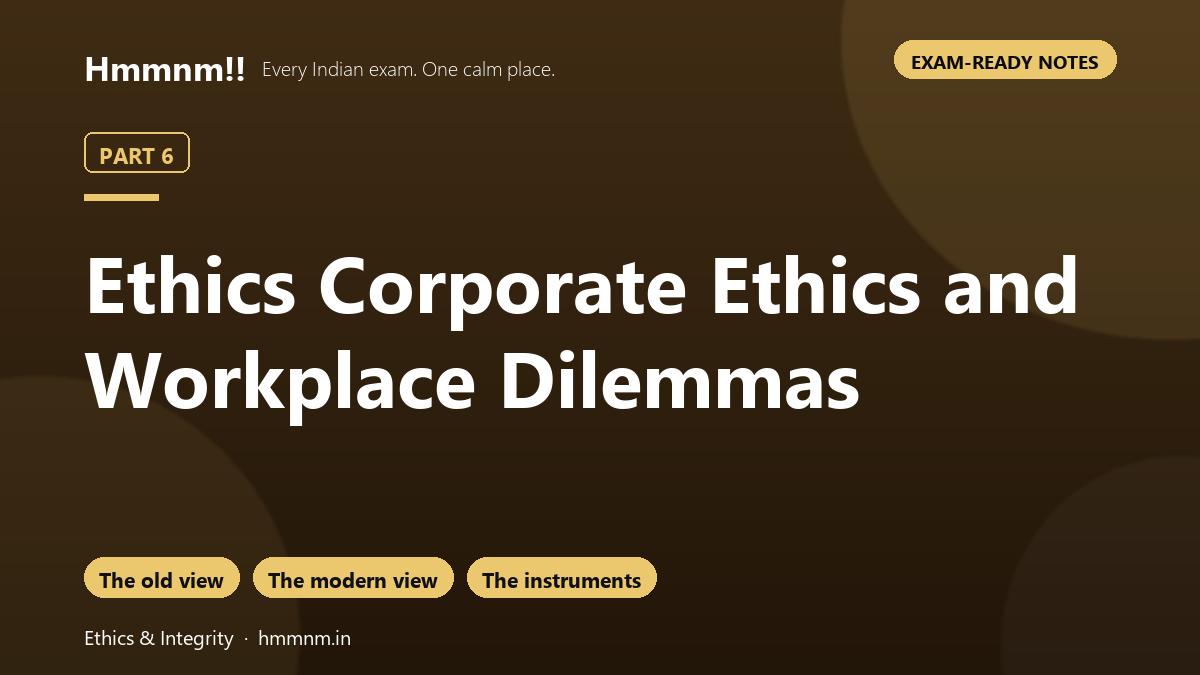
Corporate Ethics: Navigating Modern Business Dilemmas With Confidence
Quick answer: In one line: Ethics Part 6: Corporate ethics entered GS-4 through the syllabus line "ethical issues in international relations and funding" and through case studies. In fact, corporate…
- Table of Contents.
- 1. Corporate Ethics: From Shareholder to Stakeholder.
- 2. CSR in India: The Statutory Model.
- 3. Corporate Governance: The Machinery.
- 4. The Workplace Dilemma Set.
- 5. Whistleblowing: When Loyalty Breaks.
- 6. How Exams Probe This Topic.
- 7. Quick Revision: One-Glance Facts.
- Related exam guides.
- Frequently Asked Questions
- What should you know about 1. Corporate Ethics: From Shareholder to Stakeholder?
- What should you know about 2. CSR in India: The Statutory Model?
- What should you know about 3. Corporate Governance: The Machinery?
- What should you know about 4. The Workplace Dilemma Set?
- What should you know about 5. Whistleblowing: When Loyalty Breaks?
- About the Author
- References & authoritative sources
In one line: Ethics Part 6: Corporate ethics entered GS-4 through the syllabus line "ethical issues in international relations and funding" and through case studies.
In fact, corporate ethics entered GS-4 through the syllabus line “ethical issues in international relations and funding” and through case studies set in companies — CSR, whistleblowing, misleading advertising, data privacy. In fact, with UGC-NET/Management and Commerce exams also testing the area, this note builds the frameworks: stakeholder theory, CSR’s Indian statutory form. The standard workplace dilemma set with resolution logic.
Quick Answer: Corporate ethics entered GS-4 through the syllabus line “ethical issues in international relations and funding” and through case studies set in companies — CSR, whistleblowing, misleading advertising, data privacy. Moreover, with UGC-NET/Management and Commerce exams also testing the area, this note builds the frameworks:…
Table of Contents.
- Therefore, corporate Ethics: From Shareholder to Stakeholder
- CSR in India: The Statutory Model
- Corporate Governance: The Machinery
- The Workplace Dilemma Set
- Whistleblowing: When Loyalty Breaks
- How Exams Probe This Topic
- Quick Revision: One-Glance Facts
1. Corporate Ethics: From Shareholder to Stakeholder.
- The old view. Meanwhile, milton Friedman’s dictum — “the social responsibility of business is to increase its profits” (1970) — shareholder primacy, legality as the only moral boundary.
- The modern view. As a result, stakeholder theory (Freeman, 1984) — a firm owes duties to shareholders, employees, customers, suppliers, community and environment. Moreover, long term value includes trust, licence to operate and ESG standing. India’s CSR law (below) is a statutory embodiment of the stakeholder view.
- In other words, codes of conduct, ethics officers and hotlines, ESG disclosure (SEBI’s BRSR — Business Responsibility and Sustainability Reporting. Therefore, mandatory for top listed companies from 2023), the Companies Act 2013’s independent director and audit committee architecture.
- The recurring corporate vices. Notably, misleading advertising, product safety shortcuts, price gouging, tax avoidance vs evasion. Meanwhile, supply chain exploitation (gig workers, homeworkers), data misuse — each maps to a stakeholder whose trust is spent.
2. CSR in India: The Statutory Model.
- Indeed, section 135, Companies Act 2013 — companies with net worth ≥ ₹500 crore or turnover ≥ ₹1. As a result, 000 crore or net profit ≥ ₹5 crore must spend 2% of average net profits of the preceding three years on CSR activities (Schedule VII list: hunger. Poverty, education, gender equality, environment, heritage, PM/Government relief funds, incubation, rural development, slums, technology incubators, waste-management, sports for the disabled etc.).
- CSR Committee (3+ directors, one independent), board report disclosure. Specifically, unspent amounts transferred to escrow/specified funds (2021 amendment rules); penalties for non disclosure under Section 134/135.
- The debate lines. Similarly, (a) Mandated philanthropy vs authentic responsibility — “tax by another name” criticism. In other words, (b) CSR washing — branding spend on events as CSR. (c) the Gandhi trusteeship defence (Part 2) — the wealthy as trustees. Exams reward quoting both sides.
3. Corporate Governance: The Machinery.
- The scandals lineage. Overall, satyam (2009, India’s Enron — promoter fraud) → Companies Act 2013 reforms. Notably, enron/WorldCom (2001-02) → Sarbanes-Oxley in the US — the international regulatory learning loop to cite.
- The India stack. Consequently, independent directors and audit committees; NFRA (National Financial Reporting Authority. Indeed, 2018) — audits the auditors; SEBI LODR disclosure norms; related party transaction approvals; class action suits (Section 245); the Uday Kotak committee (2017) reforms.
- The failures to cite. Furthermore, satyam, IL&FS (2018, board/governance collapse), Yes Bank, PNB-Nirav Modi fraud (rogue employee + audit failure). Specifically, the Adani-Hindenburg governance debate (2023, independent director questions) — one-line citation each is enough; depth expected on one.
4. The Workplace Dilemma Set.
Likewise, the six recurring case studies and their resolution logic:
- In short, the boss asks you to fudge a report/numbers. Similarly, resolution: refuse politely with the compliance alternative (restate the finding, offer the defensible version). Document in writing; escalate to ethics officer/audit committee if repeated; external regulator as last resort. The line: professional duty > hierarchy, but use the channel first.
- Subsequently, a colleague’s misconduct (harassment, expense fraud). Distinguish gossip from evidence; report through the formal channel (PoSH committee for harassment — the 2013 Act’s ICC is mandatory for 10+ employee organisations); protect confidentiality; no vigilante confrontation.
- In fact, discrimination/poaching in hiring, or a biased promotion. Anchor on documented criteria; dissent on record; if overruled illegitimately, escalate to HR/ethics committee.
- The misleading advertisement/product claim. Moreover, test claim against evidence; dissent internally; comply with ASCI (Advertising Standards Council of India) and the Consumer Protection Act 2019’s CCPA powers (misleading-ads penalties — the surrogate advertising crackdowns are current examples); refusing to be part of deception is non-negotiable.
- Conflict of interest (vendor is a relative; you hold shares). Disclosure + recusal — the universal two-step; hidden conflicts, not conflicts themselves, are the offence.
- Meanwhile, data privacy shortcuts (selling/sharing user data). The DPDP Act 2023 consent regime governs (see the site’s DPDP notes). Consent, purpose-limitation, breach reporting — the officer’s duty is refusal plus escalation.
- As a result, the universal skeleton for any of these: identify stakeholders → name the ethical clash (e.g. Loyalty vs integrity) → options with consequences → decision on the least-harm/lawful path → escalation and documentation → institutional fix.
5. Whistleblowing: When Loyalty Breaks.
- In other words, disclosure by an insider of organisational wrongdoing to internal or external authorities — from loyal dissent (internal channels) to civil disobedience (external/press. When internal channels are exhausted or captured).
- Notably, section 177(9)-(10) Companies Act 2013 — mandatory vigil mechanism for listed and specified companies. SEBI LODR extends it; on the public side. The Whistle Blowers Protection Act 2014 (notified for some purposes but weakly operational — Governance Part 4’s critique).
- Indeed, satyendra Dubey (NHAI, 2003 — murdered after writing to the PMO. The case that forced the whistle blower debate in India) and Manoj Mishra. Internationally, Sherron Watkins (Enron) and Edward Snowden (the harder case: motive vs method debate — a good contrast pair).
- The ethics line. Whistleblowing is justified when: serious public harm, internal channels exhausted or clearly futile, evidence not speculation, and motive is public interest. Deception in service of exposure needs the test of proportionality — the Kant-vs-Mill terrain from Part 2.
6. How Exams Probe This Topic.
- Mains direct: “CSR in India has moved from philanthropy to mandate. Has it also moved from compliance to conviction—. “Independent directors have failed to prevent governance collapses in India. Critically examine” — the machinery + failure citations above carry both.
- Case study standard: the fudged report or harassment witness case (from section 4) — the skeleton earns structure marks. One corporate governance citation (Satyam/IL&FS) earns content marks.
- Commerce/Management exams (UGC-NET, MBA): CSR Schedule VII eligibility thresholds, Section 135 machinery, BRSR. Stakeholder vs shareholder theory as short answer staples — the facts above are drawn to that precision.
- Interview: “Your manager takes credit for your work — what do you do× a behavioural answer rehearsal of skeleton item 3.
7. Quick Revision: One-Glance Facts.
- Friedman (shareholder) vs Freeman (stakeholder); Gandhi’s trusteeship as the Indian bridge.
- Sec 135, Companies Act 2013: ₹500cr / ₹1,000cr / ₹5cr thresholds; 2% of 3-year avg profit; Schedule VII; CSR committee.
- NFRA 2018; independent directors; Kotak committee; Satyam → 2013 Act; IL&FS/Yes Bank as modern failures.
- stakeholders → clash → options → lawful least harm → escalate/document → fix.
- Sec 177 vigil mechanism; WBP Act 2014; Dubey case; justification conditions (harm, exhaustion, evidence, motive).
- CCPA/Consumer Act 2019; PoSH 2013; DPDP 2023.
Corporate ethics questions are governance questions in private clothes: the same integrity-objectivity accountability triad from Part 1, wearing a lanyard. Master the stakeholder shift, the CSR statutory card. The six dilemma skeleton and the whistleblowing conditions — and you can handle the GS-4 case study set in companies as confidently as the collectorate ones. And the NET/Management short answers alongside.
Read next: The Indus Waters Treaty, 1960-2026: Survival, Abeyance and the Exam Questions, Exam-Ready Notes
Related exam guides.
- The Indus Waters Treaty, 1960-2026: Survival, Abeyance and the Exam Questions, Exam-Ready Notes.
- Junagadh and the Integration of the Princely States: From the 1948 Plebiscite to the 2025 Supreme Court Verdict, Exam-Ready Notes.
- Partition 1947: The Largest Migration in History, Exam-Ready Notes.
Frequently Asked Questions
What should you know about 1. Corporate Ethics: From Shareholder to Stakeholder?
The old view. Milton Friedman’s dictum — “the social responsibility of business is to increase its profits” (1970) — shareholder primacy, legality as the only moral boundary. The modern view. Stakeholder theory (Freeman, 1984) — a firm owes duties to shareholders, employees, customers, suppliers, community and environment. Long term value includes trust, licence to operate and ESG standing. India’s CSR law (below) is a statutory embodiment of the stakeholder view.
What should you know about 2. CSR in India: The Statutory Model?
Section 135, Companies Act 2013 — companies with net worth ≥ ₹500 crore or turnover ≥ ₹1. 000 crore or net profit ≥ ₹5 crore must spend 2% of average net profits of the preceding three years on CSR activities (Schedule VII list: hunger. Poverty, education, gender equality, environment, heritage, PM/Government relief funds, incubation, rural development, slums, technology incubators, waste-management, sports for the disabled etc.).
What should you know about 3. Corporate Governance: The Machinery?
The scandals lineage. Satyam (2009, India’s Enron — promoter fraud) → Companies Act 2013 reforms. Enron/WorldCom (2001-02) → Sarbanes-Oxley in the US — the international regulatory learning loop to cite. The India stack. Independent directors and audit committees; NFRA (National Financial Reporting Authority. 2018) — audits the auditors; SEBI LODR disclosure norms; related party transaction approvals; class action suits (Section 245); the Uday Kotak committee (2017) reforms.
What should you know about 4. The Workplace Dilemma Set?
The six recurring case studies and their resolution logic: The boss asks you to fudge a report/numbers. Resolution: refuse politely with the compliance alternative (restate the finding, offer the defensible version). Document in writing; escalate to ethics officer/audit committee if repeated; external regulator as last resort. The line: professional duty > hierarchy, but use the channel first.
What should you know about 5. Whistleblowing: When Loyalty Breaks?
Disclosure by an insider of organisational wrongdoing to internal or external authorities — from loyal dissent (internal channels) to civil disobedience (external/press. When internal channels are exhausted or captured). Section 177(9)-(10) Companies Act 2013 — mandatory vigil mechanism for listed and specified companies. SEBI LODR extends it; on the public side. The Whistle Blowers Protection Act 2014 (notified for some purposes but weakly operational — Governance Part 4’s critique).
References & authoritative sources
- Britannica — concept background
- United Nations — official documents
- UPSC — official syllabus & notifications
- PIB — government releases
- National Portal of India
Source: compiled from official notifications, standard textbooks and our own mock-test analytics; last reviewed September 2026.
Quick revision
- Therefore, corporate Ethics: From Shareholder to Stakeholder
- CSR in India: The Statutory Model
- Corporate Governance: The Machinery
- The Workplace Dilemma Set
- Whistleblowing: When Loyalty Breaks
- How Exams Probe This Topic
Have a doubt on this topic?
Sources & official references
External references for fact-checking and further reading.