India-China Reset: Key Takeaways from the Modi-Xi Meet
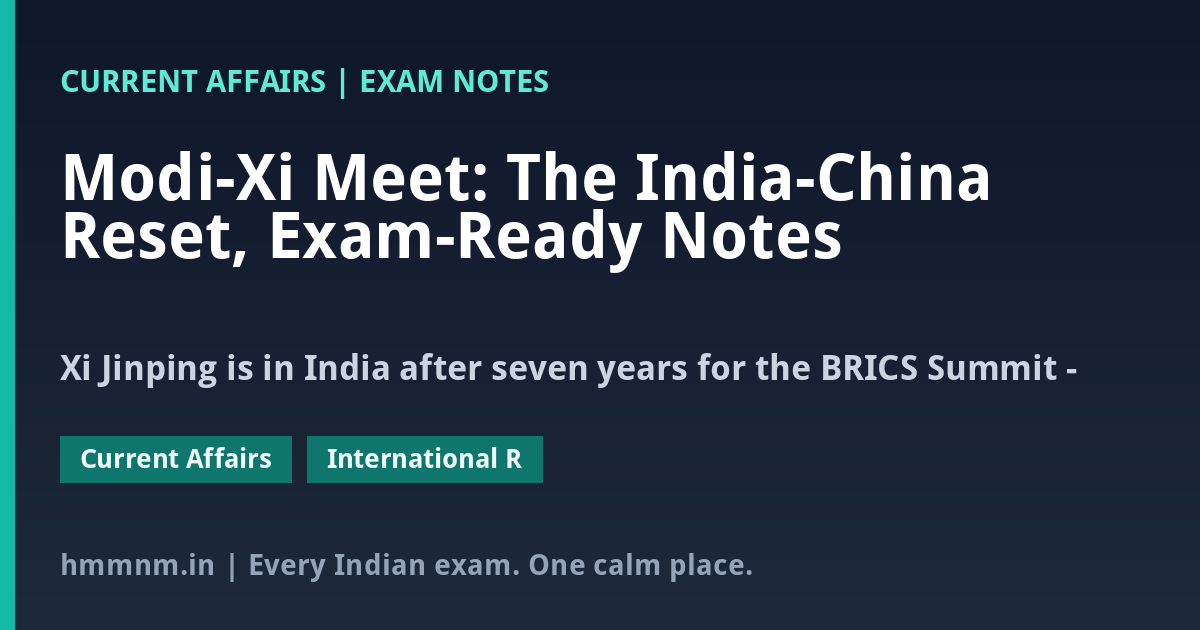
Quick answer: Xi Jinping is in India for the first time in about seven years for the BRICS Summit, with a Modi–Xi bilateral expected to advance the post-Galwan reset: calmer borders, restored flights and the Kailash Mansarovar Yatra, against unresolved trade and river-water frictions.
- Why is this meeting symbolically loaded?
- What has actually been restored so far?
- What remains unresolved on the border?
- Which frictions come to the table besides the border?
- What does China want from the visit?
- How does this fit India’s multi-alignment strategy?
- What are the deliverables to watch?
- Risks that could snap the thaw
- Rapid facts for prelims
- Practice questions
- Mains practice
- Revision card
- Sources
- Post-meeting update (13 September): what the bilateral delivered
- About the Author
- References & authoritative sources
- Frequently asked questions
- What is the Modi–Xi meeting about, in one line?
- Why is Xi Jinping’s 2026 India visit significant?
- How should aspirants use this guide?
Current Affairs explainer · 12 September 2026 · IR coverage of the India–China reset
The news in one line: On the margins of the BRICS Summit in New Delhi, PM Narendra Modi meets President Xi Jinping — the Chinese leader’s first India visit in roughly seven years — to consolidate a cautious reset built since the 2024 border disengagement.
Why is this meeting symbolically loaded?
No bilateral relationship carries as much frozen history as India–China after Galwan (June 2020), the first lethal clash on the Line of Actual Control in 45 years. For four years the relationship ran on autopilot downwards: envoys recalled, apps banned, flights halted, patrols colliding. The turn began at Kazan in October 2024, when Modi and Xi met on the BRICS sidelines after completing disengagement in the last two friction points, Depsang and Demchok. A Tianjin meeting followed at the SCO summit, and now Xi lands in Delhi. Symbol matters here: the last time a Chinese president visited India for a bilateral-summit combination was Mamallapuram, 2019 — before everything froze. The very fact of the visit signals both capitals have chosen managed competition over open confrontation.
What has actually been restored so far?
- Border calm: disengagement at the friction points, agreed patrolling protocols back in force, and continued corps-commander and diplomatic (WMCC) dialogue to keep the Line of Actual Control quiet.
- Direct flights: suspended since 2020, resumed as part of the step-by-step normalisation package.
- Kailash Mansarovar Yatra: the pilgrimage via the Nathu La route resumed after a five-year suspension — a people-to-people signal with domestic resonance in both countries.
- Visa facilitation and exchanges: eased arrangements for business, students and tourists, still far below pre-2020 levels but moving in the right direction.
Analysts describe the method as a “structured incremental process” — small, verifiable steps exchanged for small steps, designed so that one incident does not flip the whole relationship back to freeze.
What remains unresolved on the border?
Disengagement is not de-escalation, and de-escalation is not a settlement. Tens of thousands of troops remain forward-deployed on both sides — a permanent mobilisation that costs both treasuries and keeps every patrol a potential flashpoint. De-escalation (thinning forward deployments) and delimitation (clarifying where the LAC actually runs) remain unstarted, and India maintains that peace and tranquillity on the border is the precondition for normal relations elsewhere — the exact doctrine Beijing has spent 2025–26 quietly accepting in practice while never formally endorsing. The Himalayan infrastructure race continues regardless: roads, tunnels, airfields and railways on both sides of the line.
Which frictions come to the table besides the border?
Trade imbalance is India’s loudest economic grievance: bilateral trade has swelled past $118 billion, but India’s deficit with China is of a similar order — the largest bilateral deficit India runs — fuelled by imports of electronics components, machinery, pharma intermediates and solar cells. India’s answers have been quality-control orders, PLI incentives and FDI screening, not tariffs. River waters could surface from the other side: analysts expect China to raise India’s suspension of the Indus Waters Treaty on Pakistan’s behalf, while India counters with its own concerns over Chinese upstream damming of the Yarlung Tsangpo (Brahmaputra), including the mega-dam project at Medog. Security and technology round out the list: app bans and telecom screening on the Indian side, and Chinese irritation over India’s Quad membership and Taiwan-facing semiconductor partnerships on the other.
What does China want from the visit?
Beijing’s published line is that it will “properly handle differences” — diplomatic vocabulary for freezing the border dispute while growing everything else. Concretely, China wants: Indian supply-chain openness for its manufacturers facing US tariffs; a softer Indian line on Chinese investment in electronics, EVs and batteries; support inside BRICS for multipolarity language; and breathing room on Pakistan-related issues. Naval dynamics matter too — maritime drills and Indian Ocean presence have expanded on both sides, and any defence dialogue resumption would be a concrete deliverable Delhi could offer without conceding on the border.
How does this fit India’s multi-alignment strategy?
The week itself is the illustration. In the same fortnight India hosts Xi, receives Putin’s warm messages, welcomes Iran’s president, rolls out the red carpet for the UAE crown prince, and continues trade-war management with Washington. This is multi-alignment in practice: no alliance, all partnerships, each managed on its own logic. The China reset is the hardest of these because it must reconcile three contradictory imperatives — deterrence on the border, interdependence in trade, and strategic autonomy everywhere. The exam-ready formulation: India is not choosing between the US and China; it is building the capability to refuse the choice.
What are the deliverables to watch?
- Resumption mechanics: more flight routes, further visa easing, think-tank and think-tank-adjacent academic exchanges.
- Border CBMs: agreement to begin de-escalation talks, or at least expanded hotlines and faster incident-resolution protocols.
- Trade trust-building: possible movement on Indian exports (pharma, IT services, rice) into China, and clarity for Chinese engineers servicing Indian plants.
- River-water dialogue: any expert-level mechanism on transborder rivers would be a quiet win.
Risks that could snap the thaw
One patrol death undoes years — Galwan taught both sides that. Beyond the border, three spoiler scenarios matter: a US–China escalation (Taiwan Strait or tariffs) that forces India to pick sides more visibly; a Pakistan-triggered crisis that re-couples China’s support for Islamabad with India’s China policy; and domestic politics — neither leader can afford looking soft, so the reset must always look like strength. The structural truth that outlasts any summit: India and China are the world’s two most populous powers sharing an undemarcated 3,488-km border and an asymmetrical economic relationship. Management, not friendship, is the realistic best case — and both capitals now openly say so.
Rapid facts for prelims
LAC length: 3,488 km (India’s figure). Galwan clash: 15–16 June 2020, 20 Indian soldiers killed; Chinese casualties undisclosed. Friction points disengaged: Galwan, Pangong north/south (2021), Gogra-Hot Springs (2022), Depsang and Demchok (October 2024). Mechanisms: WMCC (Working Mechanism for Consultation and Coordination, est. 2012), corps-commander talks (14th–23rd rounds), Special Representatives Talks (revived 2025). Trade (FY25): ~$118–138 billion; India’s deficit the largest it runs with any country. China’s Brahmaputra project: Medog hydropower mega-dam approved December 2024.
Practice questions
- Arrange in order: Galwan clash, Kazan Modi–Xi meeting, Depsang–Demchok disengagement, Xi’s Delhi visit. — Galwan (2020) → Depsang–Demchok disengagement (Oct 2024) → Kazan meeting (Oct 2024) → Delhi visit (Sep 2026).
- What is the WMCC? — The India–China Working Mechanism for Consultation and Coordination on border affairs, established 2012 — the diplomatic channel running alongside military talks.
- India’s stated doctrine linking the border to the wider relationship? — Peace and tranquillity on the LAC is the prerequisite for normal relations in other domains.
- Name two people-to-people deliverables of the reset. — Resumed direct flights and the Kailash Mansarovar Yatra (via Nathu La).
Mains practice
- “The India–China reset is a management strategy, not a resolution.” Examine the statement in light of recent high-level engagements. (GS-2)
Revision card
- Xi in India: first visit in ~7 years; bilateral on BRICS margins, September 2026.
- Reset anchor: Oct 2024 Depsang–Demchok disengagement + Kazan meeting.
- Restored: flights, Kailash Mansarovar Yatra, visa easing.
- Open issues: de-escalation, LAC delimitation, trade deficit, transborder rivers.
- Watch: IWT raised by China for Pakistan; Brahmaputra dams raised by India.
Sources
- NDTV — Beijing: will “properly handle differences” ahead of Xi visit
- ORF — analysis: the India–China reset and border talks
- Chatham House — the Modi–Xi meeting and the reset
Post-meeting update (13 September): what the bilateral delivered
The meeting this guide anticipated has taken place — on day one of the Delhi summit (12 September), the first face-to-face since Galwan. Three headlines for your notes: Modi’s metric — “met three times in three months” (WION) — his measure of how far the reset has travelled since October 2024; the commitment to facilitating trade and investment while reducing risks (The Hindu readout) — calibrated language for a relationship with a $100-billion-plus deficit problem; and the wider frame — the declaration now confirms it — para 140: “We extend full support to China for its BRICS Chairship in 2027 and the holding of the XIX BRICS Summit in China” (PIB official text), with India’s public backing. The structural takeaway stands, now with a wrinkle: management, not friendship — and in 2027 the management gavel passes to Beijing.
References & authoritative sources
Source: compiled from official notifications, standard textbooks and our own mock-test analytics; last reviewed September 2026.
Frequently asked questions
What is the Modi–Xi meeting about, in one line?
On the margins of the BRICS Summit in New Delhi (September 2026), the leaders aim to consolidate the post-Galwan reset — border calm, restored flights and pilgrimages — while managing unresolved trade and river-water frictions.
Why is Xi Jinping’s 2026 India visit significant?
It is the Chinese president’s first visit to India in about seven years — the highest-level contact since the 2020 Galwan clash froze the relationship, and a signal that both capitals prefer managed competition.
How should aspirants use this guide?
Read the explainer once, revise from the revision card, then attempt the practice questions — the same three-pass method our mentors use in class.
Quick revision
- Border calm: disengagement at the friction points, agreed patrolling protocols back in force, and continued corps-commander and diplomatic (WMCC) dialogue to keep…
- Direct flights: suspended since 2020, resumed as part of the step-by-step normalisation package.
- Kailash Mansarovar Yatra: the pilgrimage via the Nathu La route resumed after a five-year suspension — a people-to-people signal with domestic resonance in both countries.
- Visa facilitation and exchanges: eased arrangements for business, students and tourists, still far below pre-2020 levels but moving in the right direction.
- Resumption mechanics: more flight routes, further visa easing, think-tank and think-tank-adjacent academic exchanges.
- Border CBMs: agreement to begin de-escalation talks, or at least expanded hotlines and faster incident-resolution protocols.
Have a doubt on this topic?