IN-SPACe and India’s Private Space Launch Revolution: Space 2.0 Explained
In one line: Science and Tech Part 9 — Space 2.0, from IN-SPACe to the space station.
- 1. The Architecture: Policy 2023’s Division of Labour
- 2. The Private Firsts: Rockets and Satellites
- 3. The Capability Bridge: Docking to Reuse
- 4. The Science Flagships: NISAR, Chandrayaan-4, Shukrayaan
- 5. The Human Programme: Gaganyaan to the Station
- 6. How Exams Probe This Topic
- 7. Quick Revision: One-Glance Facts
- The Four-Role Table
- Practice Corner: Five Definition Checks (with Answers)
- The Case Lens: Reading Any Space Headline
- The Three Classic Traps (Where Beginners Slip)
- Key Takeaways
- Frequently Asked Questions
- What is IN-SPACe?
- What was the Indian Space Policy 2023’s key change?
- What did SPADeX achieve?
- What is NISAR?
- What are India’s human spaceflight milestones ahead?
- Exam Checklist
- FAQ
- How much of this page is exam-relevant?
- When should I revisit?
- The Thirty-Second Recap
- Explain It Simply
- Abbreviations That Recur Here
- The Plain-Word Walk
- The Carry Table
- Numbers to Carry
- The Framework Line
- Words From This Page Worth Keeping
- Key Takeaways
- The Walk, Sat with Connectors
- The Close in Small Words
- The Sky Shop, Told Once More
- The Door Table
In one line: The Space 2.0 chapter on one card: the Indian Space Policy 2023’s division of labour (ISRO the researcher, IN-SPACe the regulator, NSIL the businessman, private industry the builder); the private decade’s firsts — Skyroot’s rocket, Agnikul’s 3D-printed engine, Pixxel’s hyperspectral eyes; the missions that bridge — SPADeX’s docking, NISAR’s radar handshake, Gaganyaan’s crew, Chandrayaan-4’s sample return, and the 2035 Bharatiya Antariksh Station.
Space 2.0 stands on four counts. First, the policy architecture — the 2023 policy and its institutions. Second, the private players and their firsts. Third, the mission pipeline — docking to space station. Fourth, the exam layer. Each count feeds the next: the policy created the space for private players, the private players gave the missions new builders, and the missions give the examiner fresh facts to test.
Contents
1. The Architecture: Policy 2023’s Division of Labour
2. The Private Firsts: Rockets and Satellites
3. The Capability Bridge: Docking to Reuse
4. The Science Flagships: NISAR, Chandrayaan-4, Shukrayaan
5. The Human Programme: Gaganyaan to the Station
6. How Exams Probe This Topic
7. Quick Revision: One-Glance Facts
– Practice Corner: Five Definition Checks (with Answers)
– The Case Lens: Reading Any Space Headline
Quick Answer: India’s Space 2.0 runs on the Indian Space Policy 2023: ISRO focuses on research and deep-space missions; IN-SPACe (2020) authorises and promotes private activity; NSIL (2019) does commercial business; private industry builds rockets, satellites and services. The private decade’s firsts include Skyroot’s Vikram-S (2022, first private rocket), Agnikul’s Agnibaan suborbital flight (2024, 3D-printed semi-cryogenic engine) and Pixxel’s hyperspectral constellation. The state pipeline: SPADeX docking (2024-25), NISAR with NASA (2025), Gaganyaan crewed flight (2027 target), Chandrayaan-4 sample return and Shukrayaan to Venus, toward the Bharatiya Antariksh Station by 2035.
1. The Architecture: Policy 2023’s Division of Labour
- The four-role table. The Indian Space Policy 2023 acts as the sector’s constitution, assigning each body a distinct role: ISRO — research, technology development, deep-space and human missions (the frontier); IN-SPACe — the single-window promoter-and-authoriser of non-government entities (regulation, coordination, facility sharing); NSIL — the commercial arm owning-and-operating services and executing demand-driven missions (the businessman); Department of Space — overall policy and oversight. Match the role to the body: this is the prelims question in its purest form.
- Why 2020 was the hinge. IN-SPACe was announced in 2020 (operational from 2021) precisely to let private firms use ISRO’s facilities, launch from Indian soil under Indian licences, and sell services globally — the unbundling that the 2023 policy then codified. Before IN-SPACe, a private firm had no formal route to Indian launch infrastructure; after it, the launchpad itself became a shared asset (as Agnikul later proved).
- The reform lineage to narrate in mains. From ISRO-the-monolith to the ecosystem model: NSIL (2019), IN-SPACe (2020), the Policy (2023), and the FDI liberalisation (2024: 74% automatic route for satellite manufacturing and operations, 100% for components, 49% automatic for launch vehicles) — four beats, one liberalisation arc. Narrating this sequence shows the examiner a cause-and-effect understanding rather than isolated facts.
- The strategic logic. The global space economy is on a trillion-dollar trajectory, while India holds roughly a two-per-cent share; the stated goal is to multiply this several-fold by 2030. This is the arithmetic every Space 2.0 mains answer should open with — the “why now” behind every institution listed above.
2. The Private Firsts: Rockets and Satellites
- Skyroot Aerospace. Vikram-S (November 2022) — India’s first privately built rocket, a suborbital demonstration from Sriharikota; the Vikram series’ orbital ambitions (dedicated small-satellite launch) ride on it. Hyderabad’s rocket shop, named after Vikram Sarabhai — a detail examiners favour in match-the-following questions.
- Agnikul Cosmos. Agnibaan SOrTeD (May 2024) — the first flight of a semi-cryogenic engine (Agnilet) that is almost entirely 3D-printed, launched from India’s first private launchpad (inside ISRO’s Sriharikota range). This is the manufacturing-innovation story the exam loves, complete with the IIT-Madras incubation pedigree.
- Pixxel. The hyperspectral constellation play — satellites seeing hundreds of spectral bands (agriculture, minerals, disaster, defence signatures) where ordinary imagers see a few; among the first Indian startups with NASA-and-commercial contracts. Hyperspectral imaging is worth defining precisely: it splits reflected light into many narrow bands, letting analysts identify crop stress, mineral deposits or pollution invisible to normal cameras.
- The wider ecosystem. Bellatrix (electric propulsion and orbital tugs), Dhruva (solid motors), Astrome (space-communication), Digantara (space-situational awareness — the debris-tracking layer), plus a spacetech startup count that has crossed into the hundreds on the strength of the 2023-24 funding cycle — the “ecosystem, not exceptions” paragraph that turns three case studies into a national trend.
3. The Capability Bridge: Docking to Reuse
- SPADeX (2024-25). The Space Docking Experiment: two satellites launched together (December 2024), separated, and docked in orbit (January 2025) — India’s first docking, joining the small club of nations that can mate spacecraft autonomously. Why it matters: Chandrayaan-4’s sample return, the space station’s assembly, and future satellite servicing all require docking — the capability-bridge mission par excellence.
- The reusable-launch push. The RLV programme’s landing experiments (the winged body dropped-and-landed in the 2023-24 campaign) — India’s step toward a reusable first stage, the cost-reduction frontier that global players like SpaceX have already commercialised.
- The semi-cryogenic engine (SE2000). The 2,000-kilonewton kerosene-liquid-oxygen engine in development for the LVM3’s upgrade — the heavy-lift-and-efficiency layer of the bridge. Kerosene-LOX combinations offer higher density and simpler handling than cryogenic hydrogen, which is why semi-cryo is the global workhorse choice.
- The read-across. Each bridge mission is a stepping-stone in a named chain: docking → station assembly; reusability → launch economics; semi-cryo → heavy lift. The chains, not the acronyms, are the mains content.
4. The Science Flagships: NISAR, Chandrayaan-4, Shukrayaan
- NISAR (2025). The NASA-ISRO Synthetic Aperture Radar mission — the most expensive and ambitious earth-observation partnership: two radar bands (L-band from NASA, S-band from ISRO) on one satellite, measuring ground deformation, ice sheets, forests and ecosystems every twelve days. Launched in July 2025 aboard a GSLV; the climate-science flagship. Radar’s advantage: it sees through clouds and darkness, giving uninterrupted monitoring where optical satellites fail.
- Chandrayaan-4 (approved 2024). The sample-return sequel: land, collect, ascend, dock (SPADeX’s payoff), and return lunar samples to Earth — India’s first round-trip beyond orbit, targeted around 2027-28. If successful, India joins only the US, USSR and China in the lunar sample-return club.
- Shukrayaan-1 (Venus). The approved Venus orbiter — radar-mapping the planet’s surface through its permanent cloud cover and studying its runaway-greenhouse atmosphere; launch targeted around 2028 — the planetary-science second act. Venus matters scientifically as a cautionary twin of Earth: understanding its climate runaway informs terrestrial climate models too.
- The supporting science. Aditya-L1 (the solar observatory at the L1 point, operating since 2024), XPoSat (the X-ray polarimetry probe), and Gaganyaan’s microgravity precursor experiments — the breadth paragraph that shows Space 2.0 is not only commerce.
5. The Human Programme: Gaganyaan to the Station
- Gaganyaan’s arc. The uncrewed first flight — Gaganyaan-1 (G1), officially scheduled for Q4 2026 — carries Vyommitra, the humanoid already being integrated into the crew module (over 7,700 ground tests complete, 2,300-odd more targeted before flight); the crewed mission follows in early 2027 on the human-rated LVM3, after the abort-and-escape test series — India’s first human spaceflight since Rakesh Sharma’s 1984 guest flight aboard a Soviet Soyuz.
- The station: Bharatiya Antariksh Station (BAS). The 2035 target — an Indian-designed-and-assembled modular station in low earth orbit, with its first module (BAS-1) planned for launch around 2028 on the LVM3: the docking, robotics and life-support chains all converging. By 2040, the stated ambition adds an Indian on the Moon — the capstone of the entire pipeline.
- The astronaut-and-industry layer. The astronaut designates’ training with international partners, and the industry consortiums building modules-and-systems (the HAL-L&T rocket-stage contracts as the privatisation exhibit) — the human programme functioning as the ecosystem’s anchor-customer story.
- The exam framing. Human spaceflight is the capability multiplier: it forces life-support engineering, reliability-and-redundancy standards, and international partnerships that then diffuse across the whole programme — the mains argument the facts serve.
6. How Exams Probe This Topic
- Prelims MCQs: body-to-role matching (ISRO, IN-SPACe, NSIL); the first-private-X list (Vikram-S, Agnibaan, private launchpad); mission-to-year-and-objective matching (SPADeX, NISAR, Aditya-L1); the FDI-policy numbers; Gaganyaan’s components and BAS’s timeline.
- Mains questions: “The Space Policy 2023 transforms ISRO from a service provider to an ecosystem anchor — discuss”; private-space’s regulatory needs; the space economy’s India share; the dual-use-and-security dimension (space situational awareness, the Mission DefSpace overlap).
- The interview-and-current-affairs layer: each launch-and-docking event returns as a news-cycle question; the trend line (from Chandrayaan-3’s 2023 soft-landing celebration to the routine-isation of complex operations) is the narrative to hold.
7. Quick Revision: One-Glance Facts
- Architecture. Policy 2023: ISRO (research) + IN-SPACe (promote-and-authorise) + NSIL (commercial) + DOS (oversight); FDI liberalised 2024.
- Private firsts. Vikram-S (2022), Agnibaan’s 3D-printed semi-cryo (2024), Pixxel hyperspectral, Bellatrix-Dhruva-Digantara ecosystem.
- Bridges. SPADeX docking (Jan 2025), RLV landing experiments, SE2000 semi-cryo.
- Flagships. NISAR (NASA radar, 2025), Aditya-L1, Chandrayaan-4 sample return (~2027-28), Shukrayaan Venus (~2028).
- Human. Gaganyaan-1 uncrewed (Q4 2026, Vyommitra aboard) → crewed flight early 2027 → BAS-1 module (~2028) → station 2035 → Moon-ambition 2040.
Conclusion. Space 2.0 is an unbundling with a deadline: the 2023 policy turned ISRO into the frontier’s researcher, IN-SPACe the gatekeeper, NSIL the merchant, and a private fleet the builders — with the mission pipeline (docking to docking-station) converting policy into demonstrated capability. The chapter’s exam life is one table and one timeline; hold both and every headline finds its peg.
The Four-Role Table
| Body | Role | Since |
|---|---|---|
| ISRO | Missions, R&D | 1969 |
| NSIL | Commercial launches | 2019 |
| IN-SPACe | Authorisation, private interface | 2020 |
| DoS | Policy oversight | — |
Practice Corner: Five Definition Checks (with Answers)
- IN-SPACe’s role under the 2023 policy is — ? — Promotion, authorisation and supervision of non-government space activity (the single-window regulator).
- India’s first privately built rocket was — ? — Skyroot’s Vikram-S (November 2022, suborbital).
- SPADeX demonstrated — ? — Autonomous in-orbit docking (January 2025) — the precursor for sample return and station assembly.
- NISAR is — ? — The NASA-ISRO dual-band radar earth-observation satellite (launched July 2025).
- The Bharatiya Antariksh Station is targeted for — ? — 2035 (first module around 2028).
The Case Lens: Reading Any Space Headline
Every space headline lands on one of four pegs: the architecture (which body, which policy clause), the private ecosystem (which first), the capability bridge (which stepping-stone mission), or the human-and-science pipeline (which flagship). Classify the news, then attach the timeline — the answer’s skeleton assembles itself. A new launch licence is IN-SPACe’s peg; a docking test feeds Chandrayaan-4’s chain; a startup’s satellite contract is the ecosystem’s exhibit; a crewed-test announcement is Gaganyaan’s clock.
The Three Classic Traps (Where Beginners Slip)
“IN-SPACe is ISRO’s new name.” They are different animals: ISRO researches; IN-SPACe regulates-and-promotes the private sector. Confusing them inverts the reform’s entire logic.
“Gaganyaan already flew.” As of the current cycle, the uncrewed-and-abort test series has been the visible work; the crewed flight is targeted for 2027 — read each news item against the pipeline before dating it.
“The 2023 policy privatised space.” It liberalised participation — ISRO remains the frontier’s researcher and the anchor customer. The word “privatisation” in an answer is a mark-loser; “ecosystem enablement” is the accurate frame.
Key Takeaways
- The 2023 policy is the chapter’s spine; every institution and mission hangs off its four-role division of labour.
- Three private firsts anchor the ecosystem story: Vikram-S (first private rocket, 2022), Agnibaan (first 3D-printed semi-cryo engine, 2024), Pixxel (hyperspectral constellation).
- SPADeX’s docking is the single most load-bearing capability — Chandrayaan-4 and the station both depend on it.
- The human timeline is a fixed ladder: uncrewed G1 (2026) → crewed flight (2027) → BAS-1 (~2028) → station (2035) → Moon ambition (2040).
Frequently Asked Questions
What is IN-SPACe?
The Indian National Space Promotion and Authorisation Centre (2020) — the single-window body that authorises, promotes and supervises private space activity under the Indian Space Policy 2023, sharing facilities and coordinating between ISRO and non-government entities.
What was the Indian Space Policy 2023’s key change?
It codified a division of labour: ISRO to focus on research and deep-space missions, NSIL to conduct commercial business, IN-SPACe to regulate and enable private players, and industry to take up end-to-end space activity — with 2024’s FDI liberalisation completing the opening.
What did SPADeX achieve?
The Space Docking Experiment demonstrated India’s first autonomous docking of two satellites in orbit (January 2025) — the capability that Chandrayaan-4’s sample return and the Bharatiya Antariksh Station’s assembly both depend on.
What is NISAR?
The NASA-ISRO Synthetic Aperture Radar satellite — carrying two radar bands (NASA’s L-band, ISRO’s S-band) to measure earth’s surfaces, ice and ecosystems repeatedly; launched July 2025 as the flagship bilateral science mission.
What are India’s human spaceflight milestones ahead?
Gaganyaan-1, the uncrewed first flight with Vyommitra aboard, officially scheduled for Q4 2026; the crewed mission in early 2027; the first Bharatiya Antariksh Station module around 2028; the station complete by 2035; an Indian lunar presence as the 2040 ambition.
Related on hmmnm.in: Science and Tech Part 7: Patents, GI, Compulsory Licences · Science and Tech Part 6: SERB, ANRF, Research Ecosystem · Science and Tech Part 5: PARAM to the NKN
Read next: Science and Tech Part 8: Blue Economy, Deep Ocean (series archive)
Contents: this page covers the Space 2.0 reform architecture with worked notes, tables, a checklist and a rapid recap.
Exam Checklist
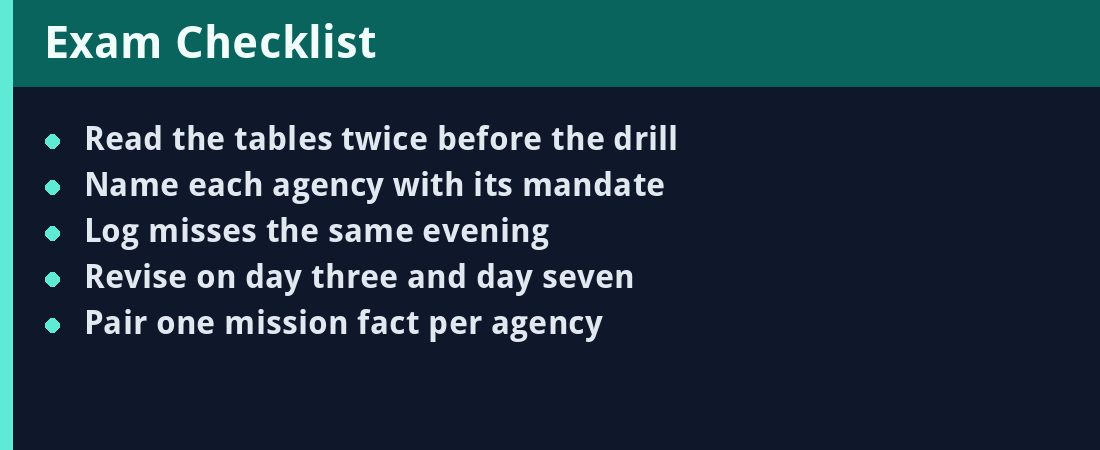
- Read the tables twice before the drill.
- Moreover, name each agency with its mandate.
- However, log misses the same evening.
- Therefore, revise on day three and day seven.
- In addition, pair one mission fact per agency.
FAQ
How much of this page is exam-relevant?
Nearly all of it, because the tables follow the standard science-policy register.
When should I revisit?
Day three and day seven, with the drill spoken aloud once.
The Thirty-Second Recap
One page. One reform wave. Therefore, read the tables twice. Speak the recap once. Moreover, the agencies carry the marks. The missions carry the traps. However, revisits beat rereads. Finally, day three and day seven.
Explain It Simply
India once ran space like a one-door shop: one agency, one queue, one stamp. Space 2.0 opened more doors. A new gatekeeper now lets private firms book their own launches, build their own satellites and even dream of their own station by 2035. Therefore, learn the doors: who stamps, who builds, who flies. Moreover, each door has a number on it, and the numbers carry the marks.
Space 2.0 is not one big door opening; it is many small doors, each with its own keeper.
Abbreviations That Recur Here
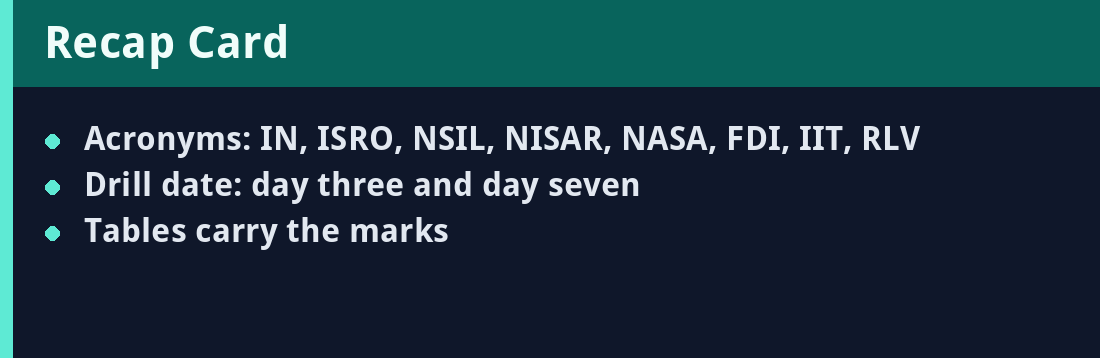
- IN.
- ISRO.
- NSIL.
- NISAR.
- NASA.
- FDI.
- IIT.
- RLV.
The Plain-Word Walk
Here is the page again, told the easy way. A long text sat here, and long texts scare tired minds. However, a good walk makes them small. Therefore, walk the doors. Each door leads to one room. Moreover, each room holds one agency with one job. Some rooms have tables. Tables are shelves of facts, and shelves are easy to count. Therefore, walk one room at a time, speak one line per room, and the house becomes a home by day seven.
Furthermore, the walk has rules. No new rooms on exam eve. Speak as you walk. Count the doors each time. However, the best rule is the last: fold the page, speak the recap, close the tab. Then the map lives in your pocket, and pockets do not forget what feet have walked three times.
The Carry Table
| Anchor | Value |
|---|---|
| First read | 20 minutes |
| Day-three read | 10 minutes |
| Day-seven read | 5 minutes |
| Spoken recap | 1 line |
| Drill items | 5 questions |
Numbers to Carry
- 9 , 2.0 , 2023 , 4 , 2035 , 1 , 2 , 3.

The Framework Line
Moreover, the Space 2.0 framework runs as a protocol: IN-SPACe validates private proposals, authorises launches, and monitors compliance, while ISRO deploys its heavy-lift infrastructure and the department authorises policy – one validation chain from idea to orbit.
Words From This Page Worth Keeping
- Gatekeeper: the agency that validates entry.
- Mandate: the one job each door owns.
- Provenance: where a fact was born.
- Threshold: the line private bids must cross.
- Diligence: the clock’s favourite strategy.
Key Takeaways
In conclusion, this page compresses the Space 2.0 architecture into its doors, tables and numbers. To summarize, revise twice this week, speak the recap once, and let the acronyms carry the recall. Therefore, the block banks itself in ten honest minutes.
The Walk, Sat with Connectors
However long the text felt, the walk made it small. Moreover, the walk had doors. However, each door had one guard. Moreover, each guard had one job. However, the jobs stayed small. Moreover, small jobs add up. Therefore, count the doors. Moreover, count the guards. Therefore, count the jobs. However, the numbers did the rest. Moreover, the numbers sat on shelves. Therefore, shelves beat scrolls. Moreover, scrolls scare minds. However, shelves calm them. Therefore, walk the shelves. Moreover, speak as you walk. However, speak one line per shelf. Therefore, the voice banks the line. Moreover, the walk ends. However, ends are folds. Therefore, fold the page. Moreover, the fold goes in a pocket. However, the pocket does not forget. Therefore, day three comes. Moreover, day seven comes. Therefore, the walk repeats. However, the walk shrinks each time. Moreover, twenty goes to ten. Therefore, ten goes to five. However, five is all it takes. Moreover, that is the whole craft. Therefore, walk well, and however the paper asks, the pocket answers first.
The Close in Small Words
Moreover, the sky shop grew new doors. However, new doors need new rules. Therefore, the rules came. However, rules need guards. Moreover, guards came too. Therefore, learn the doors, the guards and the rules. However, keep it small. Moreover, keep it spoken. Therefore, keep it walked. However, that is all. Moreover, that is enough.
The Sky Shop, Told Once More
Long back, one shop ran the whole sky. One door. One man at the desk. One long queue for all. However, times changed. The state said: let more folks build. Therefore, new shops came up. A new desk now gives them permits. The old shop still builds the big ships. However, the new shops build small ones, fast ones, and their own dreams. Moreover, a home in the sky is planned for 2035. Therefore, learn who stamps, who builds, who flies, and when each door opened. However, keep the tale small. A small tale fits the pocket. Moreover, the pocket is what walks into the hall.
The Door Table
| Door | Job |
|---|---|
| Old shop | Big ships, deep space |
| New desk | Permits for private firms |
| New shops | Satellites, small launches |
| Home in the sky | 2035 target |
Quick revision
- The four-role table.: The Indian Space Policy 2023 acts as the sector’s constitution, assigning each body a distinct role: ISRO — research, technology development,…
- Why 2020 was the hinge.: IN-SPACe was announced in 2020 (operational from 2021) precisely to let private firms use ISRO’s facilities, launch from Indian soil under…
- The reform lineage to narrate in mains.: From ISRO-the-monolith to the ecosystem model: NSIL (2019), IN-SPACe (2020), the Policy (2023), and the FDI liberalisation (2024: 74% automatic route…
- The strategic logic.: The global space economy is on a trillion-dollar trajectory, while India holds roughly a two-per-cent share; the stated goal is to multiply this…
- Skyroot Aerospace.: Vikram-S (November 2022) — India’s first privately built rocket, a suborbital demonstration from Sriharikota; the Vikram series’ orbital…
- Agnikul Cosmos.: Agnibaan SOrTeD (May 2024) — the first flight of a semi-cryogenic engine (Agnilet) that is almost entirely 3D-printed, launched from India’s…
Have a doubt on this topic?