JEE/NEET Physics · Thermal Properties of Matter series · Part 3 of 4 · All parts →
- Conduction: heat hand-to-hand through matter — no matter moves (metals excel)
- Convection: hot fluid itself travels and carries heat along (liquids/gases only)
- Radiation: electromagnetic waves — needs no medium; that’s how the Sun warms us
- Conduction rate: Q/t = kAΔT/L — thick walls and small gaps slow the leak
- Black surfaces absorb AND radiate best; shiny ones reflect — Kirchhoff’s twin rule
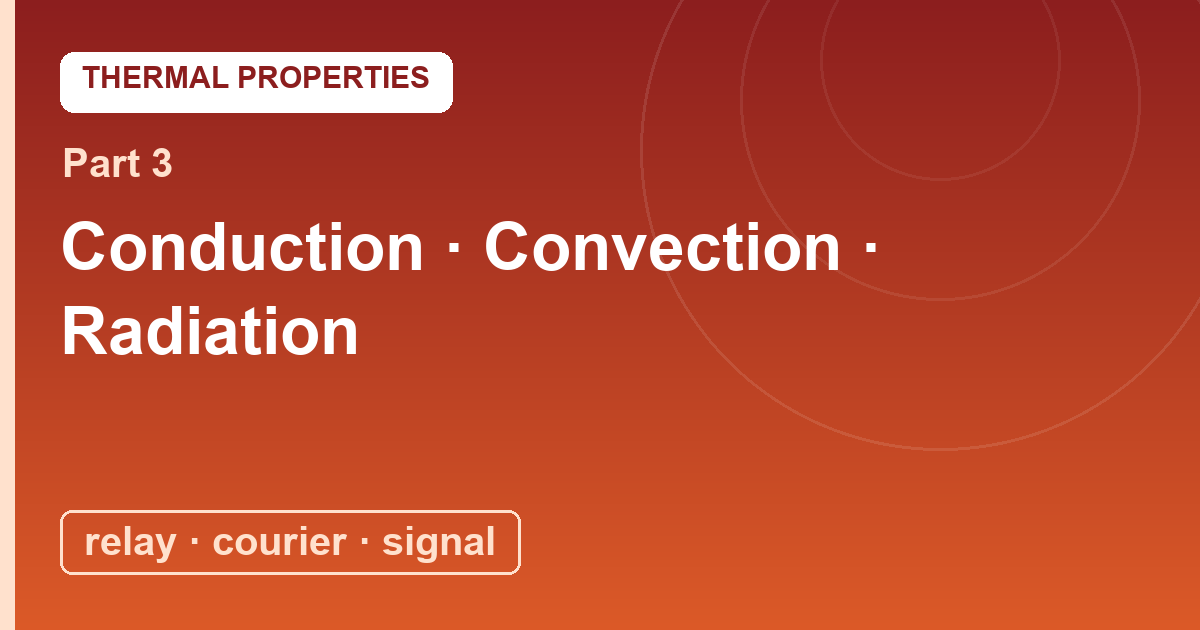
Touch a hot pan (conduction), feel the warm air rise above it (convection), and bask in sunlight that crossed 150 million km of empty space (radiation). Heat has three vehicles — know which one is driving. Part 3 of the Thermal Properties of Matter series.
- Conduction: the relay
- Convection: the courier
- Radiation: the messenger
- The conduction law
- Surface colours and radiation
- Solved examples
- Common mistakes
- This physics in your daily life
- Practice set
- Recap
Conduction: The Relay
One end of an iron rod in fire: hot atoms jiggle harder, knocking neighbours, who knock theirs — energy relayed hand-to-hand while the atoms themselves stay put. Free electrons make metals relay champions: that’s why pan handles are wood or plastic (terrible relays = safe).
Convection: The Courier
Warm fluid expands, gets lighter, rises; cooler fluid sinks to replace it — a circulating current that physically transports heat. Impossible in solids; rules oceans, weather, and boiling pots.
Radiation: The Messenger
All bodies emit infrared electromagnetic waves — no medium required. The Sun’s heat crosses vacuum; a campfire warms your face across cold air; thermal cameras see your glow. This is the same ‘light’, just in invisible colours.
The Conduction Law
| Letter | What it means (plain words) | Value / unit |
|---|---|---|
| k | thermal conductivity | W/(m·°C); copper ~400, water 0.6, wood 0.1 |
| A | cross-section area of the path | m² |
| L | thickness the heat must cross | m — thicker = slower |
Surface Colours and Radiation
Black surfaces are the best absorbers AND the best emitters; polished shiny surfaces reflect both ways. Wear white in summer, paint solar collectors black, wrap survival blankets shiny-side-in.
Solved Examples
Convection — the fluid (air) itself moves carrying heat.
✔
Answer: Convection
Q/t = 400 × 10⁻⁴ × 80/0.5 = 6.4 W.
✔
Answer: 6.4 W
Layers add like resistances: R_total = R_glass1 + R_air + R_glass2 — air’s tiny k (0.026) makes its ‘resistance’ L/kA enormous despite a thin gap.
The stack blocks many times more heat than thick glass alone — trapped still air is the insulator, not the panes.
✔
Answer: Series layers add resistance; trapped air dominates
- Convection in solids. Impossible — solids’ atoms can’t circulate; only conduction and (slightly) radiation operate.
- Radiation ‘needs air’. It needs NOTHING — vacuum is its natural habitat (sunlight).
- Inverting the conduction law. Rate ∝ 1/L: thicker wall, slower leak — students often flip the fraction.
- Black only absorbs. Black absorbs best AND emits best — the same emissivity does both (Kirchhoff).
This Physics in Your Daily Life
- Thermos flasks — fight all three modes at once: vacuum (kills conduction+convection), shiny walls (kills radiation): engineering truce with heat.
- Sea breezes and monsoons — giant convection cells driven by land-sea heating differences: weather is convection at planetary scale.
- White clothes in summer, dark in winter — radiation absorption tuned by wardrobe.
- Cooking vessels: copper bottoms, plastic handles — high-k where you want heat, low-k where you hold: one object, both extremes.
- Greenhouses and car interiors heating in sun — glass passes visible light in, blocks infrared out: radiation’s one-way trap.
Heat is molecular jiggle, and it can move only if that jiggle is passed on. Pass it atom-to-atom in place (conduction), load it onto flowing fluid (convection), or convert it into electromagnetic waves that need no atoms at all (radiation). Matter relay, matter courier, or pure signal — there’s simply nothing else.
Copper vs wood, same shape: 400 vs 0.1 W/m°C — 4000× different relay speeds (burns from a ‘cold’ spoon in tea, safe wooden handle on a hot pan). Air, k = 0.026: still air is the champion insulator — that’s what wool, fur, and double glazing all trap.
Three cartoons side by side: a row of people passing buckets (conduction), a river carrying boats (convection), a lighthouse beam (radiation). Each image is a different answer to ‘how does the energy physically relocate?’
Practice set (answers hidden — try first)
(NEET-level) Heat from the Sun reaches Earth by:
(JEE Main-level) Doubling a wall’s thickness does what to conduction rate?
(NEET-level) Best absorber of radiation:
(Concept) Convection cannot occur in:
(JEE Main-level) Q/t = kAΔT/L with k=0.2, A=2 m², ΔT=30, L=0.1:
- conduction: relay through stationary matter
- convection: fluid courier (no solids)
- radiation: EM waves, vacuum-fine
- Q/t = kAΔT/L — area helps, thickness hinders
- black = best absorber AND emitter
- 🔁 three modes and their media
- 🔁 conduction rate law
- 🔁 series layers add resistance
- 🧠 Chant: ‘relay, courier, signal’.
- 🧠 Insulation = trapped still air (wool, glazing, fur).
- 🏠 Daily: thermos fights all three modes at once.
- 🏠 Daily: sea breeze = convection cell you can feel.
Quick revision
- Conduction: heat hand-to-hand through matter — no matter moves (metals excel)
- Convection: hot fluid itself travels and carries heat along (liquids/gases only)
- Radiation: electromagnetic waves — needs no medium; that’s how the Sun warms us
- Conduction rate: Q/t = kAΔT/L — thick walls and small gaps slow the leak
- Black surfaces absorb AND radiate best; shiny ones reflect — Kirchhoff’s twin rule
- Surface colours and radiation
Have a doubt on this topic?