JEE/NEET Physics · Units & Measurements series · Part 4 of 6 · All parts →
- Absolute error = |your value − true value|; it carries the unit
- Relative error = absolute ÷ true value; fractional, unitless
- Percentage error = relative × 100
- In sums/differences: ABSOLUTE errors add; in products/quotients: RELATIVE errors add
- Mean absolute error and ‘±’ notation: 20.1 ± 0.3 cm is a promise, not a guess
Every measurement ever made is wrong — the only question is by how much, and whether you KNOW by how much. Error analysis is the science of being wrong correctly. Part 4 of the Units & Measurements series.
- Absolute, relative, percentage: the three reporting levels
- How errors combine in arithmetic
- The mean-absolute-error protocol
- Solved examples
- Common mistakes
- This physics in your daily life
- Practice set
- Recap
The Three Reporting Levels
Measure a rod four times: 20.1, 20.4, 19.9, 20.0 cm. The true value’s best estimate is the mean, 20.1 cm. Each reading’s absolute error is its distance from the mean (0.0, 0.3, 0.2, 0.1). The mean absolute error ≈ 0.2 cm → report 20.1 ± 0.2 cm. Divide by the value for the relative error (~0.01), multiply by 100 for percentage error (~1%).
How Errors Combine in Arithmetic
| Operation | What adds | Why |
|---|---|---|
| A + B or A − B | absolute errors | the ± bands stack |
| A × B or A ÷ B | relative errors | percentage slop multiplies |
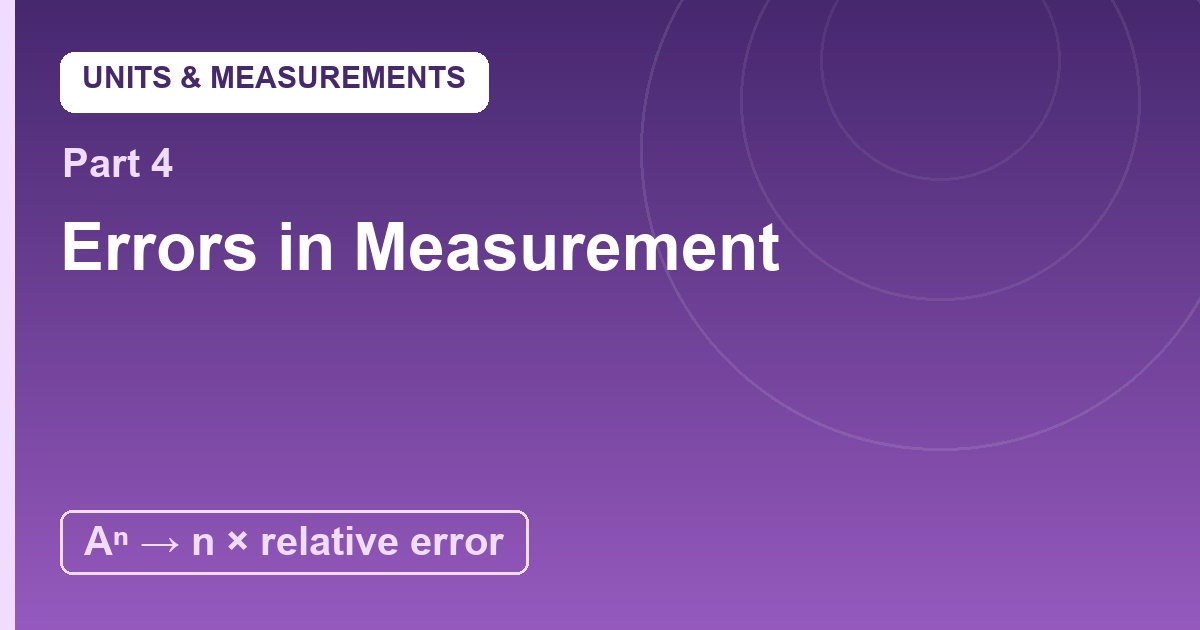
| Aⁿ | relative error × n | exponentiation repeats the slop |
The Mean-Absolute-Error Protocol
Take readings → average → absolute deviations → average those → report mean ± mean error. The ‘±’ is a promise about where the truth lives, which is why it appears on every lab report, medicine label, and election poll in the world.
| Letter | What it means (plain words) | Value / unit |
|---|---|---|
| ΔA | the absolute error in A | same unit as A |
| ΔA/A | relative error — the honest fraction | unitless (a pure ratio) |
| ± x | the uncertainty band of the result | truth promised within x |
Solved Examples
Absolute error = |20.4 − 20.0| = 0.4 cm.
Relative = 0.4/20.0 = 0.02 → percentage error = 2%.
✔
Answer: 2%
Relative error in T = 0.1/2.0 = 5%.
T² doubles it: 10%.
This is exactly why period-squared graphs stretch errors — and why examiners love this question. ✔
Answer: 10%
P = 8.0. Relative errors: 0.1/4.0 = 2.5%; 0.2/2.0 = 10% → total 12.5%.
ΔP = 12.5% of 8.0 = 1.0.
P = 8.0 ± 1.0 — one honest band around the answer. ✔
Answer: P = 8.0 ± 1.0
- Adding relative errors in a subtraction. A − B still adds ABSOLUTE errors — subtraction of values never cancels the slop.
- Forgetting the exponent multiplier. In A³, relative error ×3, not ×1 — the single most-tested slip.
- Averaging before subtracting to reduce error. Errors never subtract; uncertainty only grows through arithmetic, never shrinks.
- Reporting 20.145 ± 0.2. The error digit and the last value digit must align — write 20.1 ± 0.2.
This Physics in Your Daily Life
- Election polls ‘48% ± 3%’ — the ± band you see on TV is exactly this chapter: a promise about where the truth lives.
- Medicine doses (‘500 mg ± tolerance’) — pharmaceutical manufacturing lives inside error budgets; pills must deliver the promised digit.
- Cricket ball-tracking (LBW ‘umpire’s call’) — projected paths carry uncertainty ellipses; the third umpire rules WITHIN the error band.
- Your phone GPS says ‘accuracy ~5 m’ — the chip reports its own ΔA; navigation apps plan routes through error ellipses, not points.
- Weather ’30 ± a few °C’ — ensembles are literally error arithmetic: many forecasts averaged, spread reported honestly.
A blind archer fires arrows. Where they land is each measurement; the cluster’s centre is the mean; the scatter size is the error. Reporting a value without its scatter is showing the bullseye but hiding the spread — technically true, practically a lie. The ± is the archer’s honest confession.
Weigh a coin 4 times: 10.1, 9.9, 10.2, 9.8 g → mean 10.0, mean absolute error ≈ 0.15 g. Report 10.0 ± 0.2 g. Multiply two such measurements and the relative slops add: (0.2/10) + (0.2/10) = 4% total — the honest band on the product is wider than on either factor. Arithmetic amplifies dishonesty unless you track it.
Draw each measurement as a dot on a number line with a shaded halo around it (the ± band). Stack two quantities: the halos stack too (addition). Multiply: the halos’ percentage widths stack. Every arithmetic step is a new picture with a fatter halo — the picture never lies about the slop growing.
Practice set (answers hidden — try first)
(NEET-level) True 40.0, measured 41.2. % error:
(JEE Main-level) % error in V = 4/3 πr³ if r has 2% error:
(NEET-level) Errors in Z = A + B combine as:
(Concept) Readings 10.1, 10.2, 10.0. Mean absolute error:
(JEE Main-level) Z = A²/B; % errors 2% and 1%:
- absolute error |measured − true|, in units
- relative = absolute ÷ value; percentage × 100
- + − : absolute errors add; × ÷ : relative errors add
- Aⁿ multiplies relative error by n
- report as mean ± mean absolute error
- 🔁 absolute/relative/percentage error ladder
- 🔁 ± rule for sums vs products
- 🔁 power rule: Aⁿ → n × relative error
- 🧠 Chant: ‘plus/minus: absolutes; times/divide: relatives’.
- 🧠 Powers: ‘squared doubles the %, cubed triples it’.
- 🏠 Daily: ‘48% ± 3%’ polls = this chapter on TV.
- 🏠 Daily: GPS ‘accuracy ~5 m’ = the ± in your pocket.
Quick revision
- Absolute error = |your value − true value|; it carries the unit
- Relative error = absolute ÷ true value; fractional, unitless
- Percentage error = relative × 100
- In sums/differences: ABSOLUTE errors add; in products/quotients: RELATIVE errors add
- Mean absolute error and ‘±’ notation: 20.1 ± 0.3 cm is a promise, not a guess
- Absolute, relative, percentage: the three reporting levels
Have a doubt on this topic?