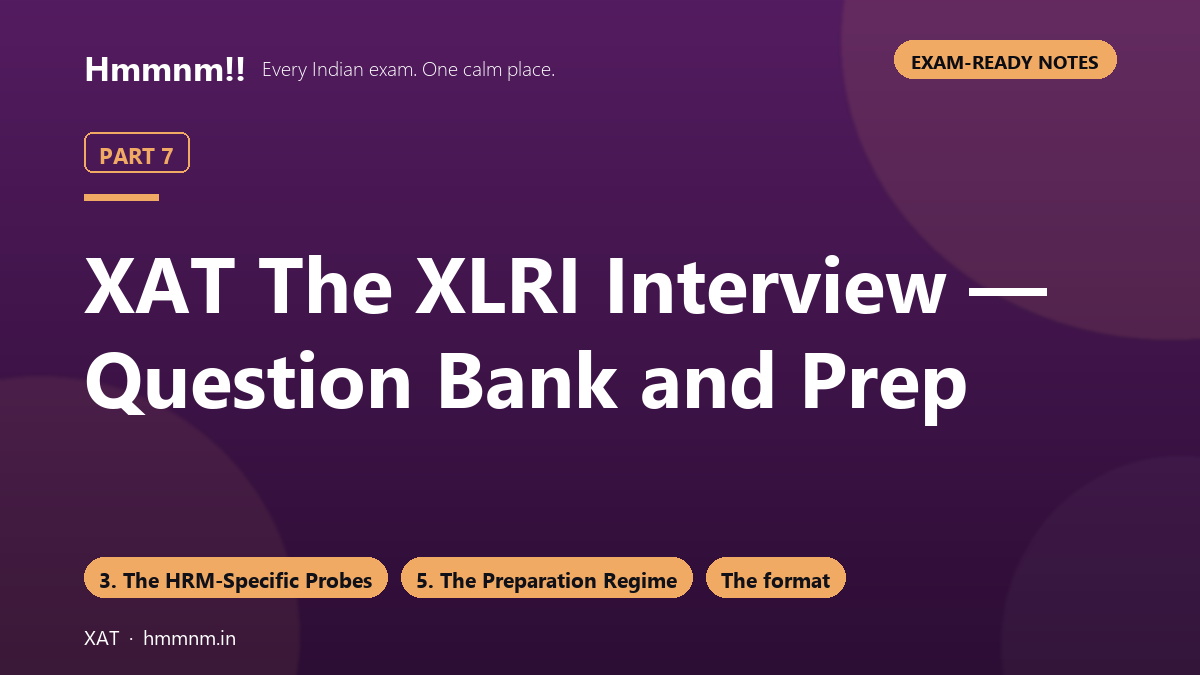
XAT Part 7: XLRI Interview Playbook for Final Selection Success
Quick answer: In one line: XAT Part 7: XLRI's interviews carry the ethics and judgment signature of the school: the HRM probes run deep on people-orientation, the BM on managerial.…
- Table of Contents.
- 1. The Interview’s Character.
- 2. The Core Question Bank.
- 3. The HRM-Specific Probes.
- 4. The Ethics-and Judgment Zone.
- 5. The Preparation Regime.
- 6. How Exams Probe This Topic.
- 7. Quick Revision: One-Glance Facts.
- Practice Corner: The Interview Bank in Five Questions (with Model Directions).
- The Last 48 Hours Before the PI.
- Practice Corner: Five More Checks (with Answers).
- The Question You Should Hope For (And How to Build It).
- The Questions You Ask Back (The Underside of the Interview).
- Related exam guides.
- Frequently Asked Questions
- What should you know about 1. The Interview's Character?
- What should you know about 2. The Core Question Bank?
- What should you know about 3. The HRM-Specific Probes?
- What should you know about 4. The Ethics-and Judgment Zone?
- What should you know about 5. The Preparation Regime?
- About the Author
- References & authoritative sources
In one line: XAT Part 7: XLRI's interviews carry the ethics and judgment signature of the school: the HRM probes run deep on people-orientation, the BM on managerial.
XLRI’s interviews carry the ethics and judgment signature of the school: the HRM probes run deep on people-orientation. In fact, the BM on managerial clarity — with the DM and essay signals already in the file. Meanwhile, this note provides the question bank and the preparation.
Quick Answer: XLRI’s interviews carry the ethics and judgment signature of the school: the HRM probes run deep on people-orientation. Moreover, the BM on managerial clarity — with the DM and essay signals already in the file. Meanwhile, this note provides the question bank and the preparation.
Table of Contents.
- The Interview’s Character
- The Core Question Bank
- The HRM-Specific Probes
- The Ethics-and Judgment Zone
- The Preparation Regime
- How Exams Probe This Topic
- Quick Revision: One-Glance Facts
1. The Interview’s Character.
- Panels of 2-3 (faculty-and alum), 15-25 minutes, the application-form-and essay-driven. XLRI’s Jesuit ethos panels weigh integrity-and self awareness signals over polish — rehearsed robotic answers underperform more visibly here than anywhere.
2. The Core Question Bank.
- Introduce yourself — the 90-second steering narrative (CAT Part 7’s design).
- Why MBA / why XLRI / why BM-vs-HRM — the genuine thread test. Therefore, the “why HRM especially” for the HRM call (the trap: the fallback frame leaking).
- Work-and academics — the STAR-achievements; the graduation-subjects’ fundamentals; the industry’s one live issue.
- Meanwhile, the essay-and DM connect — panels probe your essay’s argument (“you wrote X — defend it”) and the DM answers’ reasoning (the judgment consistency check).
- Current affairs — the year’s business-economy and social themes with positions. XLRI’s social concern tilt (the inclusive-growth, the ESG themes).
- As a result, the hobbies-and reads — the two-level deep genuineness probe.
3. The HRM-Specific Probes.
- The people orientation evidence. “Describe a conflict you mediated”; “a team member underperforming — what did you do—; the people influence stories (the 10-story bank’s teamwork and leadership draws).
- The HR-domain awareness. In other words, the basics of the HR world (the gig-work-and employee engagement trends, the HR-tech wave. Meanwhile, the labour-codes’ one-liners) — the two evening briefing that separates the serious HRM candidate.
- Notably, the corporate-HR-vs-HR-consulting-and OD paths’ articulation — “what does an HR manager actually do all day—(the surprise classic).
4. The Ethics-and Judgment Zone.
- The dilemma probes. “Your boss asks you to fudge a number — what do you do—. Indeed, the workplace ethics scenarios — XLRI’s signature. Indeed, the method: the Part 2-of this series framework (procedural-integrity-plus-empathy) delivered conversationally, not as a recited model.
- The integrity anecdotes. Specifically, one genuine story where you chose the harder right over the easier wrong (the form’s and life’s real material) — the single most XLRI-resonant preparation artefact.
5. The Preparation Regime.
- Similarly, the application-form’s line by line re-read. Meanwhile, the essay’s defence-prep; the 10-story bank (2 achievements-2 failures-2 teamwork-2 leadership-2 integrity); the HR-domain briefing (for HRM).
- 8-10 mock-PIs (the XLRI-alum profile if findable). Overall, the stress-variant; the recording and review for the rehearsal detection (the naturalisation pass).
- XLRI’s programmes’ specifics (the courses, the committees, the Magis-ethos) — the “why XLRI” that names names.
6. How Exams Probe This Topic.
- Consequently, the real test — the February-March rounds; the question bank above IS the syllabus.
- Cross-reference: CAT Part 7 (the base playbook), XAT Part 2 (the judgment framework), Part 5 (the programme specifics).
7. Quick Revision: One-Glance Facts.
- Ethics-and self awareness weighted; anti rehearsal panels.
- Intro / why MBA-XLRI-programme / work acads / essay defence / current affairs / hobbies.
- Furthermore, the people-stories, the HR-domain briefing, the career-clarity.
- Form re-read, essay defence, the 10-story bank, one integrity anecdote, 8-10 mocks.
Likewise, the XLRI interview rewards genuineness with structure: the steering intro, the programme specific “why”, the people stories for HRM. Meanwhile, one real integrity anecdote — all rehearsed to naturalness, never to polish. Prepare the question bank’s ten zones, brief the HR domain if HRM-bound. Notably, the panel meets a candidate rather than a performance.
Practice Corner: The Interview Bank in Five Questions (with Model Directions).
- “Why HRM and not BM× Model direction: a genuine people thread (a mediation story. In short, an OB interest) plus HRM’s career logic; never “BM is more competitive.”
- “Defend your XAT essay’s argument.” — Restate the thesis in one-line, give the strongest objection, answer it — the panel tests reasoning, not stubbornness.
- “What does an HR manager actually do all day× Talent acquisition, performance and rewards administration, employee relations, compliance with labour codes. Culture interventions — the honest five part answer.
- “Your boss asks you to fudge a number — what do you do× Refuse courteously. Offer the lawful alternative, document, escalate if repeated — the framework delivered conversationally.
- “Tell me about a failure.” — A real one, with the reflection and the changed behaviour — the panel’s self awareness probe, not a weakness-pretending-to be strength.
The Last 48 Hours Before the PI.
Re read your application form line by line — every claimed achievement must survive two follow-up questions. Rehearse the 90-second intro aloud five times until it sounds spoken, not recited. Prepare three questions to ask the panel (about the programme’s committees, the placements’ sector mix, the faculty’s research) — genuine curiosity signals. Sleep seven hours; a tired candidate reads as a low energy one, and panels score energy. And on the morning: arrive an hour early, watch one earlier candidate emerge and breathe — the process is ordinary. Treating it as ordinary is the entire composure game.
Practice Corner: Five More Checks (with Answers).
- XLRI interviews typically run? — 15-25 minutes before 2-3 member panels .
- The panel weighs most heavily? — Integrity and self awareness over polish .
- HRM candidates must prepare? — People influence stories and the HR domain’s basics .
- The essay defence probe tests? — Reasoning consistency, not stubbornness .
- Subsequently, the single most XLRI-resonant preparation artefact? — One genuine integrity anecdote .
The Question You Should Hope For (And How to Build It).
In fact, every interview has one “tell me about a time you…” moment you can pre-select: choose your single best story — a conflict you mediated, a shortcut you refused. Indeed, a failure you corrected — and develop it three layers deep: the situation in two sentences. The choice you faced in one, the outcome and the lesson in two. Rehearse it aloud until it sounds recounted, not recited. Panels remember one story per candidate; the candidates who are remembered are the ones who chose their story rather than waiting for whatever came to mind. Specifically, this is the highest return ten minutes of XLRI interview preparation.
The Questions You Ask Back (The Underside of the Interview).
Moreover, the interview’s closing minute — “any questions for us× is scored. Meanwhile, most candidates waste it on logistics or nothing. The three question types that work: the programme specific (asking about a named course, centre or committee — proving research without showing off). Overall, the experiential (asking the panel member about their own observation of the institute’s culture or the cohort’s evolution). And the forward looking (asking how the programme is adapting to an industry shift you know — AI in HR, analytics in general management). Avoid the answered before question (anything on the website), the negotiating question (placements-as entitlement) and the no question (the missed cue). Prepare two, ask the one that fits the conversation’s flow. Panels remember candidates who made the final minute a conversation — and in a selection where dozens of profiles cluster at the margin. Being remembered favourably at the close is worth its weight in composite scores.
Read next: SNAP Part 8: The 8-Week Plan with CAT Overlap, Exam-Ready Notes
Related exam guides.
- SNAP Part 8: The 8-Week Plan with CAT Overlap, Exam-Ready Notes.
- SNAP Part 7: GE-PI-WAT — The SIBM Interview Loop, Exam-Ready Notes.
- SNAP Part 6: Retakes — The Multi-Attempt Rule and How to Use It, Exam-Ready Notes.
Frequently Asked Questions
What should you know about 1. The Interview's Character?
Panels of 2-3 (faculty-and alum), 15-25 minutes, the application-form-and essay-driven. XLRI’s Jesuit ethos panels weigh integrity-and self awareness signals over polish — rehearsed robotic answers underperform more visibly here than anywhere.
What should you know about 2. The Core Question Bank?
Introduce yourself — the 90-second steering narrative (CAT Part 7’s design). Why MBA / why XLRI / why BM-vs-HRM — the genuine thread test. Therefore, the “why HRM especially” for the HRM call (the trap: the fallback frame leaking). Work-and academics — the STAR-achievements; the graduation-subjects’ fundamentals; the industry’s one live issue.
What should you know about 3. The HRM-Specific Probes?
The people orientation evidence. “Describe a conflict you mediated”; “a team member underperforming — what did you do—; the people influence stories (the 10-story bank’s teamwork and leadership draws). The HR-domain awareness. Meanwhile, the basics of the HR world (the gig-work-and employee engagement trends, the HR-tech wave. Meanwhile, the labour-codes’ one-liners) — the two evening briefing that separates the serious HRM candidate.
What should you know about 4. The Ethics-and Judgment Zone?
The dilemma probes. “Your boss asks you to fudge a number — what do you do—. As a result, the workplace ethics scenarios — XLRI’s signature. Meanwhile, the method: the Part 2-of this series framework (procedural-integrity-plus-empathy) delivered conversationally, not as a recited model. The integrity anecdotes. Likewise, one genuine story where you chose the harder right over the easier wrong (the form’s and life’s real material) — the single most XLRI-resonant preparation artefact.
What should you know about 5. The Preparation Regime?
In other words, the application-form’s line by line re-read. Meanwhile, the essay’s defence-prep; the 10-story bank (2 achievements-2 failures-2 teamwork-2 leadership-2 integrity); the HR-domain briefing (for HRM). 8-10 mock-PIs (the XLRI-alum profile if findable). The stress-variant; the recording and review for the rehearsal detection (the naturalisation pass).
References & authoritative sources
Source: compiled from official notifications, standard textbooks and our own mock-test analytics; last reviewed September 2026.
Quick revision
- The Interview’s Character
- The Ethics-and Judgment Zone
- How Exams Probe This Topic
- Quick Revision: One-Glance Facts
- Panels of 2-3 (faculty-and alum), 15-25 minutes, the application-form-and essay-driven.
- Introduce yourself — the 90-second steering narrative (CAT Part 7’s design).
Have a doubt on this topic?
Sources & official references
External references for fact-checking and further reading.