
Quick Answer
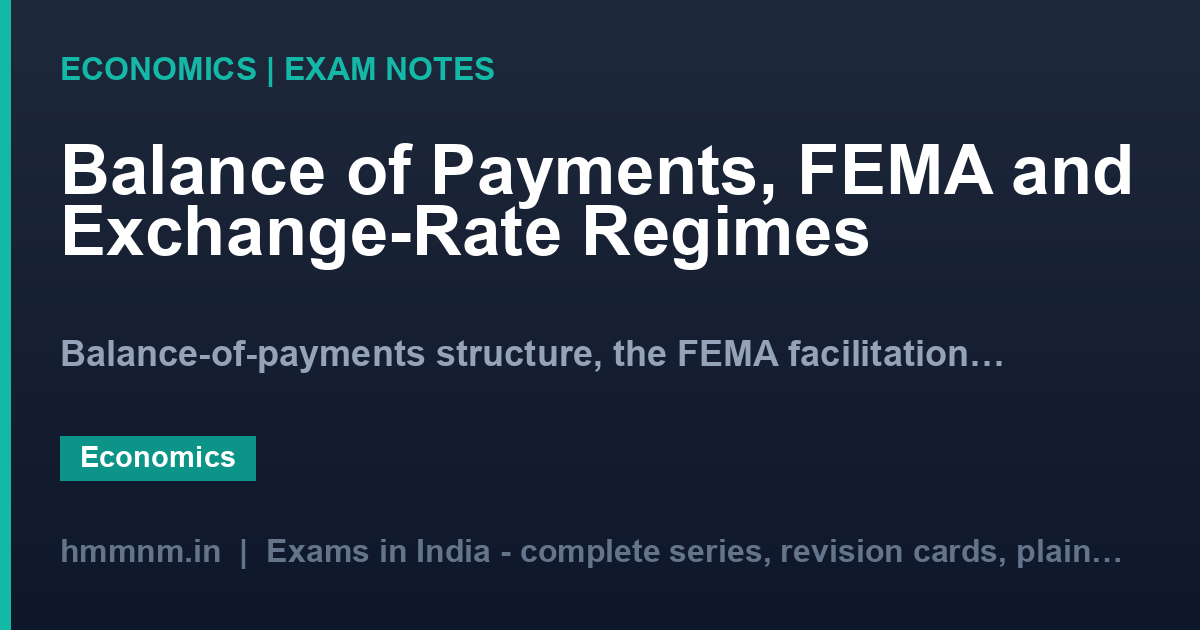
The balance of payments splits into the current account (goods, services, income, transfers) and the capital/financial account (investment flows); reserves balance the total. FEMA (1999) replaced FERA to facilitate trade and payments — civil penalties, not criminal. Exchange rates float, fix, or float managed: devaluation is official, depreciation is market-driven.
Visual Summary
- Current account — trade, services, income, transfers.
- Capital account — FDI, portfolio and loans.
- FEMA 1999 — management, facilitation; civil penalties.
- Devaluation — official; depreciation — market-driven.
The BOP Structure
The current account records visible trade (goods), invisibles (services, primary income, transfers such as remittances) — its balance is the trade balance plus net invisibles. The capital/financial account records FDI, portfolio investment, loans and banking flows. The overall BOP balances through official reserve changes; surpluses build reserves, deficits draw them down.
Regimes and the Currency Vocabulary
India runs a managed float: markets set the rupee’s rate, the RBI intervenes to smooth extremes. Devaluation is a deliberate official cut under a fixed regime; depreciation is continuous market repricing — same direction, different decision-maker. Eurocurrency is any currency banked outside its home country; the SDR is the IMF’s basket-based reserve asset (USD, euro, yuan, yen, sterling) — book money, never banknotes.
Exam Angle
NET passages test account classification (which flow goes where), FEMA’s civil character, and the devaluation-depreciation split. Practise in the UGC NET Commerce mock.
FAQ
Does a BOP deficit always mean crisis?
No — components can deficit while reserves smooth the total; sustained deficits do strain reserves.
What replaced FERA and why?
FEMA, 1999 — to facilitate external trade and payments, with civil rather than criminal penalties.
Related reading
- UPSC Economy: Complete Topic-Wise Weightage Guide and 3-Month Study Path
- National Income Explained: GDP, GNP, NNP, NDP at Factor Cost vs Market Price for UPSC Economy
Exam angle
How exams use this: Prelims tests Economy via scheme–ministry–outlay pairs, Articles and macro numbers; one confused figure costs the question. Test it under exam conditions →
Quick revision
- Current account: — trade, services, income, transfers.
- Capital account: — FDI, portfolio and loans.
- FEMA 1999: — management, facilitation; civil penalties.
- Devaluation: — official; depreciation — market-driven.
- UPSC Economy: Complete Topic-Wise Weightage Guide and 3-Month Study Path
- National Income Explained: GDP, GNP, NNP, NDP at Factor Cost vs Market Price for UPSC Economy
Have a doubt on this topic?