Quick Answer: Union Budget 2026-27 at a Glance
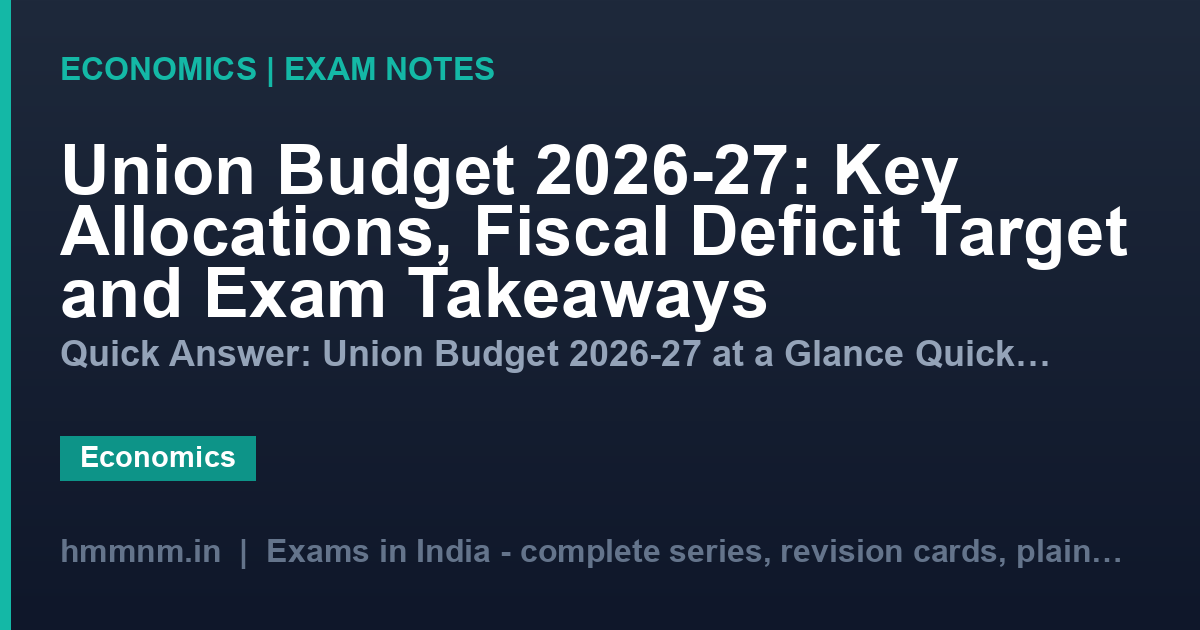
Union Budget 2026-27: Key Allocations, Fiscal Deficit Target and Exam Takeaways
Quick Answer: The Union Budget 2026-27, presented on 1 February 2026 by Finance Minister Nirmala Sitharaman, sets the fiscal deficit target at 3.5% of GDP, continuing the consolidation glide path below the FRBM-era 4.5% milestone already achieved. Total expenditure is budgeted at approximately ₹57 lakh crore, with capital expenditure of around ₹11.92 lakh crore. Defence remains the largest ministry-wise allocation at roughly ₹6.81 lakh crore, and salaried taxpayers got relief with tax-free income effectively up to ₹12.8 lakh under the new regime.
- Quick Answer: Union Budget 2026-27 at a Glance
- What Is the Union Budget and Why It Matters for Exams
- Headline Numbers: Total Expenditure, Receipts and Borrowings
- Fiscal Deficit Target and Fiscal Consolidation Path
- Sector-wise Key Allocations
- Flagship Schemes and New Announcements
- Taxation Proposals: Direct and Indirect Tax Highlights
- MCQ-worthy Facts: Dates, Names and Numbers to Memorise
- Previous Year Questions on Union Budget
- Glossary of Budget Terms for Aspirants
- Frequently Asked Questions (FAQ)
- Q: What is the fiscal deficit target in Budget 2026-27?
- Q: When was the Union Budget 2026-27 presented?
- Q: Which sector received the highest allocation in Budget 2026-27?
- Q: Is the Union Budget mentioned in the Constitution?
- Q: Which budget facts are most important for SSC and Banking exams?
- Related reading
- Fiscal deficit (BE 2026-27): 3.5% of GDP
- Total expenditure: ~₹57 lakh crore (against ₹50.65 lakh crore BE in 2025-26)
- Capital expenditure: ~₹11.92 lakh crore (up from ₹11.21 lakh crore in 2025-26)
- Defence allocation: ~₹6.81 lakh crore — highest for any ministry
- Income tax: rebate enhancement makes income up to ₹12.8 lakh tax-free for salaried taxpayers under the new regime
Note: Figures are as per the Budget at a Glance document and PIB releases; always cross-check the final numbers at indiabudget.gov.in and pib.gov.in before the exam, as Revised Estimates are updated during the year.
What Is the Union Budget and Why It Matters for Exams
The Union Budget is the government’s annual statement of estimated receipts and expenditure. Constitutionally, it is called the Annual Financial Statement under Article 112 of the Constitution, and it must be laid before both Houses of Parliament. It is not called a “Budget” anywhere in the Constitution — a classic UPSC and SSC trick question.
Do not confuse the Budget with the Economic Survey, prepared by the Chief Economic Adviser’s team in the Department of Economic Affairs and presented a day before the Budget. The Survey reviews the outgoing year; the Budget plans the incoming one.
For exam weightage: UPSC Prelims typically picks 1–2 questions on constitutional provisions, deficit figures or scheme names; SSC CGL/CHSL and Banking (IBPS/SBI, RBI Grade B) lean heavily on numeric facts — deficit percentages, tax slabs, capex and flagship scheme allocations. Since 2017, the Railway Budget has been merged with the Union Budget, another favourite MCQ point.
Headline Numbers: Total Expenditure, Receipts and Borrowings
The table below compares the headline aggregates of Budget 2026-27 with Budget 2025-26 (Budget Estimates):
| Indicator | Budget 2025-26 (BE) | Budget 2026-27 (BE) |
|---|---|---|
| Total expenditure | ₹50.65 lakh crore | ~₹57 lakh crore |
| Capital expenditure | ₹11.21 lakh crore | ~₹11.92 lakh crore |
| Fiscal deficit (% of GDP) | 4.4% | 3.5% |
| Gross tax revenue | ₹42.70 lakh crore | ~₹48 lakh crore |
| Market borrowings (net) | ₹11.69 lakh crore | moderated in line with consolidation |
Key takeaway for essays and Mains: revenue expenditure still dominates the total, but the capex share has risen steadily since 2021-22, reflecting the government’s “public capex crowd-in private investment” strategy.
Fiscal Deficit Target and Fiscal Consolidation Path
The fiscal deficit for 2026-27 is budgeted at 3.5% of GDP, a clear step down from the 4.4% budgeted for 2025-26. This matters because the government had committed, under its fiscal consolidation statement, to reach below 4.5% by 2025-26 — a target achieved, allowing further glide toward the FRBM Act’s medium-term anchor.
Context for Mains: the Fiscal Responsibility and Budget Management (FRBM) Act, 2003 originally mandated a 3% fiscal deficit. Subsequent amendments and pandemic-era suspension revised the path; the 2021-22 Budget announced the 4.5%-by-2025-26 goal. Examiners often frame questions on this glide path, so remember the sequence: pandemic peak (~9.2% in 2020-21) → 4.4% (2025-26 BE) → 3.5% (2026-27 BE).
Sector-wise Key Allocations
| Sector / Ministry | Budget 2026-27 (approx.) | Exam Point |
|---|---|---|
| Defence | ₹6.81 lakh crore | Highest ministry-wise allocation |
| Railways | ~₹2.8 lakh crore | Continued record capex push |
| Education (school + higher) | ~₹1.35 lakh crore | Watch for PM SHRI and skill missions |
| Health & Family Welfare | ~₹1.1 lakh crore | Track Ayushman Bharat expansion |
| Agriculture & allied | ~₹2 lakh crore (with PM Dhan-Dhaanya Krishi Yojana) | Focus on 100 low-productivity districts |
| Road transport & highways | ~₹2.9 lakh crore | Infrastructure spending mainstay |
Exact ministry-wise figures change with supplementary demands; treat the above as Budget Estimate magnitudes and verify against the Expenditure Profile on indiabudget.gov.in.
Flagship Schemes and New Announcements
- PM Dhan-Dhaanya Krishi Yojana — announced in Budget 2025-26 and funded through 2026-27; targets 100 districts with low agricultural productivity.
- Ayushman Bharat (PM-JAY) — expanded coverage up to ₹10 lakh per family for eligible senior citizens aged 70+, a first-of-its-kind move.
- PM Surya Ghar: Muft Bijli Yojana — rooftop solar for households continues as a marquee energy-transition scheme.
- Capex-linked interest-free loans to states — the 50-year interest-free loan mechanism continues, incentivising state-level infrastructure.
- Nuclear energy mission — announced in 2025 with ₹20,000 crore outlay for Bharat Small Reactors; allocations carry into 2026-27.
- Centre of Excellence in AI for Education — ₹500 crore allocation signalled in the previous Budget, part of the AI-in-governance push.
Taxation Proposals: Direct and Indirect Tax Highlights
Direct tax: The Finance Act following Budget 2025-26 had already overhauled the new regime slabs (zero tax up to ₹12 lakh via Section 87A rebate). Budget 2026-27 extended relief to salaried taxpayers, with rebate enhancement making income up to ₹12.8 lakh effectively tax-free after the standard deduction. The new regime is now the default; the old regime survives only for those who opt in.
Indirect tax: Key GST and customs points relevant for Banking and SSC exams:
- Life insurance policies served outside India and reinsurance services (including in IFSC offices) exempted from GST — a widely tested new exemption.
- The two-slab GST structure (5% and 18%) agreed in September 2025 took effect from 22 September 2025 — expect MCQs on the slab count and effective date.
- Basic customs duty rationalisation continued on electronics components and critical minerals to support domestic manufacturing.
- TCS (tax collected at source) thresholds on remittances under the LRS and education loans were eased from 1 April 2025.
MCQ-worthy Facts: Dates, Names and Numbers to Memorise
- Budget 2026-27 presented on 1 February 2026 by Nirmala Sitharaman — her ninth consecutive Budget.
- Constitutional name: Annual Financial Statement — Article 112.
- Fiscal deficit target: 3.5% of GDP.
- FRBM Act enacted in 2003.
- Railway Budget merged with Union Budget since 2017; the date of presentation moved to 1 February from 2017.
- GST came into force on 1 July 2017; new two-slab structure effective 22 September 2025.
- First Budget of independent India: R.K. Shanmukham Chetty, 26 November 1947.
- Defence: highest allocation at roughly ₹6.81 lakh crore.
- Economic Survey is presented a day before the Budget and authored by the office of the Chief Economic Adviser.
Previous Year Questions on Union Budget
UPSC Prelims frames budget questions conceptually rather than numerically — e.g., asking which Article governs the Annual Financial Statement, the difference between appropriation and expenditure charged on the Consolidated Fund, or the constitutional position of the CEA. SSC and Banking papers, by contrast, ask direct facts: who presented the Budget, the fiscal deficit percentage, GST slab changes and flagship scheme names. The safe strategy: memorise constitutional provisions (Articles 112, 110, 265, 266, 292) for UPSC, and the year’s headline numbers for SSC/Banking.
Glossary of Budget Terms for Aspirants
| Term | Plain-English Meaning |
|---|---|
| Fiscal deficit | Total expenditure minus total receipts excluding borrowings — how much the government must borrow. |
| Capital expenditure | Spending that creates assets — roads, railways, buildings; boosts growth capacity. |
| Cess | A tax levied for a specific purpose; proceeds must be used for that purpose (needs no sharing with states). |
| Appropriation Bill | Authorises withdrawal of money from the Consolidated Fund for voted expenditure. |
| Finance Bill | Introduces or changes tax proposals; must be passed for the Budget’s tax changes to take effect. |
| Consolidated Fund of India | Article 266(1) fund holding all government receipts; withdrawals need parliamentary approval. |
Frequently Asked Questions (FAQ)
Q: What is the fiscal deficit target in Budget 2026-27?
The fiscal deficit is budgeted at 3.5% of GDP for 2026-27, as announced in the Budget documents and PIB’s Budget highlights — a step down from 4.4% in 2025-26, confirming continued fiscal consolidation.
Q: When was the Union Budget 2026-27 presented?
On 1 February 2026, following the convention in place since 2017, by Finance Minister Nirmala Sitharaman.
Q: Which sector received the highest allocation in Budget 2026-27?
The Ministry of Defence, with an allocation of approximately ₹6.81 lakh crore per the Budget at a Glance and Expenditure Profile documents — the largest ministry-wise allocation.
Q: Is the Union Budget mentioned in the Constitution?
The word “Budget” does not appear, but Article 112 requires the President to cause the Annual Financial Statement to be laid before Parliament — this is the constitutional form of the Union Budget.
Q: Which budget facts are most important for SSC and Banking exams?
- Fiscal deficit: 3.5% of GDP (2026-27 BE)
- Capex: ~₹11.92 lakh crore
- Tax-free income for salaried: up to ₹12.8 lakh (new regime)
- GST slabs: 5% and 18% (from 22 September 2025)
- Defence: ~₹6.81 lakh crore; Article 112; FRBM Act 2003
Sources: Union Budget documents (indiabudget.gov.in), Press Information Bureau, and Reserve Bank of India. Verify final numbers against official documents before your exam.
Related reading
- Types of Budget Explained: Revenue vs Capital, Balanced, Deficit, Surplus & Zero-Based Budgeting for UPSC & SSC
- Monetary Policy Committee Explained: Repo Rate, MPC Members and Inflation Targeting for Bank Exams
Quick revision
- Total expenditure: ~₹57 lakh crore (against ₹50.65 lakh crore BE in 2025-26)
- Capital expenditure: ~₹11.92 lakh crore (up from ₹11.21 lakh crore in 2025-26)
- Defence allocation: ~₹6.81 lakh crore — highest for any ministry
- Income tax: rebate enhancement makes income up to ₹12.8 lakh tax-free for salaried taxpayers under the new regime
- PM Dhan-Dhaanya Krishi Yojana: — announced in Budget 2025-26 and funded through 2026-27; targets 100 districts with low agricultural productivity.
- Ayushman Bharat (PM-JAY): — expanded coverage up to ₹10 lakh per family for eligible senior citizens aged 70+, a first-of-its-kind move.
Have a doubt on this topic?
Related explainers
Saturday Budget Special Quiz: 15 Economy & Budget MCQs in 12 Minutes (with Timer Targets)
National Income Aggregates Explained: GDP, GNP, NNP, PCI at Factor Cost vs Market Price for UPSC & SSC Exams