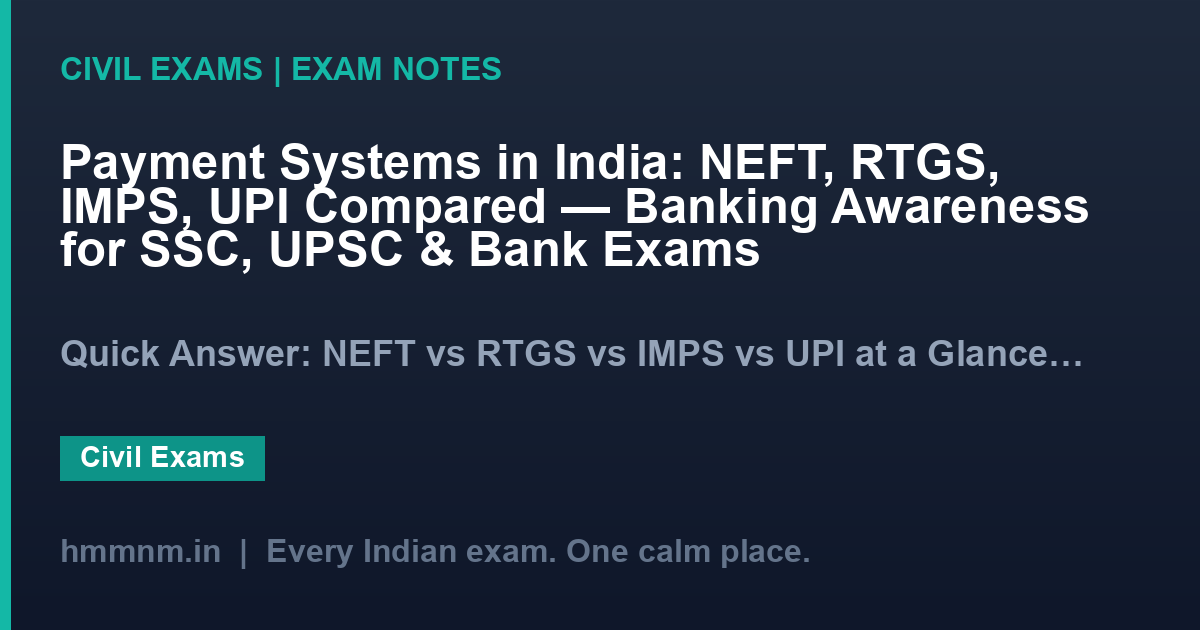
Quick Answer: NEFT vs RTGS vs IMPS vs UPI at a Glance
Payment Systems in India: NEFT, RTGS, IMPS and UPI Compared
Quick Answer: NEFT and RTGS are operated by the RBI, while IMPS and UPI are run by NPCI. NEFT settles in half-hourly batches 24×7 with no minimum limit; RTGS settles instantly and individually with a minimum of Rs 2 lakh, making it the choice for large-value transfers. IMPS offers instant 24×7 transfers up to Rs 5 lakh, and UPI — India’s most used system — caps most transactions at Rs 1 lakh per day.
- Quick Answer: NEFT vs RTGS vs IMPS vs UPI at a Glance
- Why Payment Systems Matter in Competitive Exams
- NEFT (National Electronic Funds Transfer): Full Overview
- RTGS (Real Time Gross Settlement): Full Overview
- IMPS (Immediate Payment Service): Full Overview
- UPI (Unified Payments Interface): Full Overview
- Master Comparison Table: Timings, Limits, Settlement and Operators
- Key Differences: Settlement Mechanism Explained in Plain English
- RBI’s Payment and Settlement Systems Vision Documents
- Which Exam Asks What: PYQ Patterns and Expected Questions
- Memory Tricks and One-Liner Facts for Revision
- Practice MCQs on Indian Payment Systems
- Frequently Asked Questions
- Q: What is the minimum amount for RTGS transfer?
- Q: Is NEFT available 24×7?
- Q: What is the UPI transaction limit per day?
- Q: Who operates IMPS and UPI?
- Q: What does RBI’s Payments Vision 2025 focus on?
- Related reading
| Feature | NEFT | RTGS | IMPS | UPI |
|---|---|---|---|---|
| Full form | National Electronic Funds Transfer | Real Time Gross Settlement | Immediate Payment Service | Unified Payments Interface |
| Operator | RBI | RBI | NPCI | NPCI |
| Launch | 2005 (as SSIs 2000) | 2004 | 2010 | 2016 |
| Availability | 24×7 since 16 Dec 2019 | 24×7 since 14 Dec 2020 | 24×7 since launch | 24×7 since launch |
| Minimum | None | Rs 2 lakh | None | None |
| Limit (per txn) | No RBI cap (bank-set) | No RBI cap | Rs 5 lakh | Rs 1 lakh (Rs 5 lakh for hospitals, education, insurance) |
| Settlement | Deferred net (half-hourly batches) | Real-time, gross, individual | Instant retail clearing | Instant retail clearing |
Why Payment Systems Matter in Competitive Exams
Payment systems in India — NEFT, RTGS, IMPS and UPI — form one of the most reliably repeated segments of Banking Awareness and financial current affairs. IBPS PO, SBI PO, RBI Grade B and IBPS Clerk papers regularly test operators, limits and timings. SSC CGL and CHSL GK sections ask who runs UPI and the RTGS minimum. UPSC Prelims Economy questions have touched digital payments trends and the RBI’s Vision documents, while CLAT current affairs papers have referenced UPI’s global expansion. One well-made comparison table covers nearly all of it.
NEFT (National Electronic Funds Transfer): Full Overview
- Operated by the Reserve Bank of India; launched in its current form in 2005 (evolved from the Special Electronic Funds Transfer system of 2000).
- Available 24x7x365 since 16 December 2019 — India was among the first countries to make a national electronic funds transfer system round-the-clock.
- Transactions are settled in 48 half-hourly batches every day — a deferred net settlement (DNS) mechanism.
- No minimum or maximum limit set by RBI; individual banks impose their own caps.
- One unique feature: transfers can be initiated even without a bank account (cash-based remittance through bank branches, subject to limits).
- No charges for online NEFT transfers by retail customers as per RBI’s current stance.
RTGS (Real Time Gross Settlement): Full Overview
- Launched on 26 March 2004 and operated by the RBI.
- “Real time” means settlement happens immediately, instruction by instruction; “gross” means each transaction is settled individually, without netting against others.
- Minimum amount: Rs 2 lakh. RBI sets no upper ceiling.
- Available 24x7x365 since 14 December 2020 — a global first for a country-wide RTGS system.
- Settlement occurs in the RBI’s books, so it carries finality and irrevocability — ideal for large-value, time-critical transfers such as property payments, business settlements and interbank trades.
IMPS (Immediate Payment Service): Full Overview
- Run by the National Payments Corporation of India (NPCI), launched in 2010 on the Mobile Payment Gateway model piloted by NPCI.
- Provides instant, 24×7 interbank electronic fund transfer through mobile phones, internet banking and ATMs.
- Current transaction limit: Rs 5 lakh per transaction.
- Pioneered the use of MMID (Mobile Money Identifier) and mobile number + MMID transfers, alongside account + IFSC transfers.
- Before UPI’s rise, IMPS was India’s flagship instant retail payment channel; it remains important for exam purposes.
UPI (Unified Payments Interface): Full Overview
- Built and operated by NPCI, launched in April 2016 under then-RBI Governor Raghuram Rajan’s initiative, with banks rolling out apps from August 2016.
- Instant, 24×7, mobile-first payment system that allows transferring money using a Virtual Payment Address (VPA/UPI ID) without sharing bank details.
- General cap: Rs 1 lakh per day; the cap rises to Rs 5 lakh for payments to hospitals, educational institutions and insurance (per NPCI circulars effective 2023–24).
- UPI has crossed well over 10 billion transactions a month (RBI/NPCI data, 2023 onwards) — a world-leading figure.
- International linkages: UPI-PayNow (Singapore, 2023), NPCI International partnerships for UPI acceptance in UAE, Singapore, France, Sri Lanka, Mauritius, Nepal and Bhutan.
Master Comparison Table: Timings, Limits, Settlement and Operators
| Point | NEFT | RTGS | IMPS | UPI |
|---|---|---|---|---|
| Operator | RBI | RBI | NPCI | NPCI |
| Year launched | 2005 | 2004 | 2010 | 2016 |
| 24×7 since | Dec 2019 | Dec 2020 | 2010 | 2016 |
| Minimum amount | No minimum | Rs 2 lakh | No minimum | No minimum |
| Upper limit | Bank-decided | No RBI ceiling | Rs 5 lakh | Rs 1 lakh/day (Rs 5 lakh for hospitals, education, insurance) |
| Settlement mode | Half-hourly batches (net) | Real-time, gross | Instant | Instant |
| Best suited for | Regular retail transfers | Large-value transfers | Instant smaller transfers | Everyday retail payments |
Key Differences: Settlement Mechanism Explained in Plain English
Think of the three mechanisms as three ways of clearing a queue:
- NEFT — deferred net settlement: transactions are collected and settled together in half-hourly batches, with debits and credits netted off. Cheaper and efficient, but not instant.
- RTGS — real-time gross settlement: each transaction is settled the moment it is processed, one by one, in the RBI’s books. No waiting, no netting — hence the Rs 2 lakh minimum to justify the cost of instant individual settlement.
- IMPS/UPI — instant retail clearing: these are instant message-routing systems for retail payments where funds move within seconds via NPCI’s switching infrastructure, typically with comparatively smaller limits than RTGS.
So for the exam question “which system for large-value transfers?” — the answer is RTGS, because real-time gross settlement gives immediate finality for high-value, urgent payments.
RBI’s Payment and Settlement Systems Vision Documents
- Vision 2019–21 (“Payment and Settlement Systems in India: Vision 2019–2021”): theme “Empowering Exceptional (E)payment Experience” — goals included moving toward a cashless society, “anytime, anywhere” payments, customer trust and affordability.
- Payments Vision 2025 (released June 2022): central theme “E-Payments for Everyone, Everywhere, Everytime” (“E-Payments for All”). Key focus areas — UPI lite, CBDC (Digital Rupee), contactless payments, fintech innovation, cyber-security, and the target of 3,000 digital payment transactions per capita per year.
- The Digital Rupee (e₹) pilot launched in November 2022 (wholesale) and December 2022 (retail) flows directly from Vision 2025.
Verify current details on the RBI’s official payments portal: rbi.org.in; NPCI system details at npci.org.in.
Which Exam Asks What: PYQ Patterns and Expected Questions
- IBPS/SBI/RBI: operators of each system, RTGS minimum, IMPS limit, UPI caps, Vision 2025 theme, charges on NEFT/RTGS.
- SSC (CGL/CHSL/MTS): “UPI is operated by?” (NPCI), “RTGS minimum amount?” (Rs 2 lakh), “NEFT 24×7 since?” (Dec 2019).
- UPSC: economy questions on digital payments growth, CBDC, cashless economy initiatives — less on limits, more on policy and Vision documents.
- CLAT: current-affairs items like UPI’s international expansion and UPI-PayNow linkage.
- CAT GK / SNAP / CMAT: one-liner facts — launch years, full forms, operators.
Memory Tricks and One-Liner Facts for Revision
- Mnemonic “2-5-1”: RTGS minimum 2 lakh, IMPS max 5 lakh, UPI general cap 1 lakh per day.
- “RBI does the big two”: NEFT and RTGS (R-governed); “NPCI does the new two”: IMPS and UPI.
- December duo: NEFT went 24×7 in Dec 2019; RTGS followed in Dec 2020.
- RTGS = Real, Gross, 2 lakh+; NEFT = _batches (Batch = NEFT).
- UPI launched 2016; IMPS 2010; RTGS 2004; NEFT 2005.
- UPI higher cap of Rs 5 lakh applies to hospitals, education and insurance.
- Vision 2025 theme: “E-Payments for Everyone, Everywhere, Everytime”; target 3,000 digital transactions per person per year.
Practice MCQs on Indian Payment Systems
Q1. Which payment system has a minimum transaction amount of Rs 2 lakh?
(a) NEFT (b) IMPS (c) RTGS (d) UPI
Answer: (c) RTGS
Q2. UPI was launched in which year and by whom?
(a) 2010, RBI (b) 2016, NPCI (c) 2016, RBI (d) 2019, NPCI
Answer: (b) 2016, NPCI
Q3. NEFT settlements occur in:
(a) Real time, individually (b) Instant via mobile (c) Half-hourly batches (d) Daily batches
Answer: (c) Half-hourly batches
Q4. The general UPI per-day transaction cap is:
(a) Rs 50,000 (b) Rs 1 lakh (c) Rs 2 lakh (d) Rs 5 lakh
Answer: (b) Rs 1 lakh (Rs 5 lakh for hospitals, educational institutions and insurance)
Q5. The theme of RBI’s Payments Vision 2025 is:
(a) Cashless India (b) E-Payments for Everyone, Everywhere, Everytime (c) Digital for All (d) One Nation One Payment
Answer: (b) E-Payments for Everyone, Everywhere, Everytime
Frequently Asked Questions
Q: What is the minimum amount for RTGS transfer?
The minimum amount for an RTGS transfer is Rs 2 lakh per transaction. RBI has set no upper ceiling for RTGS, which is why it is used for large-value transfers.
Q: Is NEFT available 24×7?
Yes. NEFT has been available 24x7x365 since 16 December 2019, with settlements processed in half-hourly batches throughout the day.
Q: What is the UPI transaction limit per day?
The general UPI cap is Rs 1 lakh per day. For payments to hospitals, educational institutions and insurance, the cap is enhanced to Rs 5 lakh. Banks may set lower limits.
Q: Who operates IMPS and UPI?
Both IMPS and UPI are operated by NPCI (National Payments Corporation of India). NEFT and RTGS are operated by the RBI.
Q: What does RBI’s Payments Vision 2025 focus on?
Its theme is “E-Payments for Everyone, Everywhere, Everytime” (E-Payments for All), with targets including 3,000 digital payment transactions per capita per year, UPI Lite, the Digital Rupee (CBDC), contactless payments and stronger cyber-security.
Related reading
- Internal Security Part 9: Radicalisation Online and the CVE Playbook
- Ancient India Daily: The Mauryan Empire – Rulers, Sources and Ashoka in One Page
Quick revision
- Operated by the Reserve Bank of India; launched in its current form in 2005 (evolved from the Special Electronic Funds Transfer system of 2000).
- Available 24x7x365 since 16 December 2019 — India was among the first countries to make a national electronic funds transfer system round-the-clock.
- Transactions are settled in 48 half-hourly batches every day — a deferred net settlement (DNS) mechanism.
- No minimum or maximum limit: set by RBI; individual banks impose their own caps.
- One unique feature: transfers can be initiated even without a bank account (cash-based remittance through bank branches, subject to limits).
- No charges for online NEFT transfers by retail customers as per RBI’s current stance.
Have a doubt on this topic?