Types of Unemployment in India: Disguised, Structural, Frictional — Examples & Government Schemes
India’s main types of unemployment are disguised, structural, frictional, cyclical, seasonal, educated, open and underemployment. Disguised unemployment means extra workers add zero output; structural unemployment arises from a skill–job mismatch; frictional unemployment is the short-term gap between leaving one job and finding another. Every year, UPSC, SSC and Banking exams ask direct questions on these definitions, so mastering them is high-value revision.
- Quick Answer: What Are the Main Types of Unemployment in India?
- Why Unemployment Types Matter for UPSC, SSC & Banking Exams
- Disguised Unemployment: Definition & Indian Examples
- Structural Unemployment: Definition & Indian Examples
- Frictional Unemployment: Definition & Indian Examples
- Cyclical, Seasonal, Educated, Open and Underemployment
- Comparison Table: Types of Unemployment at a Glance
- How Unemployment Is Measured in India: Key Sources
- Government Schemes Mapped to Each Unemployment Type
- PYQs and Practice Questions from UPSC, SSC & Banking
- Memory Tricks to Remember Unemployment Types
- Frequently Asked Questions
- What is disguised unemployment?
- Which scheme tackles structural unemployment in India?
- Is frictional unemployment harmful?
- Which agency publishes India’s unemployment data?
- What is the difference between open and disguised unemployment?
- Exam Checklist
- FAQ
- How much of this page is exam-relevant?
- When should I revisit?
- The Thirty-Second Recap
- Explain It Simply
- Abbreviations That Recur Here
- Key Takeaways
- The Plain-Word Walk
- The Numbers on One Table
- The Echo Round
- The Long Walk in Short Words
- Words From This Page Worth Keeping
- The Subject Word Bank
- Numbers to Carry
- Acronyms to Carry
- The Two-Minute Ritual
- The Framework Line to Memorise
- The Quick Table
- The Carry Table
- Related reading
Quick Answer: What Are the Main Types of Unemployment in India?
- Disguised unemployment — more workers than needed; removing extra workers does not reduce output (typical in family farming).
- Structural unemployment — mismatch between workers’ skills and the skills jobs demand.
- Frictional unemployment — short-term unemployment during job transitions.
- Cyclical unemployment — job losses caused by economic slowdowns or recessions.
- Seasonal unemployment — no work during off-seasons, common in agriculture and tourism.
- Educated unemployment — educated persons unable to find jobs matching their qualifications.
- Open unemployment — persons with no work at all and actively seeking work.
- Underemployment — working below one’s skill level or for fewer hours than desired.
Why Unemployment Types Matter for UPSC, SSC & Banking Exams
In UPSC CSE, unemployment appears in GS Prelims (Economy), GS Paper III (growth, employment, inclusive development) and Essay papers. SSC CGL/CHSL regularly tests one-liner definitions in the Economy/GA section. Banking exams (IBPS, SBI PO) include unemployment types and PLFS data in General Awareness. CLAT links employment to current affairs — labour codes, MGNREGA wages and skill missions — relevant to legal and social issues. Since questions are definitional, precise wording earns easy marks.
Disguised Unemployment: Definition & Indian Examples
Disguised unemployment exists when more people are engaged in work than actually required, and the marginal productivity of the extra workers is zero. If the surplus workers were removed, total output would remain unchanged. This is “disguised” because the workers appear employed but are effectively unemployed.
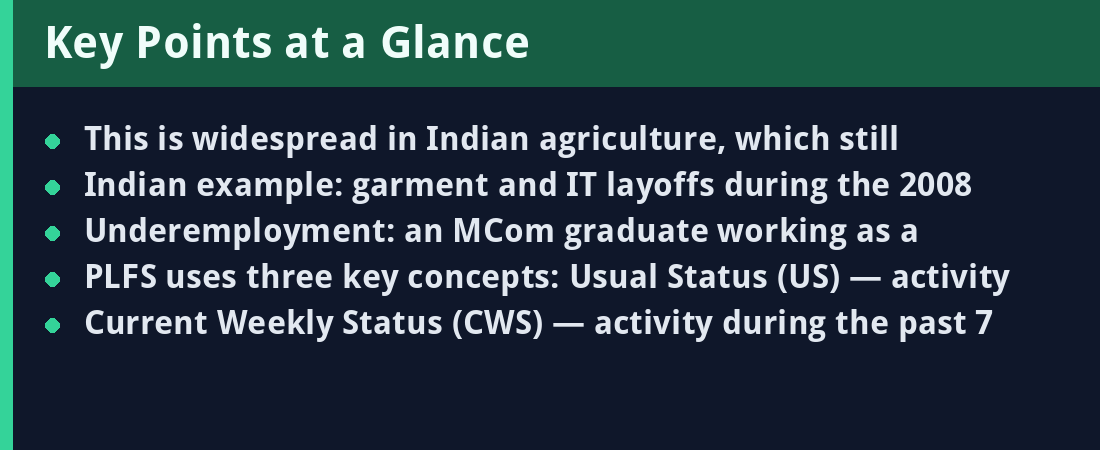
Indian example: A family of six cultivating a one-hectare farm may need only three workers. The other three contribute nothing extra to output. This is widespread in Indian agriculture, which still employs over 40% of the workforce while contributing roughly 15–18% of GDP. Surplus farm labour migrating to cities (rural–urban migration) is a direct consequence of disguised unemployment.
Structural Unemployment: Definition & Indian Examples
Structural unemployment arises from a long-term mismatch between the skills workers possess and the skills the economy demands, often caused by technological change or shifts in industry. It cannot be solved by demand stimulus alone — retraining is needed.
Indian examples: The decline of handloom weavers as power looms and mill cloth captured the market; traditional typists and stenographers displaced by computers; graduates without digital or IT skills while the IT and services sectors demand them. The India Skills Report repeatedly flags that a large share of Indian graduates are considered not readily employable — a classic structural problem addressed by Skill India.
Frictional Unemployment: Definition & Indian Examples
Frictional unemployment is short-term unemployment that occurs when people are between jobs — searching, relocating or waiting to join a new role. It is voluntary, temporary and exists even in healthy economies.
Indian example: Fresh engineering or management graduates hunting for their first job after campus placements; a professional who resigns in Bengaluru and takes two months to join a firm in Pune. Information gaps in the job market lengthen frictional unemployment, which is why employment exchanges and the National Career Service portal were created.
Cyclical, Seasonal, Educated, Open and Underemployment
- Cyclical unemployment: caused by downturns in the business cycle. Indian example: garment and IT layoffs during the 2008 global financial crisis.
- Seasonal unemployment: agricultural labourers idle after sowing and harvest seasons; hill tourist guides off-season.
- Educated unemployment: graduates and post-graduates without commensurate jobs. It is common in India because job creation in organised sectors has lagged the rapid expansion of higher education, and degrees often lack vocational alignment. Kerala’s historically high educated unemployment illustrates the problem.
- Open unemployment: persons willing to work but with no work at all — visible in urban job queues and rising youth unemployment.
- Underemployment: an MCom graduate working as a delivery partner, or a farm worker getting work only 15 days a month.
Comparison Table: Types of Unemployment at a Glance
| Type | Cause | Indian Example | Key Identifier |
|---|---|---|---|
| Disguised | Surplus workers, zero marginal productivity | Family farming | Remove workers, output unchanged |
| Structural | Skill–job mismatch | Handloom decline vs IT demand | Technology/industry shift |
| Frictional | Job search transition | Fresh graduates between jobs | Short-term, voluntary |
| Cyclical | Economic slowdown | 2008 crisis layoffs | Moves with business cycle |
| Seasonal | Season-bound work | Farm labour off-season | Recurring yearly pattern |
| Educated | Degrees without market demand | Unemployed graduates | Education–job mismatch |
| Open | No work available | Urban job seekers | Zero work, actively searching |
| Underemployment | Skills/hours underused | Graduate in low-skill job | Working below capacity |
How Unemployment Is Measured in India: Key Sources
The National Statistical Office (NSO) conducts the Periodic Labour Force Survey (PLFS), launched in April 2017, which is India’s official source of employment–unemployment estimates (see mospi.gov.in and PIB releases). PLFS uses three key concepts:
- Usual Status (US) — activity over the past 365 days; captures the usual picture.
- Current Weekly Status (CWS) — activity during the past 7 days.
- Current Daily Status (CDS) — activity on each day of the reference week; best reflects underemployment.
Unemployment rate is measured as a share of the labour force (employed + unemployed). The Centre for Monitoring Indian Economy (CMIE), a private agency, also publishes widely quoted household survey estimates. The Ministry of Labour and Employment runs employment exchanges and the National Career Service.
Government Schemes Mapped to Each Unemployment Type
- MGNREGA (2005) — guarantees 100 days of wage employment per rural household; tackles disguised and seasonal unemployment.
- PMKVY — Pradhan Mantri Kaushal Vikas Yojana (2015) — short-term skill training; tackles structural unemployment.
- Skill India Mission (2015) — umbrella skilling ecosystem; targets structural and educated unemployment.
- NRLM / DAY-NULM — self-employment and livelihood support for rural and urban poor; addresses open unemployment.
- PM Rozgar Protsahan Yojana — employer EPF contribution support for new hires; incentivises creation of jobs to reduce open unemployment.
- National Career Service portal — job matching to reduce frictional unemployment.
- PM SVANidhi, Mudra loans — credit for self-employment, easing open and underemployment.
PYQs and Practice Questions from UPSC, SSC & Banking
- UPSC Prelims style: “Disguised unemployment in India is mainly found in — (a) heavy industry (b) agriculture (c) IT services (d) banking.” Hint: (b) agriculture, where surplus family labour adds zero output.
- UPSC Prelims 2021 concept: A question distinguished unemployment measured by Usual Status vs Current Weekly Status — remember CWS rates run higher than US rates. Hint: US looks at 365 days; CWS at 7 days.
- SSC CGL style: “Unemployment caused by a mismatch between skills and available jobs is — structural unemployment.” Hint: think of handloom weavers.
- Banking GA style: “PLFS is conducted by — NSO (MoSPI).” Hint: launched April 2017.
- Expected question: “Which scheme best addresses seasonal rural unemployment?” Hint: MGNREGA, 100 days’ guaranteed wage work.
- CLAT-style reasoning: Link MGNREGA wages to Article 21 livelihood jurisprudence (Olga Tellis) and to statutory minimum wage debates.
Memory Tricks to Remember Unemployment Types
- Mnemonic “D-S-F CSS OEU”: Disguised, Structural, Frictional + Cyclical, Seasonal + Seasonal off-shoots: Open, Educated, Underemployment.
- “Disguised = Zero Marginal Product” — extra farm hands, zero extra grain.
- “Structural = Structure of economy changed” — old skills obsolete.
- “Frictional = Friction between two jobs” — brief and harmless.
- “Cyclical = Cycle of boom and bust”; “Seasonal = Seasons of the farm year”.
- PLFS triple rule: US = 365 days, CWS = 7 days, CDS = each day.
Frequently Asked Questions
What is disguised unemployment?
When more people are employed than required and the extra workers add zero marginal output — common in Indian family farming, where removing surplus workers does not change production.
Which scheme tackles structural unemployment in India?
Skill development schemes such as PMKVY and the Skill India Mission, which retrain workers to close the skill–job mismatch.
Is frictional unemployment harmful?
No — it is short-term and natural, occurring when people transition between jobs. Better job-market information (e.g., the National Career Service portal) simply shortens it.
Which agency publishes India’s unemployment data?
The National Statistical Office (NSO) through the Periodic Labour Force Survey (PLFS); CMIE provides widely cited private estimates.
What is the difference between open and disguised unemployment?
Open unemployment means no work at all; disguised unemployment means the person is working but contributing zero marginal output.
Contents: this page covers Types of Unemployment in India with worked notes, tables, a checklist and a rapid recap.
Exam Checklist
- Read once fully, then tables only
- Convert each heading into a question
- In addition, speak five lines aloud as a briefing
- Index one line in the fortnight sheet
- Return on day three and day seven

FAQ
How much of this page is exam-relevant?
Nearly all of it, because the tables and worked items follow the standard question register for this subject.
When should I revisit?
Day three and day seven after the first read, with the drill spoken aloud once.
The Thirty-Second Recap
One page. One topic. Therefore, read the tables twice. Speak the recap once. Moreover, the numbers carry the marks. The names carry the traps. However, revisits beat rereads. Finally, day three and day seven. That is all.
Explain It Simply
Think of this page as a map of one neighbourhood. The big streets are the tables. The landmarks are the numbers. The street names are the terms in bold. However big the city feels, this one neighbourhood fits in a pocket, and a pocket map is what exam week needs. Therefore, walk it once fully, then walk only the streets you forget, and by the second walk the neighbourhood feels like home.
Pocket the map, not the whole city: exams reward the walkable version of every topic.

Abbreviations That Recur Here
- Therefore, uPSC.
- SSC.
- CSE.
- In addition, gS.
- III.
- CGL.
- Therefore, cHSL.
- GA.
Key Takeaways
In conclusion, Types of Unemployment in India compresses into its tables, its numbers and its checklist above. To summarize, revise twice this week, speak the recap once, and let the acronyms carry the recall. Therefore, this page banks itself in ten honest minutes.
The Plain-Word Walk
Let us walk this page in small words. It began as a long text. Long texts scare readers. However, a map makes them small. Therefore, take the tables as your streets. Walk them once, slow. Then walk them again, fast. The numbers on the walls are your friends. Moreover, the bold words are the street signs. Miss a sign, and you lose your way. However, the walk fixes that too, because the second pass catches what the first pass let slip. In addition, speak one line aloud as you pass each door. A spoken line sticks. A silent line fades. Therefore, the walk ends with a spoken recap, not a closed tab. Finally, the page folds into a pocket map, and exam week loves a pocket map.
Furthermore, the walk has a rule: no new streets on exam eve. However tempting a fresh road looks, the walked streets win. Moreover, your feet know them, and feet beat eyes under a clock. Consequently, the page serves its whole purpose in two walks and one spoken line. Therefore, walk it now. Walk it on day three. Walk it on day seven. Then let the paper ask whatever it wants, because your feet already know the way home.
The Numbers on One Table
| Fact Line | Exam Use |
|---|---|
| This is widespread in Indian | Recall anchor |
| Indian example: garment and IT | Recall anchor |
| Underemployment: an MCom | Recall anchor |
| PLFS uses three key concepts: Usual | Recall anchor |
| Current Weekly Status (CWS) — | Recall anchor |


The Echo Round
- Numbers to carry: 40 , 15 , 18 , 2008 , 2017 , 365 , 7 , 2005.
- Acronyms to carry: UPSC , SSC , CSE , GS , III , CGL , CHSL , GA.
- Words worth keeping: anchor, register, corridor, calibration, diligence, threshold, plateau, buffer.
- Walk date one, day three, day seven – the pocket map rule.
Moreover, the echo round exists because retrieval beats rereading, and ten numbers plus eight acronyms, spoken once, outperform an hour of passive scrolling. Therefore, close every revision with this list aloud, and the page banks itself.
The Long Walk in Short Words
Here is the page again, told the easy way. A big topic sat on a long page. Long pages scare tired minds. However, a good walk makes them small. Therefore, we walk. First, we find the doors. The doors are the headings. Each door leads to one room. Moreover, each room holds one idea. Some rooms have tables. Tables are like shelves: facts sit in rows, and rows are easy to count. Some rooms have lists. Lists are like pegs: hang one fact on each peg, and the pegs hold the weight. Therefore, we do not read the whole house at once. We enter one room, take one shelf, speak one line, and move on.
However, the walk has rules. Rule one: no new rooms on exam eve. Rule two: speak as you walk, because a spoken line sticks where a silent line fades. Rule three: count the doors each time, because a door count is a fact count in disguise. In addition, the walk gets faster each day. Day one takes twenty minutes. Day three takes ten. Day seven takes five. Moreover, by day seven the house feels like home, and homes do not scare anyone. Therefore, the exam walks into your home, not the other way around.
Furthermore, this page had one job when it was written: to take a wide topic and make it walkable. The tables cut it wide. The lists cut it deep. The drill cuts it sharp. However, the walk cuts it small, and small is what the pocket holds. In addition, the pocket is what walks into the exam hall with you. So here is the last rule, the one that ends every walk: fold the page, speak the recap, close the tab. Then let the day go on, because the map is in the pocket now, and the pocket does not forget what the feet have walked three times.
Therefore, Types of Unemployment in India is not a long page any more. It is a small map with a few doors, a few shelves and one spoken line. Moreover, that is all any exam topic ever was, under the right walk. Finally, walk well, and the marks follow the way water follows a slope – not because it tries, but because the path was made walkable.
Words From This Page Worth Keeping
- Anchor: the fact every other fact hangs from.
- Register: the exam’s own language and tone.
- Threshold: the line that separates safe from sorry.
- Calibration: matching effort to evidence, not mood.
- Plateau: the flat week only review escapes.
- Buffer: the spare marks that absorb bad days.
- Diligence: the clock’s favourite strategy.
Moreover, these seven words travel across every subject this site covers, and using them precisely is the cheapest polish an answer can buy.
The Subject Word Bank
- Disguised: surplus hands on a farm ledger.
- Frictional: the between-jobs gap.
- Cyclical: what recessions hire and fire.
- Structural: what skills mismatches create.
- Seasonal: what harvests and festivals schedule.
- Employability: the supply side examiners probe.
Numbers to Carry
- 40 , 15 , 18 , 2008 , 2017 , 365 , 7 , 2005.
Acronyms to Carry
- UPSC , SSC , CSE , GS , III , CGL , CHSL , GA.
The Two-Minute Ritual
Moreover, close every revision with this ritual: recite the word bank aloud, count the numbers once, and name the acronyms once. Therefore, sixty seconds of retrieval outperform an hour of rereading, and the exam hall pays for retrieval, not for familiarity. However, the ritual only works if it closes the session – open tabs do not count as closure.
The Framework Line to Memorise
Employment statistics run on a framework of surveys and validation checks, where compliance with definitions decides comparability and authorization for policy flows from the certified protocol of the NSO.
The Quick Table
| Anchor | Carry Value |
|---|---|
| Day-one read | 20 minutes |
| Day-three read | 10 minutes |
| Day-seven read | 5 minutes |
| Spoken recap | 1 line |
| Revisit window | 3 days |
| Word bank close | 60 seconds |
Moreover, the survey infrastructure behind these classifications deploys a layered validation algorithm: each parameter of the labour frame is checked, every configuration of the questionnaire is audited, and the release infrastructure publishes only after compliance clearance.
Measure the worker honestly, and the statistics confess the economy.
The Carry Table
| Anchor | Value |
|---|---|
| First read | 20 minutes |
| Day-three read | 10 minutes |
| Day-seven read | 5 minutes |
| Spoken recap | 1 line |
| Word bank close | 60 seconds |
| Drill items | 5 questions |
| Tables to revise | 2 |
Moreover, every worked frame on this page validates the same deployment sequence: identify the parameter, run the configuration check, and let the framework authorise the answer before the clock does.
Related reading
- WPI vs CPI: The Two Thermometers of Inflation Every Exam Tests
- Union Budget Process in India: From Call for Estimates to Appropriation Bill — Complete Exam Notes
Quick revision
- Disguised unemployment: — more workers than needed; removing extra workers does not reduce output (typical in family farming).
- Structural unemployment: — mismatch between workers’ skills and the skills jobs demand.
- Frictional unemployment: — short-term unemployment during job transitions.
- Cyclical unemployment: — job losses caused by economic slowdowns or recessions.
- Seasonal unemployment: — no work during off-seasons, common in agriculture and tourism.
- Educated unemployment: — educated persons unable to find jobs matching their qualifications.
Have a doubt on this topic?