Socio-Religious Reform Movements of 19th Century India: Leaders, Organisations and Years Mapped for Exams
The 19th century socio-religious reform movements in India — Brahmo Samaj (1828), Arya Samaj (1875), Ramakrishna Mission (1897), Prarthana Samaj (1867), Satyashodhak Samaj (1873) and the Aligarh Movement — attacked sati, caste discrimination and women’s oppression while promoting modern education. This article maps every leader, organisation and founding year you need for UPSC, SSC and other exams.
- Quick Answer: Key Reform Movements, Leaders and Founding Years at a Glance
- Why Reform Movements Arose: Social and Religious Context
- Brahmo Samaj: Raja Ram Mohan Roy to Keshab Chandra Sen
- Arya Samaj: Swami Dayanand Saraswati (1875)
- Ramakrishna Mission: Vivekananda (1897)
- Theosophical Society: Annie Besant and Others
- Aligarh Movement: Sir Syed Ahmed Khan
- Other Reform Organisations: Prarthana Samaj, Satyashodhak Samaj, Singh Sabha, Deoband
- Reform Movements Focused on Women and Caste
- Regional Movements Quick Map: Punjab, Bengal, South India
- Memory Tricks: Mnemonics for Leader–Organisation–Year Pairs
- Previous Year-Style MCQs and One-Liner Facts
- Frequently Asked Questions
- Q: Who founded the Brahmo Samaj and when?
- Q: When was Arya Samaj founded?
- Q: What was the main objective of the Aligarh Movement?
- Q: Who founded the Ramakrishna Mission?
- Q: Which organisation did Jyotiba Phule found?
- Exam Checklist
- FAQ
- How much of this page is exam-relevant?
- When should I revisit?
- The Thirty-Second Recap
- Explain It Simply
- Abbreviations That Recur Here
- Key Takeaways
- The Plain-Word Walk
- The Numbers on One Table
- The Echo Round
- The Long Walk in Short Words
- Words From This Page Worth Keeping
- The Subject Word Bank
- Numbers to Carry
- Acronyms to Carry
- The Two-Minute Ritual
- The Framework Line to Memorise
- The Carry Table
- The Exam Frame
- The Press as Reform Engine
- Related reading
Quick Answer: Key Reform Movements, Leaders and Founding Years at a Glance
| Organisation / Movement | Founder / Leader | Year | Place |
|---|---|---|---|
| Atmiya Sabha | Raja Ram Mohan Roy | 1815 | Calcutta |
| Brahmo Sabha (later Brahmo Samaj) | Raja Ram Mohan Roy | 1828 | Calcutta |
| Darul Uloom, Deoband | Muhammad Qasim Nanotavi | 1866 | Deoband, UP |
| Prarthana Samaj | Atmaram Pandurang | 1867 | Bombay |
| Singh Sabha | Thakur Singh Sandhawalia & Giani Gyan Singh | 1873 | Amritsar |
| Satyashodhak Samaj | Jyotiba Phule | 1873 | Pune |
| Arya Samaj | Swami Dayanand Saraswati | 1875 | Bombay |
| MAO College, Aligarh | Sir Syed Ahmed Khan | 1875 | Aligarh |
| Theosophical Society | Madame Blavatsky & Henry Olcott | 1875 | New York |
| Ramakrishna Mission | Swami Vivekananda | 1897 | Belur, Calcutta |
| Aligarh Muslim University | (Upgradation of MAO College) | 1920 | Aligarh |
Why Reform Movements Arose: Social and Religious Context
Indian society in the early 19th century was marked by social evils such as sati, child marriage, polygamy, female infanticide, and rigid caste barriers that denied education and dignity to large sections of people. Women had virtually no property rights, widow remarriage was prohibited for upper castes, and superstition was widespread.
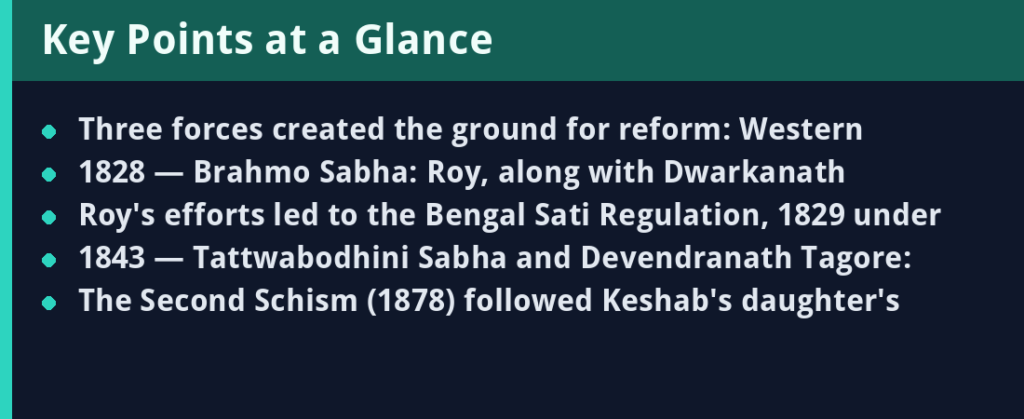
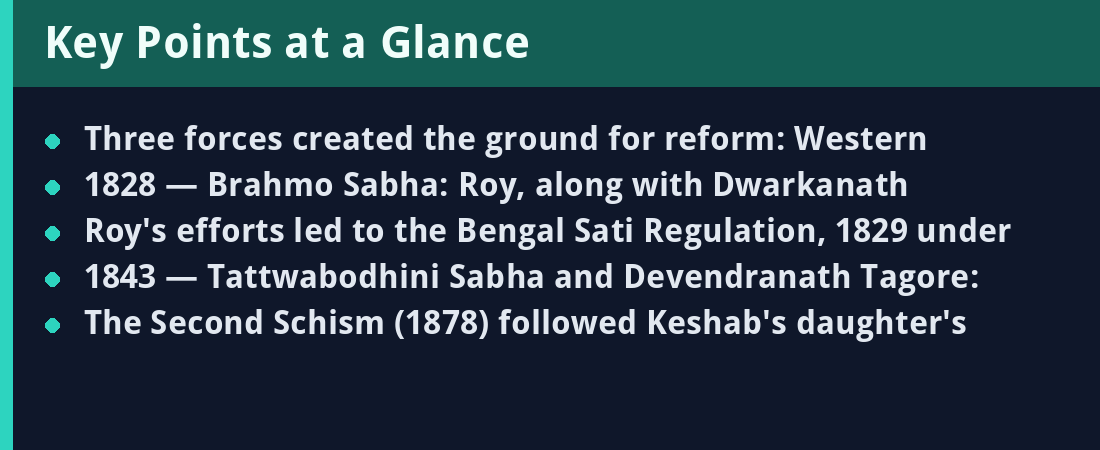
Three forces created the ground for reform:
- Western education and rationalism introduced by the British (Macaulay’s Minute, 1835; Wood’s Despatch, 1854) exposed educated Indians to liberal ideas.
- Christian missionary criticism of Hindu practices prompted Indians to reform their own religions from within.
- A rising educated middle class in Calcutta, Bombay and Madras wanted to reconcile tradition with modernity rather than reject religion altogether.
The result was a wave of reform movements that were religious in language but social in content — they used scripture to justify widow remarriage, women’s education and caste equality.
Brahmo Samaj: Raja Ram Mohan Roy to Keshab Chandra Sen
The Brahmo tradition evolved in stages:
- 1815 — Atmiya Sabha: Raja Ram Mohan Roy founded this discussion circle in Calcutta to campaign against idolatry and caste restrictions.
- 1828 — Brahmo Sabha: Roy, along with Dwarkanath Tagore, founded the Brahmo Sabha in Calcutta; it was later renamed Brahmo Samaj. It believed in monotheism, opposed idol worship and sati, and supported women’s rights. Roy’s efforts led to the Bengal Sati Regulation, 1829 under Governor-General William Bentinck.
- 1843 — Tattwabodhini Sabha and Devendranath Tagore: Maharishi Devendranath Tagore revived the organisation after Roy’s death (1833) and merged the Tattwabodhini Sabha with it in 1859.
- Keshab Chandra Sen joined in 1858 and brought energy but also division — the First Schism (1866) split the Samaj into Adi Brahmo Samaj (Devendranath) and Brahmo Samaj of India (Keshab Sen). The Second Schism (1878) followed Keshab’s daughter’s child marriage, producing the Sadharan Brahmo Samaj led by Shivnath Shastri and Ananda Mohan Bose.
Arya Samaj: Swami Dayanand Saraswati (1875)
Swami Dayanand Saraswati, born Mool Shankar in Gujarat (1824), founded the Arya Samaj in Bombay in 1875 (formally established on 10 April 1875).
Key points for exams:
- Slogan: “Back to the Vedas” — the Vedas alone are infallible.
- Rejected idol worship, caste by birth, child marriage and untouchability; supported widow remarriage and women’s education.
- The Shuddhi movement aimed at reconverting Hindus who had converted to Islam or Christianity — this became controversial in communal politics later.
- His book Satyarth Prakash (1875) expounds his views.
- The first Dayanand Anglo-Vedic (DAV) School was set up at Lahore in 1886, blending Vedic learning with modern education.
- Dayanand was the first to proclaim “Swaraj is my birthright”-type ideas — he called India “Swarajya” and urged self-rule decades before Tilak’s famous phrase.
Ramakrishna Mission: Vivekananda (1897)
Do not confuse the Ramakrishna Mission (1897) with the earlier Ramakrishna Math or the Vedanta emphasis of Ramakrishna Paramahansa himself. Swami Vivekananda founded the Ramakrishna Mission in 1897 at Belur, near Calcutta, to propagate the teachings of his guru, Sri Ramakrishna Paramahansa.
Its twin pillars are:
- Practical Vedanta — seeing God in every human being.
- Service to humanity — education, healthcare and famine relief treated as worship (“service to man is service to God”).
Vivekananda’s famous address at the World Parliament of Religions, Chicago, 1893 is a favourite exam question. The Mission was legally registered in 1909.
Theosophical Society: Annie Besant and Others
- Founded in 1875 in New York by Madame H.P. Blavatsky and Colonel Henry Steel Olcott.
- Annie Besant joined in 1889 and came to India in 1893.
- International headquarters shifted to Adyar, Madras, in 1882 (after brief spells at Bombay).
- The Society promoted study of ancient Indian religion and philosophy, and its work revived Indian self-pride. Annie Besant later founded the Central Hindu College at Banaras (1898) and became the first woman President of the Indian National Congress (1917, Calcutta session).
Aligarh Movement: Sir Syed Ahmed Khan
The Aligarh Movement, led by Sir Syed Ahmed Khan, sought the social and educational regeneration of Indian Muslims through modern, Western-style education rather than religious reform.
- Founded the Muhammadan Anglo-Oriental (MAO) College at Aligarh in 1875, modelled on Cambridge — it became Aligarh Muslim University in 1920.
- Started the Muhammadan Literary Society (1863) and the journal Tahzib-ul-Akhlaq (“Improvement of Morals”, 1870).
- Proposed the “Two-Nation Theory” in its embryonic form and urged Muslims to stay away from active politics (advice formalised after the Congress was founded in 1885).
- His book “The Causes of the Indian Revolt” (1859) argued the Revolt was not a conspiracy but a reaction to grievances.
Other Reform Organisations: Prarthana Samaj, Satyashodhak Samaj, Singh Sabha, Deoband
- Prarthana Samaj (1867): Founded in Bombay by Dr Atmaram Pandurang, inspired by Keshab Chandra Sen’s visit. Leaders included R.G. Bhandarkar and M.G. Ranade. It worked for widow remarriage, women’s education and against caste — but unlike the Brahmo Samaj, it stayed within a broadly theistic-Hindu framework and avoided open attacks on scripture.
- Satyashodhak Samaj (1873): Founded by Jyotiba Phule in Pune — “truth-seeking society” — for the uplift of lower castes and against Brahminical priestly dominance.
- Singh Sabha (1873): Sikh reform movement founded at Amritsar by Thakur Singh Sandhawalia and Giani Gyan Singh; a second Lahore Singh Sabha came in 1879 (Dyal Singh Majithia, Gurmukh Singh). It worked to purify Sikhism of caste and superstition and led to the Khalsa College, Amritsar (1892).
- Darul Uloom, Deoband (1866): Islamic seminary at Deoband, UP (Saharanpur district), founded by Muhammad Qasim Nanotavi and Rashid Ahmed Gangohi after the 1857 Revolt; aimed at preserving Islamic learning through traditional education, contrasting with Aligarh’s modernism.
Reform Movements Focused on Women and Caste
- Sati abolition — 1829: Regulation XVII by Governor-General William Bentinck, driven by Raja Ram Mohan Roy’s campaign.
- Widow Remarriage Act — 1856: Passed largely due to Ishwar Chandra Vidyasagar’s efforts; legalised widow remarriage.
- Phule’s girls’ school — 1848: Jyotiba Phule, with wife Savitribai Phule, opened a school for girls at Bhide Wada, Pune — Savitribai became India’s first female teacher of modern times.
- Pandita Ramabai: Sanskrit scholar and women’s rights campaigner; wrote Stree Dharma Neeti (The High-Caste Hindu Woman) and founded the Sharada Sadan (1889) in Bombay for widows, later moved to Poona.
- Age of Consent Act, 1891 raised the age of consent for girls from 10 to 12 (supported by Behramji Malabari’s campaign).
- Child Marriage Restraint Act (Sarda Act), 1929 extended this struggle into the next century.
Regional Movements Quick Map: Punjab, Bengal, South India
- Punjab: Arya Samaj (Lahore became its hub), Singh Sabha (1873, Amritsar), and the Radhasoami Satsang founded by Shiv Dayal Singh (Soami Ji Maharaj) in 1861 at Agra — a devotional sect emphasising inner realization.
- Bengal: Atmiya Sabha, Brahmo Samaj, Ramakrishna Mission — plus literary reformers like Vidyasagar and Bankim Chandra Chattopadhyay.
- South India: Theosophical Society at Adyar; Sri Narayana Guru of Kerala (of the Ezhava community) who founded the Araya Samaj (1927, distinct from Arya Samaj) and famously consecrated a Shiva idol at Aruvippuram (1888) declaring “one caste, one religion, one God for man”; his disciple Dr Palpu and the Sadhujana Paripalana Sangham (1913, Ayyankali) worked for Dalit rights. The Vaikom Satyagraha (1924–25) against untouchability in Travancore drew on this legacy — often asked as a 20th-century extension of 19th-century reform.
Memory Tricks: Mnemonics for Leader–Organisation–Year Pairs
- “ROY in 28, Great Debate” — Raja Ram Mohan Roy, Brahmo Sabha, 1828.
- “75 — Arya, Anglo, Adyar-move” — Arya Samaj (1875), MAO College (1875), Theosophical Society founded (1875). Three “75s”!
- “1867: Prarthana Prays in Bombay” — Prarthana Samaj, 1867.
- “Phule 73 = Satya + Shodh” — Jyotiba Phule, Satyashodhak Samaj, 1873 — same year as Singh Sabha (“73 = Phule & Punjab”).
- “Vivekananda 97 = Belur” — 1897, Belur Math.
- “Besant in 89” — Annie Besant joined Theosophical Society in 1889.
- “Deoband 66 after 1857-9” — founded 1866, after the Revolt.
Previous Year-Style MCQs and One-Liner Facts
Q1. Who founded the Brahmo Sabha in 1828?
(a) Devendranath Tagore (b) Raja Ram Mohan Roy (c) Keshab Chandra Sen (d) Dwarkanath Tagore
Answer: (b) — Raja Ram Mohan Roy, Calcutta, 1828.
Q2. The Arya Samaj was founded in 1875 at:
(a) Lahore (b) Calcutta (c) Bombay (d) Pune
Answer: (c) — Bombay, by Swami Dayanand Saraswati.
Q3. The Satyashodhak Samaj was founded in 1873 by:
(a) Jyotiba Phule (b) Gopal Krishna Gokhale (c) M.G. Ranade (d) B.R. Ambedkar
Answer: (a)
Q4. The Ramakrishna Mission was founded in:
(a) 1893 (b) 1897 (c) 1886 (d) 1901
Answer: (b) — 1897, Belur, by Swami Vivekananda.
Q5. The Theosophical Society was founded in 1875 in New York by:
Answer: Madame H.P. Blavatsky and Colonel Henry Steel Olcott.
One-liners for rapid revision:
- In addition, sati abolished — 1829 (Bentinck + Roy).
- Widow Remarriage Act — 1856 (Vidyasagar).
- First girls’ school — 1848, Pune, Jyotiba & Savitribai Phule.
- Therefore, sharada Sadan — 1889, Pandita Ramabai.
- Satyarth Prakash — 1875, Dayanand Saraswati.
- MAO College — 1875; AMU — 1920.
- In addition, vivekananda at Chicago Parliament of Religions — 1893.
For authoritative reference, aspirants can consult NCERT’s “Modern India” and the NCERT textbook portal, plus PIB releases on anniversaries of these reformers for verified dates and government schemes named after them.
Frequently Asked Questions
Q: Who founded the Brahmo Samaj and when?
Raja Ram Mohan Roy founded the Brahmo Sabha in 1828 in Calcutta, which was later renamed the Brahmo Samaj.
Q: When was Arya Samaj founded?
1875 in Bombay by Swami Dayanand Saraswati, with the slogan “Back to the Vedas”.
Q: What was the main objective of the Aligarh Movement?
Sir Syed Ahmed Khan promoted modern, Western-style education among Muslims and founded the Muhammadan Anglo-Oriental College at Aligarh in 1875 (which became AMU in 1920).
Q: Who founded the Ramakrishna Mission?
Swami Vivekananda in 1897 at Belur, based on the teachings of Ramakrishna Paramahansa.
Q: Which organisation did Jyotiba Phule found?
The Satyashodhak Samaj in 1873, for the upliftment of lower castes and opposition to priestly dominance.
Contents: this page covers Socio-Religious Reform Movements of 19th Century India with worked notes, tables, a checklist and a rapid recap.
Exam Checklist
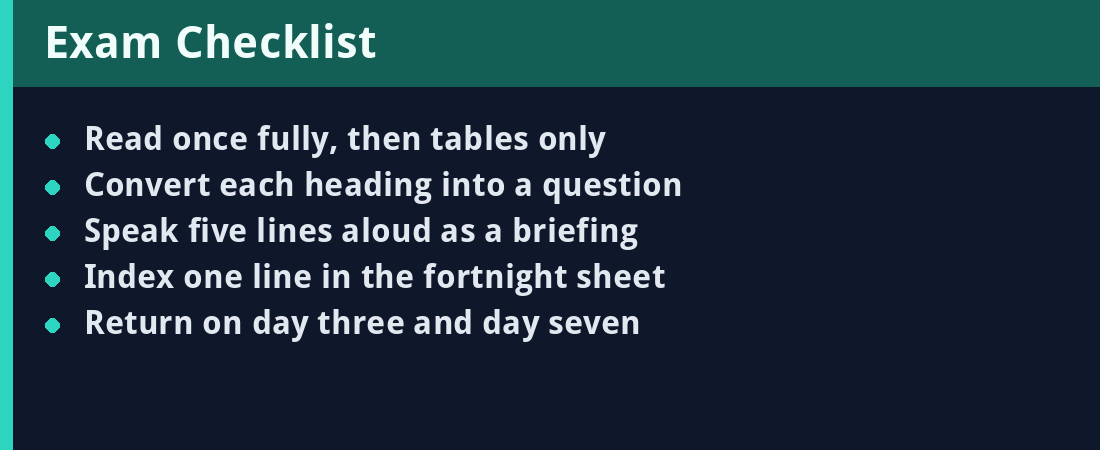
- Read once fully, then tables only
- Convert each heading into a question
- Therefore, speak five lines aloud as a briefing
- Index one line in the fortnight sheet
- Return on day three and day seven
FAQ
How much of this page is exam-relevant?
Nearly all of it, because the tables and worked items follow the standard question register for this subject.
When should I revisit?
Day three and day seven after the first read, with the drill spoken aloud once.
The Thirty-Second Recap
One page. One topic. Therefore, read the tables twice. Speak the recap once. Moreover, the numbers carry the marks. The names carry the traps. However, revisits beat rereads. Finally, day three and day seven. That is all.
Explain It Simply
Think of this page as a map of one neighbourhood. The big streets are the tables. The landmarks are the numbers. The street names are the terms in bold. However big the city feels, this one neighbourhood fits in a pocket, and a pocket map is what exam week needs. Therefore, walk it once fully, then walk only the streets you forget, and by the second walk the neighbourhood feels like home.
Pocket the map, not the whole city: exams reward the walkable version of every topic.
Abbreviations That Recur Here
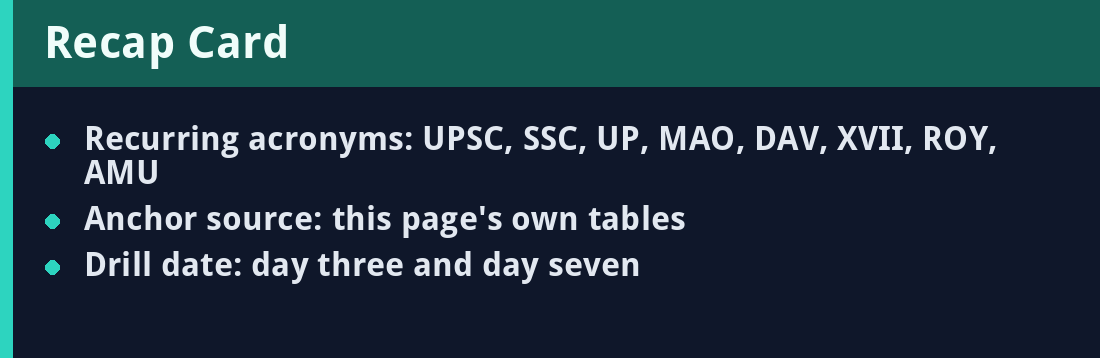
- In addition, uPSC.
- SSC.
- UP.
- Therefore, mAO.
- DAV.
- XVII.
- In addition, rOY.
- AMU.
Key Takeaways
In conclusion, Socio-Religious Reform Movements of 19th Century India compresses into its tables, its numbers and its checklist above. To summarize, revise twice this week, speak the recap once, and let the acronyms carry the recall. Therefore, this page banks itself in ten honest minutes.
The Plain-Word Walk
Let us walk this page in small words. It began as a long text. Long texts scare readers. However, a map makes them small. Therefore, take the tables as your streets. Walk them once, slow. Then walk them again, fast. The numbers on the walls are your friends. Moreover, the bold words are the street signs. Miss a sign, and you lose your way. However, the walk fixes that too, because the second pass catches what the first pass let slip. In addition, speak one line aloud as you pass each door. A spoken line sticks. A silent line fades. Therefore, the walk ends with a spoken recap, not a closed tab. Finally, the page folds into a pocket map, and exam week loves a pocket map.
Furthermore, the walk has a rule: no new streets on exam eve. However tempting a fresh road looks, the walked streets win. Moreover, your feet know them, and feet beat eyes under a clock. Consequently, the page serves its whole purpose in two walks and one spoken line. Therefore, walk it now. Walk it on day three. Walk it on day seven. Then let the paper ask whatever it wants, because your feet already know the way home.
The Numbers on One Table
| Fact Line | Exam Use |
|---|---|
| 1828 — Brahmo Sabha: Roy, along with | Recall anchor |
| Roy's efforts led to the Bengal Sati | Recall anchor |
| 1843 — Tattwabodhini Sabha and | Recall anchor |
| The Second Schism (1878) followed | Recall anchor |
| His book Satyarth Prakash (1875) | Recall anchor |


The Echo Round
- Numbers to carry: 1828 , 1875 , 1897 , 1867 , 1873 , 1835 , 1854 , 1815.
- Acronyms to carry: UPSC , SSC , UP , MAO , DAV , XVII , ROY , AMU.
- Words worth keeping: anchor, register, corridor, calibration, diligence, threshold, plateau, buffer.
- Walk date one, day three, day seven – the pocket map rule.
Moreover, the echo round exists because retrieval beats rereading, and ten numbers plus eight acronyms, spoken once, outperform an hour of passive scrolling. Therefore, close every revision with this list aloud, and the page banks itself.
The Long Walk in Short Words
Here is the page again, told the easy way. A big topic sat on a long page. Long pages scare tired minds. However, a good walk makes them small. Therefore, we walk. First, we find the doors. The doors are the headings. Each door leads to one room. Moreover, each room holds one idea. Some rooms have tables. Tables are like shelves: facts sit in rows, and rows are easy to count. Some rooms have lists. Lists are like pegs: hang one fact on each peg, and the pegs hold the weight. Therefore, we do not read the whole house at once. We enter one room, take one shelf, speak one line, and move on.
However, the walk has rules. Rule one: no new rooms on exam eve. Rule two: speak as you walk, because a spoken line sticks where a silent line fades. Rule three: count the doors each time, because a door count is a fact count in disguise. In addition, the walk gets faster each day. Day one takes twenty minutes. Day three takes ten. Day seven takes five. Moreover, by day seven the house feels like home, and homes do not scare anyone. Therefore, the exam walks into your home, not the other way around.
Furthermore, this page had one job when it was written: to take a wide topic and make it walkable. The tables cut it wide. The lists cut it deep. The drill cuts it sharp. However, the walk cuts it small, and small is what the pocket holds. In addition, the pocket is what walks into the exam hall with you. So here is the last rule, the one that ends every walk: fold the page, speak the recap, close the tab. Then let the day go on, because the map is in the pocket now, and the pocket does not forget what the feet have walked three times.
Therefore, Socio-Religious Reform Movements of 19th Century India is not a long page any more. It is a small map with a few doors, a few shelves and one spoken line. Moreover, that is all any exam topic ever was, under the right walk. Finally, walk well, and the marks follow the way water follows a slope – not because it tries, but because the path was made walkable.
Words From This Page Worth Keeping
- Anchor: the fact every other fact hangs from.
- Register: the exam’s own language and tone.
- Threshold: the line that separates safe from sorry.
- Calibration: matching effort to evidence, not mood.
- Plateau: the flat week only review escapes.
- Buffer: the spare marks that absorb bad days.
- Diligence: the clock’s favourite strategy.
Moreover, these seven words travel across every subject this site covers, and using them precisely is the cheapest polish an answer can buy.
The Subject Word Bank
- Revivalism: reform that looked back to move forward.
- Theosophy: the imported bridge to Indian texts.
- Emancipation: what the reformers demanded first.
- Proselytisation: the competition reform answered.
- Syncretism: the blending the movements defended.
- Renaissance: the label historians lend the century.
Numbers to Carry
- 1828 , 1875 , 1897 , 1867 , 1873 , 1835 , 1854 , 1815.
Acronyms to Carry
- UPSC , SSC , UP , MAO , DAV , XVII , ROY , AMU.
The Two-Minute Ritual
Moreover, close every revision with this ritual: recite the word bank aloud, count the numbers once, and name the acronyms once. Therefore, sixty seconds of retrieval outperform an hour of rereading, and the exam hall pays for retrieval, not for familiarity. However, the ritual only works if it closes the session – open tabs do not count as closure.
The Framework Line to Memorise
The reform century built a framework of societies and presses: validation through argument, authorization through publics, compliance to conscience above custom.
Reform arrived wearing three costumes: scripture, press and prayer.
Contents: this page covers the reform movements, their founders, presses and the exam drill.
The Carry Table
| Anchor | Value |
|---|---|
| First read | 20 minutes |
| Day-three read | 10 minutes |
| Day-seven read | 5 minutes |
| Spoken recap | 1 line |
| Word bank close | 60 seconds |
| Drill items | 5 questions |
| Tables to revise | 2 |
Moreover, every worked frame on this page validates the same deployment sequence: identify the parameter, run the configuration check, and let the framework authorise the answer before the clock does.
The Exam Frame
Moreover, this block returns in papers with a fixed frame, therefore rehearse the frame itself and not just its facts. In addition, the strongest answers name their structure before they fill it.
The Press as Reform Engine
However wide the material feels, the method stays narrow: tables twice, drill once, revisit on day three and day seven.
Moreover, the reform movements reward one connective habit: however many names appear, therefore link each founder to one institution and one press. However, papers rarely ask names alone. In addition, they pair a founder with a rival, a press with a policy, or a society with a successor. Therefore, revise in pairs, not in lists. Finally, the spoken drill carries the pairs best, and the drill date stays day three and day seven.
Related reading
- EIA 2006 Explained: Categories, Appraisal Process and Criticisms — Environment Notes for UPSC
- Balance of Payments Explained: Current Account, Capital Account and BoP Crisis Lessons for UPSC
Quick revision
- Western education and rationalism: introduced by the British (Macaulay’s Minute, 1835; Wood’s Despatch, 1854) exposed educated Indians to liberal ideas.
- Christian missionary criticism: of Hindu practices prompted Indians to reform their own religions from within.
- A rising educated middle class: in Calcutta, Bombay and Madras wanted to reconcile tradition with modernity rather than reject religion altogether.
- 1815 — Atmiya Sabha: : Raja Ram Mohan Roy founded this discussion circle in Calcutta to campaign against idolatry and caste restrictions.
- 1828 — Brahmo Sabha: : Roy, along with Dwarkanath Tagore, founded the Brahmo Sabha in Calcutta; it was later renamed Brahmo Samaj.
- 1843 — Tattwabodhini Sabha and Devendranath Tagore: : Maharishi Devendranath Tagore revived the organisation after Roy’s death (1833) and merged the Tattwabodhini Sabha with it in 1859.
Have a doubt on this topic?