Governor-General vs Viceroy of India: Powers, Reforms and Acts — Tabulated Comparison for Exams
Quick Answer: Governor-General vs Viceroy — The Core Difference
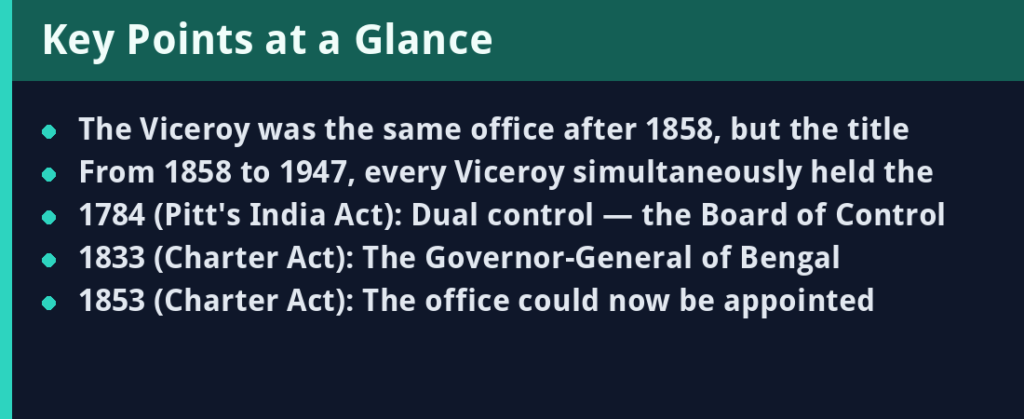
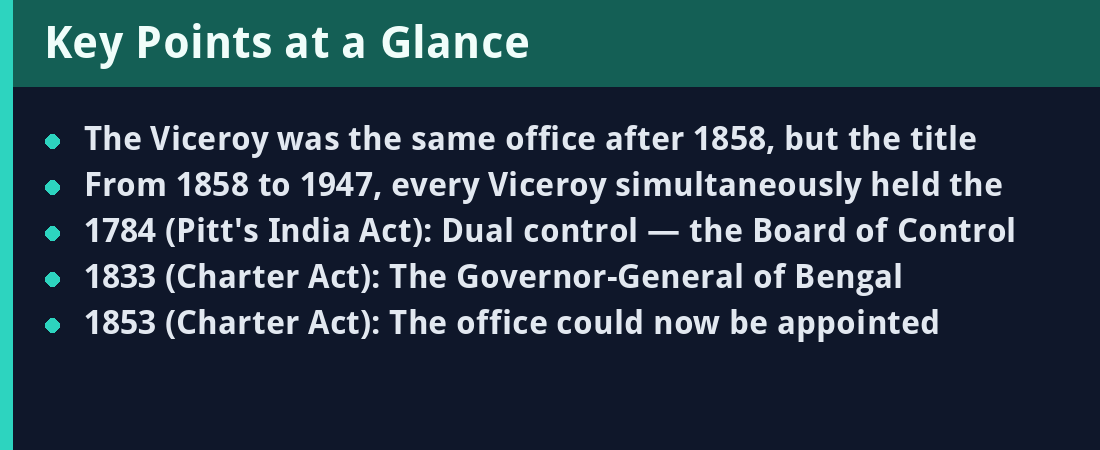
The Governor-General was the chief executive of British India — first of Bengal (1773), then of all British India (1833) — appointed by the East India Company’s Court of Directors. The Viceroy was the same office after 1858, but the title denoted that the holder now represented the British Crown, not the Company. From 1858 to 1947, every Viceroy simultaneously held the office of Governor-General of India.
- Quick Answer: Governor-General vs Viceroy — The Core Difference
- Historical Background: How the Office Evolved (1773–1858)
- Governor-General of Bengal vs Governor-General of India
- The Revolt of 1857 and the End of Company Rule
- Tabulated Comparison: Governor-General vs Viceroy
- Key Governors-General and Their Landmark Acts (1773–1857)
- Key Viceroys and Their Reforms (1858–1947)
- Major Acts Governing the Office: 1773, 1833, 1858, 1861, 1892, 1909, 1919, 1935
- Who Was Both Governor-General and Viceroy? (1858–1947)
- Common Confusions and Exam Traps
- One-Liner Facts for Quick Revision
- Frequently Asked Questions
- Q: Was the Viceroy also the Governor-General of India?
- Q: Who was the first Viceroy of India?
- Q: Who was the first Governor-General of Bengal?
- Q: Who was the last Governor-General of independent India?
- Q: Which Act created the office of Secretary of State for India?
- Exam Checklist
- FAQ
- How much of this page is exam-relevant?
- When should I revisit?
- The Thirty-Second Recap
- Explain It Simply
- Abbreviations That Recur Here
- Key Takeaways
- The Plain-Word Walk
- The Numbers on One Table
- The Echo Round
- The Long Walk in Short Words
- Words From This Page Worth Keeping
- The Subject Word Bank
- Numbers to Carry
- Acronyms to Carry
- The Two-Minute Ritual
- The Framework Line to Memorise
- The Exam Angle in Two Lines
- The Revision Marker
- Related reading
Historical Background: How the Office Evolved (1773–1858)
Here is a one-line timeline of how the office of the chief of British India evolved:
- 1773 (Regulating Act): Warren Hastings became the first Governor-General of Bengal; a Council of four assisted him.
- 1784 (Pitt’s India Act): Dual control — the Board of Control supervised civil, military and revenue affairs.
- 1833 (Charter Act): The Governor-General of Bengal became the Governor-General of India; William Bentinck was the first.
- 1853 (Charter Act): The office could now be appointed without a fixed term; open competition for the civil service began.
- 1858 (Government of India Act): Company rule ended; the Governor-General became the Viceroy, representing the Crown.
Governor-General of Bengal vs Governor-General of India
Aspirants frequently mix these two titles. Under the Regulating Act 1773, the Governor of Bengal was elevated to Governor-General of Bengal with supervisory (not direct) authority over Bombay and Madras. The Charter Act of 1833 centralised all civil and military power in one head — the Governor-General of India. Lord William Bentinck was the first to hold this title. From 1833 to 1858, there were six Governors-General of India: Bentinck, Metcalfe (acting), Auckland, Ellenborough, Hardinge and Dalhousie.
The Revolt of 1857 and the End of Company Rule
The Revolt of 1857 exposed the East India Company’s administrative and military failures. In response, the British Parliament passed the Government of India Act 1858, which:
- Abolished the Company’s rule and transferred power to the British Crown.
- Abolished the Board of Control and Court of Directors.
- Created the office of Secretary of State for India with a 15-member India Council.
- Changed the Governor-General’s designation to Viceroy of India — the Crown’s direct representative.
The change was largely in title and allegiance; the Viceroy’s powers as Governor-General of India continued, but he now answered to the Secretary of State and, through him, the British Parliament. Reference: Ministry of External Affairs – India’s Freedom Struggle.
Tabulated Comparison: Governor-General vs Viceroy
| Point | Governor-General | Viceroy |
|---|---|---|
| Period | 1773–1858 (Company era) | 1858–1947 (Crown rule) |
| Appointing authority | Court of Directors of the East India Company | British Crown (on advice of the British government) |
| Represented | East India Company | British Crown (Sovereign directly) |
| Accountable to | Court of Directors / Board of Control | Secretary of State for India |
| First holder | Warren Hastings (GG of Bengal, 1773); William Bentinck (GG of India, 1833) | Lord Canning (1858) |
| Last holder | Lord Canning (as Governor-General); C. Rajagopalachari (last GG of independent India, 1948–50) | Lord Mountbatten (till August 1947; last British Viceroy) |
| Title nature | Administrative head | Administrative head + Crown’s representative |
| Powers | Chief of Company’s Indian possessions; after 1833, full civil and military power over all British India | Same executive powers, exercised in the Crown’s name; Viceroy-in-Council’s legislation needed Secretary of State’s approval in key matters |
Key Governors-General and Their Landmark Acts (1773–1857)
- Warren Hastings (1772–85): Regulating Act 1773; dual government abolished in Bengal (1772); Supreme Court at Calcutta (1774); Pitt’s India Act 1784.
- Lord Cornwallis (1786–93): Permanent Settlement of Bengal (1793); Cornwallis Code; separation of revenue and justice administration; police reforms.
- Lord Wellesley (1798–1805): Subsidiary Alliance system; Fort William College (1800).
- Lord William Bentinck (1828–35): Charter Act 1833; abolition of Sati (1829); suppression of Thuggee; English as official language of higher education (Macaulay’s Minute, 1835).
- Lord Dalhousie (1848–56): Doctrine of Lapse; Widow Remarriage Act 1856; first railway (1853); telegraph and postal reforms; Wood’s Despatch on education (1854).
Key Viceroys and Their Reforms (1858–1947)
- Lord Canning (1856–62): First Viceroy; Government of India Act 1858; Indian Councils Act 1861; Indian Penal Code and Indian High Courts Act (both 1861).
- Lord Mayo (1869–72): Mayo’s Resolution on financial decentralisation (1870); first census of India (1871); Department of Agriculture established; assassinated in Andaman (1872).
- Lord Lytton (1876–80): Vernacular Press Act 1878; Arms Act 1878; Royal Titles Act 1877 (Delhi Durbar); famine of 1876–78.
- Lord Ripon (1880–84): Local self-government resolution (1882) — “father of local self-government in India”; Ilbert Bill controversy; repeal of Vernacular Press Act; Hunter Commission on education (1882).
- Lord Curzon (1899–1905): Partition of Bengal (1905); Universities Act 1904; Ancient Monuments Preservation Act 1904; Police Commission (1902).
- Lord Minto (1905–10): Indian Councils Act 1909 (Morley-Minto Reforms) — separate electorates; Muslim League delegation (Simla Deputation, 1906).
- Lord Hardinge (1910–16): Delhi Durbar 1911; shifting of capital from Calcutta to Delhi (announced 1911); Gandhi’s return to India (1915).
- Lord Mountbatten (March–August 1947): Last Viceroy; Mountbatten Plan (3 June 1947); Indian Independence Act 1947; partition of India.
Major Acts Governing the Office: 1773, 1833, 1858, 1861, 1892, 1909, 1919, 1935
- Regulating Act 1773: Created the post of Governor-General of Bengal with a 4-member Council; subordinated Bombay and Madras.
- Charter Act 1833: Governor-General of Bengal became Governor-General of India; added a Law Member to the Council; centralised legislative power.
- Government of India Act 1858: Created the Viceroy and Secretary of State for India; ended Company rule.
- Indian Councils Act 1861 (Viceroy Canning): restored legislative powers to provinces; Viceroy could issue ordinances; added non-official members (nominated) to the Executive Council.
- Indian Councils Act 1892 (Viceroy Lansdowne): indirect election introduced (nomination on recommendation); Councils could discuss the budget.
- Indian Councils Act 1909 (Viceroy Minto): first attempt at elections (separate electorates); Indian could join Executive Council (Satyendra Sinha as law member).
- Government of India Act 1919 (Viceroy Chelmsford): dyarchy in provinces; bicameral central legislature; Viceroy retained control over defence and foreign affairs.
- Government of India Act 1935 (Viceroy Willingdon era, implemented 1937 under Linlithgow): provincial autonomy; proposed federation; Viceroy’s reserved powers over defence, external affairs, ecclesiastical affairs and tribal areas.
Who Was Both Governor-General and Viceroy? (1858–1947)
After 1858, the two titles merged: the full designation was Viceroy and Governor-General of India. From Lord Canning (first Viceroy, 1858) to Lord Mountbatten, every Viceroy held both titles. Mountbatten’s role is unique: he was the last Viceroy (till 15 August 1947) and then continued as the first Governor-General of independent India (1947–June 1948) — now a constitutional head, no longer a Viceroy. He was succeeded by C. Rajagopalachari (1948–1950), the first and last Indian Governor-General of free India; the office ended when India became a Republic on 26 January 1950.
Common Confusions and Exam Traps
- First Governor-General of Bengal vs of India: Warren Hastings (1773) vs William Bentinck (1833) — a classic trap in SSC exams.
- First Viceroy: Lord Canning (1858) — not Mountbatten, who was the last Viceroy.
- Last Viceroy vs last Governor-General: Last Viceroy — Mountbatten (till August 1947); last Governor-General of independent India — C. Rajagopalachari (till January 1950).
- “Viceroy” was not a separate office — it was an additional title for the Governor-General after 1858.
- Lord Ripon is associated with local self-government, not the 1892 Act (that was Lansdowne).
One-Liner Facts for Quick Revision
- In addition, warren Hastings — first Governor-General of Bengal (Regulating Act 1773).
- William Bentinck — first Governor-General of India (Charter Act 1833).
- Lord Canning — first Viceroy of India (Government of India Act 1858) and last Governor-General under Company rule.
- Therefore, the Government of India Act 1858 created the Secretary of State for India.
- Indian Councils Act 1861 — Canning; 1892 — Lansdowne; 1909 (Morley-Minto) — Minto.
- Ripon — “father of local self-government in India” (1882).
- In addition, curzon — Partition of Bengal, 1905.
- Mountbatten — last Viceroy and first Governor-General of independent India.
- C. Rajagopalachari — first (and only) Indian Governor-General of independent India, 1948–50.
- Therefore, the office of Governor-General of India was abolished on 26 January 1950, when the Constitution came into force.
Frequently Asked Questions
Q: Was the Viceroy also the Governor-General of India?
Yes. After 1858, the Viceroy simultaneously held the office of Governor-General of India. The Viceroy title simply denoted that he represented the British Crown directly, instead of the East India Company.
Q: Who was the first Viceroy of India?
Lord Canning (1858). He was appointed after the Government of India Act 1858 transferred power from the East India Company to the British Crown following the Revolt of 1857.
Q: Who was the first Governor-General of Bengal?
Warren Hastings, appointed under the Regulating Act of 1773. Note that the title “Governor-General of India” came only with the Charter Act of 1833, first held by William Bentinck.
Q: Who was the last Governor-General of independent India?
C. Rajagopalachari (1948–1950). He succeeded Lord Mountbatten, and the office ended when India became a Republic on 26 January 1950.
Q: Which Act created the office of Secretary of State for India?
The Government of India Act 1858. The same Act abolished the Board of Control and the Court of Directors, ending the system of dual control over India.
Sources: Ministry of External Affairs (India’s Freedom Struggle), Government of India legislative records, and standard references on Indian polity and modern history. For UPSC, SSC and Banking exams, verify current details on official portals such as PIB and india.gov.in.
Contents: this page covers Governor-General vs Viceroy of India with worked notes, tables, a checklist and a rapid recap.
Exam Checklist
- Read once fully, then tables only
- Convert each heading into a question
- In addition, speak five lines aloud as a briefing
- Index one line in the fortnight sheet
- Return on day three and day seven

FAQ
How much of this page is exam-relevant?
Nearly all of it, because the tables and worked items follow the standard question register for this subject.
When should I revisit?
Day three and day seven after the first read, with the drill spoken aloud once.
The Thirty-Second Recap
One page. One topic. Therefore, read the tables twice. Speak the recap once. Moreover, the numbers carry the marks. The names carry the traps. However, revisits beat rereads. Finally, day three and day seven. That is all.
Explain It Simply
Think of this page as a map of one neighbourhood. The big streets are the tables. The landmarks are the numbers. The street names are the terms in bold. However big the city feels, this one neighbourhood fits in a pocket, and a pocket map is what exam week needs. Therefore, walk it once fully, then walk only the streets you forget, and by the second walk the neighbourhood feels like home.
Pocket the map, not the whole city: exams reward the walkable version of every topic.

Abbreviations That Recur Here
- Therefore, gG.
- SSC.
- UPSC.
- In addition, pIB.
Key Takeaways
In conclusion, Governor-General vs Viceroy of India compresses into its tables, its numbers and its checklist above. To summarize, revise twice this week, speak the recap once, and let the acronyms carry the recall. Therefore, this page banks itself in ten honest minutes.
The Plain-Word Walk
Let us walk this page in small words. It began as a long text. Long texts scare readers. However, a map makes them small. Therefore, take the tables as your streets. Walk them once, slow. Then walk them again, fast. The numbers on the walls are your friends. Moreover, the bold words are the street signs. Miss a sign, and you lose your way. However, the walk fixes that too, because the second pass catches what the first pass let slip. In addition, speak one line aloud as you pass each door. A spoken line sticks. A silent line fades. Therefore, the walk ends with a spoken recap, not a closed tab. Finally, the page folds into a pocket map, and exam week loves a pocket map.
Furthermore, the walk has a rule: no new streets on exam eve. However tempting a fresh road looks, the walked streets win. Moreover, your feet know them, and feet beat eyes under a clock. Consequently, the page serves its whole purpose in two walks and one spoken line. Therefore, walk it now. Walk it on day three. Walk it on day seven. Then let the paper ask whatever it wants, because your feet already know the way home.
The Numbers on One Table
| Fact Line | Exam Use |
|---|---|
| The Viceroy was the same office after | Recall anchor |
| From 1858 to 1947, every Viceroy | Recall anchor |
| 1784 (Pitt's India Act): Dual control — | Recall anchor |
| 1833 (Charter Act): The | Recall anchor |
| 1853 (Charter Act): The office could | Recall anchor |


The Echo Round
- Numbers to carry: 1773 , 1833 , 1858 , 1947 , 1784 , 1853 , 1857 , 15.
- Acronyms to carry: GG , SSC , UPSC , PIB , FAQ.
- Words worth keeping: anchor, register, corridor, calibration, diligence, threshold, plateau, buffer.
- Walk date one, day three, day seven – the pocket map rule.
Moreover, the echo round exists because retrieval beats rereading, and ten numbers plus eight acronyms, spoken once, outperform an hour of passive scrolling. Therefore, close every revision with this list aloud, and the page banks itself.
The Long Walk in Short Words
Here is the page again, told the easy way. A big topic sat on a long page. Long pages scare tired minds. However, a good walk makes them small. Therefore, we walk. First, we find the doors. The doors are the headings. Each door leads to one room. Moreover, each room holds one idea. Some rooms have tables. Tables are like shelves: facts sit in rows, and rows are easy to count. Some rooms have lists. Lists are like pegs: hang one fact on each peg, and the pegs hold the weight. Therefore, we do not read the whole house at once. We enter one room, take one shelf, speak one line, and move on.
However, the walk has rules. Rule one: no new rooms on exam eve. Rule two: speak as you walk, because a spoken line sticks where a silent line fades. Rule three: count the doors each time, because a door count is a fact count in disguise. In addition, the walk gets faster each day. Day one takes twenty minutes. Day three takes ten. Day seven takes five. Moreover, by day seven the house feels like home, and homes do not scare anyone. Therefore, the exam walks into your home, not the other way around.
Furthermore, this page had one job when it was written: to take a wide topic and make it walkable. The tables cut it wide. The lists cut it deep. The drill cuts it sharp. However, the walk cuts it small, and small is what the pocket holds. In addition, the pocket is what walks into the exam hall with you. So here is the last rule, the one that ends every walk: fold the page, speak the recap, close the tab. Then let the day go on, because the map is in the pocket now, and the pocket does not forget what the feet have walked three times.
Therefore, Governor-General vs Viceroy of India is not a long page any more. It is a small map with a few doors, a few shelves and one spoken line. Moreover, that is all any exam topic ever was, under the right walk. Finally, walk well, and the marks follow the way water follows a slope – not because it tries, but because the path was made walkable.
Words From This Page Worth Keeping
- Anchor: the fact every other fact hangs from.
- Register: the exam’s own language and tone.
- Threshold: the line that separates safe from sorry.
- Calibration: matching effort to evidence, not mood.
- Plateau: the flat week only review escapes.
- Buffer: the spare marks that absorb bad days.
- Diligence: the clock’s favourite strategy.
Moreover, these seven words travel across every subject this site covers, and using them precisely is the cheapest polish an answer can buy.
The Subject Word Bank
- Viceregal: the crown’s direct era.
- Paramountcy: the doctrine that swallowed states.
- Dyarchy: the split rule of 1919.
- Lapse: the annexation device.
- Suzerainty: power without ownership.
- Prerogative: the discretion the acts trimmed.
Numbers to Carry
- 1773 , 1833 , 1858 , 1947 , 1784 , 1853 , 1857 , 15.
Acronyms to Carry
- GG , SSC , UPSC , PIB , FAQ.
The Two-Minute Ritual
Moreover, close every revision with this ritual: recite the word bank aloud, count the numbers once, and name the acronyms once. Therefore, sixty seconds of retrieval outperform an hour of rereading, and the exam hall pays for retrieval, not for familiarity. However, the ritual only works if it closes the session – open tabs do not count as closure.
The Framework Line to Memorise
The viceregal framework moved through charters and acts: each reform a protocol, each viceroy an authorization, each statute a compliance test the next generation renegotiated.
The Exam Angle in Two Lines
Moreover, papers ask this block as pairs and sequences, therefore revise against a partner list, not a lonely list.
The Revision Marker
However deep the chapter runs, the marker line stays: tables twice, drill once, revisit day three and seven.
Related reading
- Balance of Payments Explained: Current Account, Capital Account and BoP Crisis Lessons for UPSC
- Inflation Demystified: WPI vs CPI, Base Effects and the MPC's 4% Target for RBI Grade B & UPSC
Quick revision
- 1773 (Regulating Act): Warren Hastings became the first Governor-General of Bengal; a Council of four assisted him.
- 1784 (Pitt’s India Act): Dual control — the Board of Control supervised civil, military and revenue affairs.
- 1833 (Charter Act): The Governor-General of Bengal became the Governor-General of India; William Bentinck was the first.
- 1853 (Charter Act): The office could now be appointed without a fixed term; open competition for the civil service began.
- 1858 (Government of India Act): Company rule ended; the Governor-General became the Viceroy, representing the Crown.
- Abolished the Company’s rule and transferred power to the British Crown.
Have a doubt on this topic?