- The Promise: 300 Units From Your Own Roof
- The Architecture and the Money
- Rooftop Versus Park: Why the Roof at All
- The DISCOM Problem: The Honest Economics
- The Panchamrit Arithmetic
- How Exams Ask This Card
- Quick Revision: Ten Lines
- Frequently Asked Questions
- Is the 300 units “free electricity” a direct cash transfer?
- Who owns the panels, and what happens on resale?
- Why cap the subsidy at 3 kW?
- How does this differ from the earlier rooftop programmes (e.g., the grid connected rooftop scheme lineage)?
- What should a mains answer say about the scheme’s biggest risk?
- Related explainers
- The Application Flow, Step by Step
Can your roof pay your electricity bill?
In one line: PM Surya Ghar: Muft Bijli Yojana – Rs 75,021 crore. One crore rooftops, 300 free units a month and the subsidy slabs that fund them: exam-ready notes.
Related: Panchamrit and the Renewable Targets
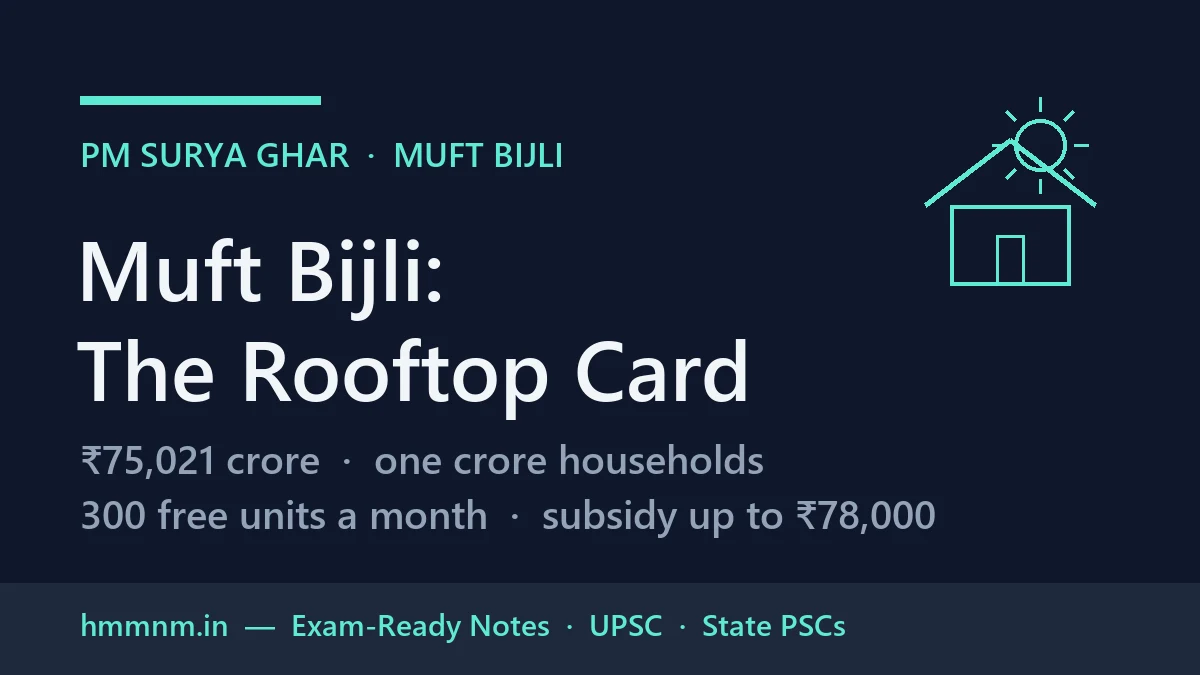
Announced in the Interim Budget of 1 February 2024. Approved by the Union Cabinet on 29 February 2024. And launched as the Prime Minister’s rooftop solar programme, PM Surya Ghar: Muft Bijli Yojana is the government’s ₹75,021-crore plan to put solar on one crore (10 million) homes — and, in the framing that named it, to give each participating household up to 300 units of free electricity every month from its own roof. This card assembles the exam kit: the promise. The money and slabs machinery. The economics of rooftop versus-park, the DISCOM problem the scheme must survive, and the Panchamrit arithmetic it feeds.
The Promise: 300 Units From Your Own Roof
The headline framing. One crore households. Rooftop solar. And the “muft bijli” (free electricity) claim of up to 300 units a month — the number every prelims question anchors to. The honest reading the mains answer should carry: 300 units/month is the usable output framing for a well sized (about 3 kW) system on a reasonably sunny roof — not a guarantee of a bill at zero. Since consumption patterns. Roof size and- orientation and net metering rules decide the actual rupee outcome per household.
Who it is for. Residential consumers — the scheme’s subsidy logic (Section 2) applies to homes. With the portal (pmsuryaghar.gov.in) as the single registration window: apply. Vendor and DISCOM feasibility, installation, inspection and net meter, subsidy to the bank account. The resident owns the asset; the grid is the battery.
The Architecture and the Money
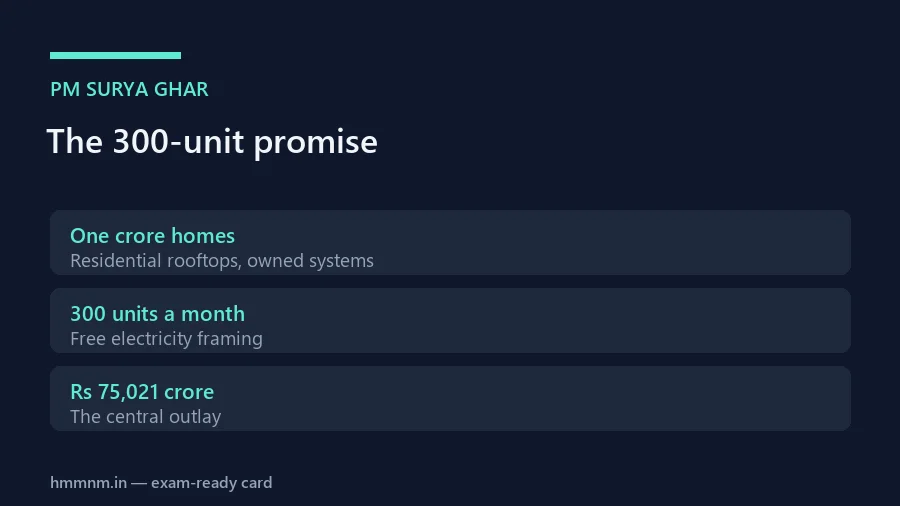
The outlay. ₹75,021 crore of central support for the programme — the Budget-2024 number the exams quote.
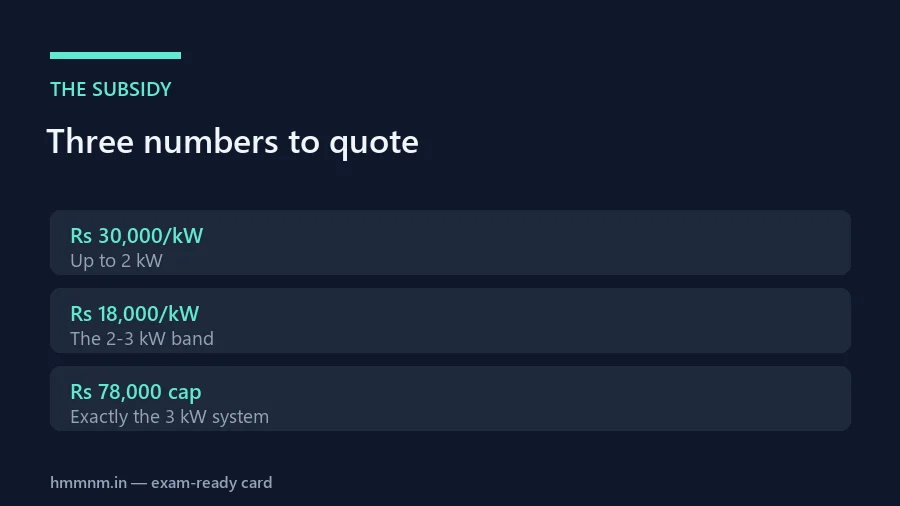
The Central Financial Assistance slabs — the card’s most testable table:
| System size | Subsidy |
|---|---|
| Up to 2 kW | ₹30,000 per kW |
| 2–3 kW (the more band) | ₹18,000 per kW |
| Above 3 kW | total CFA capped at ₹78,000 |
Worked check: a 3 kW system draws 2 × 30,000 + 1 × 18,000 = ₹78,000 — the cap arriving exactly at 3 kW. Which is why “3 kW, ₹78,000” is the pair to memorise. States may add their own top ups on top of the central CFA.
The delivery design. National portal as the single door; DISCOMs as the verification and net metering arm; vendors empanelled through the portal. The subsidy landing in the household’s bank account by DBT. Note for editors: loan and model village provisions have evolved since launch — re-verify current guidelines on the portal before quoting rates or village level numbers. And cite the portal date.
Rooftop Versus Park: Why the Roof at All
The land answer. Utility scale solar parks buy land and transmission; rooftops rent neither — the household’s roof is the site. The distribution network is already built. And generation sits exactly where consumption lives (no transmission loss, no new corridors).
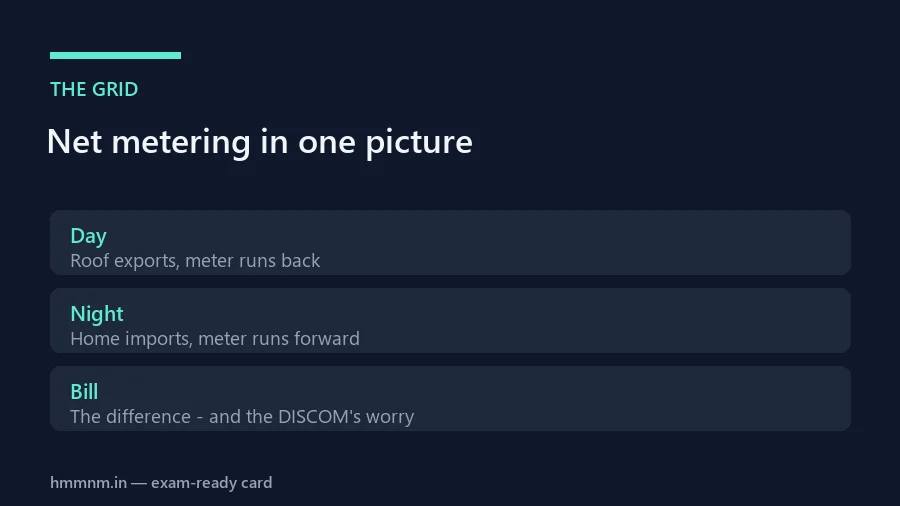
The prosumer answer. Rooftop solar converts consumers into prosumers — households that both draw from and feed the grid through net metering: daytime surplus exported. Night time imports drawn. The bill settling the difference. The “300 units free” is, in practice, this arithmetic on a well sized roof.
The federal answer. Electricity distribution is a state subject in practice — DISCOMs are the scheme’s real operating partners. Which is where the hard part lives (next section).
The DISCOM Problem: The Honest Economics
The revenue hole. DISCOMs earn from paying residential customers. A million rooftop prosumers are a million partial exits from the billing base. A DISCOM already in loss reads net metering growth as revenue walking away — hence caps. Approval delays and inspection queues in some states. The scheme’s quietest bottleneck.
The counter ledger. Rooftop solar also cuts DISCOM daytime procurement. Shaves peak and technical losses. And avoids network augmentation the parks route would demand — the honest mains paragraph runs both columns rather than cheering only one.
The fix the scheme bets on. Single window portal processes. DBT subsidy flow and central pressure on state net metering rules — administrative answers to an incentive problem. The deeper structural fix (tariff reform. DBT for subsidy in DISCOM finances) predates the scheme and will outlive it.
The Panchamrit Arithmetic
The 500 GW link. India’s Panchamrit commitment — 500 GW of non-fossil capacity by 2030 (our Panchamrit card) — counts rooftop solar’s decentralised gigawatts the same as a park’s: one crore roofs at an average 2–3 kW is 20-30 GW of household capacity. Plus the avoided transmission a park of the same size would have needed.
The household budget link. Free electricity framed as a welfare measure is also demand side decarbonisation: the same watt priced out of coal’s grid. The mains savvy framing joins the two — climate commitment and household economics delivered by one roof.
The federal implementation caveat (Section 4’s) is the paragraph that separates a 6-marks answer from a 3-marks one.
How Exams Ask This Card
- Prelims numbers: outlay (₹75,021 crore); households (one crore);
300 units; the ₹30,000/₹18,000/₹78,000 slab triple.
- Statement pairs: “applies to commercial establishments” (false —
residential focus); “subsidy is delivered through the national portal by DBT” (true); “the scheme builds utility scale parks” (false — rooftop. Though grid scale components like net metering infrastructure are involved).
- Mains GS-III: rooftop solar’s role in the 500 GW target; the DISCOM
tension and fixes.
- Mains GS-II: the welfare framing (300 units) versus the delivery
reality (portal, DBT, state variation) — the design implementation gap question.
- Banking/awareness papers: the DBT flow, the portal, the prosumer
concept.
One crore households, up to 300 units of free electricity a month from their own roof – the framing that named the scheme.
CFA: Rs 30,000/kW up to 2 kW + Rs 18,000/kW (2-3 kW) = cap Rs 78,000
net metering: export by day, import by night, bill the difference
Quick Revision: Ten Lines
- Scheme: PM Surya Ghar: Muft Bijli Yojana — rooftop solar for
residential India.
- Timeline: announced Interim Budget 1 Feb 2024; Cabinet approved
29 Feb 2024.
- Outlay: ₹75,021 crore.
- Target: one crore households.
- Framing: up to 300 units of free electricity a month per
participating household.
- Subsidy: ₹30,000/kW up to 2 kW; ₹18,000/kW for the 2–3 kW band.
- Cap: ₹78,000 total CFA (exactly the 3 kW system).
- Door: pmsuryaghar.gov.in — register, install, inspect, DBT.
- Mechanism: net metering — the prosumer’s export import settlement.
- Bottleneck: DISCOM revenue anxiety; state net metering variation.
- Climate link: 20-30 GW of decentralised capacity toward the 500 GW
Panchamrit goal.
Frequently Asked Questions
Is the 300 units “free electricity” a direct cash transfer?
No — it is the output framing of a subsidised rooftop system: the household generates, exports surplus, imports at night, and the net bill can reach zero for a well sized roof and consumption match. The cash the Centre transfers is the capital subsidy (the ₹30,000/₹18,000 slabs), not monthly electricity money.
Who owns the panels, and what happens on resale?
The household owns the asset (or the loan on it); net metering agreements are with the DISCOM, and the subsidy follows the installation, not the seller — a genuine self owned model rather than a leased one.
Why cap the subsidy at 3 kW?
Because beyond 3 kW the household is typically subsidising its own comfort rather than its basic consumption — the slabs are deliberately regressive in favour of the modest roof, which is also where the one crore-households arithmetic lives.
How does this differ from the earlier rooftop programmes (e.g., the grid connected rooftop scheme lineage)?
Scale and simplicity: a larger dedicated outlay, a single national portal, higher CFA slabs and the household facing “300 units” framing — institutionally a relaunch with the bottlenecks (approvals, subsidy flow) redesigned around DBT.
What should a mains answer say about the scheme’s biggest risk?
The DISCOM incentive conflict — net metered prosumers shrink the paying base of loss making distributors, and where state rules lag, installations queue behind approvals. Pair the point with the fixes (single window, central pressure, eventual tariff reform) to close the loop.
Related explainers
- Panchamrit and the Renewable Targets
- National Green Hydrogen Mission: The Big Molecule Bet
- Governance Part 5: Regulators — TRAI, SEBI, RBI and the Independence
Question
Written and maintained by the Hmmnm Editorial Team — exam mentors and subject editors. Scheme figures compiled from the PIB announcement and pmsuryaghar.gov.in and re-checked each cycle.
The Application Flow, Step by Step
Registration on the national portal comes first, with Aadhaar and
bank details. The distribution company then runs a feasibility check
and an empanelled vendor installs the system. Inspection and net meter
approval follow. And the subsidy lands in the bank account by direct
transfer. Every step is trackable on the portal. Which is itself an
exam favourite: the scheme is a digital first design.
State top ups sit on top of the central slabs. So the honest answer
on cost varies by state. The exam answer does not: quote the central
slabs. The cap. And the portal, and note that states may add more.
Read more: National Green Hydrogen Mission · Learn more: Environment & Ecology Part 6: UNFCCC
Written and maintained by the Hmmnm Editorial Team – exam mentors and subject editors. Every card is compiled against the official sources listed and re-checked each cycle.
Quick revision
- Prelims numbers: outlay (₹75,021 crore); households (one crore);
- Statement pairs: “applies to commercial establishments” (false —
- Mains GS-III: rooftop solar’s role in the 500 GW target; the DISCOM
- Mains GS-II: the welfare framing (300 units) versus the delivery
- Banking/awareness papers: the DBT flow, the portal, the prosumer
- Scheme: PM Surya Ghar: Muft Bijli Yojana — rooftop solar for
Have a doubt on this topic?